Speaker Design
Speaker Enclosure Design: How Sealed, Ported and Other Boxes Work
Published October 5, 2026
How speaker enclosures actually work: sealed, ported, infinite baffle and bandpass boxes compared, with Thiele/Small basics, worked volume and port examples, and practical build advice.
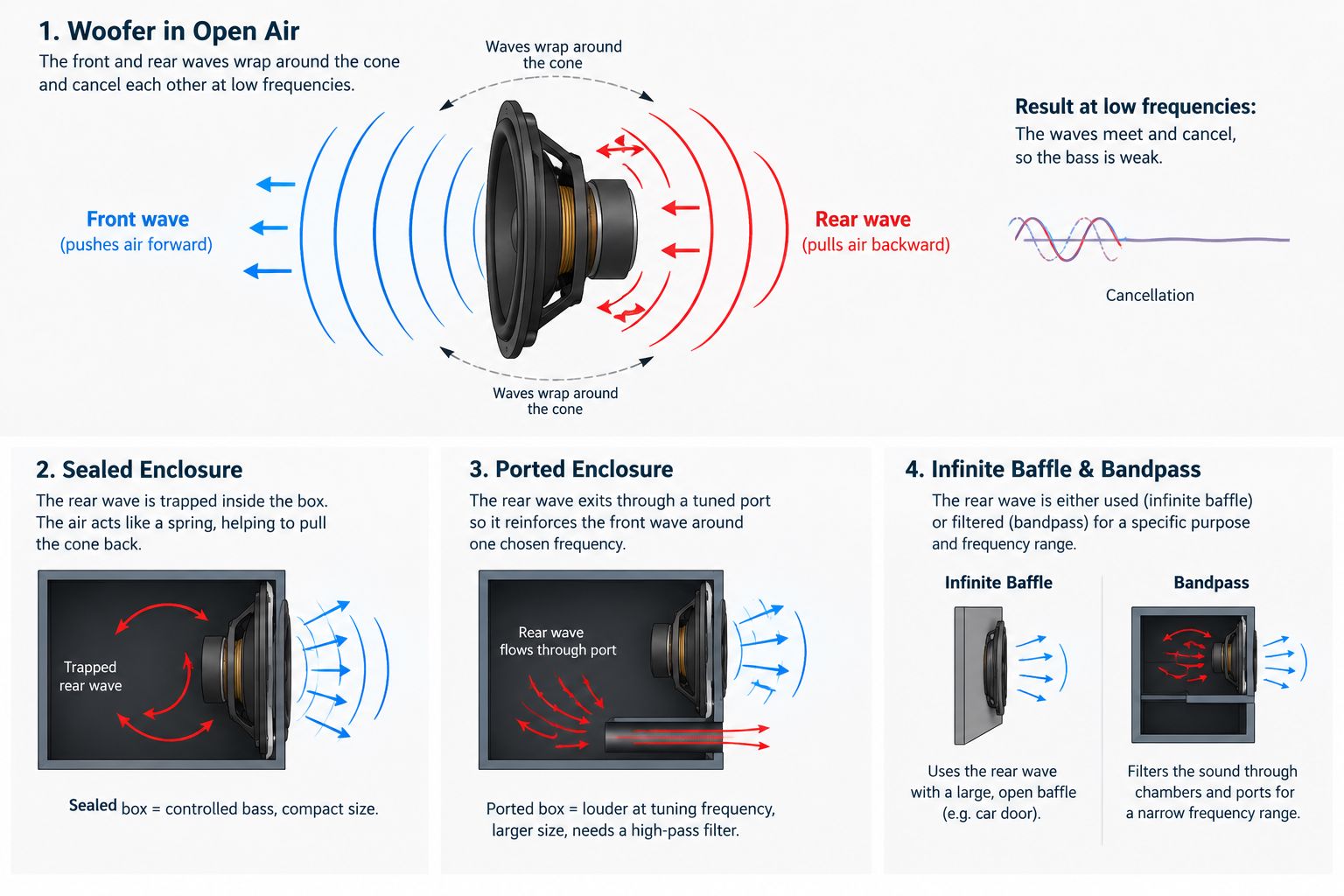
A bare loudspeaker driver is a surprisingly poor source of bass. The cone pushes air forward and pulls air backward at the same moment, and at low frequencies those two opposite waves simply flow around the edge of the driver and cancel each other. An enclosure prevents that, but it does a lot more besides. Its volume, shape and openings decide how deep the bass goes, how loud it plays, how quickly it stops, and how much power the driver can safely take.
This guide explains how the main enclosure types work (sealed, ported, infinite baffle, bandpass and a few rarer designs), how a driver's own specifications point toward one type or another, how to calculate a box, and where builds usually go wrong. The examples lean toward subwoofers and car audio because that is where enclosure choices are easiest to hear, but the physics applies to any speaker.
The short version: a sealed box is the most forgiving choice and gives controlled bass in a compact size. A ported box plays louder around its tuning frequency but is larger, harder to get right and needs a high-pass filter. Infinite baffle and bandpass designs suit particular drivers and goals. Let the driver's Thiele/Small parameters make the decision, not a preference for one box type.
Why a speaker needs an enclosure
Sound travels at about 343 metres per second in air at room temperature. Wavelength is speed divided by frequency, so a 100 Hz note is about 3.4 metres long and a 50 Hz note is about 6.9 metres long. A woofer cone is a few tens of centimetres across, tiny by comparison, so the air pushed out at the front of the cone has an easy short path round to the back, where the pressure is opposite. This is often called an acoustic short circuit. It is why a woofer held in open air sounds thin, while the same woofer in a sensible box does not.
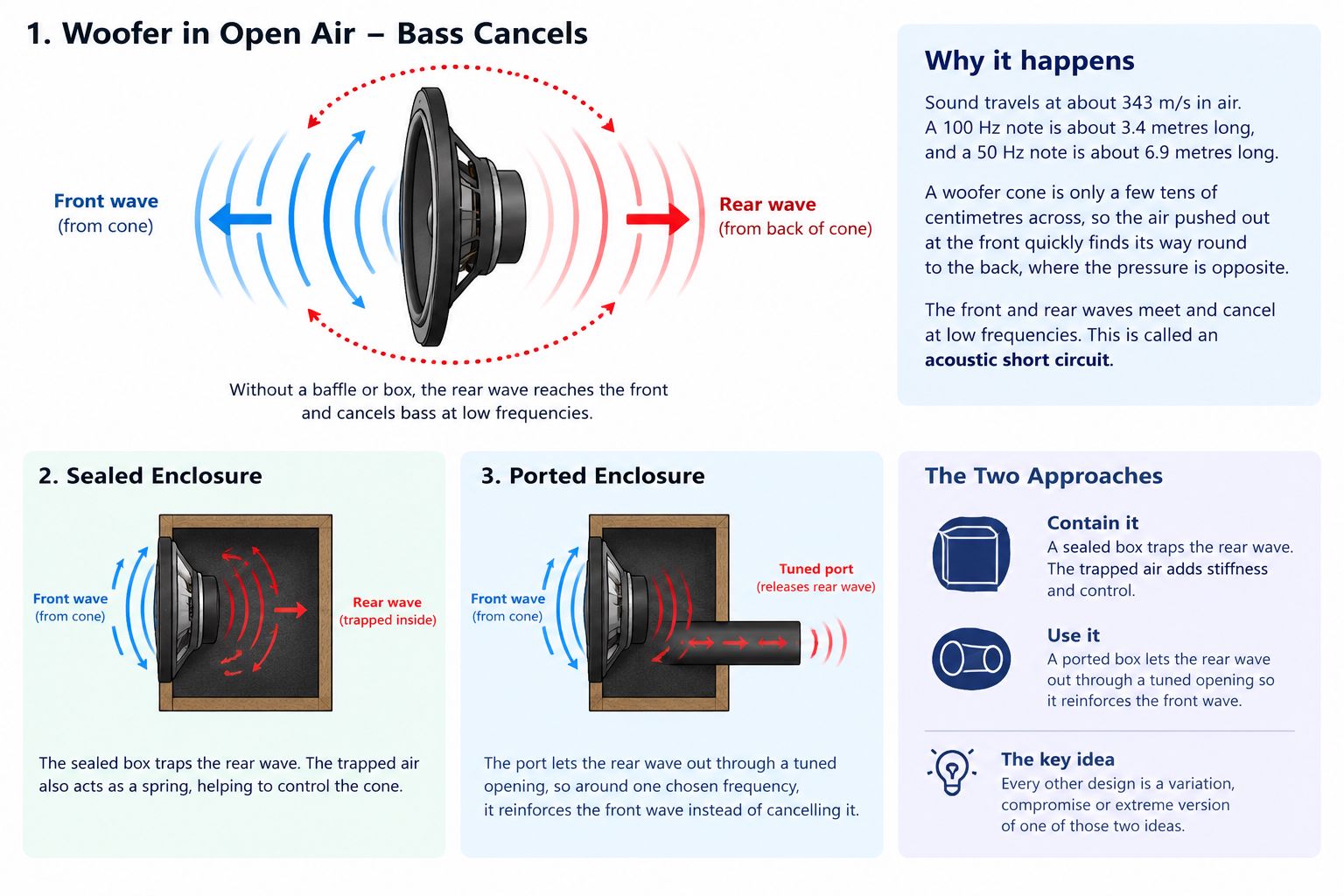
There are two basic ways to deal with the rear wave:
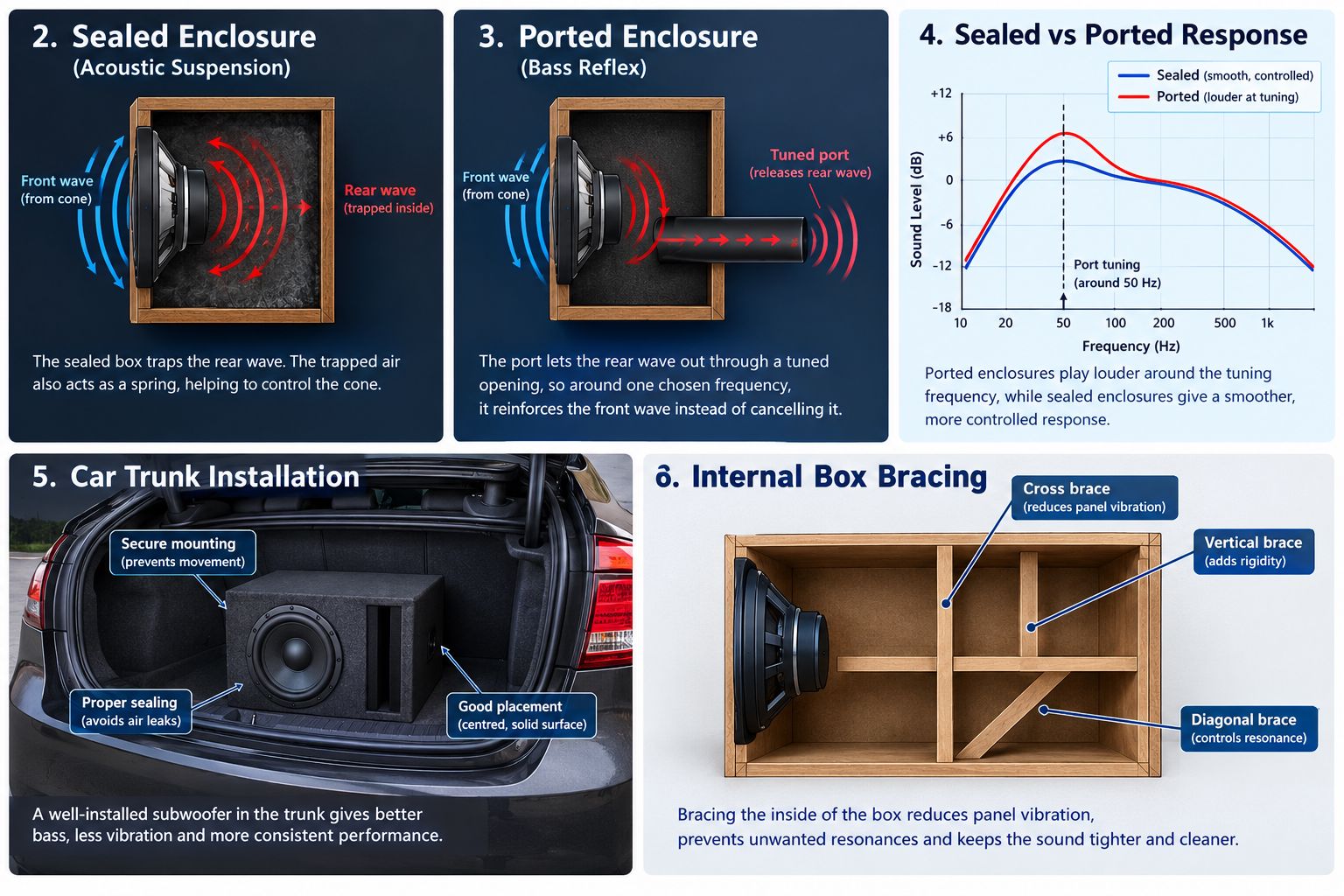
- Contain it. A sealed box traps the rear wave. The trapped air also acts as a spring that helps pull the cone back, so the box becomes part of the driver's suspension.
- Use it. A ported box lets the rear wave out through a tuned opening so that, around one chosen frequency, it reinforces the front wave instead of cancelling it.
Every other design in this guide is a variation, a compromise or an extreme version of one of those two ideas.
Start with the driver: Thiele/Small parameters
Enclosure design is a matching problem. A driver's electrical and mechanical behaviour is summarised by a set of Thiele/Small (T/S) parameters, named after A. Neville Thiele and Richard H. Small, whose work on box alignments in the 1960s and early 1970s underpins modern box design. Manufacturers list these figures on data sheets, and every box calculator depends on them.
| Parameter | What it describes | Why it matters for the box |
|---|---|---|
| Fs | Free-air resonance frequency of the driver, in Hz | Marks where the driver naturally moves most easily. A sealed box raises it; a ported box is tuned around it. |
| Qts | Total damping of the driver at Fs. Low values mean heavily damped, high values mean lightly damped | The quickest single clue to which box type suits the driver. |
| Qes | Electrical damping, the control the motor and amplifier have over the cone | Used with Fs to calculate the efficiency bandwidth product (see "How to choose"). |
| Vas | Volume of air with the same stiffness as the driver's suspension (litres or cubic feet) | Compared with the box volume to show how much the box stiffens the driver. |
| Xmax | Maximum cone travel before distortion rises sharply | Decides how loud the driver can play, and matters most in ported and infinite baffle designs where the cone moves a lot. |
| Sd | Effective area of the cone | Together with Xmax it sets how much air the driver can move. |
Two cautions. First, published T/S figures are typical values for a production run. An individual driver can differ, especially a new one that has not been broken in, so measure the driver if a precise result matters. Second, T/S figures describe small-signal behaviour. They do not guarantee that a box will sound good or survive at high output.
Sealed enclosures (acoustic suspension)
How a sealed box works
A sealed box has no openings except the driver itself. The enclosed air is compressed as the cone moves in and thinned as it moves out, so it adds stiffness to the driver's own suspension. That extra stiffness raises the resonance of the whole system: the box's resonance (Fc) ends up higher than the driver's free-air Fs, and the total damping of the system (Qtc) ends up higher than the driver's Qts. A smaller box means a stiffer air spring, and therefore a higher Fc and Qtc.
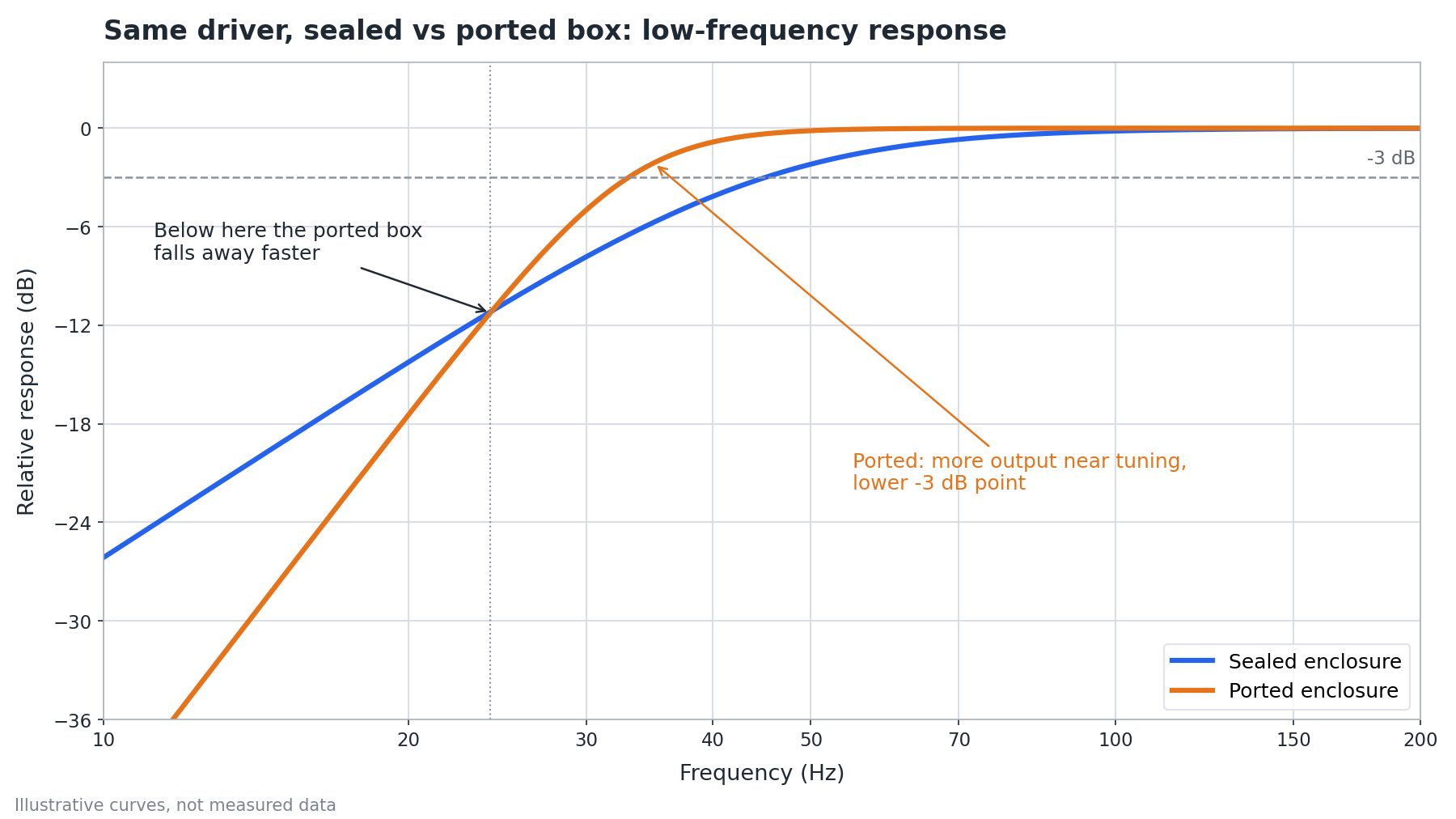
Below Fc, a sealed system loses output at 12 dB per octave, a gentle second-order slope. That gradual slope is a large part of why sealed boxes are easy to live with: the cone stays controlled and output does not fall off a cliff.
What Qtc means for the sound
- Qtc around 0.7 is the maximally flat (Butterworth) alignment: the flattest response before roll-off and well-controlled transient behaviour. Many designers treat it as the standard target.
- Qtc well below 0.7 usually means a larger box. The response is smooth and very well damped with no peak, but the volume needed grows quickly (see the example below).
- Qtc above about 0.7 means a smaller box. There is a bump of extra output around Fc, which many people hear as warmth or punch, but the response also rings for longer, which can become boomy or "one-note".
Worked example (hypothetical driver)
The two standard relationships for a sealed box are:
Fc = Fs × (Qtc ÷ Qts)
Vb = Vas ÷ ((Qtc ÷ Qts)² − 1)
Take an imaginary driver with Fs = 30 Hz, Qts = 0.40 and Vas = 100 litres, and see what different targets cost in box size:
| Target Qtc | Box volume (Vb) | System resonance (Fc) | Character |
|---|---|---|---|
| 0.50 | about 178 litres | 37.5 Hz | Very smooth and damped, but a very large box |
| 0.707 | about 47 litres | 53 Hz | Flat and controlled, a sensible balance |
| 0.90 | about 25 litres | about 68 Hz | Compact, with a bump of extra output around Fc |
The useful lesson is the diminishing return: going from Qtc 0.707 to 0.50 needs almost four times the volume, while the small box gives up bass depth in exchange for size. These figures treat the box as empty. In practice, damping material and the volume taken up by the driver and bracing shift the real result slightly, so treat the calculation as a starting point.
Strengths and limits
- Strengths: predictable behaviour, tolerance of small construction errors, a controlled cone (the air spring limits excursion at low frequencies), good transient response and a compact size for a given bass extension.
- Limits: lower efficiency than a ported box, so more amplifier power is needed for the same output, and less output at the very bottom of the range.
Damping material
Lining the inside walls with fibreglass, wool or polyester fibre absorbs mid-frequency reflections inside the box. In a sealed box it also slows the effective speed of sound inside, so the box behaves as if it were somewhat larger. A commonly quoted figure is roughly 10 to 15 percent, but treat that as an estimate rather than a rule. Do not pack material so tightly that it touches the cone or blocks its movement.
Ported (bass reflex) enclosures
How a ported box works
A ported box is a sealed box with a deliberate opening, a tube or a slot. The mass of air in the port bounces against the springiness of the air in the box, in the same way that air resonates when you blow across the top of a bottle (a Helmholtz resonator). The box and port together resonate at the tuning frequency, Fb. Near Fb, the air in the port moves strongly and in step with the front output of the cone, adding to the total sound, while the cone itself barely moves because the port is doing much of the work.
Below Fb the arrangement stops helping. The port's output starts to cancel the cone's, the cone loses the support of the air spring and can move far more than normal, and output falls at 24 dB per octave, twice as steep as a sealed box. That is why a ported subwoofer can sound loud and deep and then drop away abruptly, and why a ported box should be protected with a high-pass (subsonic) filter set a little below Fb.
Choosing the tuning frequency
Box volume and tuning are chosen together. Tuning lower gives deeper extension but less output in the upper bass. Tuning higher boosts the upper bass but gives up depth. Many car-audio subwoofer boxes are tuned somewhere in the 30 to 45 Hz range, depending on the driver and what the owner wants, but the right value is whatever your simulation shows works for your driver.
Sizing the port
A port has two jobs to do: reach the correct tuning, and be wide enough that air does not become turbulent. For a round port with one end flush in the baffle, a standard approximation (SI units) is:
Lv = (c² × Av) ÷ (4π² × Fb² × Vb) − 0.73 × D
Here Lv is the port length in metres, c is the speed of sound (343 m/s), Av is the port's cross-sectional area in m², Fb is the tuning frequency in Hz, Vb is the box volume in m³ and D is the port diameter in metres.
Example: a 100-litre box (0.100 m³) tuned to 35 Hz with a 100 mm diameter port needs a port about 0.118 m long, or roughly 12 cm. The same box and tuning with a 50 mm port would need only about 1 cm of tube, which is too short to be practical and would push air through far faster.
That points to the central trade-off: for a given tuning, a larger port must be longer, and a narrower port is shorter but makes the air move faster. A widely used rule of thumb is to keep peak port air speed below about 5 percent of the speed of sound, roughly 17 m/s. Above that, turbulence produces audible "chuffing" and the port starts to compress the output. Flared port ends help, and so does leaving at least about one port diameter of clearance between the port opening and the nearest wall.
The formula is only a starting point. Real tuning shifts with damping material, port end shape and the space the port itself takes up, so add the port's volume to the box volume when you plan the dimensions, and check the tuning by measurement afterwards.
Strengths and limits
- Strengths: more output around the tuning frequency for the same amplifier power, and reduced cone movement near Fb, which helps power handling there.
- Limits: a larger box, a steeper 24 dB per octave roll-off, a need for a subsonic filter, possible port noise, and less forgiveness of construction and tuning errors. A badly tuned port can make bass sound slow or boomy.
Infinite baffle and open baffle
In theory, an infinite baffle is a wall so large that the rear wave never reaches the front, so the driver behaves as it would in ideal conditions. In practice the term describes a driver mounted so that its rear wave is sent into an enclosed volume so large, compared with the driver's Vas, that the air spring becomes negligible. The system then behaves almost like the driver on its own, with Qtc close to Qts and Fc close to Fs. A driver mounted in the wall between two rooms is one example. In cars, the usual version is a sub mounted in an airtight baffle between the cabin and a sealed-off trunk.
An infinite baffle installation asks a lot of the driver and the installer:
- The baffle and the trunk must be airtight. Any leak lets the front and rear waves meet and cancel.
- The driver should be designed for it, typically with low Fs, high Vas and a fairly high Qts, plus a robust suspension and plenty of Xmax, because there is no air spring to limit cone travel.
- It needs real amplifier power and a high-pass filter near Fs to protect the cone from excursion at very low frequencies.
Do not confuse infinite baffle with open baffle, also called dipole. An open baffle has no rear volume at all. The rear wave is allowed to escape, and bass cancels as soon as the wavelength is larger than the path from front to back, so the response falls away and usually needs equalisation and a large baffle. Some designers prefer it for its lack of box colouration, and the late Siegfried Linkwitz was a well-known advocate. It is easy to build but hard to design well for low frequencies.
Other enclosure types
Bandpass
In a bandpass box the driver sits inside the enclosure and sound leaves only through a port. The box acts as a filter, giving a narrow band of high output and little outside it. Bandpass boxes were popular in car audio for their punch within that band, but they are harder to design, less tolerant of errors, limited in bandwidth and usually less versatile for varied music.
Aperiodic (damped vent)
An aperiodic enclosure sits between sealed and ported. The vent is deliberately restricted with resistive material, so the box behaves like a slightly leaky sealed box or a heavily constricted ported box. Rod Elliott of Elliott Sound Products has noted that reliable design equations for this type are hard to find, which is one reason it is uncommon.
Passive radiator
A passive radiator replaces the port with a second, undriven diaphragm whose mass is tuned to set the box's resonance. It suits compact speakers where a port would be too long to fit, and it avoids port noise and dust entering the box. The costs are extra parts, a tuning mass to get right, and more baffle area used.
Transmission line
A transmission line sends the rear wave down a long, folded, stuffed duct. The aim is to absorb unwanted energy and let the useful low frequencies emerge in step with the front. The design is large, complicated to build and unforgiving of mistakes, so it is mostly seen in hobbyist projects and a small number of commercial designs.
Enclosure types at a glance
| Type | Bass character | Efficiency | Box size | Difficulty | Best suited to |
|---|---|---|---|---|---|
| Sealed | Controlled, gradual 12 dB/octave roll-off | Lower | Small to medium | Easy | Accuracy, limited space, most general-purpose drivers |
| Ported | Louder near tuning, steep 24 dB/octave roll-off | Higher | Large | Moderate | Output, drivers with low Qts |
| Infinite baffle | Deep and relaxed when done right | Low, needs power | Uses the trunk or a room | Moderate (sealing is critical) | Drivers designed for it, tidy installs |
| Bandpass | Narrow band, high output within it | High in band | Medium to large | Hard | Specific goals where narrow bandwidth is acceptable |
| Passive radiator | Similar to ported | Similar to ported | Smaller than a port-tube equivalent | Moderate to hard | Compact designs |
How to choose an enclosure for your driver
- Decide what matters most. Tight, accurate bass in a small space points to sealed. Maximum output and extension, with space to spare, points to ported.
- Read the manufacturer's recommendation first. Most subwoofer data sheets give a recommended net volume range for sealed and ported use. Start there.
- Use the parameters as a first screen. A common rule of thumb is that Qts below about 0.4 leans toward ported, 0.4 to 0.7 suits sealed, and above 0.7 leans toward infinite baffle or open baffle. A second screen is the efficiency bandwidth product (EBP, calculated as Fs ÷ Qes): below about 50 suggests sealed, above about 100 suggests ported, and in between either can work. Manufacturers draw these lines in slightly different places, so treat them as guidance, not law.
- Compare the required volume with the space you have. If the ideal box does not fit, adjust the target (a slightly higher Qtc for sealed) or reconsider the driver.
- Check excursion and power. Simulate with your actual amplifier power and confirm the cone stays within Xmax, especially for ported boxes below the tuning frequency.
- Simulate before you cut wood. Free programs such as WinISD and Hornresp let you compare box types, volumes and tunings in minutes.
Enclosure design in a car
Cabin gain. A car cabin is a small closed space, and it reinforces low frequencies. The effect depends on the vehicle, but it is often noticeable below roughly 60 Hz. In practice this means a sealed subwoofer box usually sounds fuller in a car than the same box would in a large room, and a ported box tuned very low may sound heavy or boomy because the cabin is already adding bass. Treat this as a reason to experiment with tuning rather than copying a box designed for room use.
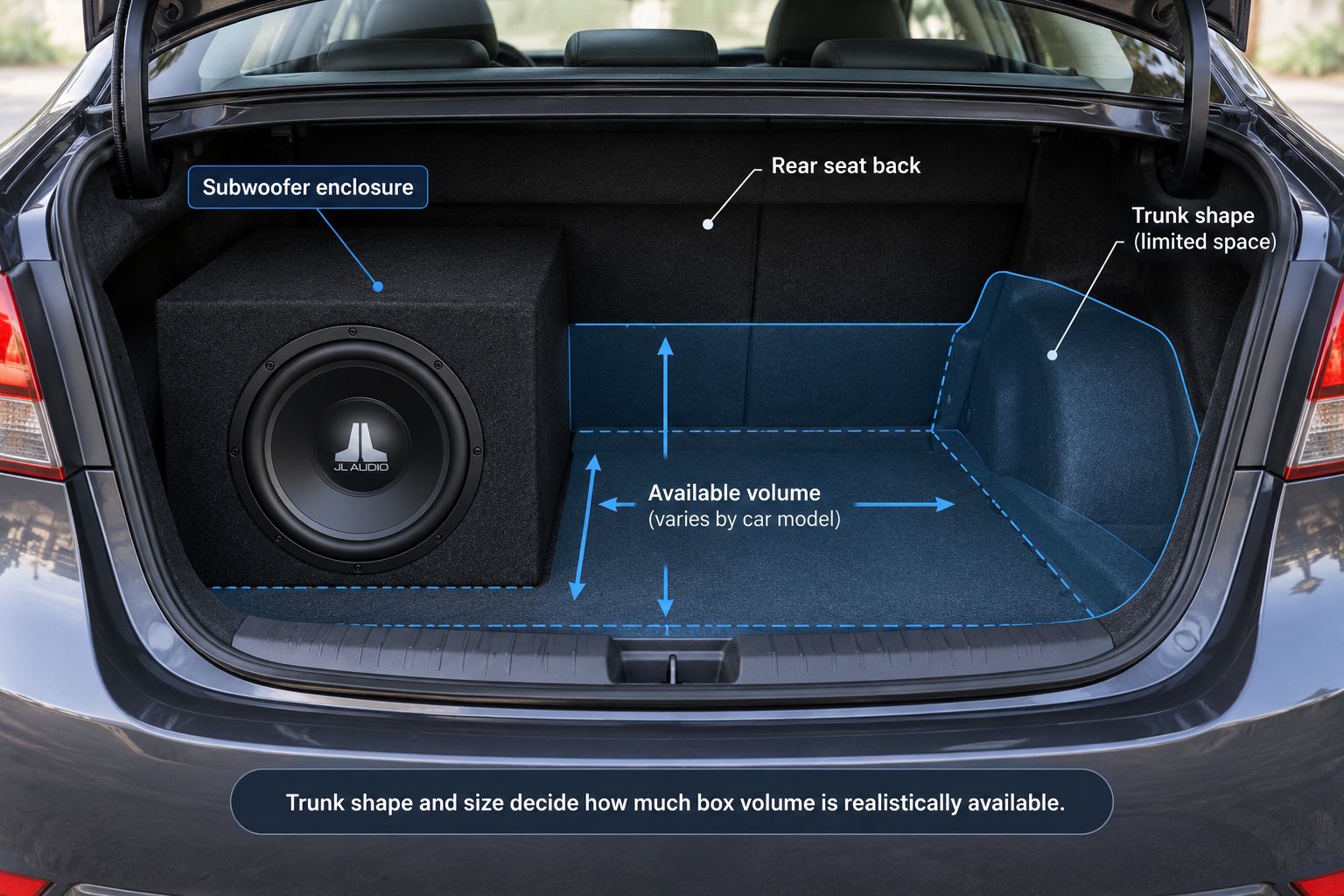
Trunk boxes. Trunk space limits volume, so check the real usable space before choosing a design. Where a sealed box and a ported box are both possible, the sealed box is usually the easier fit. A trunk with leaks between the trunk and the cabin changes behaviour, and the direction the driver faces can change the response in the cabin.
Doors as enclosures. A door-mounted mid-bass driver uses the door cavity as its enclosure, and a stock door is a leaky, resonant one. Common fixes are sealing the large openings in the inner door skin with a rigid panel, adding damping mats to the outer skin to reduce panel vibration, and mounting the driver on a rigid baffle ring so it is sealed against the panel. The goal is to separate the front wave from the rear wave and stop the door itself from adding noise.
Building the box
Work out the internal volume
Start from the net volume you want, the air actually available to the driver, then add everything that takes up space inside: the driver's own displacement, any bracing, and for a ported box the port itself. Useful conversions are 1 cubic foot = 1,728 cubic inches = about 28.3 litres.
| Step | Example |
|---|---|
| Target net volume | 1.00 ft³ |
| Add driver displacement | + 0.06 ft³ |
| Add bracing | + 0.03 ft³ |
| Gross internal volume | 1.09 ft³ = about 1,884 in³ |
| Pick internal height and width | 12 in × 16 in |
| Calculate internal depth | 1,884 ÷ (12 × 16) = about 9.81 in |
| Add panel thickness (3/4 in MDF on both sides = 1.5 in per dimension) | External size about 13.5 × 17.5 × 11.31 in |
Choose sensible proportions
Avoid a cube, and avoid dimensions that are identical or simple multiples of each other, because they stack internal resonances at the same frequencies. The first internal resonance along a dimension is roughly the speed of sound divided by twice that dimension, so a 0.4 m internal dimension resonates near 430 Hz. That is well above a subwoofer's working range, which is why internal damping matters most for midrange and woofer boxes, while panel stiffness is the bigger concern for subwoofer boxes.
Materials and thickness
- MDF: dense, uniform, well damped and easy to machine, which is why it is the common choice. It is heavy, swells if it gets wet, and the dust is harmful, so wear a mask when cutting.
- Plywood (such as birch ply): stiff for its weight and holds screws well, but check for voids inside the sheet and expect splintering when cutting.
- Particleboard and thin sheet: flexes and rings, and is best avoided.
- Thickness: 3/4 in (18 to 19 mm) is a common baseline for small and medium boxes. Large or high-power subwoofer boxes benefit from 1 in (25 mm) material or a double-thickness front baffle.
Bracing, sealing and finishing
Stiffness matters more than thickness alone. Flexing panels waste energy and add their own sound, so connect opposite walls with braces (a window brace works well) and glue every joint as well as screwing it. Seal the joints, the driver cutout and the terminal cup so the box is airtight. A simple check for a sealed box: press the cone in gently and let go. In an airtight box the cone returns slowly. If it snaps straight back, or you can hear air hissing at the joints, the cutout or the terminal cup, find and seal the leak. Tapping the panels is a useful check too: a dull thud is good, while a ringing tone means the panel needs more bracing.
Common mistakes
- Confusing gross and net volume. Forgetting the space taken by the driver, bracing and port leaves the real volume smaller than planned.
- Unit errors. Mixing litres, cubic feet and cubic inches is the most frequent calculation mistake. Write the unit on every number.
- A port that is too small. Air speed climbs, causing noise and compression. Use a wider port or a slot port, even if it means a longer tube.
- No high-pass filter on a ported box. Below tuning the cone loses its support and can bottom out.
- Air leaks. Leaks around the terminal cup, driver cutout or joints change the box's behaviour and can hiss at high output.
- Flimsy panels and cube shapes. Both add resonances that no simulation will show.
- Trusting power ratings as performance. A high power rating says what the driver might survive, not how the box will sound.
- Building without simulating first. A few minutes in WinISD or Hornresp can save a box that has to be rebuilt.
Testing and fine-tuning
After building, measure what you made. An impedance sweep, which can be done with free software such as Room EQ Wizard (REW) and a suitable measurement interface, shows the box's behaviour clearly. A sealed box shows a single impedance peak at Fc. A ported box shows two peaks with a dip between them near the tuning frequency, and the position of that dip tells you whether the port is tuned where you planned. Lengthening the port lowers the tuning, and shortening it raises the tuning. Adding or removing damping material also moves it slightly.
Then listen on familiar tracks at a range of volumes, and note whether the port makes noise at high levels. Measurements inside a car depend heavily on where the microphone is placed, so repeat them at the listening position and judge by ear as well as by the graph.
Sources and further reading
The explanations and worked examples above were written for this guide. These references are listed for readers who want the underlying mathematics.
- A. N. Thiele, "Loudspeakers in Vented Boxes," originally published in 1961 and reprinted in the Journal of the Audio Engineering Society in 1971.
- R. H. Small, "Closed-Box Loudspeaker Systems" (Journal of the Audio Engineering Society, 1972) and "Vented-Box Loudspeaker Systems" (Journal of the Audio Engineering Society, 1973).
- J. Ernest Benson, Theory & Design of Loudspeaker Enclosures, Prompt Publications, 1996.
- Rod Elliott, Loudspeaker Enclosure Design Guidelines, Elliott Sound Products.
Last reviewed: October 2026.
Speaker enclosure design FAQ
Is a sealed or ported enclosure better?
Neither is better in every case. A sealed box gives tighter, more controlled bass in a smaller size and forgives small errors. A ported box plays louder and deeper around its tuning frequency for the same power, but it is larger, needs a high-pass filter and is less forgiving. The driver's Thiele/Small parameters and the space you have should decide it.
What happens if a sealed box is too small or too big?
A box that is too small stiffens the air spring, raising the system resonance and adding a bump of output that can sound boomy, while giving up deep bass. A box that is too large lowers the resonance and gives a smoother, more damped response but costs space and, past a point, adds little extra bass.
How do I find the right box volume for a subwoofer?
Start with the manufacturer's recommended net volume range. Then check it with the driver's Thiele/Small parameters in a simulation program such as WinISD or Hornresp, and add the space taken by the driver, bracing and any port to get the gross internal volume you actually need to build.
Do I need a subsonic filter with a ported box?
It is strongly recommended. Below the tuning frequency a ported box stops loading the cone, so the cone can move far more than normal and may bottom out. A high-pass filter set a little below the tuning frequency protects the driver.
What is the difference between infinite baffle and a sealed box?
In a sealed box the trapped air adds noticeable stiffness to the driver. In an infinite baffle installation the rear volume is so large compared with the driver's Vas that the air spring is negligible, so the driver behaves almost as it would on its own. Infinite baffle needs an airtight baffle and a driver built for it.
Does the shape of the box matter?
Volume matters most, but shape still has an effect. Avoid cubes and dimensions that are identical or simple multiples, because they stack internal resonances at the same frequencies. Panel stiffness and bracing matter at least as much as exact proportions.
Is MDF or plywood better for a speaker box?
Both work. MDF is dense, uniform and well damped, which is why it is the common choice, but it is heavy and swells when wet. Good plywood is stiff for its weight and holds screws well, but it can contain voids. Either should be braced and sealed properly, and thin particleboard is best avoided.