AudioControl · DM-810
AudioControl DM-810 Review: Flexible DSP, Limited Specs
Research-based review of the AudioControl DM-810 car DSP: 8 inputs, 10 outputs, speaker-level inputs and 30-band EQ for $899, with trade-offs and rivals.
Pros
- Eight speaker-level inputs (up to 40 V) plus eight RCA line-level inputs for factory or aftermarket sources
- Ten RCA outputs with any-input-to-any-output matrix routing and input summing
- 12 or 24 dB/octave Linkwitz-Riley high-pass and low-pass filters from 20 Hz to 20 kHz on every output
- Real-time analyzers on every input and output, plus an AutoEQ function in the DM Smart DSP software
- 30-band one-third-octave graphic EQ with 0.1 dB adjustment steps
- Coaxial and Toslink digital inputs, with an Option Port for the optional AC-BT24 Bluetooth module
Cons
- No signal-to-noise or dynamic-range figure is published, and the THD+N test conditions are not stated
- Bluetooth streaming and the ACR-3 dash remote cost extra
- The manual documents a graphic EQ only; retail listings mention parametric filters that the manual does not describe
- Crossover settings are not stored in the four memory presets, which limits quick A/B comparison of filters
- MILC clip detection and GTO signal-sensing turn-on work on inputs 1 and 2 only
- Warranty terms differ between sources (one year on the product page, five years via authorized installation in the older manual)
Specifications
| Analog inputs | 8 channels: speaker-level (summed) and RCA line-level |
|---|---|
| Crossovers | 12 or 24 dB/octave Linkwitz-Riley, 20 Hz to 20 kHz |
| Digital inputs | 1 x Toslink + 1 x coaxial S/PDIF, 32 to 96 kHz, 16/24-bit (shared with inputs 7-8) |
| Dimensions | 10.51 x 5.75 x 1.61 in (267 x 146 x 41 mm) |
| Equalizer | 30-band 1/3-octave graphic EQ (14-band and 10-band modes), 0.1 dB steps |
| Frequency response | 20 Hz to 24 kHz (tolerance not stated) |
| Input impedance | Manual: 14 kOhm; product page: 20 kOhm line / 7 kOhm speaker-level (sources differ) |
| Maximum delay | 21.3 ms input, 21.3 ms output |
| Maximum input level | 8 V line-level; 40 V speaker-level |
| Maximum output level | 10 V (manual); 10 Vrms (product page) |
| Output impedance | 150 ohms |
| Power | Specified at 14.4 V; 1 A draw; 3 A fuse recommended |
| Preamp outputs | 10 channels, RCA |
| THD+N | 0.01% (test conditions not stated) |
| Warranty | 1 year per product page; older manual: 5 years if installed by an authorized dealer |
| Weight | 2.6 lb (1.2 kg) |
Verdict
The AudioControl DM-810 suits anyone who needs to integrate a factory radio and drive several amplifiers, thanks to eight speaker-level inputs, ten outputs and built-in analyzers. Its main compromise is data: AudioControl publishes no signal-to-noise figure, and I found no independent measurements. At $899 it sits between the cheaper JL Audio TwK-88 and the pricier Helix DSP PRO MK3, so value depends on how much you need those speaker-level inputs.
This AudioControl DM-810 review covers an 8-input, 10-output car audio digital signal processor (DSP) for people who keep a factory radio and feed several amplifiers. At $899 it is worth a look if speaker-level inputs and a large output matrix matter more to you than a published noise floor, because AudioControl lists a distortion figure and a frequency range but no signal-to-noise ratio. The manufacturer page lists no successor, and the rating here is 3.5 out of 5.
As an Amazon Associate I earn from qualifying purchases; affiliate links on this page never affect the ratings.
AudioControl DM-810 design and build
The DM-810 is a flat, rectangular box. The manual gives 10.51 x 5.75 x 1.61 in (267 x 146 x 41 mm) and a weight of 2.6 lb (1.2 kg). The product page shows a depth of 5.7 in in its specification list and 6.217 in in a second table, so leave some clearance beyond the manual's drawing when you pick a spot.
Four 0.187 in (about 4.7 mm) holes handle mounting. Connections are RCA jacks for line inputs and outputs, plug-in terminals for power and speaker-level wiring, a micro-USB port for the tuning software, a telephone-style jack for the optional ACR-3 remote, and an Option Port. LEDs report maximized inputs and outputs, source clipping, USB activity and power.
AudioControl's 2017 literature sheet states that the DM series is engineered, designed and manufactured in the USA, and the manual names Mountlake Terrace, Washington. Current production location, case material and internal construction are not confirmed, so the build score below stays at 3.5.
What the DM-810 does: routing, filters and tuning
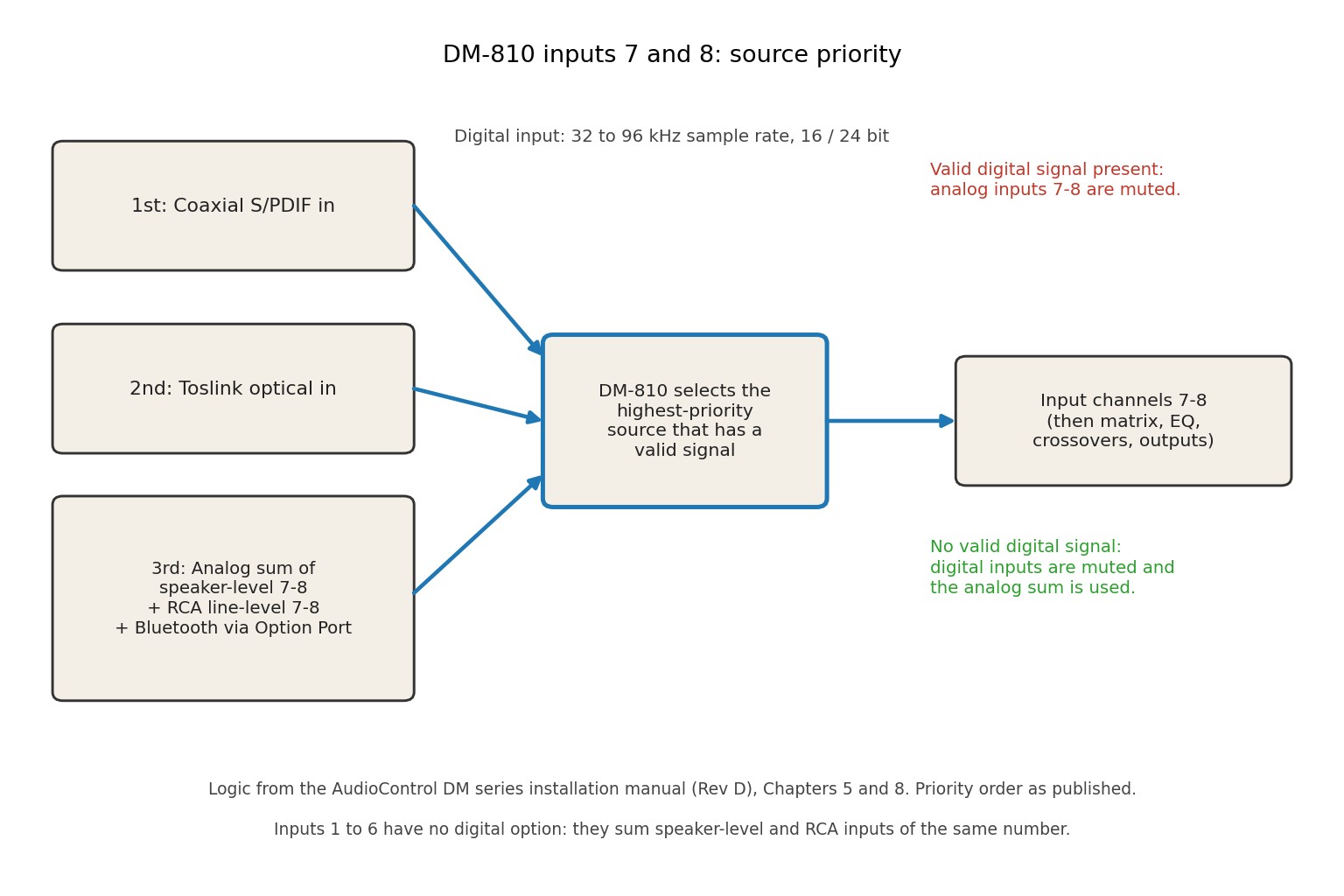
According to the manual, any input can be sent to any output, and inputs can be summed. Speaker-level inputs take up to 40 V and RCA line inputs up to 8 V, and a speaker-level input is added to the RCA input with the same number. Inputs 5 and 6 are mono, meant for center and subwoofer feeds. The coaxial and Toslink digital inputs share channels 7 and 8, with digital sample rates of 32 to 96 kHz at 16 or 24 bit.
The priority on channels 7 and 8 is fixed: coax first, optical second, analog third. When a valid digital stream is present, the analog inputs on those channels are muted.
Every output has high-pass and low-pass filters, 12 or 24 dB per octave Linkwitz-Riley, between 20 Hz and 20 kHz, and the two can be combined into a band-pass. Equalization is a graphic EQ with 30 one-third-octave bands, plus 14-band and 10-band modes, adjustable in 0.1 dB steps. Parametric filters are not confirmed, because the manual describes only the graphic EQ. Input and output delay each reach 21.3 ms and can be entered as time or distance. Our calculation, assuming sound travels at 343 m/s, puts 21.3 ms at about 7.3 m (24.0 ft) of path difference.
Tuning runs through the DM Smart DSP app. AudioControl's product page offers it as a free download for Mac and PC and links iOS and Android versions. Every input and output has a real-time analyzer, which the manual presents as the way to identify and sum factory speaker-level signals. AutoEQ uses pink noise to propose a correction curve that you can accept or reject. The manual describes its goal as a flat response at the DM-810 outputs, which is an electrical target rather than an acoustic one.
AccuBASS is AudioControl's bass restoration for factory head units, with a threshold and a boost level for each output. MILC clip detection and GTO signal-sensing turn-on work on inputs 1 and 2 only. Four memory presets store tunings, but crossover settings are deliberately left out of them so tweeter filters cannot change by accident from the remote. The default PIN is 1234, and the manual shows how to change it.
Bluetooth is not built in. The Option Port takes the optional AC-BT24 streamer, which feeds channels 7 and 8, and the ACR-3 dash remote for level and preset recall is also an optional purchase.
DM-810 rated performance and what is missing
A DSP does not make sound. It shapes the signal your amplifiers reproduce, so noise, distortion and headroom are the numbers that count. AudioControl rates the DM-810 at 0.01% THD+N, a 20 Hz to 24 kHz frequency response and a 10 V maximum output, with specifications taken at a 14.4 V supply. The manual gives no frequency-response tolerance, no signal conditions for the distortion figure and no signal-to-noise or dynamic-range number. Both rivals compared below publish a signal-to-noise ratio with a stated weighting, which makes the gap easy to see.
Our research found no independent lab measurements for this model. What exists is design description. According to the manual, input gain is set in the analog domain before the converter, which the manual says maximizes headroom and noise-floor performance. A 2017 BestCarAudio.com product spotlight, labeled as a sponsored post, describes balanced differential inputs and digitally controlled input attenuators. It adds that 10 V is more than many amplifiers accept and says an internal jumper cuts each channel pair to 5 V.
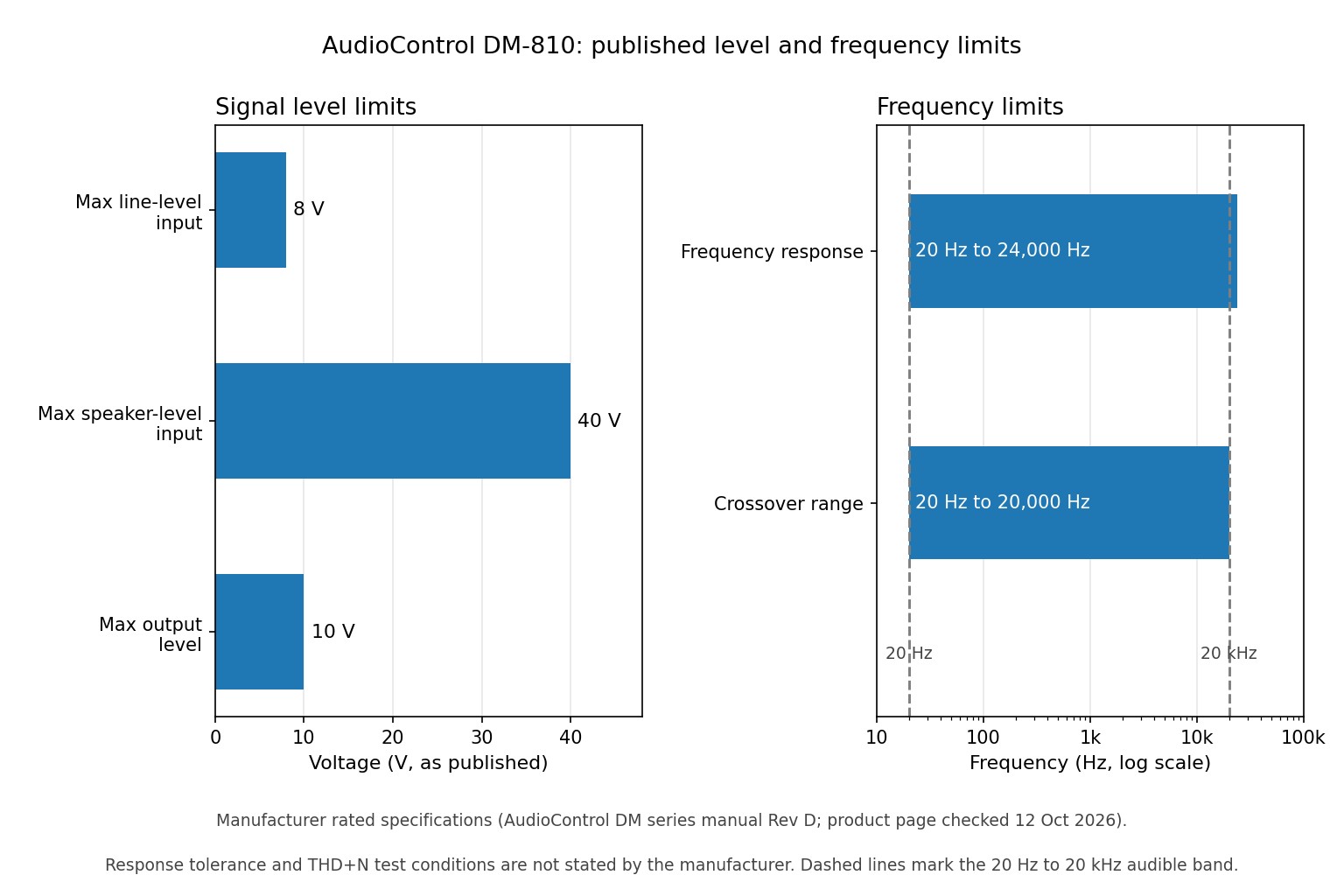
The manual and the product page disagree on input impedance: 14 kΩ in the manual, and 20 kΩ for line inputs with 7 kΩ for speaker-level inputs on the product page. The manual wins here. Our calculation from the rated levels shows the 40 V speaker-level limit sits 14.0 dB above the 8 V line-level limit, so a factory amplifier output has far more room than a line-level feed. The 10 V output is 1.9 dB above the 8 V line input limit, and it only helps if the receiving amplifier accepts that voltage.
Installing the DM-810 and living with it
AudioControl recommends the trunk or cargo area, or under a front seat if there is room, with ventilation and protection from heat, moisture and dirt. Mount it as far from the antenna and radio-sensitive electronics as you can. Power needs a sufficient-gauge insulated cable and a 3 A in-line fuse on the +12 V line. The rated draw is 1 A, which works out to 14.4 W at the 14.4 V the specifications use, and the 3 A fuse is three times that rated draw. Keep RCA cables at least 18 in (45 cm) from power and speaker cables.
The manual's quick start has you disconnect the battery first, wire power, ground and turn-on, connect the inputs, install the software, then connect by USB, enter the default PIN and tune. The quick start and the software chapter disagree on whether the unit should be plugged in during software installation, so follow the installer's on-screen warning. Setup is done with the amplifiers off or disconnected, because wrong crossover settings can damage tweeters. The amplifier connections come last.
- Factory radio: find the speaker wires with a wiring diagram, as the manual advises, and keep polarity on the speaker-level inputs.
- Turn-on: use the radio's remote trigger, or GTO signal sensing on inputs 1 and 2.
- Amplifier inputs: compare each amplifier's input sensitivity with the 10 V maximum output and set output levels to match.
- Space: allow for the 10.51 x 5.75 x 1.61 in body plus connector clearance.
- Radios that monitor their speaker connections: AudioControl's documents list no feature for this on the DM-810, so ask an authorized installer about your vehicle.
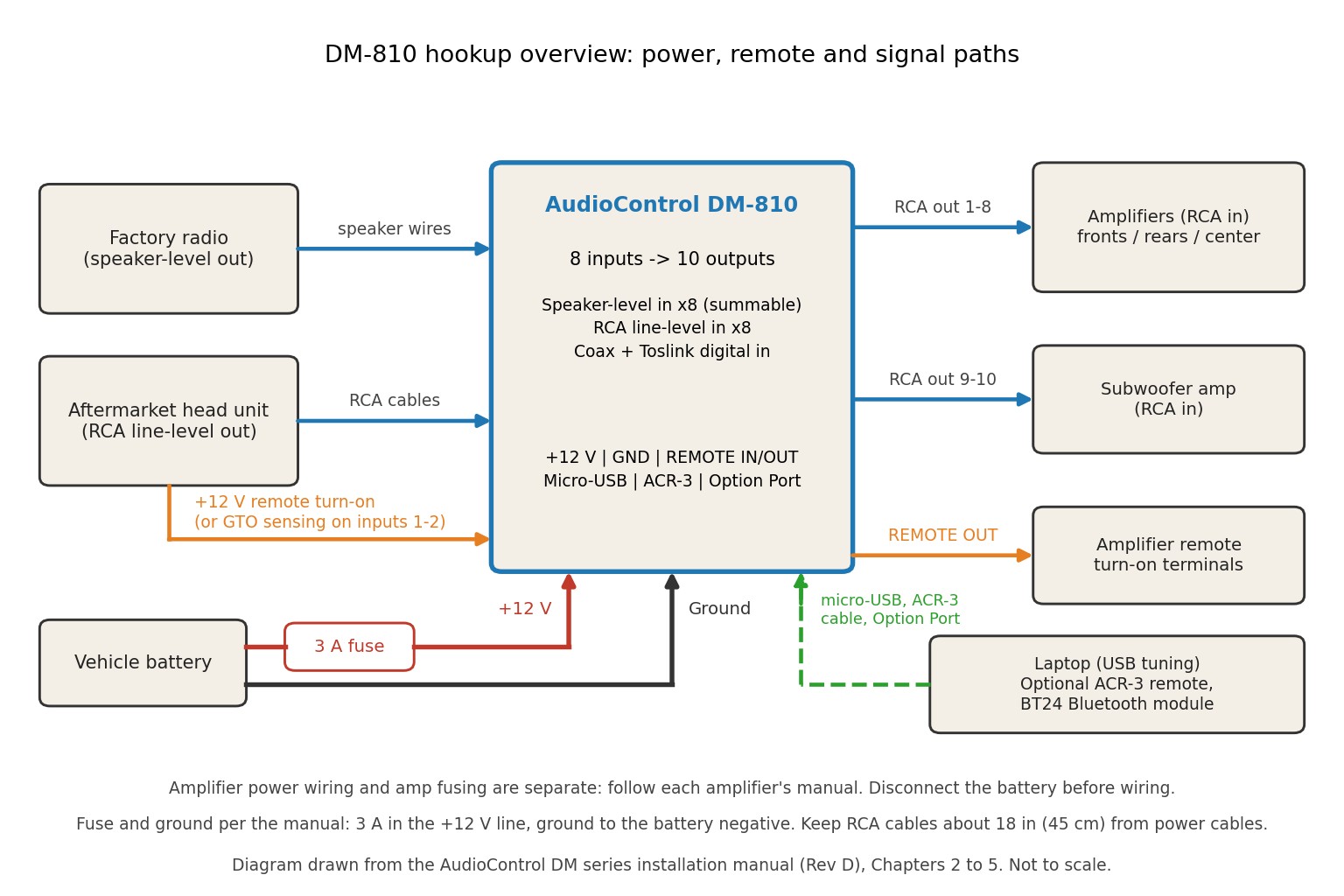
Safety notes: disconnect the vehicle battery before wiring, and check for fuel lines, brake lines and wiring before drilling. Amplifier power wiring and fusing follow each amplifier's own manual. High playback volume can cause permanent hearing loss.
After tuning, the unit runs on its stored settings without a computer. Save the settings file before any firmware update, because the manual says unsaved settings are lost. For a car with a complex factory system, the product page advises leaving installation to an authorized AudioControl installer.
DM-810 against two rivals
The two rivals checked for this review bracket the DM-810 on price. The JL Audio TwK-88 is priced at $579.99 at Abt, takes only line-level inputs and comes with a dash remote. The Helix DSP PRO MK3 is priced at $1,299.00 at ResoNix, adds high-level inputs up to 32 V and publishes a 111 dB analog signal-to-noise ratio. Our calculation from the three prices gives $89.90 per output channel for the DM-810, $129.90 for the Helix DSP PRO MK3 and $72.50 for the JL Audio TwK-88.
| Specification | AudioControl DM-810 | Helix DSP PRO MK3 | JL Audio TwK-88 |
|---|---|---|---|
| Price | $899.00 (AudioControl) | $1,299.00 (ResoNix) | $579.99 (Abt) |
| Analog inputs | 8 speaker-level (to 40 V) + 8 RCA (to 8 V) | 8 high-level (to 32 V) + 8 RCA (to 4 V) | 8 RCA only (to 7.1 V) |
| Digital inputs | Coax + Toslink | Coax + Toslink | Coax + Toslink |
| Outputs | 10 RCA, 10 V max | 10 RCA, 8 V max | 8 RCA, 4 V max, plus optical pass-through |
| Equalizer | 30-band graphic (14 and 10-band modes) | Parametric (TuneEQ auto-correction) | 10-band graphic or parametric on 8 banks |
| Published THD+N | 0.01% (signal conditions not stated) | Below 0.001% (analog input) | 0.02% at rated output, 20 Hz to 20 kHz |
| Published signal-to-noise | Not published | 111 dB A-weighted (analog input) | 98 dB A-weighted, 4 V reference |
| Processing | Internal depth not published; digital input 32 to 96 kHz, 16/24 bit | 64-bit DSP, 96 kHz | 24-bit, 48 kHz |
| Maximum delay | 21.3 ms | 20 ms per channel | Not confirmed |
| Rated current draw | 1 A | 650 mA | 0.7 A at 13.8 V |
| Remote in the box | No (ACR-3 optional) | No (accessories sold separately) | Yes (DRC-200) |
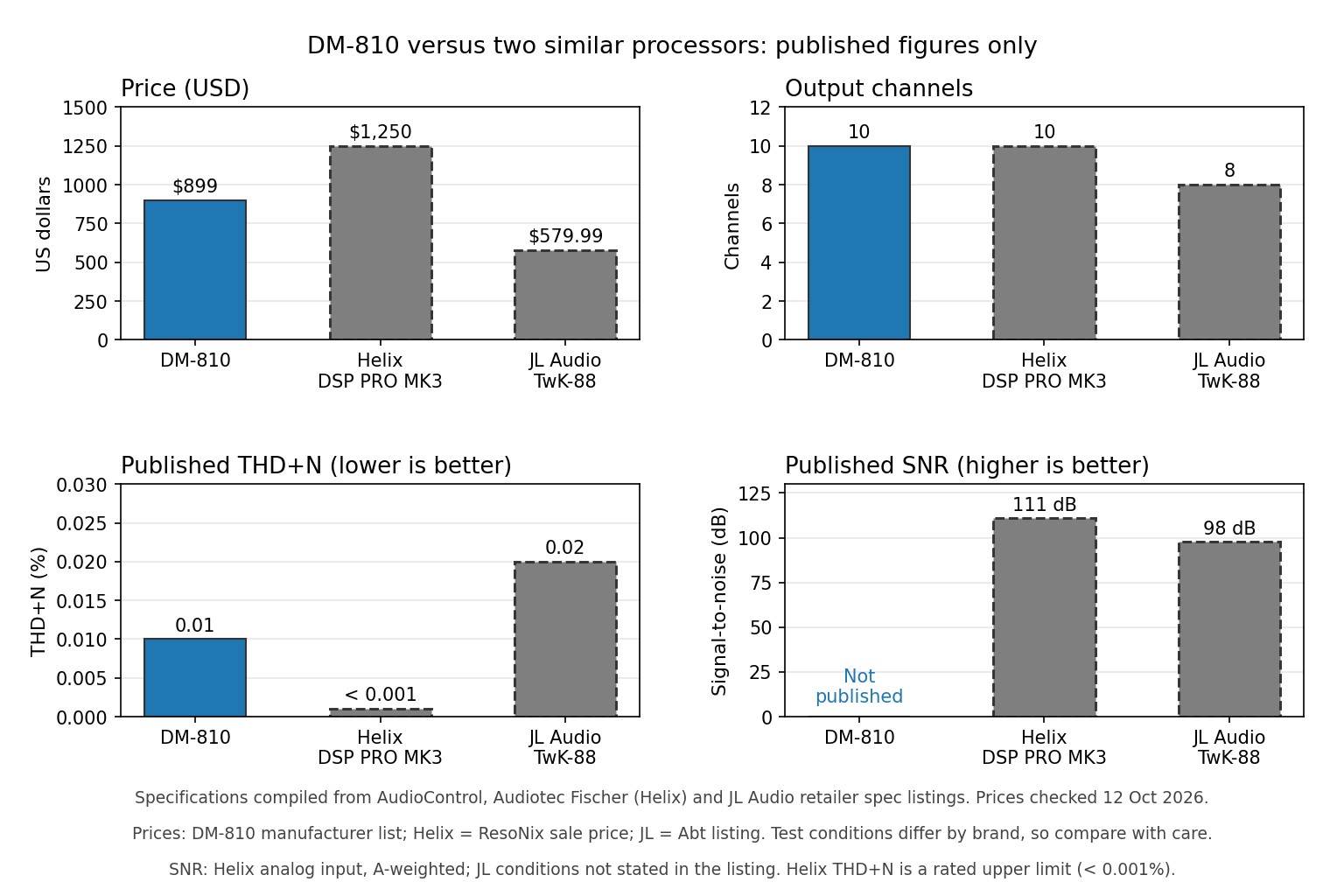
Test conditions differ by brand, so these figures are not a like-for-like ranking. The Abt listing shows 96 dB for the JL Audio TwK-88, while the JL Audio manual, which wins here, gives 98 dB. The DM-810's 10 V output works out to 1.9 dB above the Helix DSP PRO MK3's 8 V and 8.0 dB above the JL Audio TwK-88's 4 V, and whether that matters depends on your amplifier inputs. In short, the DM-810 matches the Helix DSP PRO MK3 on input and output count, sits between the two on price and publishes the least about noise.
Who should buy the DM-810 and who should skip it
It suits installers and DIYers who want to keep a factory radio, need speaker-level inputs and want ten outputs for a front stage, rears, a center and a subwoofer. It also suits anyone who wants input and output analyzers to match and sum factory signals. If that describes your car, the AudioControl DM-810 is worth pricing against the two rivals above.
Skip it if the lowest published noise floor is your priority, because the Helix DSP PRO MK3 publishes 111 dB and the DM-810 publishes no figure. Skip it if you have an aftermarket head unit with RCA outputs and need only eight outputs, since the JL Audio TwK-88 costs $579.99 and includes a remote. Skip it as well if you want Bluetooth or a dash remote in the purchase price, because both are extras.
DM-810 price and what to check before buying
The DM-810 is priced at $899.00 by AudioControl. Prices change often, so check the current listing. The box holds the processor, power and speaker connectors, a USB cord, the manual and warranty information, and the ACR-3 remote and AC-BT24 Bluetooth streamer are sold separately.
Check the model first: the DM-608 is the smaller sibling with 6 inputs and 8 outputs, and the manual says its controls and features are much the same. Check the warranty next. The manual describes five years when an authorized AudioControl dealer installs the unit and one year otherwise, requires registration within 15 days, and says products from unauthorized dealers are not covered, while the product page lists one year. To compare sellers, check the current price on Amazon next to AudioControl's own store, and confirm the seller is an authorized dealer before you order. Budget for the extras: power wire and a 3 A fuse, quality shielded RCA cables, and the optional remote or Bluetooth module.
DM-810 final verdict and score
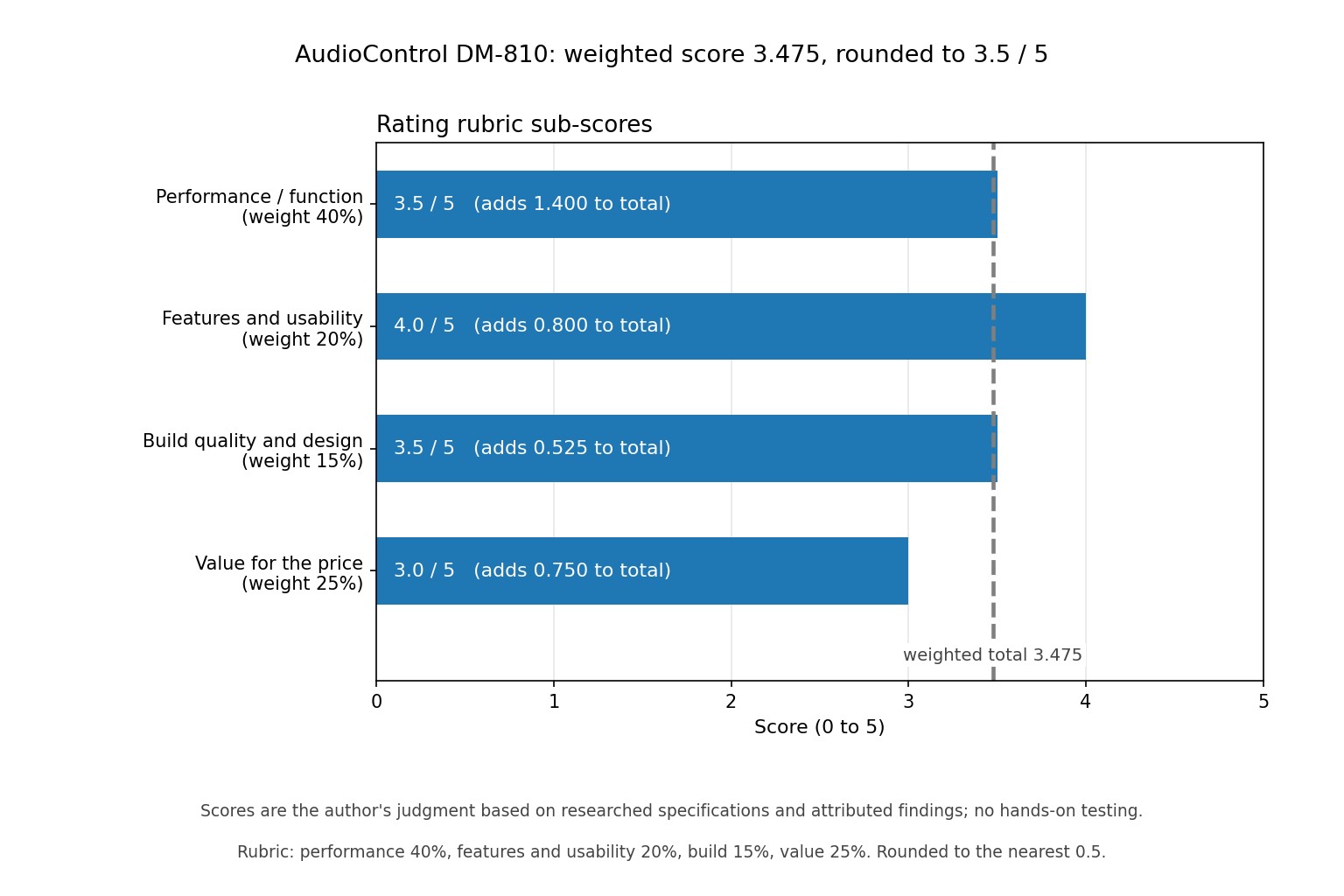
The DM-810 earns 3.5 out of 5. Its speaker-level inputs, ten-output matrix and built-in analyzers suit factory-radio integration, and its weak points are value against the cheaper rival and the missing noise, dynamic-range and processing-depth numbers. The rubric weights performance and function at 40%, features and usability at 20%, build quality and design at 15%, and value for the price at 25%.
| Category | Weight | Score (0 to 5) | Weighted points |
|---|---|---|---|
| Performance and function | 40% | 3.5 | 1.400 |
| Features and usability | 20% | 4.0 | 0.800 |
| Build quality and design | 15% | 3.5 | 0.525 |
| Value for the price | 25% | 3.0 | 0.750 |
| Total | 100% | 3.475, rounded to 3.5 | |
Our research score is based on the rated figures and documented details above.
Sources and further reading
- AudioControl DM-810 product page (specifications, price, warranty, software)
- AudioControl DM series installation manual (wiring, input priority, specifications, warranty terms)
- AudioControl DM series literature sheet (2017 feature list and build statement)
- BestCarAudio.com DM-810 product spotlight (sponsored post, 2017; circuit description)
- Audiotec Fischer Helix DSP PRO MK3 page (rival specifications)
- ResoNix listing for the Helix DSP PRO MK3 (rival price)
- Abt listing for the JL Audio TwK-88 (rival price and specifications)
- JL Audio TwK-88 installation manual (rival specifications; PDF copy hosted by a third party)
AudioControl DM-810 FAQ
What is the AudioControl DM-810?
It is a car-audio digital signal processor with 8 input channels and 10 RCA outputs. It handles routing, crossovers, equalization, delay and level setting through the DM Smart DSP software. AudioControl began shipping it to dealers in November 2016.
Can the DM-810 work with a factory radio?
Yes, it has eight speaker-level inputs that accept up to 40 V, which are meant for factory radios and amplifiers. Whether it suits your specific vehicle depends on how the factory system is wired, so check with an installer. AudioControl lists authorized installers on its website.
Is there a newer version of the DM-810?
I found no replacement model on AudioControl's site as of October 12, 2026. The company still lists the DM-810 at $899, although the page showed it as out of stock when checked. Availability can change, so confirm with the seller.
Is the Amazon DM-810 listing genuine?
The ASIN B01EDIWWAK matches the AudioControl DM-810 across several Amazon regional stores. That confirms the listing, not any single unit. Check that the seller is AudioControl's parent company, Stinger, or an authorized dealer, because the manual says unauthorized purchases are not covered by the warranty.
What is the difference between the DM-810 and the DM-608?
The DM-608 has 6 inputs and 8 outputs, while the DM-810 has 8 inputs and 10 outputs. AudioControl's manual covers both and says their controls and features are much the same. The DM-608 weighs 2.2 lb against 2.6 lb for the DM-810.
Does the DM-810 have Bluetooth?
Not built in. Bluetooth streaming and programming need the optional AC-BT24 module, which plugs into the Option Port and feeds audio into channels 7 and 8. The module is sold separately.
Is the DM-810 worth $899?
It can be if you need speaker-level inputs and ten outputs, since the JL Audio TwK-88 has neither and costs $579.99. The Helix DSP PRO MK3 costs more but publishes stronger noise and distortion figures. Because AudioControl gives no signal-to-noise number, value depends on how much you weigh features against published performance.
What warranty does the DM-810 have?
AudioControl's current product page lists a one-year manufacturer warranty. An older installation manual describes five years when an authorized dealer installs it, with registration within 15 days of purchase. Ask the seller which terms apply to your unit.