Rockford Fosgate · P500X1BD
Rockford Fosgate Punch P500X1BD Review: 1-Ohm Bass Power
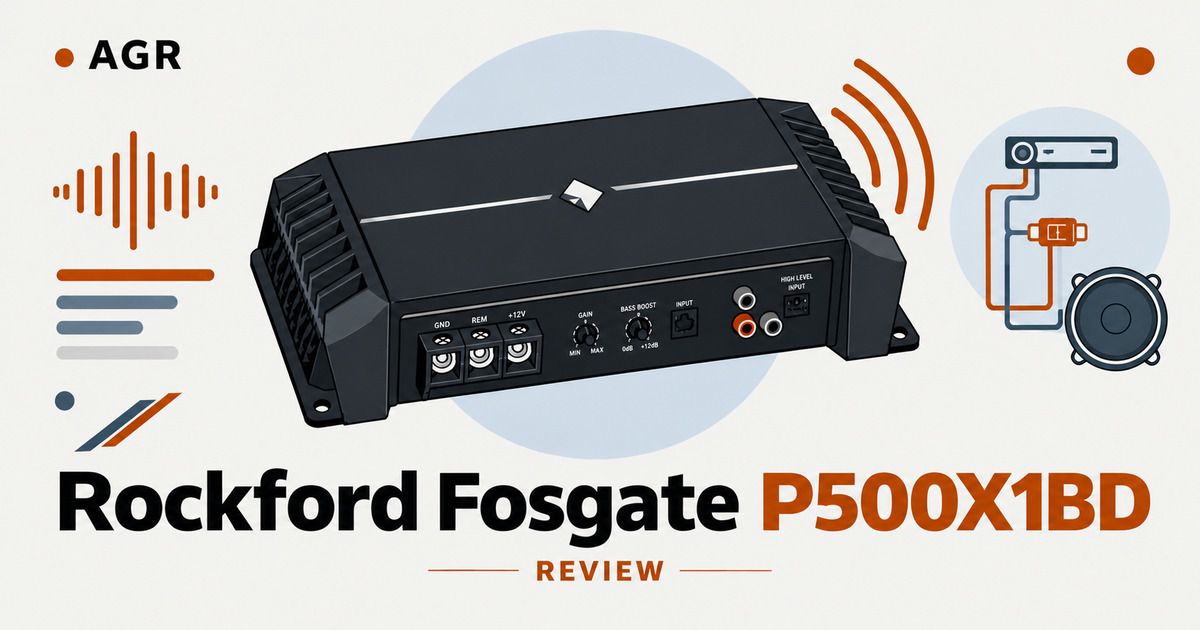
The Rockford Fosgate Punch P500X1BD delivers 500 W RMS at 1 ohm, high-level inputs, RCA pass-through, adjustable filtering, Punch EQ, and 80 A fuse guidance.
Pros
- 500 W RMS at 1 ohm, with 300 W at 2 ohms and 150 W at 4 ohms
- RCA input supports high- and low-level signals within the published sensitivity range
- RCA pass-through output for feeding another amplifier
- Variable 50-250 Hz low-pass filter and fixed 28 Hz infrasonic filter
- Punch EQ offers up to +18 dB at 45 Hz
- C.L.E.A.N. gain setup indicators help establish input and output clipping limits
Cons
- One-year manufacturer warranty listed in the supplied product details
- Full-size chassis needs more mounting room than compact DSP amplifiers
- No independent lab measurements for this exact model were found
- Punch EQ boost can increase clipping risk and subwoofer excursion if used aggressively
- Review price is high compared with compact alternatives offering automatic signal tuning
Specifications
| Amplifier Class | Class-BD |
|---|---|
| Brand | Rockford Fosgate |
| Channels | 1 mono channel |
| Dimensions (H x W x D) | 2.38 x 7.76 x 11.03 inches |
| Frequency Response | 20 Hz-250 Hz, ±1.0 dB |
| Infrasonic Filter | 28 Hz, 12 dB/octave |
| Input Sensitivity | 150 mV-12 V; high- or low-level signal support |
| Low-Pass Crossover | 50-250 Hz, 12 dB/octave Butterworth |
| Minimum Rated Load | 1 ohm |
| Operating Voltage | 9-16 V DC |
| Power Wire | 4 AWG |
| Product Model | Punch P500X1bd |
| Punch EQ | 0 to +18 dB at 45 Hz |
| Rated RMS Power | 150 W x 1 at 4 ohms; 300 W x 1 at 2 ohms; 500 W x 1 at 1 ohm |
| Recommended Fuse | 80 A, not included |
| Signal Connections | 1 RCA input pair; 1 RCA pass-through output pair |
Verdict
The P500X1bd suits subwoofer owners who need up to 500 W RMS at 1 ohm, high-level input support, and adjustable low-frequency tuning. Its practical features and 1-ohm stability are strengths, while its full-size chassis, one-year warranty, and $429.99 USD review price limit the value case against compact DSP-equipped options.
The Rockford Fosgate Punch P500X1BD is worth considering for a subwoofer system that needs a 1-ohm-stable, 500-watt mono amplifier and flexible bass tuning, but the price makes alternatives worth comparing. This Rockford Fosgate Punch P500X1BD review uses the supplied model specifications, manufacturer documentation, and published retailer information. The manufacturer still includes the P500X1bd in its Punch manual index, and a retailer identifies it as the replacement for the older P500-1BD. No successor to the P500X1bd itself was confirmed, so available evidence does not establish that this exact model is discontinued.
As an Amazon Associate I earn from qualifying purchases; affiliate links on this page never affect the ratings.
Rockford Fosgate Punch P500X1BD: design and intended use
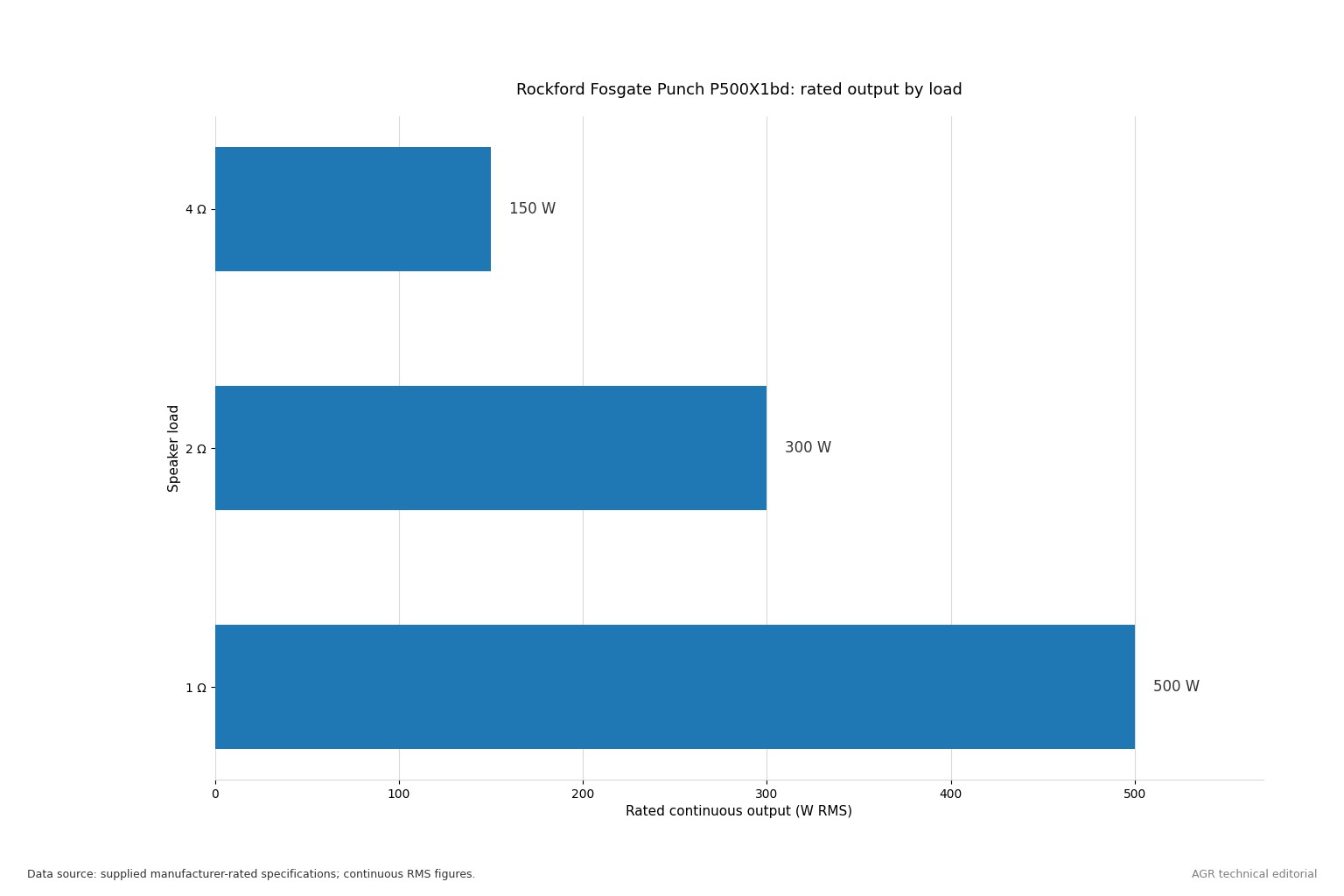
The P500X1bd is a single-channel, Class-BD car amplifier designed for low-frequency duty. Its rated output changes with the connected load: 150 watts RMS at 4 ohms, 300 watts RMS at 2 ohms, and 500 watts RMS at 1 ohm. That last figure is the source of the product's 500-watt label. The amp is not bridgeable, and it is not a full-range amplifier for powering ordinary door speakers across the audible spectrum.
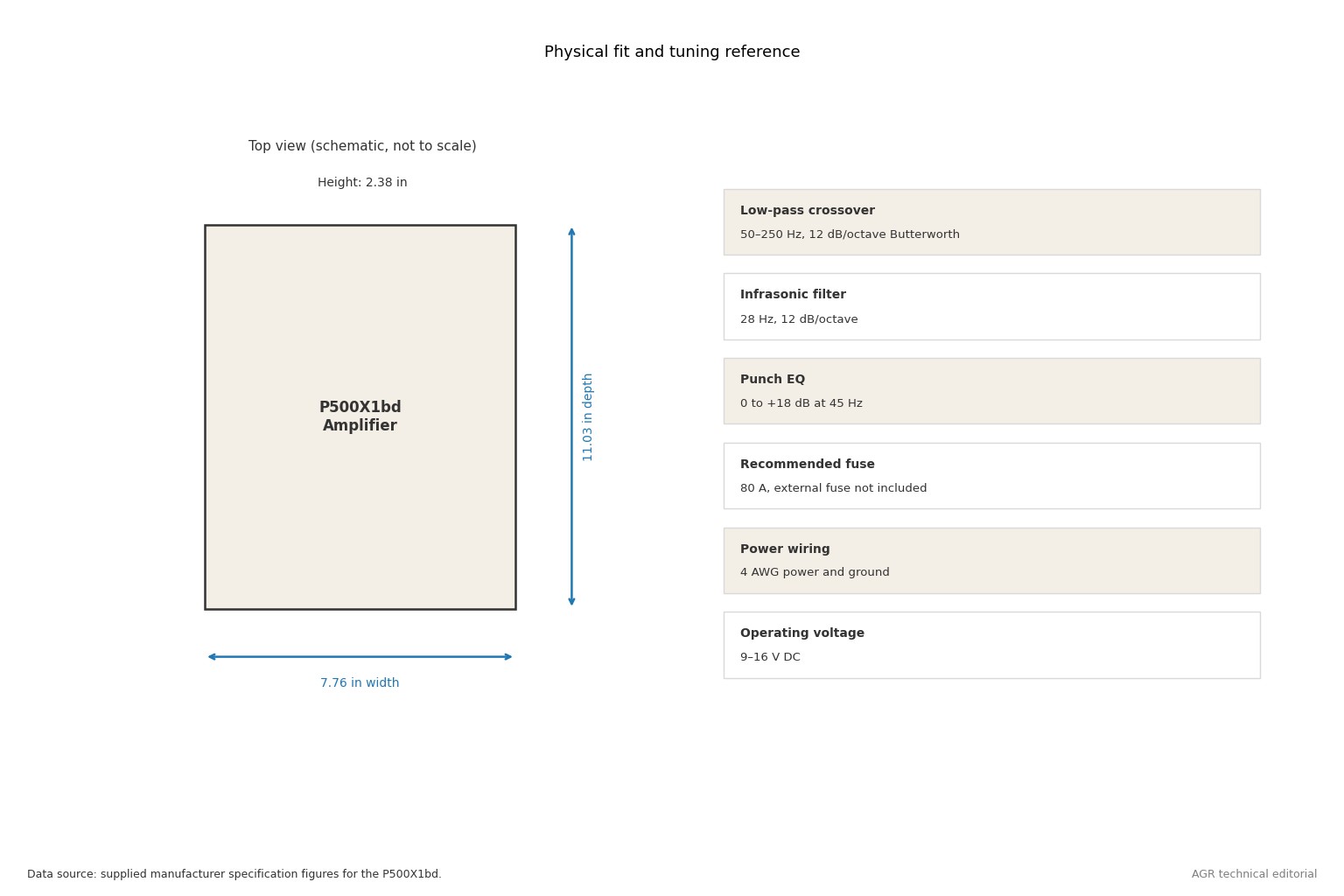
The supplied specification lists a chassis measuring 2.38 inches high, 7.76 inches wide, and 11.03 inches deep. It is a full-size unit rather than a tiny under-seat amplifier, so the available mounting surface and the space needed for power, ground, input, and speaker wiring matter. Leave room for ventilation and service access rather than sizing a space to the chassis outline alone.
Rockford Fosgate's Class-BD design is paired with a convection-cooled heatsink. There is no fan listed in the supplied specifications, so the mounting location should not block the heatsink or trap heat inside carpet, foam, or an enclosed pocket. The included warranty is listed as one year, shorter than the two-year terms published for some competing amplifiers.
Rockford Fosgate Punch P500X1BD controls and connections
The P500X1bd offers one RCA input pair that can accept low-level or high-level audio signals. The published sensitivity range is 150 mV to 12 V, allowing integration with many aftermarket or factory systems when wired according to the manual. Confirm the correct high-level adapter or harness for the particular installation before beginning; RCA sockets do not mean bare speaker wire should be inserted directly into the input.
A pair of RCA pass-through outputs can send the same signal onward to another amplifier. This is useful when the system includes a separate amplifier for other speakers, though the output does not turn the P500X1bd into a multi-channel unit. The input and output clip indicators associated with C.L.E.A.N. setup help set gain more consistently than using the position of a gain knob as a target. Gain is a matching control, not a volume boost.
The variable low-pass filter spans 50 to 250 Hz with a 12 dB-per-octave Butterworth slope. A fixed infrasonic filter is specified at 28 Hz with a 12 dB-per-octave slope. These controls let an installer limit upper-frequency content sent to the subwoofer and reduce very low-frequency energy that may be unsuitable for the enclosure or driver. The right crossover setting depends on the subwoofer, enclosure, and the rest of the system rather than a universal preset.
The onboard Punch EQ adds up to 18 dB of boost at 45 Hz. That is a substantial change in bass emphasis, not a free increase in clean output. Boosting a low-frequency band demands additional voltage and current and can push the amplifier or subwoofer into clipping or excessive excursion sooner. Start with little or no boost, set gain carefully, and confirm the subwoofer's limits.
For a system that suits its power and load range, the Rockford Fosgate Punch P500X1BD mono amplifier combines straightforward subwoofer controls with high-level input support and RCA pass-through.
Rockford Fosgate Punch P500X1BD performance and power
The rated output makes load matching central to the purchase. A 4-ohm load receives 150 watts RMS, a 2-ohm load receives 300 watts RMS, and a 1-ohm load receives 500 watts RMS. The final load must be calculated from the voice-coil wiring of every connected subwoofer. Two dual-voice-coil subs can be wired in different ways, and the final impedance should be checked before connecting the amplifier. Do not assume that the nominal impedance printed on one driver is the total load presented by the full system.
The supplied PowerCube dynamic figures are 224 watts at 4 ohms, 410 watts at 2 ohms, and 787 watts at 1 ohm. At 1 ohm, 787 watts is 287 watts, or about 57.4%, above the 500-watt continuous rating. This is a calculation from the published dynamic and RMS figures, not a claim that the amplifier can continuously supply 787 watts. Dynamic figures and continuous RMS ratings describe different conditions and should not be mixed in a simple continuous-power comparison.
The published average efficiency figure is 86% at 4 ohms, and total harmonic distortion plus noise is listed below 1.0% at 4, 2, and 1 ohm. These are manufacturer-reported specifications, not independent bench measurements. Our research found no independent lab measurements for this model. A buyer should therefore treat the rated output, efficiency, and distortion figures as published specifications rather than a guarantee of the result in a particular vehicle, with a particular battery, charging system, enclosure, or subwoofer.
The amplifier's 9 to 16 V DC operating range means vehicle supply voltage is relevant to performance. The supplied figures list average music current draw of 35 A at 13.8 V and maximum sine-wave current draw of 70 A at 13.8 V. Music demand varies with level and content, while a continuous test tone can place a more sustained demand on the charging system. These values are helpful for planning but do not establish the condition of a vehicle's alternator or battery.
Rockford Fosgate Punch P500X1BD installation and fitment
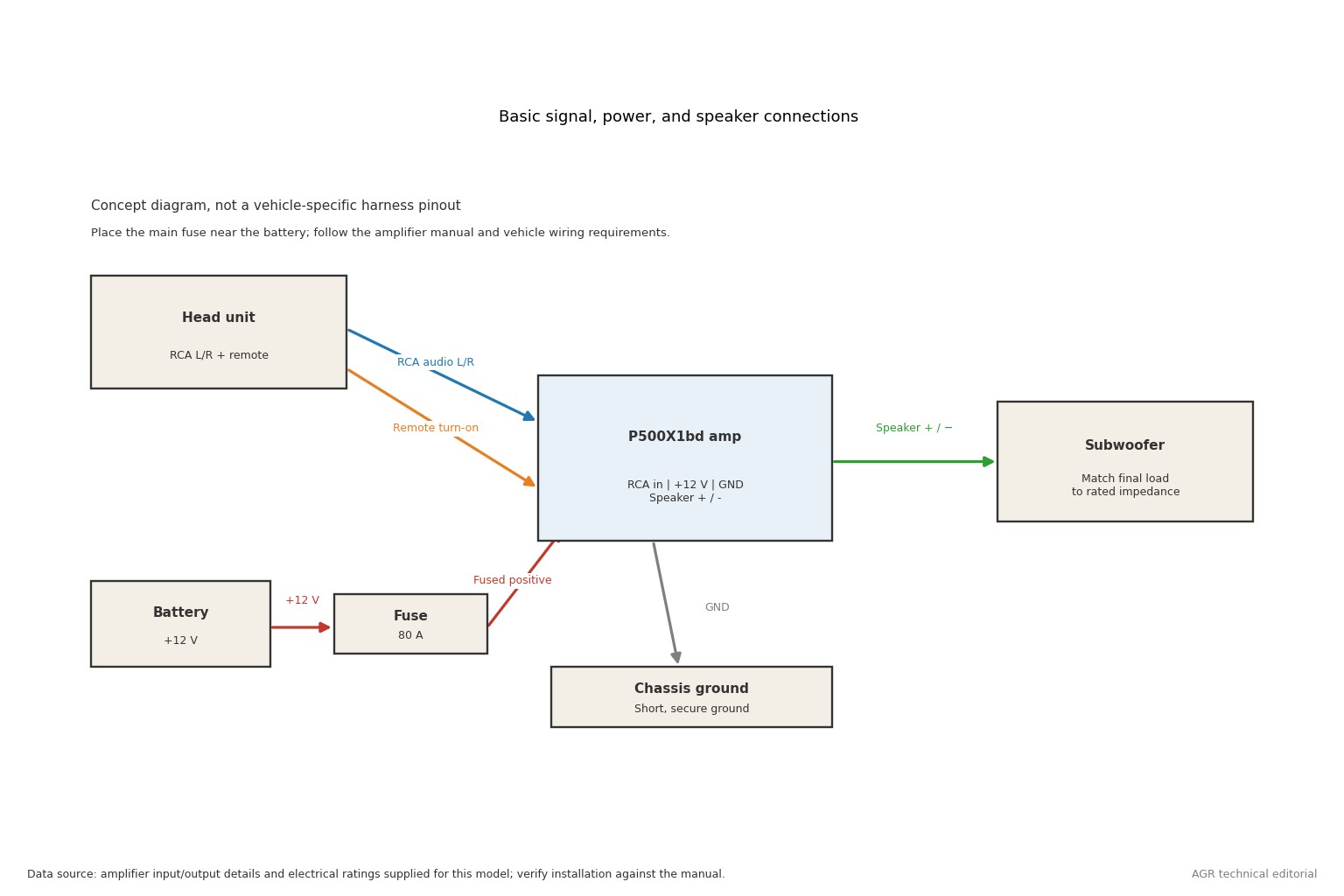
The supplied specification calls for 4 AWG power wiring and an 80 A fuse, which is not included. Fuse selection, cable length, and installation must follow the manual and the requirements of the vehicle; the fuse protects the power cable and must be placed close to the battery's positive terminal. Do not substitute a larger fuse simply to stop nuisance blowing. A fuse that is oversized for the cable may fail to protect the wiring during a fault.
The chassis uses captive C-clamp terminals for power and speaker connections, and the supplied specifications list speaker wire from 8 AWG to 18 AWG. Use an appropriate cable gauge for the terminal, current, cable run, and installation environment. Verify that terminal screws are secure, bare wire strands cannot touch adjacent terminals, and no cable is pinched under a seat bracket or sharp trim.
The suggested alternator figure in the supplied details is 75 A, but it should not be read as a guarantee that any 75 A alternator will support a full vehicle audio system. Headlights, climate controls, engine electronics, other amplifiers, battery condition, idle speed, and factory charging behavior all affect available current. If voltage falls, lights dim, protection activates, or wiring becomes warm, reduce demand and have the installation checked rather than continuing to play at high output.
Mount the amplifier on a solid surface where the heatsink has airflow and the terminals can be reached. Disconnect the battery's negative terminal before wiring, protect the power cable where it passes through metal, secure the cable away from moving parts and heat, and reconnect only after the polarity and connections have been verified. Installation by a qualified car-audio technician is sensible when the charging system, factory radio outputs, or load wiring are unclear.
Rockford Fosgate Punch P500X1BD compared with alternatives
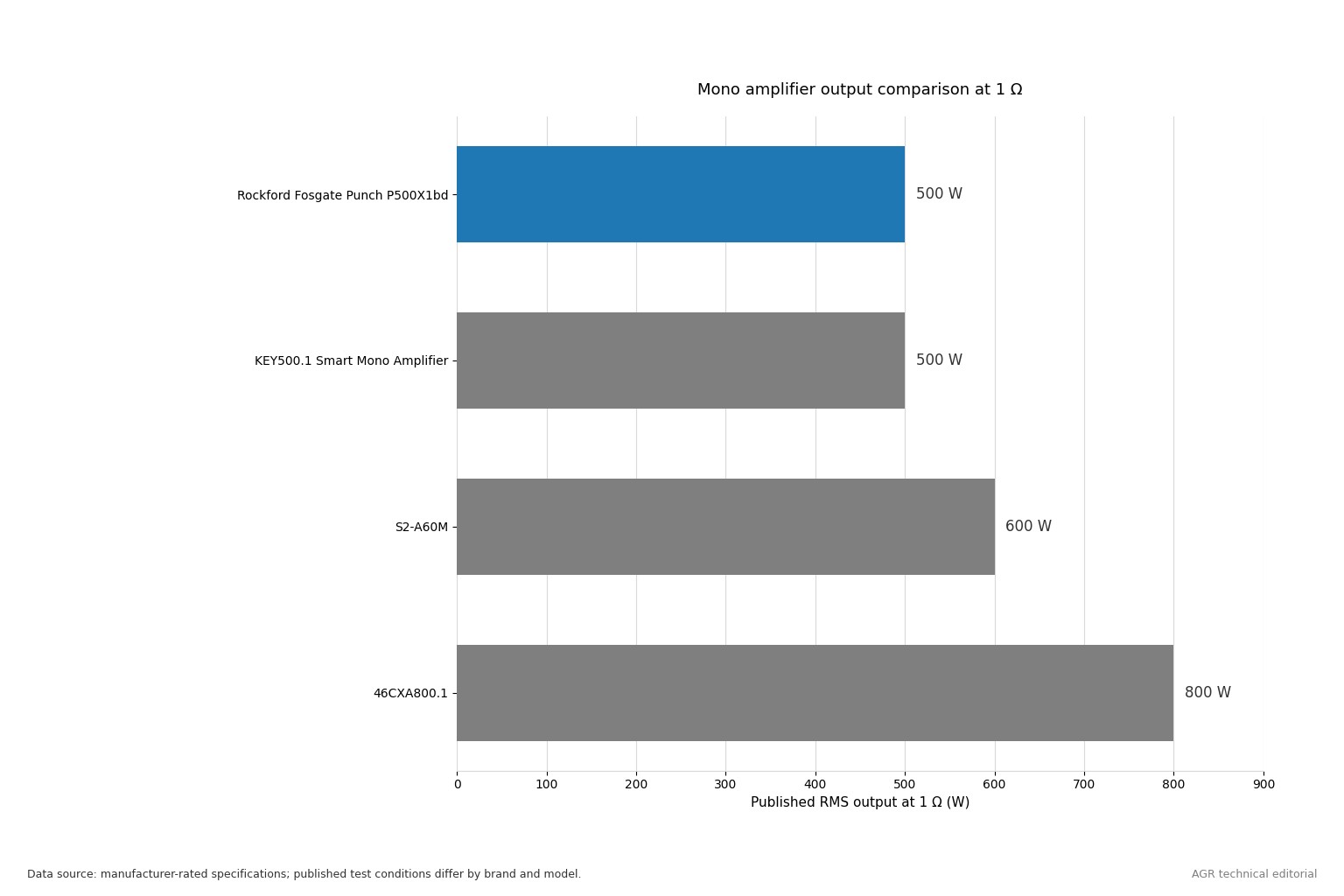
The comparison below uses the KEY500.1 Smart Mono Amplifier, the S2-A60M, and the 46CXA800.1. The first is rated at the same 500-watt maximum at 1 ohm and includes automatic signal tuning; the Alpine model adds 600 watts at 1 and 2 ohms; the higher-output KICKER model is rated for 800 watts at 1 ohm. Each manufacturer publishes its own test conditions, so the figures are useful for buyer screening, not a laboratory head-to-head result.
| Amplifier | Published RMS at 4 Ω / 2 Ω / 1 Ω | Distinctive detail | Best reason to consider it |
|---|---|---|---|
| Rockford Fosgate Punch P500X1bd | 150 / 300 / 500 W | Class-BD, C.L.E.A.N. setup, Punch EQ, RCA pass-through | Existing system match and familiar controls |
| KEY500.1 Smart Mono Amplifier | 150 / 300 / 500 W | Compact design, DSP auto-EQ, high-level input range up to 40 V | Factory-radio integration and automatic tuning in a smaller chassis |
| S2-A60M | 330 / 600 / 600 W | Class D, selectable turn-on modes, 10-400 Hz frequency response | More rated output at 2 Ω in a smaller chassis |
| 46CXA800.1 | 300 / 600 / 800 W | Class D, variable crossover, subsonic filter, bass boost | Higher power ceiling for a system that needs more than 500 W |
On paper, the KEY500.1 is the closest power match. Its main differentiator is signal processing and a compact form factor, while the Punch relies on its C.L.E.A.N. gain setup, adjustable crossover, and Punch EQ. The Alpine offers more rated power at both 2 ohms and 1 ohm, and the 46CXA800.1 moves further up the power ladder. Higher power is only an advantage when the subwoofer, enclosure, electrical system, and budget call for it.
The P500X1bd's dimensions are about 11 inches long, while the cited alternatives are shorter. Measure the actual mounting space and allow for wiring exits before choosing based on chassis size alone. Also compare remote controls and high-level integration: features such as automatic EQ or selectable turn-on can reduce installation work in some cars, but they do not replace correct gain setting, load calculations, or safe wiring.
Who should buy it, and who should skip it
The P500X1bd makes the most sense for a buyer whose subwoofer setup is designed for 150 watts at 4 ohms, 300 watts at 2 ohms, or up to 500 watts at 1 ohm, and who values its particular controls or is matching existing equipment. It is also relevant when a factory or aftermarket source needs high-level signal compatibility and the installer wants RCA pass-through for a larger system.
Buyers who need more than 500 watts RMS should compare a higher-output amplifier rather than expect Punch EQ to deliver a substitute for rated power. Those who want automatic signal equalization in the amplifier may prefer the KEY500.1. A buyer with very limited mounting space should also prioritize a compact model, and anyone whose planned subwoofer wiring produces less than the amplifier's minimum supported load should choose a different wiring arrangement or amplifier.
Before purchase, verify the exact model number on the unit and box, the included wiring adapters and remote-control options, the warranty terms for the seller and country, and the return policy. Used examples or units sold without original packaging deserve an extra check for terminal damage, corrosion, evidence of overheating, missing hardware, and a matching serial/model label. Do not assume an optional remote or a wiring kit is included just because an accessory is pictured on a product page.
Price and pre-purchase checks
The review price for the Rockford Fosgate Punch P500X1bd is $429.99 USD, based on non-Amazon retail references. At this price, its value depends on whether the 1-ohm-rated output, high-level signal acceptance, pass-through outputs, and familiar control layout suit the planned system. Alternatives with integrated DSP or a higher power rating can be more useful for a new installation, depending on the subwoofer load and the signal source.
Prices change often, so check the current listing. Before comparing price tags, make sure the models are being compared at the same final impedance and using continuous RMS output, not peak, dynamic, or total-power labels. Confirm whether a separate bass remote, signal adapter, amplifier wiring kit, and installation labor are required. Those items can change the system cost more than a small difference in amplifier price.
The Rockford Fosgate Punch P500X1BD product listing is one way to check the exact model number and package details before ordering. Warranty coverage depends on the applicable manufacturer terms and seller documentation, so the exact invoice, regional warranty, and product variant should be checked before purchase.
Rating and score explanation
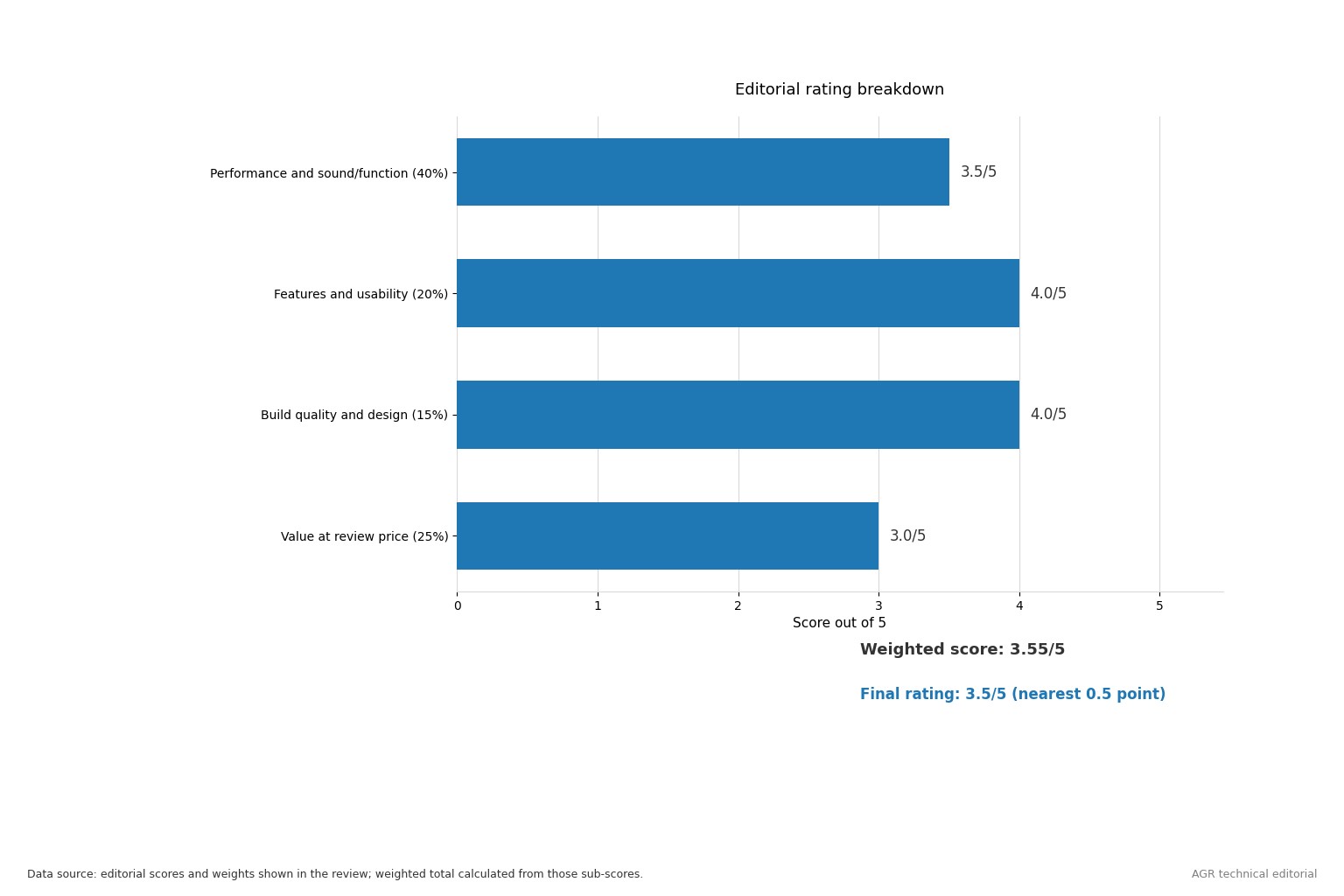
The overall score balances published output and useful setup options against price and the lack of independent measurements. Performance receives 40% of the result, features 20%, build and design 15%, and value 25%. The sub-scores below use a conservative scale; they are not measurements of sound quality or reliability.
| Area | Score | Weight | Weighted points |
|---|---|---|---|
| Performance and sound/function | 3.5/5 | 40% | 1.40 |
| Features and usability | 4.0/5 | 20% | 0.80 |
| Build quality and design | 4.0/5 | 15% | 0.60 |
| Value at review price | 3.0/5 | 25% | 0.75 |
| Weighted result | 3.55/5 | 100% | 3.55 |
The weighted value is 3.55 out of 5. Rounding to the nearest half-point gives 3.5/5 because 3.55 is closer to 3.5 than to 4.0. The features score reflects the combination of C.L.E.A.N. setup, high-level inputs, pass-through outputs, filters, and bass EQ; the value score is lower because similar RMS output is available in a compact alternative with added DSP features. Our research score is based on the rated figures and documented details above.
Sources and further reading
- Manufacturer model coverage and setup documentation: 2013 Punch amplifiers owner's manual index.
- Model pricing and retailer-published specifications: Crutchfield product specifications and review.
- Current retailer product details, prior model lineage, and rated output: Sonic Electronix product reference.
- Manufacturer-rated power, dimensions, crossover, input range, and warranty for a compact DSP comparator: KEY500.1 Smart Mono Amplifier specifications.
- Installation safety, specifications, and setup features for the same compact alternative: KEY500.1 owner's manual.
- Manufacturer-rated output and size for a 600-watt alternative: S2-A60M technical specifications.
- RMS power conditions, filters, dimensions, and current draw for a higher-output alternative: 46CXA800.1 manufacturer's specification sheet.
- How advertised prices are presented for products in the manufacturer's lineup: Rockford Fosgate pricing guidance.
Rockford Fosgate Punch P500X1BD: Frequently Asked Questions
How much RMS power does the Rockford Fosgate Punch P500X1bd produce?
The supplied specifications rate it at 150 W RMS into 4 ohms, 300 W into 2 ohms, and 500 W into 1 ohm. The final impedance depends on how the subwoofer voice coils are wired.
Is the P500X1bd stable at 1 ohm?
Yes, its published rated output includes 500 W RMS at 1 ohm. Confirm the total load from all connected voice coils before powering the system.
Can it accept a factory radio signal?
The published input sensitivity range is 150 mV to 12 V, and the model is described as accepting high- and low-level signals. Check the owner's manual for the correct adapter and turn-on method for the specific factory system.
Does it include an RCA output for another amplifier?
Yes, the supplied specifications list one pair of low-level RCA pass-through outputs. This can send signal onward to another amplifier but does not add speaker channels to the P500X1bd.
What are the crossover settings?
The low-pass filter is adjustable from 50 to 250 Hz at 12 dB per octave. The supplied data lists an infrasonic filter at 28 Hz with a 12 dB-per-octave slope.
What fuse and power wire does it require?
The supplied specifications call for an 80 A fuse and 4 AWG power wiring; the fuse is not included. Follow the exact manual and vehicle wiring requirements, including placing the main fuse close to the battery.
Is the KEY500.1 a comparable alternative?
It has the same published 150 W, 300 W, and 500 W RMS ratings at 4, 2, and 1 ohm respectively, and it adds automatic signal tuning in a more compact chassis. Its manufacturer test conditions should still be checked before treating the models as directly equivalent.
What price should buyers use for comparison?
The review price used here is $429.99 USD from non-Amazon retail references. Prices change often, so confirm the current price, seller terms, model number, and warranty before purchasing.