Rockford Fosgate · R2-250X1
Rockford Fosgate R2-250X1 Review: A Practical 250W Mono Amp
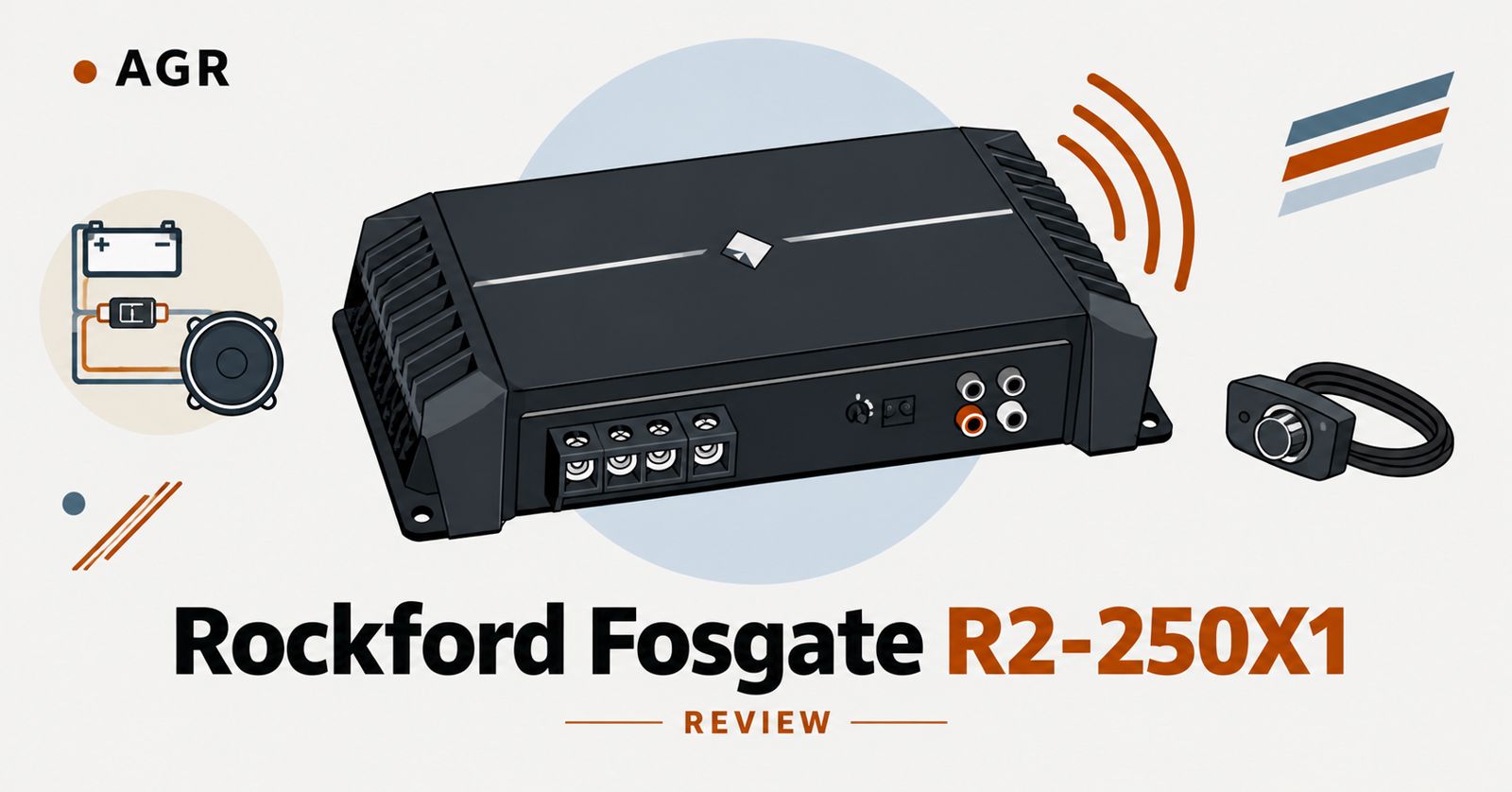
The Rockford Fosgate R2-250X1 delivers 150 W RMS at 4 ohms or 250 W at 2 ohms, with adjustable filters, Punch EQ, high-level inputs, and a wired level remote.
Pros
- 150 W RMS at 4 Ω and 250 W RMS at 2 Ω, with a published 2 Ω minimum load
- Low-pass crossover adjustable from 50 to 250 Hz at 12 dB per octave
- Infrasonic filter adjustable from 15 to 40 Hz at 12 dB per octave
- Punch EQ adjustable from 0 to +18 dB at 45 Hz
- RCA and speaker-level input options, plus RCA pass-through outputs
- Wired remote level controller and C.L.E.A.N. gain indicators are documented features
Cons
- Not rated for a 1 Ω load and not bridgeable
- 250 W RMS maximum at 2 Ω is below the output ratings of the compared alternatives
- No independent lab measurements were located for this model
- External fuse, wiring, and installation hardware are not included
- Up to +18 dB Punch EQ can consume headroom rather than create additional clean power
Specifications
| Amplifier Class | Class D |
|---|---|
| Channels | 1 (mono) |
| External Fuse Recommendation | 50 A, not included |
| Frequency Response | 20 Hz to 250 Hz |
| Infrasonic Filter | 15 Hz to 40 Hz, 12 dB/octave Butterworth |
| Input Sensitivity | Low-level 150 mV to 4 V; high-level 450 mV to 12 V |
| Inputs | One RCA pair or one 4-pin speaker-level harness |
| Low-Pass Crossover | 50 Hz to 250 Hz, 12 dB/octave Butterworth |
| Minimum Rated Load | 2 Ω |
| Model | R2-250X1 |
| Operating Voltage | 9 to 16 V DC |
| Pass-Through Outputs | One RCA pair |
| Punch EQ | 0 to +18 dB at 45 Hz |
| Rated RMS Output at 2 Ω | 250 W × 1 at 14.4 V |
| Rated RMS Output at 4 Ω | 150 W × 1 at 14.4 V |
| Warranty | 1-year manufacturer warranty |
Verdict
The Rockford Fosgate R2-250X1 suits a single subwoofer that needs up to 250 W RMS at 2 Ω or 150 W RMS at 4 Ω. Its strengths are adjustable infrasonic and low-pass filters, C.L.E.A.N. gain indicators, Punch EQ, a wired level remote, and high-level input support. Its 2 Ω minimum load and modest output limit its usefulness for power-hungry subs. Crutchfield lists it at $249.99 USD, so compare higher-output competitors before paying that amount.
The Rockford Fosgate R2-250X1 is worth considering for a modest single-subwoofer system that needs a known, restrained amount of power rather than a 500-watt-plus upgrade. Its published rating is 250 W RMS at 2 Ω and 150 W RMS at 4 Ω, and it combines RCA and speaker-level input options with a wired level remote. This Rockford Fosgate R2-250X1 review weighs those verified specifications against installation needs, alternative amplifiers, and a listed price of $249.99 USD. The manufacturer still lists the model in its amplifier catalog; research did not confirm a direct successor.
As an Amazon Associate I earn from qualifying purchases; affiliate links on this page never affect the ratings.
Rockford Fosgate R2-250X1 design and build
The R2-250X1 is a single-channel, Class-D amplifier intended for subwoofer duty. Its modest output rating is a useful fit for compact systems that do not need to drive a high-power subwoofer at low impedance. Class-D designs are generally a sensible choice when space and electrical efficiency matter, but an amplifier's class by itself does not establish a precise efficiency figure. No verified efficiency percentage for this model is used here.
The supplied manufacturer dimensions are 1.9 × 6.8 × 8.1 inches (H × W × D). Crutchfield presents a slightly different envelope of about 2 × 8-1/8 × 7-3/4 inches, likely reflecting different measurement conventions or product-card data. The numbers are close but not identical, so use the manufacturer's manual drawing and leave room for cable bends and airflow rather than cutting a mounting opening from a retailer's dimensions alone. The manual-based specification describes convection cooling rather than a fan, so the installation should not bury the heatsink in carpet or box it into a sealed pocket.
Mount the chassis on a firm surface away from water, direct heat, moving parts, and loose cargo. The space around the terminals matters as much as the chassis footprint: power, ground, speaker, input, and remote connections all need safe cable routing. Hardware and wiring are not a substitute for checking the exact vehicle layout before drilling.
Rockford Fosgate R2-250X1 features and controls
The core attraction is a useful set of adjustments for a dedicated subwoofer channel. The low-pass crossover varies from 50 to 250 Hz at 12 dB per octave, while the infrasonic filter varies from 15 to 40 Hz at the same slope. The first helps limit high frequencies sent to the subwoofer; the second can reduce very low frequencies that a particular driver or enclosure should not be asked to reproduce. A starting point should come from the subwoofer and enclosure guidance, not a universal knob position.
Punch EQ provides up to +18 dB centered at 45 Hz. That is a wide adjustment range, but maximum boost is not free output: a large bass boost uses amplifier headroom and can make clipping or excessive subwoofer excursion more likely. Start with the boost at minimum, match gain to the source, and add only a restrained amount if the rest of the system has headroom.
Rockford Fosgate's C.L.E.A.N. setup indicators are intended to help set input gain without turning the gain knob into a general volume control. The amplifier also includes a wired remote level control, useful when a track or cabin condition calls for less subwoofer output. The remote adjusts level, not crossover frequency or amplifier power capacity. The model offers one RCA input pair or a four-pin speaker-level harness, plus RCA pass-through outputs to feed another amplifier. For a closer look at the exact model and package, review the R2-250X1 product listing and verify its included accessories before purchase.
Rockford Fosgate R2-250X1 performance: what the ratings can and cannot tell you
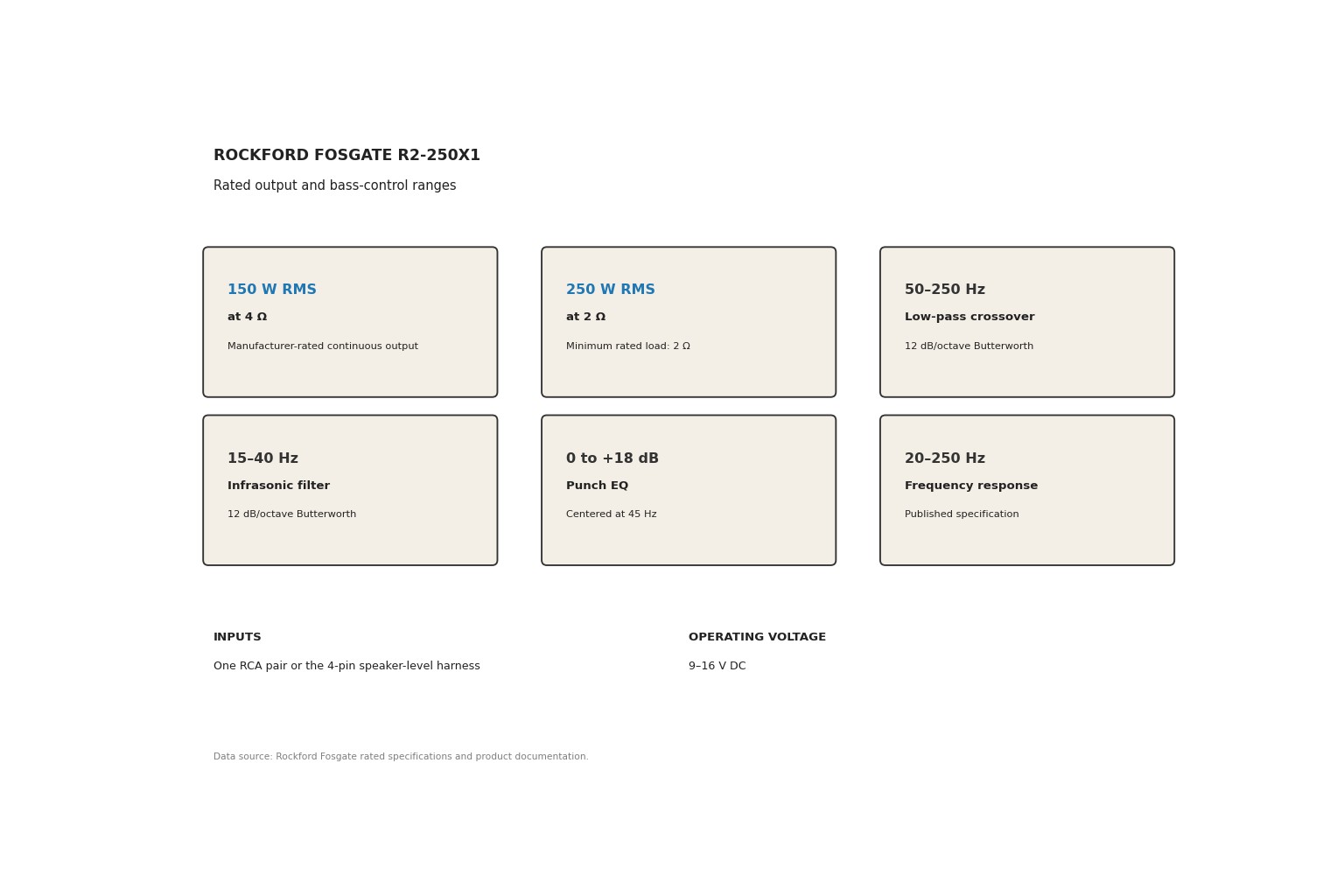
At 14.4 V, Rockford Fosgate rates the R2-250X1 at 150 W RMS into 4 Ω and 250 W RMS into 2 Ω. The 2 Ω rating is about 1.67 times the 4 Ω wattage. Expressed as a simple power ratio, that corresponds to about 2.22 dB more electrical output, calculated as 10 log10(250/150). It is not a promise of a 2.22 dB increase in cabin sound pressure: enclosure response, the subwoofer's sensitivity, its impedance curve, vehicle acoustics, and how each system is set up all matter.
The key limit is the 2 Ω minimum rated load. This is not a 1 Ω-stable mono amplifier, and it is not bridgeable. A single 2 Ω subwoofer can be compatible if its power rating suits the amp. A 4 Ω load is also supported at the lower 150 W RMS rating. With dual-voice-coil drivers or multiple subwoofers, calculate the final wired impedance from the exact voice-coil configuration before buying. Two 4 Ω single-voice-coil drivers in parallel produce a 2 Ω load; other combinations can land below the amp's limit.
Our research found no independent lab measurements for this model. The available performance assessment is therefore limited to the published output ratings, stated frequency response of 20 to 250 Hz, and listed distortion specification below 1% at the stated 2 Ω and 4 Ω loads. Those details support a sensible compatibility check, but they do not establish measured efficiency, noise, clipping behavior, or response under a particular subwoofer load.
For this power class, the sensible target is cleanly matched output rather than using bass boost to compensate for a poorly chosen enclosure or a subwoofer that needs more power. A 250 W RMS rating can be appropriate for a moderate single-sub setup; it is a poor fit if the plan is to extract the full rated power from a subwoofer that requires 500 to 800 W RMS. An amplifier with a higher wattage rating does not automatically sound better, but it may provide more usable output when the driver is designed for it.
Rockford Fosgate R2-250X1 installation and compatibility
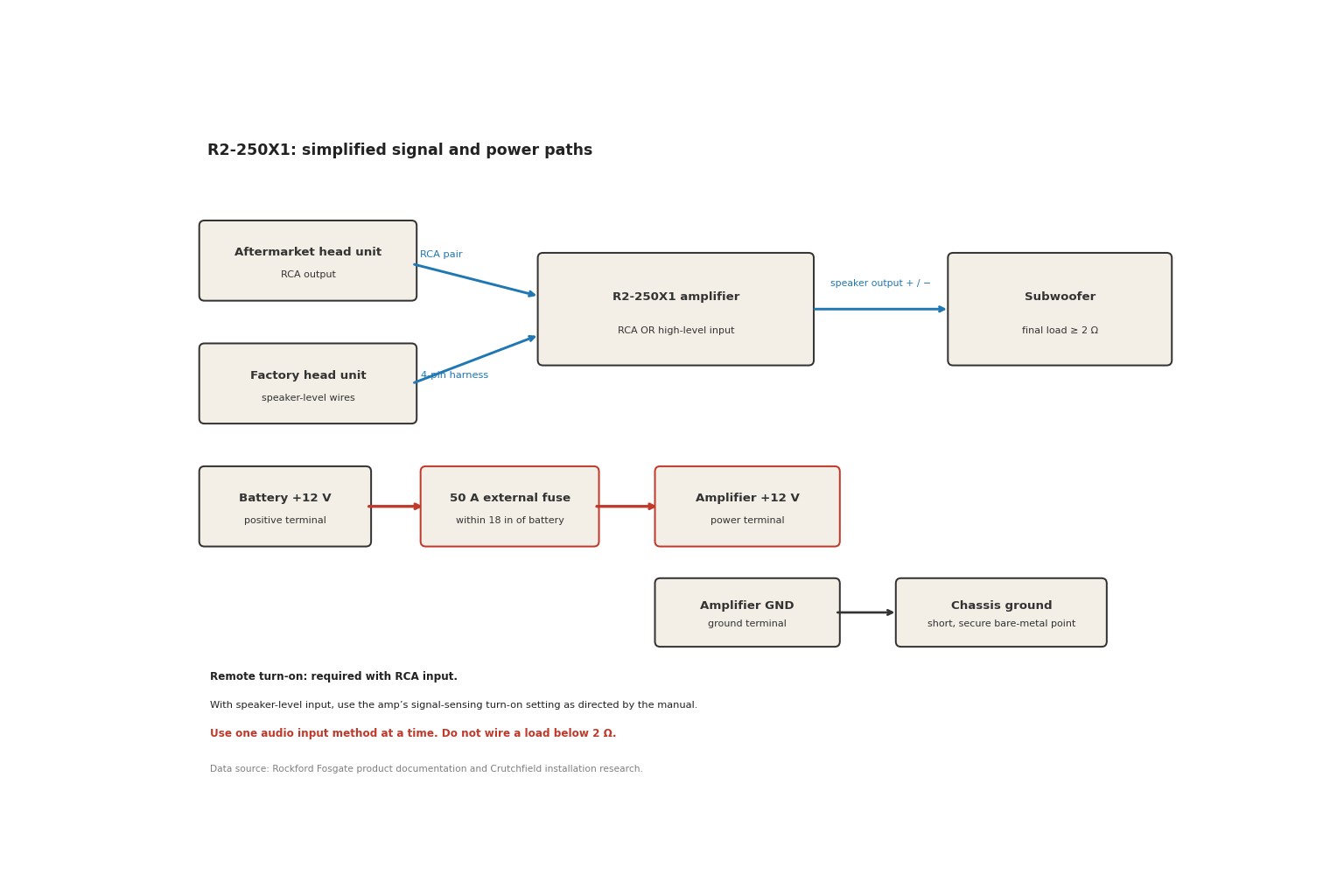
Signal integration is fairly flexible. With an aftermarket receiver, use the RCA input pair and connect the receiver's remote turn-on lead to the amplifier. With a factory radio, the included high-level harness can accept speaker-level signal; follow the manual's signal-sensing turn-on instructions for this input method. Crutchfield's installation notes say not to connect the RCA input jacks when the speaker-level harness is in use, so treat them as alternative input paths rather than simultaneous inputs.
Power wiring deserves more care than the small chassis might suggest. Crutchfield reports a 50 A external fuse requirement and recommends placing the fuse within 18 inches of the battery. The fuse should protect the power cable near its source, not simply sit beside the amplifier. The supplied product information lists 4 AWG in its power-wire specification, while Crutchfield recommends 8-gauge power and ground leads and says the terminal can accommodate larger cable. Those are not necessarily contradictory: terminal capacity, recommended cable size, run length, and the fuse determine different parts of the installation. Confirm the latest manual's cable guidance for the planned route instead of assuming a single gauge is always correct.
Disconnect the battery negative terminal before wiring, protect cables where they pass through metal, secure the ground to clean chassis metal, and keep the fuse close to the battery. Check polarity at the speaker terminals and avoid a load below 2 Ω. If the vehicle has a factory amplifier, noise-cancelling system, stop-start behavior, or nonstandard speaker outputs, confirm the integration approach first. Professional installation is prudent where safe routing, grounding, or signal detection is uncertain.
How the Rockford Fosgate R2-250X1 compares
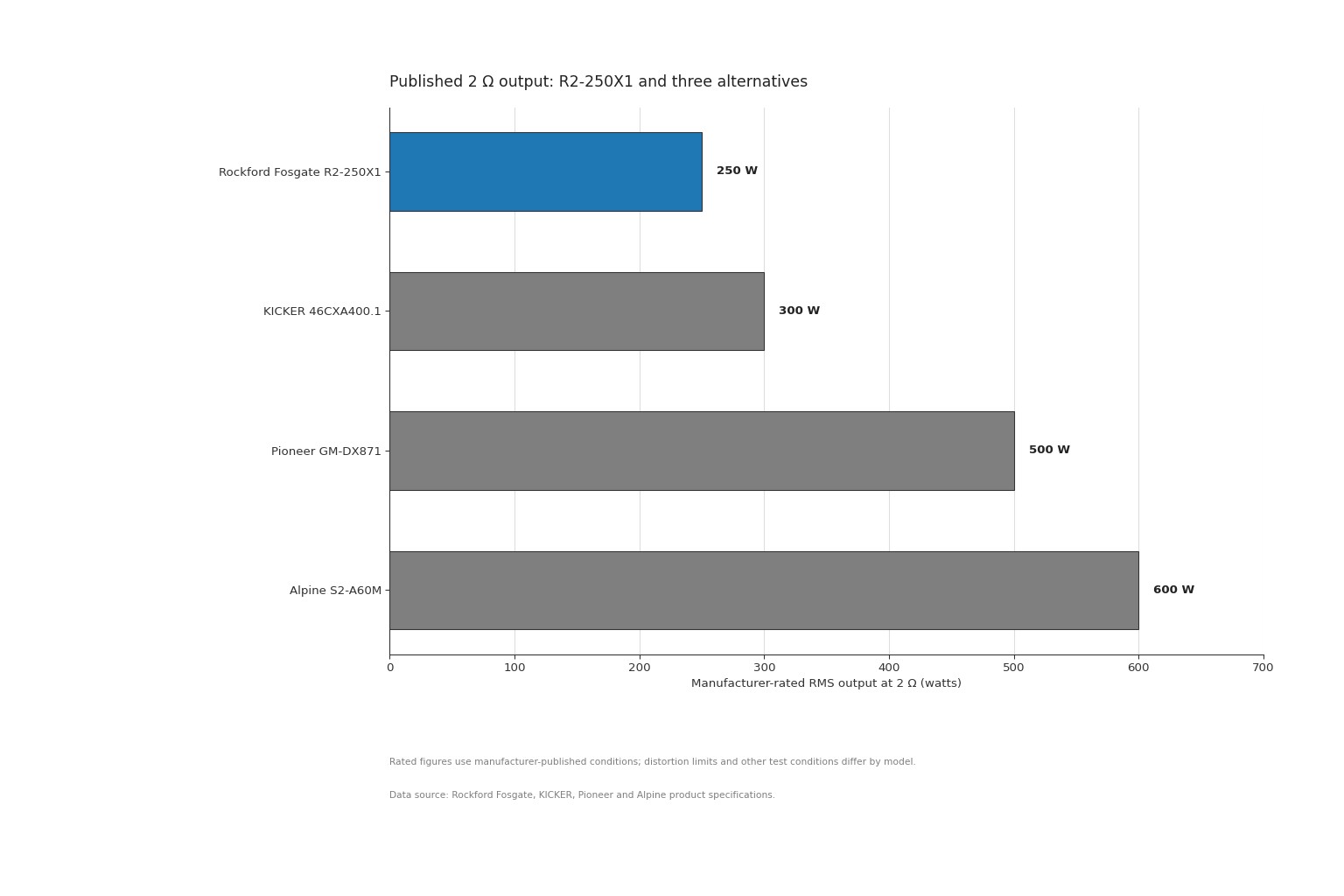
The most relevant alternatives are KICKER 46CXA400.1, Pioneer GM-DX871, and Alpine S2-A60M. KICKER rates its model at 300 W RMS into 2 Ω with 1 Ω support; Pioneer rates the GM-DX871 at 500 W RMS into 2 Ω and 800 W at 1 Ω; Alpine rates the S2-A60M at 600 W RMS into both 1 Ω and 2 Ω. Manufacturer distortion limits and measurement conditions are not identical, so use these figures as published rating comparisons, not as the results of a controlled, same-bench test.
| Model | RMS at 4 Ω | RMS at 2 Ω | RMS at 1 Ω | Load implication |
|---|---|---|---|---|
| Rockford Fosgate R2-250X1 | 150 W | 250 W | Not rated | 2 Ω minimum |
| KICKER 46CXA400.1 | 150 W | 300 W | 400 W | Supports 1 Ω |
| Pioneer GM-DX871 | 300 W | 500 W | 800 W | Supports 1 Ω |
| Alpine S2-A60M | 330 W | 600 W | 600 W | Supports 1 Ω |
The chart shows why the Rockford is a better match for a modest load than for a future high-output build. At 2 Ω it is 50 W below the KICKER's published rating, 250 W below the Pioneer, and 350 W below the Alpine. Those are arithmetic differences between published numbers, not guaranteed differences in perceived loudness. The additional headroom of the alternatives matters only if the subwoofer, enclosure, wiring, electrical system, and tuning can use it safely.
The R2-250X1's advantage is its combination of gain setup lights, a usable infrasonic filter, up to +18 dB of bass EQ, a wired level remote, and pass-through outputs. All three alternatives also have subwoofer-oriented filtering and a remote or remote option, but their power and low-impedance flexibility may make more sense if the system might grow. Buy based on the subwoofer's RMS requirement at its actual final impedance, not simply the model's headline wattage.
Who should buy the Rockford Fosgate R2-250X1?
It makes sense for a buyer whose subwoofer is rated to work with 150 W RMS at 4 Ω or up to 250 W RMS at 2 Ω, who wants a dedicated mono amp, and who values front-seat level control. The high-level input option can help integrate a factory head unit without RCA pre-outs, provided the chosen turn-on setup is supported by the vehicle and the manual. It is also a reasonable short list candidate when the amp needs to fit into a compact installation and the owner does not need 1 Ω operation.
Skip it if the driver needs 400 W RMS or more to reach the intended output, if the planned final load is 1 Ω, or if you want a DSP with app-based time alignment and parametric EQ. Also skip it if the price approaches higher-output amplifiers with better headroom for the same build plan. The included controls are useful but they are not a substitute for DSP, and the +18 dB Punch EQ should not be counted as extra clean power.
Rockford Fosgate R2-250X1 price and pre-purchase checks
Crutchfield lists the R2-250X1 at $249.99 USD. At that price, the case for buying is strongest when the power ceiling matches the system and the available controls solve a real installation need. A buyer who values maximum output per dollar should compare the R2-250X1 directly with higher-rated alternatives before committing, especially because one option in this comparison is listed by its manufacturer near the same price range.
Prices change often, so check the current listing.
Before purchase, verify the exact R2-250X1 model number rather than an older similarly named Prime amplifier, confirm the final subwoofer impedance, and check the warranty terms for the seller and region. Confirm that the wired remote, high-level harness, mounting hardware, and manual are included in the package being sold. Wiring and external fuse hardware are not included, so budget for power cable, ground cable, fuse holder, appropriate fuse, signal cable or speaker-wire adapter, and installation supplies. Check cable length and the vehicle's routing path before choosing a wiring kit.
Check the Rockford Fosgate R2-250X1 product page for the exact listing details, then compare the stated package and warranty with the retailer you intend to use. A model page can describe the amplifier family generally, so the model number on the product, box, and paperwork should match.
Rating breakdown for the Rockford Fosgate R2-250X1
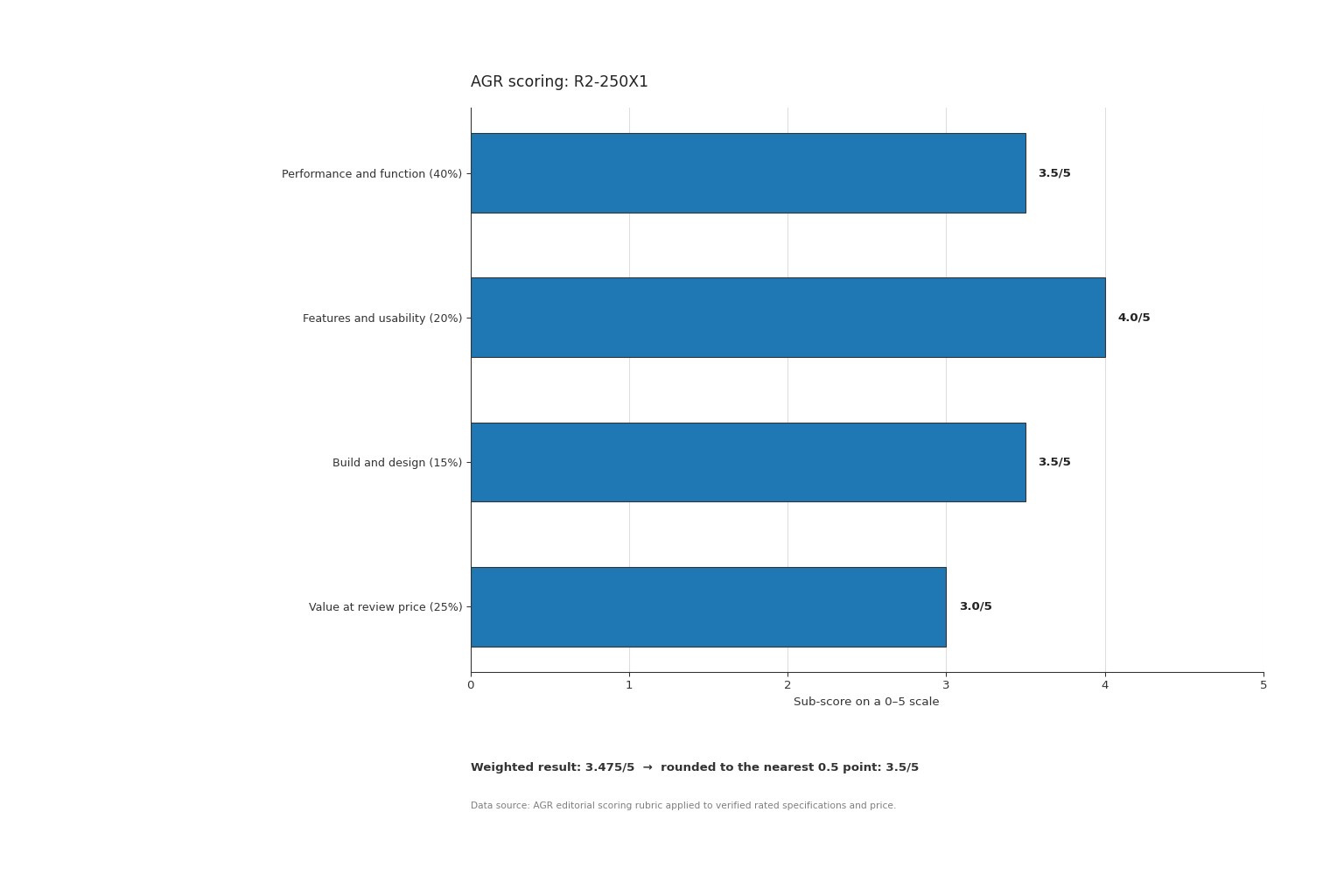
The score favors sound/function only to the extent the published output suits the intended use. Features score well because the amp supplies both input types, adjustable low-pass and infrasonic filters, gain indicators, a wired remote, and RCA pass-through. Build and design are assessed from the documented compact Class-D layout and specified connections, not from an unverified durability claim. Value is the weakest category because $249.99 buys a 250 W RMS-at-2 Ω amplifier while compared models publish more power at similar or somewhat higher manufacturer prices.
| Scoring area | Weight | Sub-score | Weighted contribution |
|---|---|---|---|
| Performance and sound/function | 40% | 3.5/5 | 1.400 |
| Features and usability | 20% | 4.0/5 | 0.800 |
| Build quality and design | 15% | 3.5/5 | 0.525 |
| Value at the review price | 25% | 3.0/5 | 0.750 |
| Total | 100% | Weighted result: 3.475/5 | Final: 3.5/5 |
Our research score is based on the rated figures and documented details above. The weighted result is 3.475 out of 5; rounded to the nearest half-point, that becomes 3.5/5. The rating reflects a capable feature set in a defined power class, balanced against the strict 2 Ω load limit and the price of more powerful alternatives.
Sources and further reading
- Rockford Fosgate amplifier catalog, model listing and amplifier-family context.
- Rockford Fosgate R2 amplifier owner's-manual page, model coverage and installation-manual access.
- Crutchfield product research for the R2-250X1, control ranges, inputs, wiring notes, package details, and a second price reference.
- KICKER 46CXA400.1 white paper, rated output, load support, crossover, dimensions, and input range.
- Pioneer GM-DX871 official product page, published output ratings, input support, and product price.
- Alpine S2-A60M official product page, manufacturer-rated power and principal features.
- Crutchfield product research for the Alpine alternative, power ratings, dimensions, wiring recommendations, and price cross-check.
Rockford Fosgate R2-250X1 - Frequently asked questions
How much power does the Rockford Fosgate R2-250X1 make?
Rockford Fosgate rates it at 150 W RMS into 4 Ω and 250 W RMS into 2 Ω at 14.4 V. Match the relevant rating to the subwoofer’s final wired impedance and RMS requirements.
Can the R2-250X1 run a 1-ohm subwoofer load?
No 1 Ω output rating is specified, and the published minimum rated load is 2 Ω. Do not wire the final load below 2 Ω; choose a model rated for 1 Ω if that is the target configuration.
Can it connect to a factory stereo?
It has a four-pin speaker-level input harness as well as RCA inputs. Follow the manual’s signal-sensing turn-on directions for high-level input and do not connect the RCA input jacks at the same time.
What filters are built in?
The low-pass filter is variable from 50 to 250 Hz at 12 dB per octave, and the infrasonic filter is variable from 15 to 40 Hz at 12 dB per octave. Set them based on the subwoofer and enclosure specifications.
Does it include a remote bass control?
Crutchfield’s package notes list a wired remote level-control module and a 16-foot cable. Confirm the accessory list with the seller, especially if considering an open-box or bundle listing.
What fuse does the R2-250X1 need?
Crutchfield’s product research specifies a 50 A external fuse and recommends locating it within 18 inches of the battery. The fuse and wiring hardware are not included, so verify the installation instructions and select a suitable cable and holder.
Is $249.99 a good price for this amplifier?
Crutchfield lists the R2-250X1 at $249.99 USD. It can make sense when 250 W RMS at 2 Ω is enough and its controls fit the installation, but buyers who need more power should compare higher-rated alternatives before spending at this level.
Is the R2-250X1 discontinued or replaced?
The model remains listed in Rockford Fosgate’s amplifier catalog and has an official R2-series manual page. This research did not confirm a direct successor, so the safest description is that no successor was verified.