Rockford Fosgate · T1000-1bdCP
Rockford Fosgate T1000-1bdCP Review: Strong Output, High Demands
The Rockford Fosgate T1000-1bdCP delivers 700 W at 4 Ω and 1,000 W at 1 or 2 Ω, with Class-BD design, adjustable filters, and substantial wiring needs.
Pros
- Rated 1,000 W RMS at both 1-ohm and 2-ohm loads
- 700 W RMS rated output at 4 ohms
- Adjustable 35 Hz to 250 Hz low-pass crossover with 24 dB/octave slope
- Infrasonic filtering and up to +18 dB Punch EQ at 45 Hz
- RCA pass-through output for signal routing to another amplifier
- Published average efficiency of 85.6% at 4 ohms and 82.1% at 2 ohms
Cons
- Requires a 150 A external fuse and substantial power wiring
- Full-size chassis needs clearance for connections and ventilation
- No dedicated speaker-level input is listed in the published specs
- Optional remote PEQ may need to be purchased separately
- Current reference price is high compared with some similarly rated mono amplifiers
- No independent lab measurements for this exact model were found
Specifications
| Amplifier topology | Class-BD Constant Power |
|---|---|
| Channels | 1 (mono) |
| Dimensions (H x W x D) | 2.14 x 8.14 x 13.66 inches (5.44 x 20.68 x 34.69 cm) |
| Dynamic PowerCube output | 772 W at 4 ohms; 1299 W at 2 ohms; 1395 W at 1 ohm |
| Frequency response | 20 Hz to 250 Hz, ±0.5 dB |
| Infrasonic filter | 12 dB/octave, -3 dB at 28 Hz |
| Low-pass crossover | 35 Hz to 250 Hz, 24 dB/octave Butterworth |
| Operating voltage | 9 to 16 V DC |
| Power wiring | 4 AWG recommended |
| Punch EQ | 0 to +18 dB at 45 Hz |
| RCA connections | 1 RCA pair input; 1 RCA pair pass-through output |
| Rated RMS power at 1 ohm | 1000 W x 1 |
| Rated RMS power at 2 ohms | 1000 W x 1 |
| Rated RMS power at 4 ohms | 700 W x 1 |
| Recommended external fuse | 150 A, not included |
| THD+Noise | <1.0% at 4 ohms, 2 ohms, and 1 ohm |
Verdict
The Rockford Fosgate T1000-1bdCP suits a high-output subwoofer system that needs 700 W RMS at 4 ohms or 1,000 W RMS at 1 or 2 ohms. Its main strengths are load flexibility, adjustable filtering, and RCA pass-through, while the full-size chassis and 150 A fuse requirement raise installation demands. At the $659.99 USD reference price, buyers should compare it with newer 1,000 to 1,200 W alternatives and confirm the correct model suffix and warranty.
The Rockford Fosgate Power T1000-1bdCP is worth considering for a system that needs up to 1,000 watts RMS from a single mono amplifier and can support its electrical demands. Its standout feature is the Class-BD Constant Power design, rated at 700 watts RMS into 4 ohms and 1,000 watts RMS into either 2 or 1 ohm. This Rockford Fosgate T1000-1bdCP review weighs the published output, useful subwoofer controls, installation demands, and its $659.99 USD reference price. The model belongs to the brand's older Power Constant Power amplifier family documented in a 2010 manual set; no direct successor was confirmed.
As an Amazon Associate I earn from qualifying purchases; affiliate links on this page never affect the ratings.
Rockford Fosgate Power T1000-1bdCP design and build
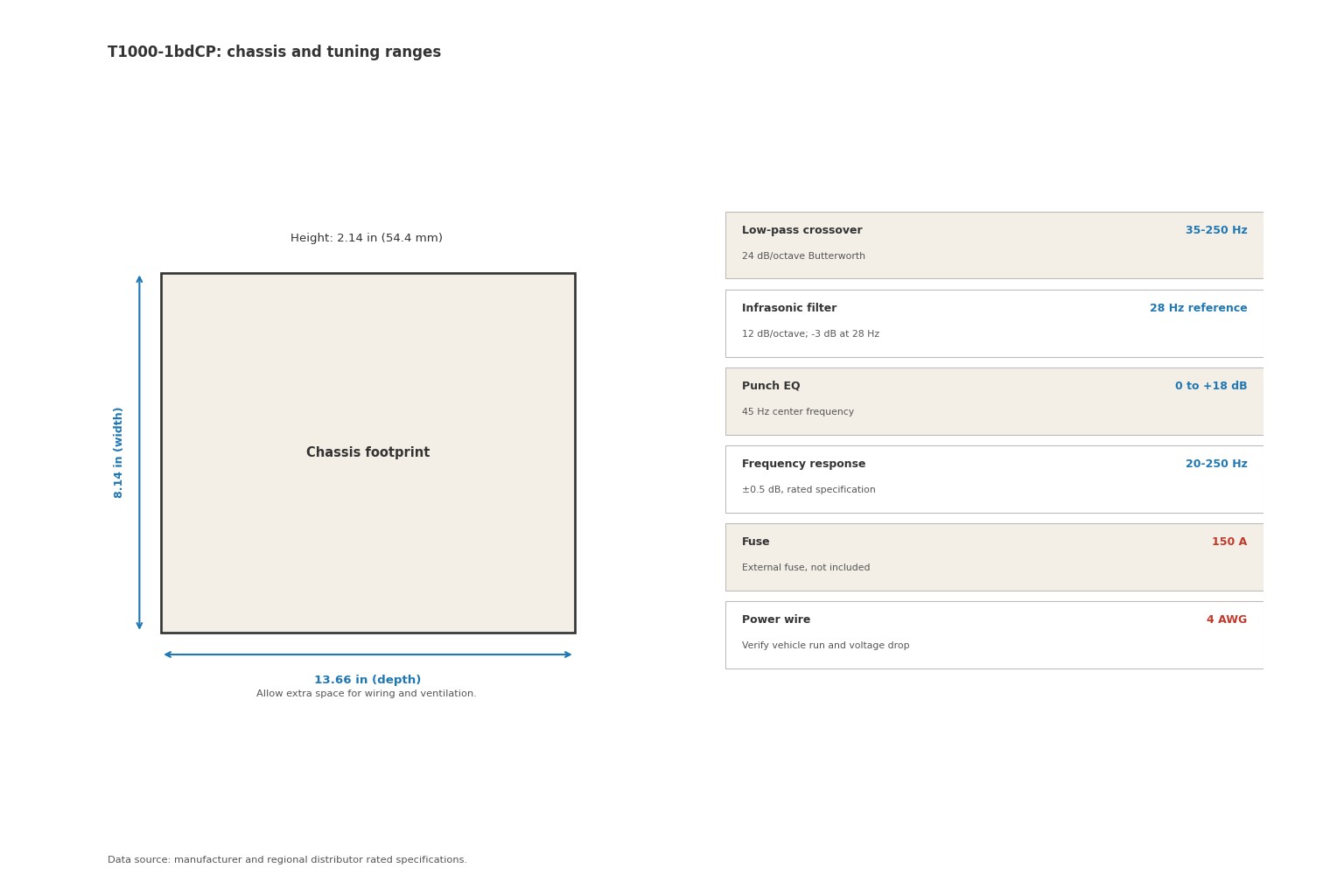
The full-size metal chassis measures 13.66 inches deep, 8.14 inches wide, and 2.14 inches high. That is not a compact under-seat amplifier, and the buyer should leave room for power, ground, speaker, and RCA connections, plus airflow around the heat sink. The model uses convection and heat-sink cooling according to its published details, so the installation should not trap the amplifier in a sealed, insulated pocket.
The exterior layout prioritizes subwoofer power rather than full-range system duties. There is one amplified mono channel, a low-pass crossover, an infrasonic filter, Punch EQ, and RCA pass-through output. It cannot be bridged to create more channels. The published frequency response is 20 Hz to 250 Hz within ±0.5 dB, a range aimed at subwoofer duty rather than a component-speaker system.
Rockford Fosgate's regional product specification page lists the same 700-watt and 1,000-watt output figures, while the company's support library hosts a combined manual set for its older Power Constant Power mono amplifiers. Those documents are a useful starting point for confirming wiring terminals, protection indicators, installation clearances, and model-specific controls before purchase.
Rockford Fosgate Power T1000-1bdCP features and controls
The low-pass crossover adjusts from 35 Hz to 250 Hz with a 24 dB-per-octave Butterworth slope. This gives the installer a broad range for aligning the amplifier with the subwoofer enclosure and the main speakers. The infrasonic section uses a 12 dB-per-octave response with its published -3 dB point at 28 Hz. It can reduce very-low-frequency content that a particular enclosure cannot reproduce safely, but the proper setting depends on the enclosure design and the subwoofer manufacturer's limits.
The built-in Punch EQ offers up to 18 dB of boost at 45 Hz. That is a substantial adjustment, not a free increase in clean output. Large bass boosts use amplifier headroom quickly and can push the amplifier or subwoofer beyond a safe operating range. Begin with boost disabled or low, set gain correctly, and only add boost after checking the subwoofer's excursion and the enclosure's response.
The amplifier has a single RCA input pair and RCA pass-through output. Those connections suit aftermarket head units or processors with preamp outputs, but a factory radio without RCA pre-outs will need a suitable interface. A speaker-level input is not listed in the product's specifications, so a buyer should not assume the amplifier can connect directly to speaker wires from a factory receiver. The optional remote PEQ can provide level adjustment from the front seat and overrides the built-in Punch Bass control; it should not be assumed to be included with every package.
For a deeper look at the amp's published specifications, the Rockford Fosgate T1000-1bdCP product page is one shopping reference, but the model number and included accessories should be checked before ordering.
Rockford Fosgate Power T1000-1bdCP power and performance
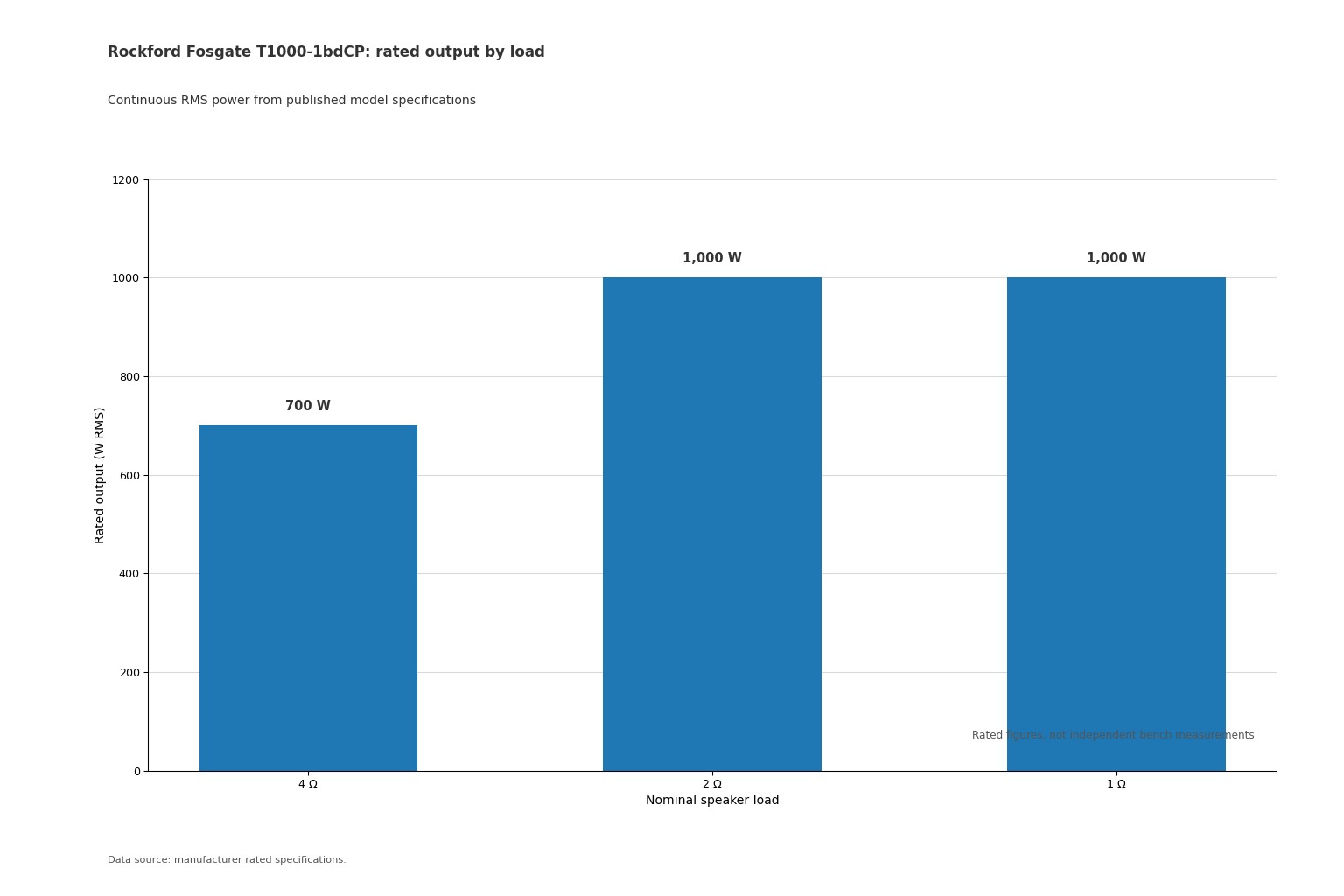
Rated continuous output is 700 watts RMS at 4 ohms, 1,000 watts RMS at 2 ohms, and 1,000 watts RMS at 1 ohm. That load flexibility is the key technical distinction: unlike many mono amplifiers that increase output when the load falls from 2 ohms to 1 ohm, this model is rated for the same 1,000-watt output at those two lower loads. The 4-ohm rating is lower. The manufacturer also publishes dynamic PowerCube figures of 772 watts at 4 ohms, 1,299 watts at 2 ohms, and 1,395 watts at 1 ohm, which are a different specification from continuous RMS power.
The listed average efficiency is 85.6% at 4 ohms, 82.1% at 2 ohms, and 70% at 1 ohm. Using those published efficiency figures and a 13.8-volt supply, the simple current estimate I = output power ÷ (voltage × efficiency) is about 59 A at 700 W into 4 ohms, 88 A at 1,000 W into 2 ohms, and 104 A at 1,000 W into 1 ohm. These are calculated estimates from the rated figures, not a promise about real music draw. The specification also lists a 70 A average music draw and up to 140 A during a 13.8-volt sine-wave condition, so wiring and vehicle power should not be treated as minor details.
Our research found no independent lab measurements for this model. The published data supports a high-output subwoofer application with extensive load flexibility, but it does not establish an independently measured sound signature or verify that an installed system will reach the full rating under every vehicle voltage and thermal condition.
Rockford Fosgate Power T1000-1bdCP installation and electrical demands
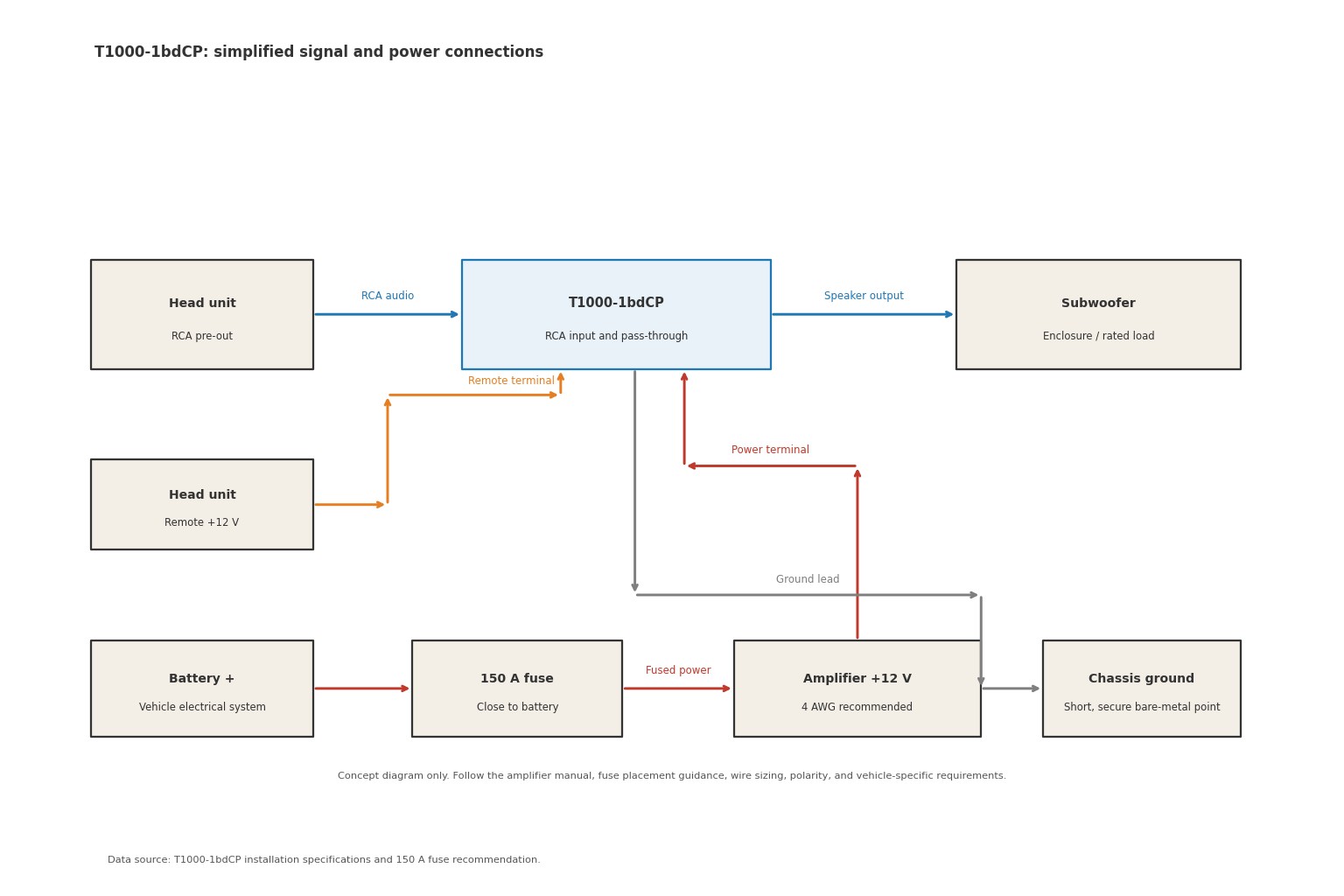
The specification calls for a 150 A external fuse, 4 AWG power wiring, and 8 to 18 AWG speaker wire. The fuse is not included in the amplifier, and the power cable needs protection close to the battery. The ground should use an appropriate short, secure connection to clean vehicle chassis metal. Size all wiring for the actual cable run, expected load, and local installation requirements; undersized wiring can cause voltage drop and heating.
A 150 A fuse rating is a signal to check the whole electrical system, not to install a larger fuse as a fix for a problem. The alternator, battery condition, factory wiring, grounds, and other high-current accessories all affect available voltage. The amp's published operating range is 9 to 16 V DC, but that does not mean sustained operation near the lower limit is desirable. If the vehicle's voltage drops substantially during bass peaks, an installer should diagnose the charging and wiring system rather than simply turning the gain up.
Before powering the system, check the final subwoofer impedance from the voice-coil wiring diagram, verify polarity, confirm the fuse and wire gauges, and set gain using the source unit's clean output level. A 1-ohm load is only appropriate when the subwoofer coils and wiring actually present that nominal load, and every connected subwoofer must stay within its own RMS and excursion limits.
It is a poor choice for a shopper who wants a low-current factory-radio upgrade with no integration hardware, or for a small system whose subwoofer needs only a few hundred watts. For a more elaborate system using this amplifier, the optional remote control and correctly sized wiring should be budgeted separately.
How the T1000-1bdCP compares with other mono amplifiers
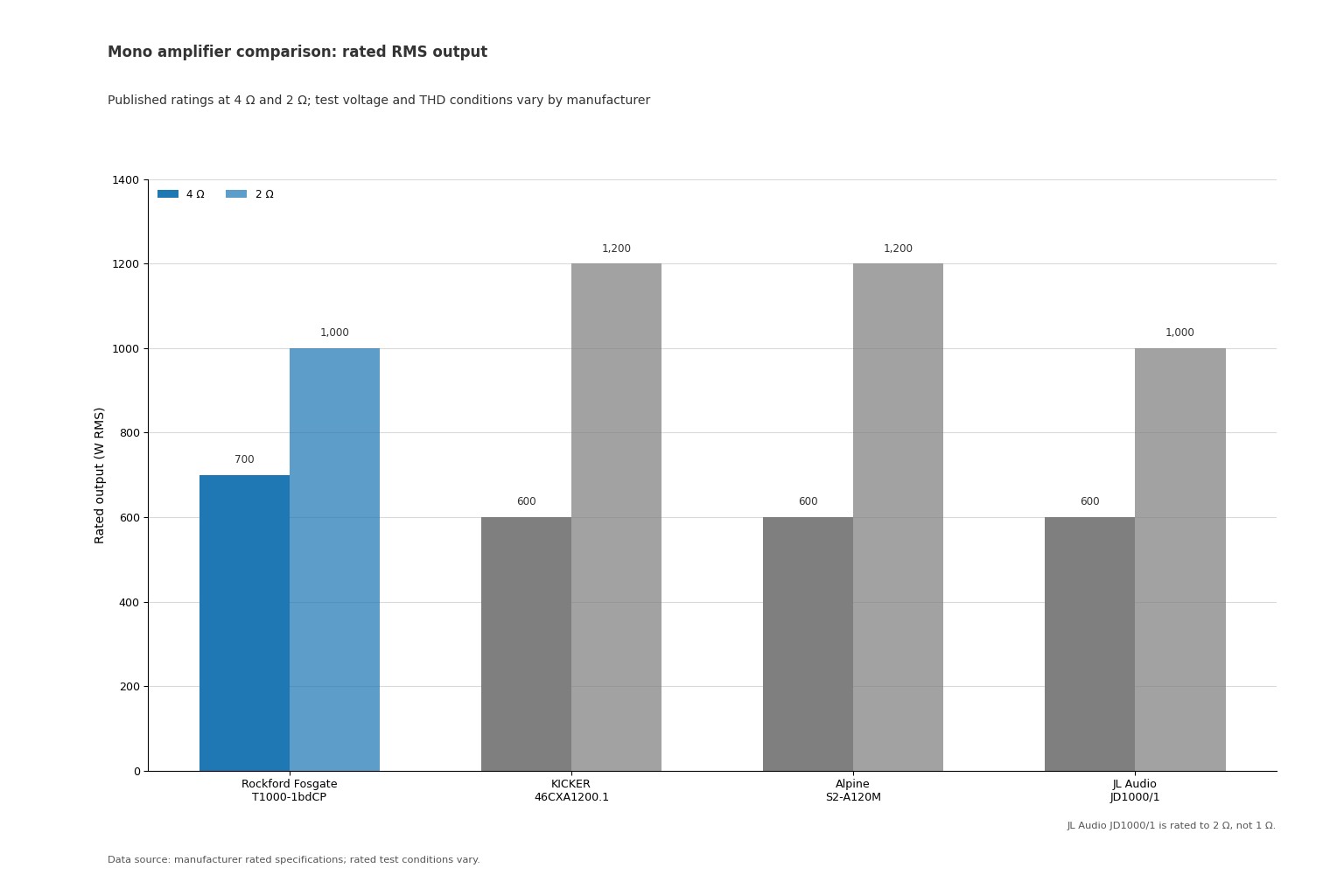
The closest alternatives for a high-output mono subwoofer system include the KICKER 46CXA1200.1, Alpine S2-A120M, and JL Audio JD1000/1. Their rated output and minimum supported load are not identical, so the published figures should be read by impedance rather than treating the wattage number as the whole decision.
| Model | RMS at 4 Ω | RMS at 2 Ω | 1 Ω operation | Notable published feature |
|---|---|---|---|---|
| Rockford Fosgate T1000-1bdCP | 700 W | 1,000 W | 1,000 W | Class-BD Constant Power, +18 dB Punch EQ |
| KICKER 46CXA1200.1 | 600 W | 1,200 W | 1,200 W ±10% | 24 dB/octave adjustable subsonic filter and crossover |
| Alpine S2-A120M | 600 W | 1,200 W | 1,200 W | Speaker-level input and selectable turn-on modes |
| JL Audio JD1000/1 | 600 W | 1,000 W | Not rated for 1 Ω | Speaker-level inputs and clipping indicator |
The figures above are sourced from the manufacturers' specifications. Rated test voltage and distortion conditions vary, particularly between the Rockford model's published figures and the 14.4-volt ratings given for the KICKER and Alpine, so the table is best used as a compatibility and output guide rather than a laboratory ranking. The T1000-1bdCP's particular advantage is the published 1,000-watt rating at 1 ohm without dropping its specified RMS output relative to 2 ohms. The KICKER and Alpine list 1,200 watts at the lower load, while the JL Audio model is specified at 2 ohms and adds speaker-level integration features.
The enclosure and system plan matter as much as amplifier output. An amplifier cannot make a subwoofer safely handle more power than it is designed for, and a larger RMS rating does not by itself indicate better sound quality. Match the amplifier to the actual subwoofer impedance, continuous rating, enclosure alignment, and intended listening level.
Who should buy the Rockford Fosgate Power T1000-1bdCP?
This model makes the most sense for an installer building a serious subwoofer system that needs 700 watts at 4 ohms or 1,000 watts at 1 or 2 ohms, has RCA-level signal available, and can support a large amplifier's current draw. It also suits someone who values the adjustable infrasonic filter, wide low-pass range, pass-through RCAs, and strong bass adjustment.
It is less attractive for buyers who prioritize a compact chassis, direct high-level input from a factory radio, the lowest possible price, or a very modest subwoofer. Newer Class-D alternatives can offer 1,200 watts at 1 or 2 ohms, factory-input features, and smaller installation dimensions. Buyers should compare those features with the Rockford model's exact 4-ohm output and Class-BD Constant Power approach rather than assuming all 1,000-watt amplifiers are equivalent.
Before purchase, confirm that the product label reads T1000-1bdCP, not the visually similar T1000-1bd or T1500-1bdCP. Verify what is included, whether the optional remote is part of the specific package, whether the warranty applies to the seller and region, and whether the installer can meet the fuse, wire, and ventilation requirements. The manual family page is especially helpful for identifying the exact model suffix and matching installation directions.
One shopping reference is the T1000-1bdCP mono amplifier. A buyer should compare the exact suffix and included items before choosing a bundle.
Price and pre-purchase checks
The T1000-1bdCP price reference is $659.99 USD at Crutchfield. That positions it above lower-cost 1,000-watt mono amplifiers, so its value depends on the buyer needing its particular load ratings, adjustable filters, pass-through output, and bass-control approach rather than wattage alone. Prices change often, so check the current listing.
Before finalizing the budget, account for the external fuse, appropriately sized power and ground cable, speaker wire, RCA cable, optional remote control, and professional installation if needed. The amplifier's 150 A fuse requirement and up-to-140 A published sine-wave draw mean the installed system cost can be noticeably higher than the amplifier alone. If the vehicle's charging system cannot maintain useful voltage under load, the system may need electrical upgrades or a different power target.
The older support-document date should also prompt a warranty check. The regional distributor still documents the model's specification family, but buyers should confirm the warranty terms that apply to the exact unit, purchase channel, and country rather than assuming that all old stock, used units, or imported versions receive identical coverage.
Rating and sub-score explanation
| Area | Score | Weight | Weighted contribution |
|---|---|---|---|
| Performance and sound/function | 4.0/5 | 40% | 1.600 |
| Features and usability | 4.0/5 | 20% | 0.800 |
| Build quality and design | 3.5/5 | 15% | 0.525 |
| Value at review price | 3.0/5 | 25% | 0.750 |
| Total weighted result | 3.675/5 | 100% | 3.675 |
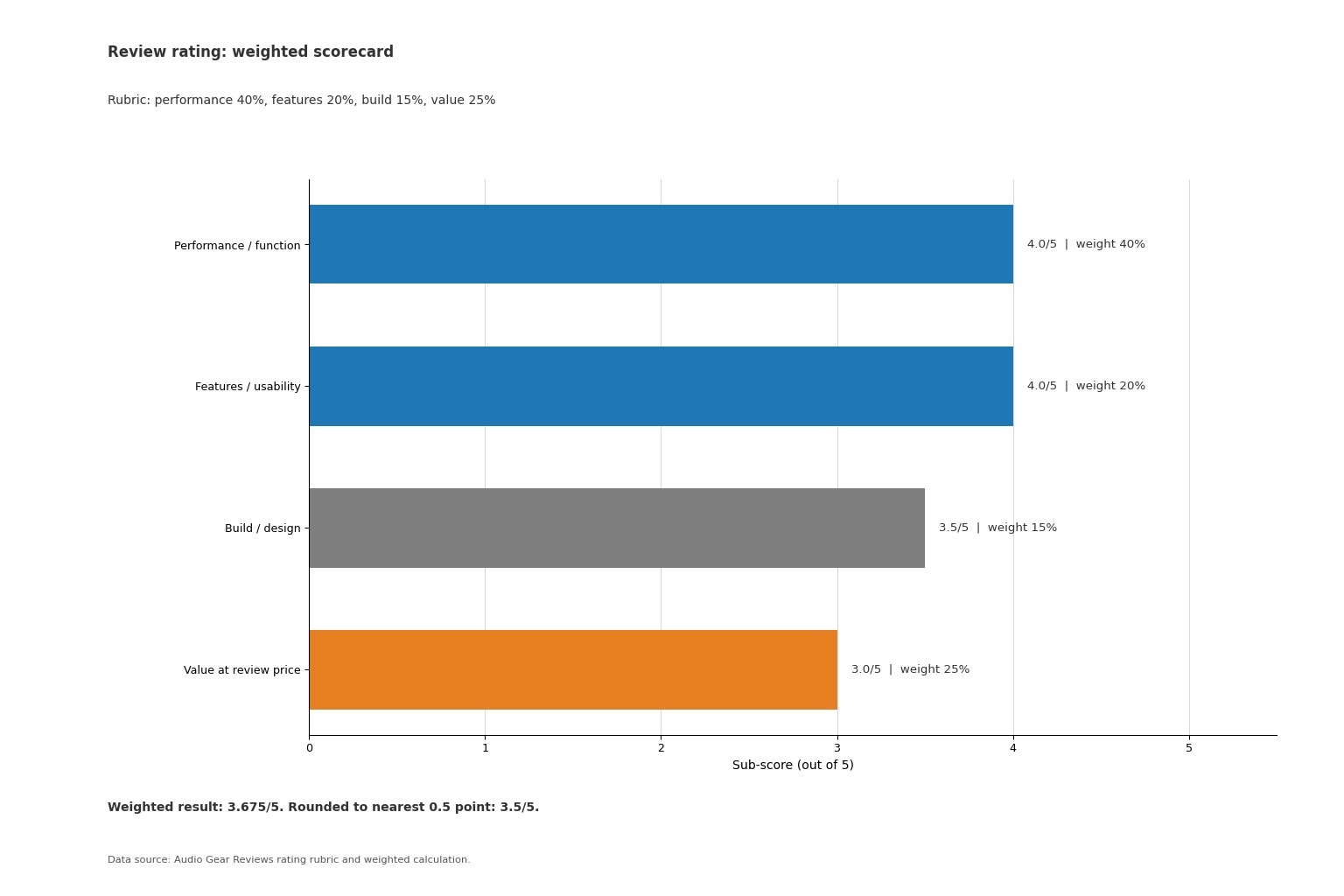
Performance receives 4.0 because the published 1,000-watt ratings at 1 and 2 ohms and 700-watt rating at 4 ohms cover useful system configurations, with strong published efficiency at 4 and 2 ohms. Features earn 4.0 for the variable low-pass and infrasonic filtering, pass-through outputs, and adjustable Punch EQ. Build and design receive 3.5 because the full chassis and connection demands are substantial, and no independent durability testing was located. Value receives 3.0 because the reference price is high beside current alternatives with similar or greater output ratings.
Our research score is based on the rated figures and documented details above. The calculated weighted result is 3.675 out of 5. Rounding to the nearest half-point gives 3.5 out of 5, because 3.675 is closer to 3.5 than to 4.0 under the half-point rubric.
Sources and further reading
- Manufacturer support manual page: model family, manual access, and installation information.
- Regional distributor product specifications: RMS output, chassis dimensions, filter ranges, Punch EQ, and the model family's place in the POWER range.
- Retailer product specifications and price reference: current non-Amazon price, wiring recommendations, included items, and power ratings.
- Manufacturer specification sheet: competing amplifier power at stated voltage and distortion, filter functions, dimensions, and electrical parameters.
- Manufacturer product specifications: competing amplifier power, speaker-level input, crossover, turn-on options, and dimensions.
- Manufacturer-linked product specification page: competing amplifier output, filter range, inputs, rated power conditions, fuse, and dimensions.
- Retailer product specifications: comparison data for a 1,000-watt mono amplifier, including minimum load and connections.
- Retailer product page: second cross-check for the competing amplifier's model identity and published details.
Frequently Asked Questions About the Rockford Fosgate T1000-1bdCP
How much RMS power does the Rockford Fosgate T1000-1bdCP make?
The published rating is 700 watts RMS into 4 ohms and 1,000 watts RMS into either 2 ohms or 1 ohm. Those are rated figures, not an independent bench measurement.
Can the T1000-1bdCP run a 1-ohm subwoofer load?
Yes, its published rating is 1,000 watts RMS at 1 ohm. The subwoofer voice coils and wiring must be configured to present the intended nominal load, and the subwoofer itself must be rated to handle the supplied power.
What fuse and power wire does it require?
The supplied specifications recommend a 150 A external fuse and 4 AWG power wiring. The fuse is not included, and it should be placed close to the battery according to the installation manual.
Does the T1000-1bdCP have speaker-level inputs?
The published connection specification lists one RCA input pair and RCA pass-through output, but does not list a dedicated speaker-level input. A factory radio without RCA pre-outs may therefore require a suitable line-output or integration interface.
Is the remote bass controller included?
The remote PEQ is described as optional and can override the built-in Punch Bass control. The buyer should verify the exact package contents instead of assuming the controller is supplied.
What does Constant Power mean on this amplifier?
The published figures show 1,000 watts RMS at both 2-ohm and 1-ohm loads, while the 4-ohm rating is 700 watts RMS. It does not mean the amplifier outputs 1,000 watts at every impedance.
How large is the amplifier?
The chassis measures 2.14 inches high, 8.14 inches wide, and 13.66 inches deep. Cable clearance and ventilation require additional installation space beyond those body dimensions.
What is the current reference price?
The reference price used in this review is $659.99 USD at Crutchfield. Prices change often, so check the current listing before buying.