Helix · DSP MINI MK2
Helix DSP MINI MK2 Review: Compact 6-Channel Car DSP
Six-output car DSP with 96 kHz processing, 107 dB analog SNR and 10 setups. Specification and research review with price check, install notes and rivals.
Pros
- Four RCA inputs, four high-level inputs and an optical input in a 177 x 104 x 40 mm case
- Rated 107 dB signal-to-noise ratio and under 0.002 % THD+N on the analog inputs
- Six RCA outputs with a 6 V maximum output level
- ADEP.3 high-level input, auto turn-on and Input Signal Analyzer help with factory radio integration
- Ten stored sound setups and a Power Save Mode that switches off the amplifier remote after 60 seconds of silence
- Internal supply keeps running with battery sag down to 6 V during engine cranking
- HEC slot accepts Bluetooth or USB audio modules later
Cons
- Six outputs rule out a three-way front plus subwoofer, which needs seven
- Digital input is optical only, stereo PCM only, and has no volume control without an extra remote
- No built-in Bluetooth; the Conductor remote and BT HD Streamer add $455 at ResoNix on 12 October 2026
- Tuning needs a computer running the free DSP PC-Tool and, for acoustic tools, a measurement microphone
- The US price of $650 is only $149 under the eight-output DSP.3S
Specifications
| Converters | Burr-Brown A/D and D/A |
|---|---|
| Crosstalk | > 90 dB |
| DSP | 64-bit fixed point, 295 MHz, 1.2 billion MAC operations per second |
| Dimensions (H x W x D) | 40 x 177 x 104 mm (1.58 x 6.97 x 4.09 in) |
| Frequency response | 10 Hz - 44 kHz (tolerance not stated by manufacturer) |
| IM distortion | Analog input < 0.005 %, digital input < 0.003 % |
| Input sensitivity | RCA 2-4 V; high-level 5-11 V (software adjustable) |
| Inputs | 4 x RCA, 4 x high-level (speaker), 1 x optical S/PDIF, 1 x remote in |
| Maximum output voltage | 6 V (RCA outputs) |
| Outputs | 6 x RCA, 1 x remote out (max 500 mA) |
| Power | Operates from 9.6 V (down to 6 V for up to 5 s); current draw < 480 mA |
| Sampling rate | 96 kHz (optical input accepts 12-96 kHz stereo PCM) |
| Signal-to-noise ratio | Analog input 107 dB, digital input 112 dB (A-weighted) |
| Sound setup memories | 10 |
| THD+N | Analog input < 0.002 %, digital input < 0.0008 % |
| Type | 6-channel digital signal processor for car audio |
Verdict
The Helix DSP MINI MK2 suits anyone building an active two-way front plus subwoofer system, or adding a processor behind a factory radio, who wants a mature tuning tool in a case 40 mm tall. Its main strengths are the rated 107 dB analog signal-to-noise ratio, 6 V outputs and the smart high-level input. The compromise is six outputs and extras that cost more. At about $650 in the US it sits $149 below the eight-channel DSP.3S.
The Helix DSP MINI MK2 is worth buying if you need a small processor for an active two-way front system with a subwoofer, or for adding tuning control behind a factory radio, and you can spend about $650 in the US. It is a poor fit if you want a three-way front plus a subwoofer, because six outputs are not enough for that, or if you only need basic equalization. The Verdict, Pros, Cons and Specs panels on this page summarize the essentials, so this article concentrates on the detail behind them.
How this review was made
This is a specification and research review. It has not been tested hands-on, and nothing here describes listening sessions, installation in a car or bench measurements by this site. The statements come from the Audiotec Fischer product page and manual, an independent magazine test published by Car&HiFi, retailer listings checked on 12 October 2026, and manufacturer data for the comparison models. Where this article describes how the unit sounds, it refers to rated figures and to what other reviewers and owners commonly report, and owner comments are treated as anecdotal. No independent laboratory measurements of the MINI MK2 were found during research.
Design and build
The MINI MK2 is a flat box measuring 40 x 177 x 104 mm, small enough to slide under a seat or behind a trim panel. The manufacturer says it is made in Germany. Connections are grouped on two sides: the inputs, auto-remote switch and power plug on one, and the outputs, USB port, Smart Control Port, status LED and control button on the other. A three-position ground-lift switch separates signal ground from power ground, ties them together, or joins them through a 200 ohm resistor, which gives an installer a tool against alternator noise.
The unit contains protection circuits for over-voltage, under-voltage and overheating. A red status LED means protection mode, and in an over-temperature event the remote and signal outputs switch off until the unit cools. The manual asks for mounting in a dry place with air circulation, away from heat sources, and secured with screws into a solid surface after checking behind the panel for wiring and brake lines. No independent teardown or durability test was found, so the build score in this review rests on the specification and the safety features rather than on long-term evidence.
Features and usability
The input section is the main reason to pick this model for a factory-radio project. It accepts four RCA channels, four high-level channels and one optical digital input. The high-level inputs use the ADEP.3 circuit, which the manufacturer says prevents the fault messages and lost fader functions that some radios produce when a processor is attached. The unit turns itself on from a speaker signal, and Power Save Mode switches off the amplifier remote after 60 seconds without signal. Many modern cars keep the radio alive for up to 45 minutes after locking, so this matters for battery drain. The Input Signal Analyzer shows what the radio is actually sending, and a per-channel input equalizer can correct factory filtering before the signal is split.
According to Car&HiFi's 2021 test, the software provides 30 parametric equalizer bands on each output channel, a five-band input equalizer per channel, free crossovers with slopes from 6 to 42 dB per octave, and output delay of up to 531 cm (15.61 ms). It also stores ten sound setups, includes an automatic time-measurement function and an undo feature called Time Machine. A real-time analyzer works with an optional measurement microphone.
Several sound effects are tied to particular outputs, which affects how a system should be laid out. The manual says the center-channel processing (RealCenter and the center ClarityXpander) acts only on output E, and the Augmented Bass Processing acts only on output F. A layout of A to D for a two-way front, E for a center speaker and F for a subwoofer uses every output and every effect.
The digital input handles uncompressed stereo PCM at 12 to 96 kHz and not MP3 or Dolby streams. Because digital sources usually have no volume control, the manual warns that amplifiers will receive full level and recommends a remote. The Conductor remote and the optional Bluetooth modules are extra purchases. Setup requires the free DSP PC-Tool over USB, which a retailer describes as a Windows program. The manufacturer's product page names version 4 of the software, a retailer names version 5, and Audiotec Fischer now offers version 6 for ACO-based processors, so confirm which version supports the MINI MK2 on the download page.
Sound and performance
Every number in this section is a manufacturer rating unless stated otherwise. On the analog inputs the unit is rated at 107 dB signal-to-noise ratio (A-weighted) and below 0.002 % THD+N, which works out to about 94 dB below the signal. The digital input is rated at 112 dB and below 0.0008 %, about 102 dB down. Intermodulation distortion is rated below 0.005 % (analog) and 0.003 % (digital), crosstalk above 90 dB, and the frequency response is 10 Hz to 44 kHz with no tolerance published. The test level and measurement bandwidth behind these figures are not stated beyond A-weighting, so treat them as rated limits rather than verified results.
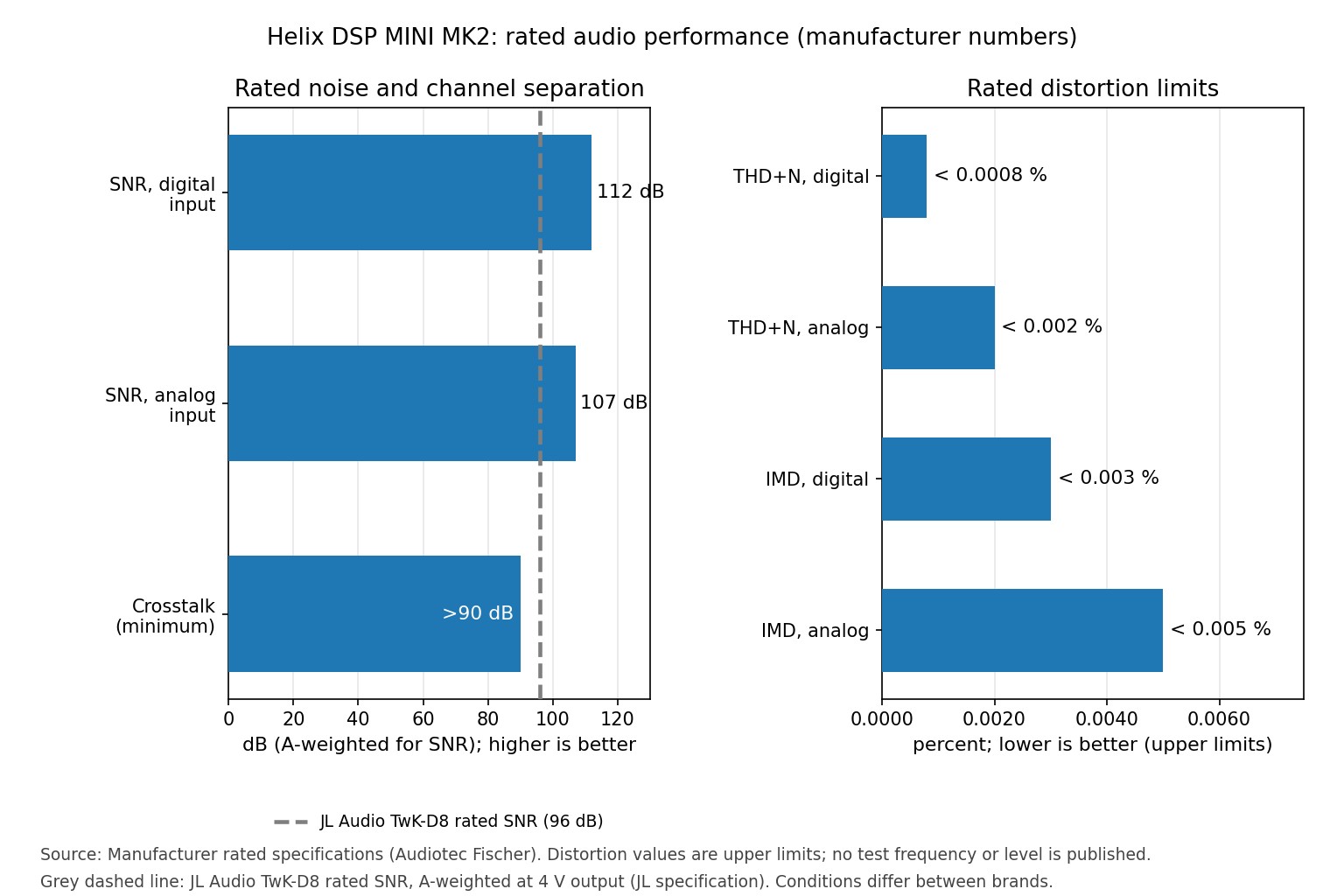
The maximum output is 6 V, which is 3.5 dB more than the 4 V of the JL Audio TwK-D8. That headroom lets a source be turned up before a downstream amplifier gain stage has to compensate, though the benefit depends on the amplifiers used. Car&HiFi reported that signal-to-noise ratio and distortion improved by about 6 dB compared with the first DSP MINI, and it identified a Burr-Brown PCM3168 converter and an Analog Devices ADAU1451 DSP chip inside. Its verdict called the MINI MK2 and DSP.3S first choices for users who need six or eight channels.
Owners on retailer pages describe clear and detailed sound and easy software, and one forum thread shows the gain-matching work that left and right outputs need in a fully active system. These are anecdotal reports, not measurements. A DSP cannot fix a poor speaker location, so the audible result depends heavily on the tuning, the speakers and the installer.
Setup, installation and daily use
The manual recommends installation by an authorized dealer and links full warranty coverage to it. The steps below summarize its safety points and are not a full installation guide.
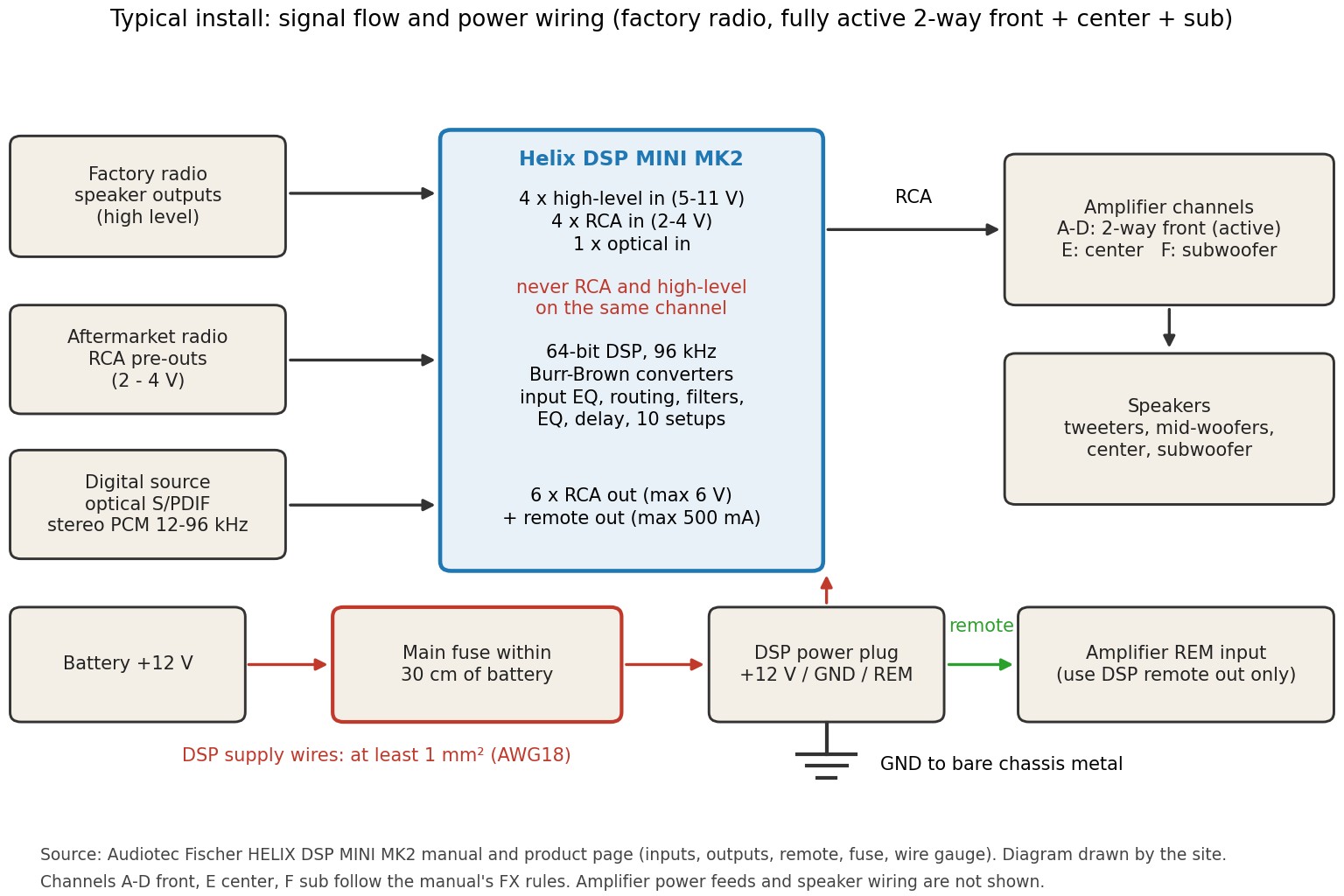
- Disconnect the battery negative terminal before any wiring, and use the unit only in a vehicle with a 12 V negative ground.
- Fit a main fuse within 30 cm of the battery on the positive feed. The DSP itself draws under 480 mA (under 5.8 W at 12 V), and the manual asks for supply wires of at least 1 mm2 (AWG18).
- Connect ground to bare chassis metal. A poor ground causes interference and malfunction.
- Use only the supplied screw-terminal plugs, and never use the high-level and RCA inputs on the same channel, which the manual says can damage the radio's outputs.
- Switch amplifiers on from the DSP remote output only, never from ignition or any other signal.
- Set input sensitivity before connecting amplifiers. Factory settings are 11 V for high-level and 4 V for RCA, and the manual describes raising the level until the clipping indicator lights and then backing off.
- In a fully active system, keep the radio volume at minimum and amplifiers disconnected until the base settings are made, because a wrong crossover can destroy speakers.
- Holding the control button for more than five seconds erases the memory, and the unit stays silent until it is reprogrammed with the software.
Day to day, the unit operates unattended after setup. The control button toggles between two preset setups, and reaching all ten needs a remote such as Conductor, DIRECTOR or WIFI CONTROL.
How it compares
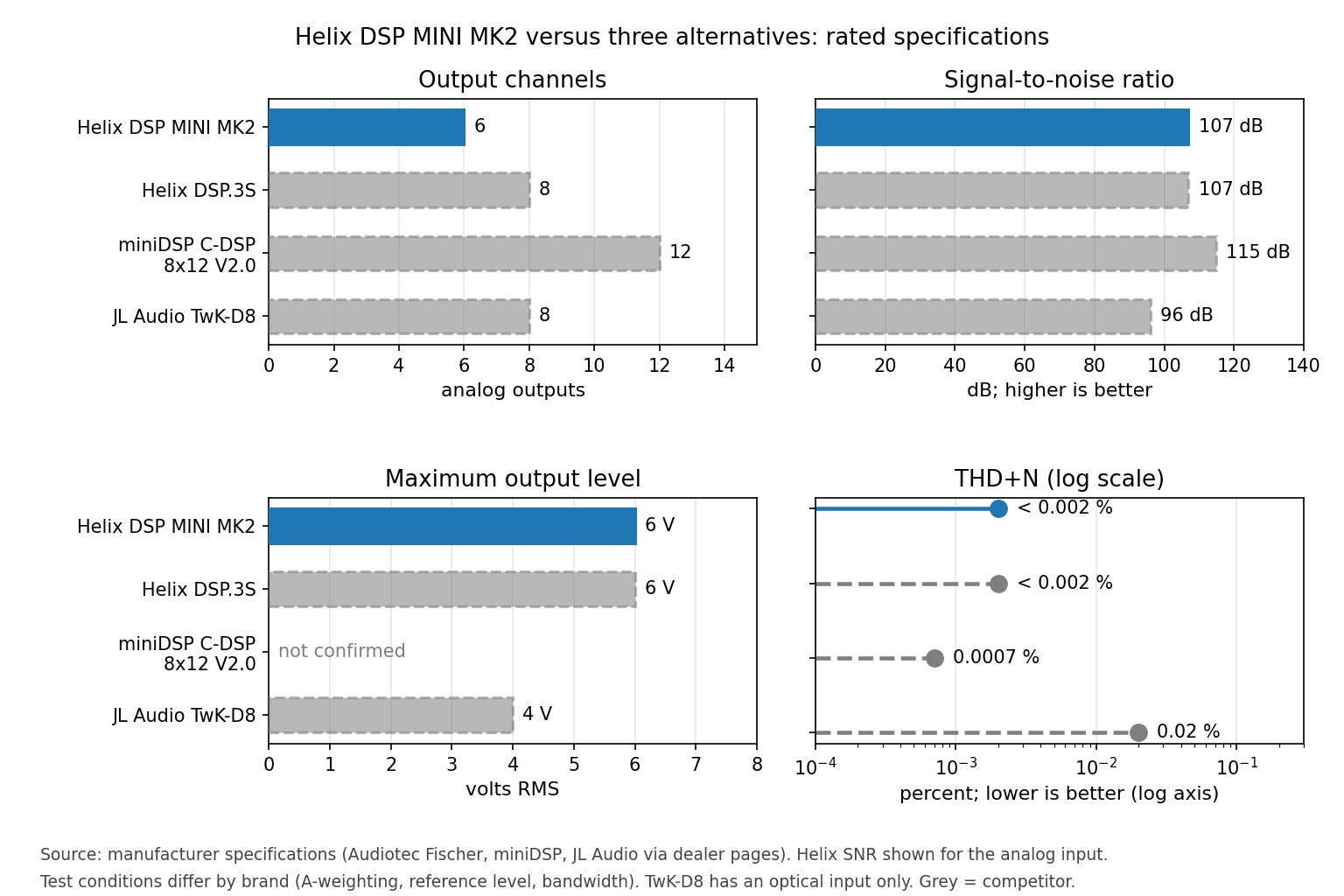
Three alternatives were chosen. The Helix DSP.3S is the step-up model from the same maker. The miniDSP C-DSP 8x12 V2.0 offers more outputs and a higher internal sample rate at a higher price. The JL Audio TwK-D8 is closer in price, but it has only a digital optical input, so it needs a separate front end such as JL's FiX 82 when used with a factory radio.
| Item | Helix DSP MINI MK2 | Helix DSP.3S | miniDSP C-DSP 8x12 V2.0 | JL Audio TwK-D8 |
|---|---|---|---|---|
| US price seen | $650 (ResoNix, 12 October 2026) | $799 (ResoNix, 12 October 2026) | $899.99 to $999.98 in listings seen; not re-verified | $519.99 list at one dealer; listing out of stock |
| Outputs | 6 RCA | 8 RCA | 12 RCA | 8 RCA |
| Analog inputs | 4 RCA + 4 high-level | 6 RCA + 6 high-level | 6 analog (low and high level) | None |
| Digital inputs | Optical, 12-96 kHz | Optical 12-96 kHz, coaxial 12-192 kHz | SPDIF and Toslink, 44.1-192 kHz | Optical |
| Processing rate | 96 kHz | 96 kHz | Up to 192 kHz | 24-bit processor |
| SNR | 107 dB analog | 107 dB analog | 115 dB | 96 dB |
| THD+N | < 0.002 % analog | < 0.002 % analog | 0.0007 % | 0.02 % |
| Max output | 6 V | 6 V | Not confirmed | 4 V |
The MINI MK2 and DSP.3S share the same rated audio figures, and the DSP.3S adds channels and a coaxial input for $149 more, which is $99.88 per output against $108.33 for the MINI MK2. The miniDSP lists better signal-to-noise and distortion numbers and more outputs, and the TwK-D8 lists weaker ones. Rated figures use different conditions across brands, so small differences should not decide the purchase. The inputs, software and integration features usually matter more.
Who should buy it and who should skip it
Buy it if you are building an active front stage with one or two subwoofer channels, if your car has a factory radio with speaker diagnosis, or if you want a processor that can be installed in tight spaces. It also suits anyone who values the manufacturer's input analysis tools and the optional Bluetooth and USB expansion path.
Skip it if you plan a three-way front plus a subwoofer, a rear-fill system with a separate center, or any layout needing more than six outputs. Buyers who want a coaxial digital input or a larger set of analog inputs should look at the DSP.3S. Anyone unwilling to use a Windows PC for tuning, or to pay a dealer for tuning, should think carefully before choosing any DSP of this class.
Buying advice
ResoNix listed the MINI MK2 at $650 on 12 October 2026, marked down from $700. Abt lists the product but does not show a price online. An eBay listing at $499 was out of stock, and European coverage in 2021 put the unit at around 400 euros, so prices differ a lot by region and seller. Compare against the DSP.3S at $799 on the same site before deciding.
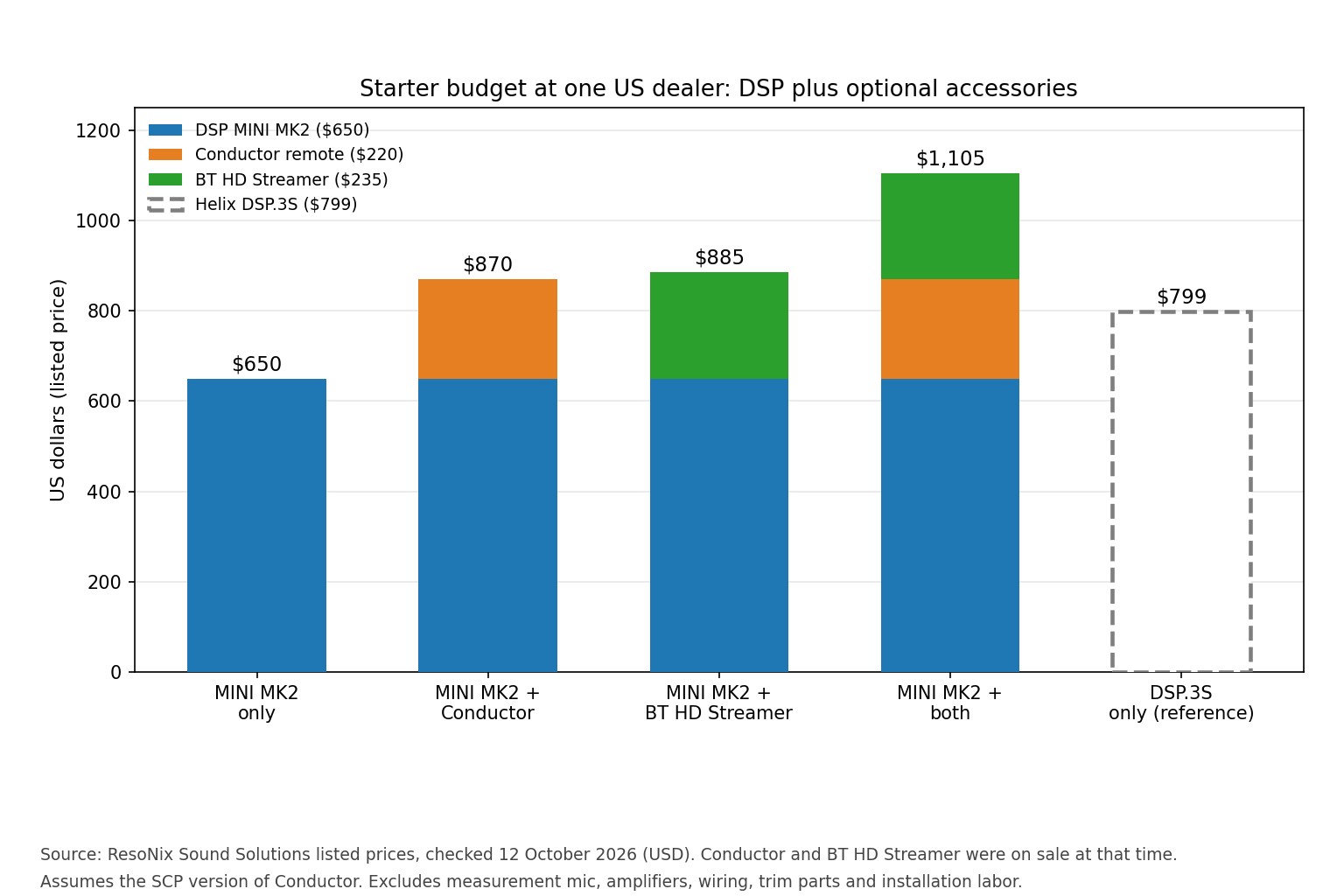
Accessories change the total quickly: the Conductor remote at $220 and the BT HD Streamer at $235 bring the setup to $1,105. Before buying, check these points:
- The listing must say MINI MK2 (order number HP50608) and not the older DSP MINI.
- The Conductor has versions for the Smart Control Port and the older Control Input connection, so confirm the right one.
- Audio tuning tools need a calibrated measurement microphone, which is not included.
- Look at warranty terms, return policy and whether the seller is an authorized dealer, because the manual ties full coverage to dealer installation.
- Sources disagree on the maximum operating voltage (17 V on the product page, 18 V in the manual), and one magazine table lists RCA sensitivity differently from the manufacturer. Use the manufacturer figures and ask a dealer if the vehicle is unusual.
Final thoughts
The rating uses a weighted rubric: performance and function 40 %, features and usability 20 %, build quality and design 15 %, and value for the price 25 %. Because this is a research-based review, the scores reflect verified manufacturer data and independent coverage, not hands-on testing. The MINI MK2 scores well on rated performance and on integration features, and loses points where evidence is thin (no independent measurements or teardown) and where the price, once accessories are added, narrows the gap to the DSP.3S. The weighted total of 3.80 rounds to a rating of 4.0 out of 5.
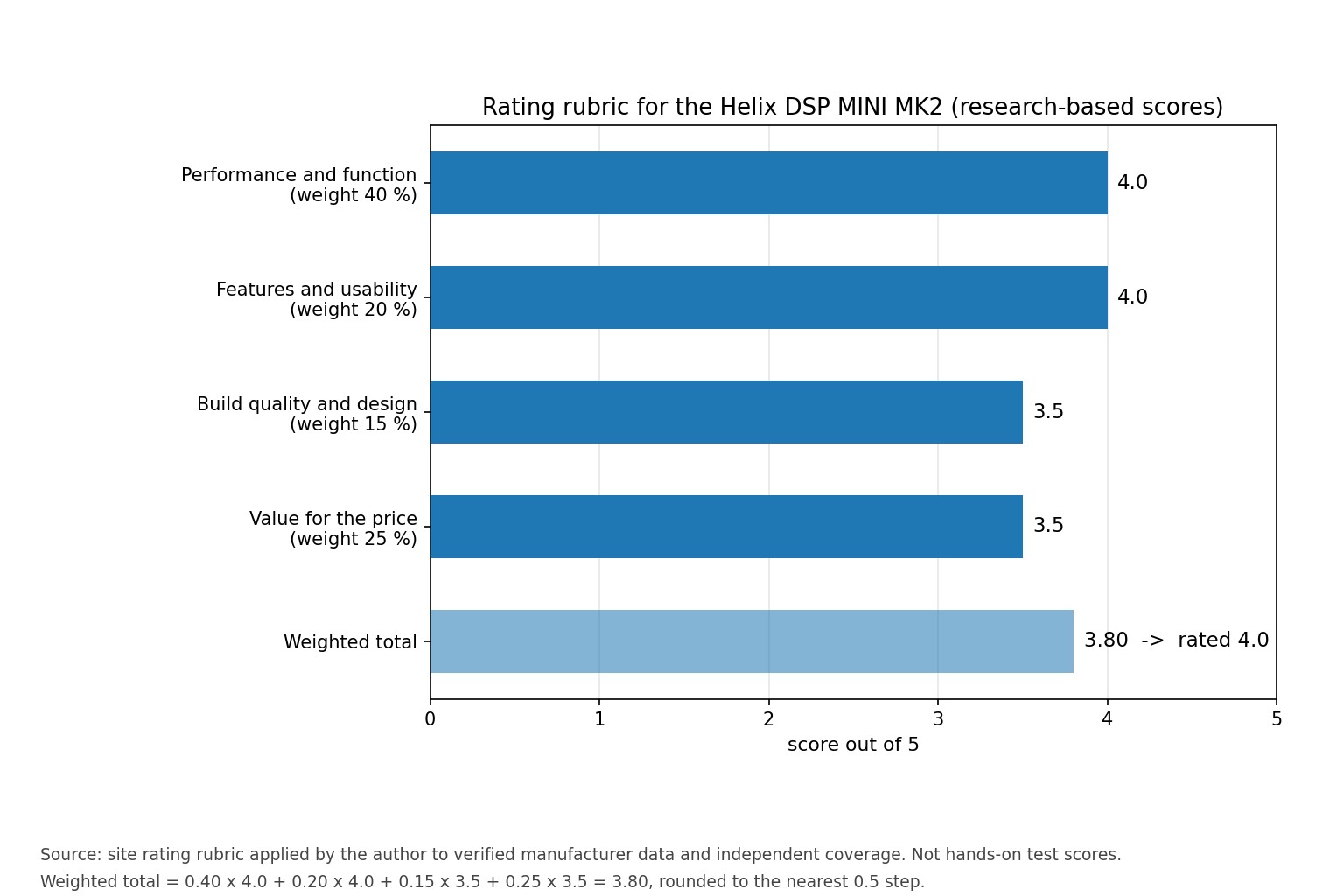
| Category | Weight | Score (0-5) |
|---|---|---|
| Performance and function | 40 % | 4.0 |
| Features and usability | 20 % | 4.0 |
| Build quality and design | 15 % | 3.5 |
| Value for the price | 25 % | 3.5 |
| Weighted total | 100 % | 3.80 (rated 4.0) |
Some links on this page are affiliate links; they never affect our ratings. As an Amazon Associate I earn from qualifying purchases.
Sources and further reading
- Audiotec Fischer: HELIX DSP MINI MK2 product page and technical data
- Audiotec Fischer: DSP MINI MK2 instruction manual (PDF)
- Car&HiFi via hifitest.de: Helix DSP Mini MK2 and DSP.3S test, 2021
- Audiotec Fischer: HELIX DSP.3S product page
- miniDSP: C-DSP 8x12 V2.0 product page
- ResoNix Sound Solutions: Helix DSP Mini MK2 listing (price checked 12 October 2026)
Helix DSP MINI MK2 FAQ
Can the Helix DSP MINI MK2 connect to a factory radio?
Yes. It has four high-level speaker inputs with an ADEP.3 circuit meant to avoid speaker-diagnosis errors, and it can turn on automatically from a speaker signal. Whether a specific car needs extra harnesses or settings is something a dealer should confirm for that model.
How many speakers can it drive?
It has six RCA outputs, so one amplifier channel per output. That covers an active two-way front pair plus a center channel and a subwoofer, or a three-way front pair with no subwoofer. A three-way front plus a subwoofer needs seven outputs, which points to the eight-output DSP.3S.
Does it have Bluetooth?
Not built in. Audiotec Fischer sells expansion modules for the HEC slot, including Bluetooth and USB audio options, and a separate BT HD Streamer. Fitting a module means swapping the side panel, so factor in the extra cost.
Do I need a computer to set it up?
Yes. Settings are made over USB with the free DSP PC-Tool from Audiotec Fischer, which a retailer describes as a Windows program. Automatic measurement tools use a microphone sold separately.
Is the MINI MK2 or the DSP.3S the better buy?
The DSP.3S adds two outputs, two more inputs and a coaxial digital input for $149 more at ResoNix on 12 October 2026 ($799 against $650). Their rated SNR and distortion figures are the same, so the choice mostly depends on how many channels the system needs.
Is it safe to use the optical digital input?
Only with care. A digital source usually carries no volume information, so the outputs run at full level and can overdrive amplifiers and speakers. The manual strongly advises an optional remote for volume, and the input accepts uncompressed stereo PCM only, not MP3 or Dolby streams.
Is there a newer version of the DSP MINI MK2?
No newer DSP MINI was found. Audiotec Fischer still listed the MINI MK2 as a current product on 12 October 2026, alongside larger models such as the DSP.3S, DSP PRO MK3 and DSP ULTRA S.
What warranty does it come with?
The manual refers to statutory warranty terms and recommends installation by an authorized dealer for full coverage. ResoNix states a one-year warranty on Helix products it sells. Check the seller's terms before buying, especially for grey-market imports.