Car Speakers
DLS Iridium 6.3 Review: 6.5-Inch 3-Way Component Speaker System
Published October 9, 2026
A specification-based review of the DLS Iridium 6.3 three-way component set: verified specs, crossover layout, mounting sizes, amp matching and buying checks.
The DLS Iridium 6.3 is a 6.5-inch three-way component set from the Swedish brand DLS. It splits the sound between a woofer, a 3-inch class dome midrange and a 28 mm silk dome tweeter, joined by passive filter boxes. This page is a specification-and-research review based on manufacturer specifications and published information. It was not tested, installed or listened to for this article.
Short version: a high-efficiency (91 dB rated), 4 ohm, 100 W nominal three-way set that suits an installer who has room to mount a separate midrange and wants a modest-power amplifier. Its main limits are installation effort, a midrange with very small rated excursion, and uncertain availability. I could not confirm that it is still in production.
Key specifications
These figures come from the DLS Iridium manual or from retailer listings that repeat DLS data. The source column shows which. Anything I could not verify is left out.
| Item | Value | Source |
|---|---|---|
| Type | 6.5 in (16.5 cm) 3-way component system | DLS manual |
| Nominal / maximum power | 100 W / 160 W | DLS manual |
| Sensitivity | 91 dB (1 W, 1 m) | DLS manual |
| Impedance | 4 ohms | Retailer listing |
| Frequency range | 50 Hz to 25 kHz | Retailer listing |
| Woofer magnet | 85 mm hybrid ferrite/neodymium | DLS manual, retailer |
| Woofer cone and surround | Non-pressed paper, rubber | Retailer listing |
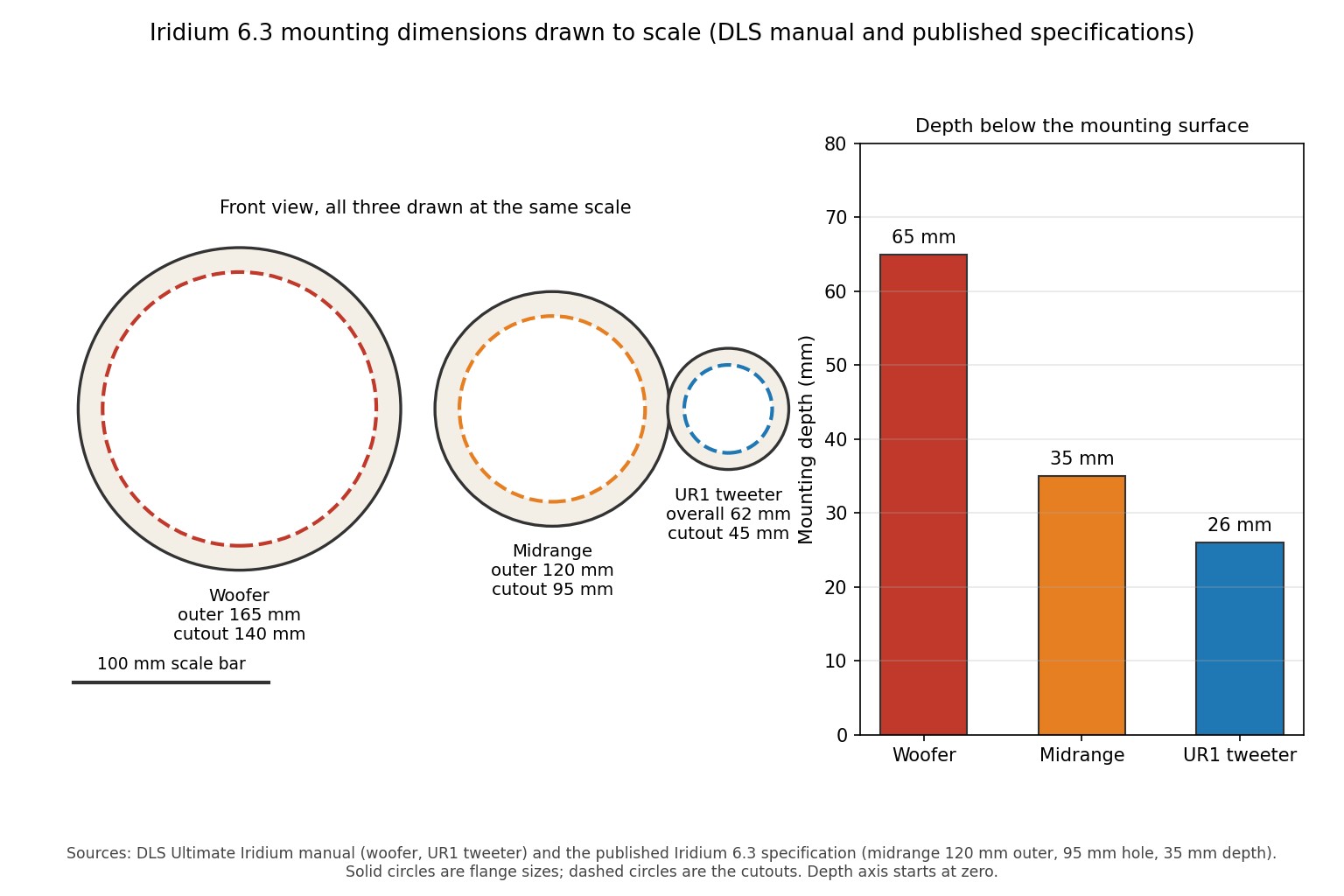
| Woofer outer diameter / mounting hole / depth | 165 mm / 140 mm / 65 mm | DLS manual, retailer |
| Midrange outer diameter / hole / depth | 120 mm / 95 mm / 35 mm | Retailer listing |
| Tweeter | 28 mm silk dome, metal housing | DLS manual, retailer |
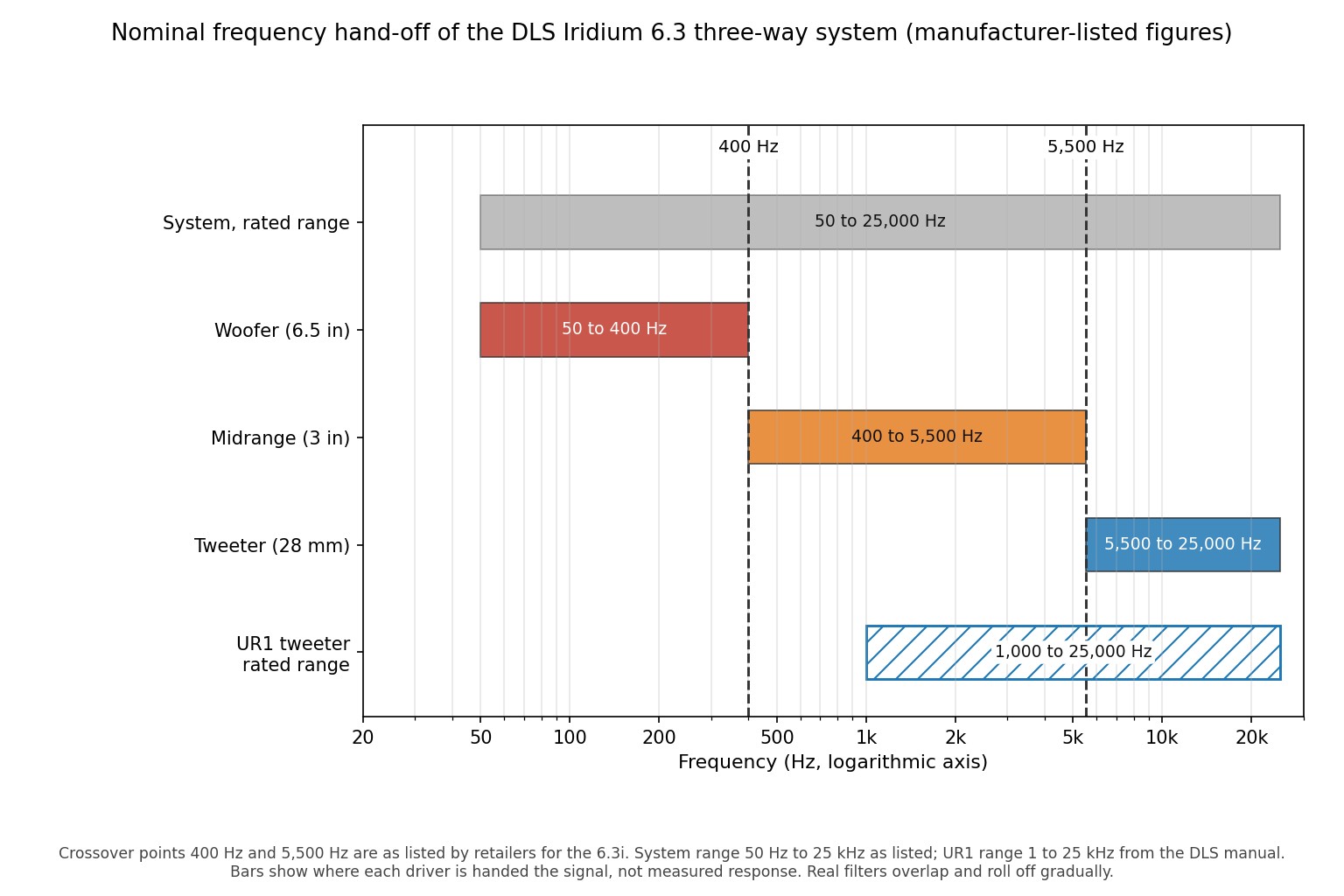
| Crossover points | 400 Hz and 5,500 Hz | Retailer listing |
| Filter slopes | 6 dB and 12 dB per octave | Retailer listing |
| Filter box size | 145 x 85 x 45 mm | Retailer listing |
Design and features
The three drivers
The woofer uses a non-pressed paper cone, a rubber surround and a die-cast basket, driven by a hybrid ferrite and neodymium magnet system. The midrange is the DLS Iridium 3, a dome with a sealed rear chamber and a neodymium magnet. DLS documents give its size as both 2.5 and 3 inches in different places, so treat the exact dome diameter as approximate and use the mounting dimensions for fitment.
The DLS Iridium 3 data sheet lists a resonance of 280 Hz, a frequency range of 250 Hz to 8 kHz, a recommended use of 400 Hz to 4.5 kHz and a rated excursion of only plus or minus 0.5 mm. That small excursion is the reason the midrange should be filtered cleanly. Owners on forums describe dome midranges of this type as sensitive to low-frequency content, which is a field report, not a standard.
The tweeter is the Iridium 1i. DLS lists it separately as 50 W nominal and 80 W maximum, a 1 kHz to 25 kHz range, 93 dB sensitivity and a 900 Hz resonance. Note that its own rating is lower than the 100 W system rating, which matters when you set crossover levels.
Mounting dimensions
The woofer needs a 140 mm hole and 65 mm of depth, and the midrange needs a 95 mm hole and 35 mm of depth. The midrange is much shallower than the woofer, which helps in dashes, A-pillars and kick panels where depth is limited.
Crossover and signal flow
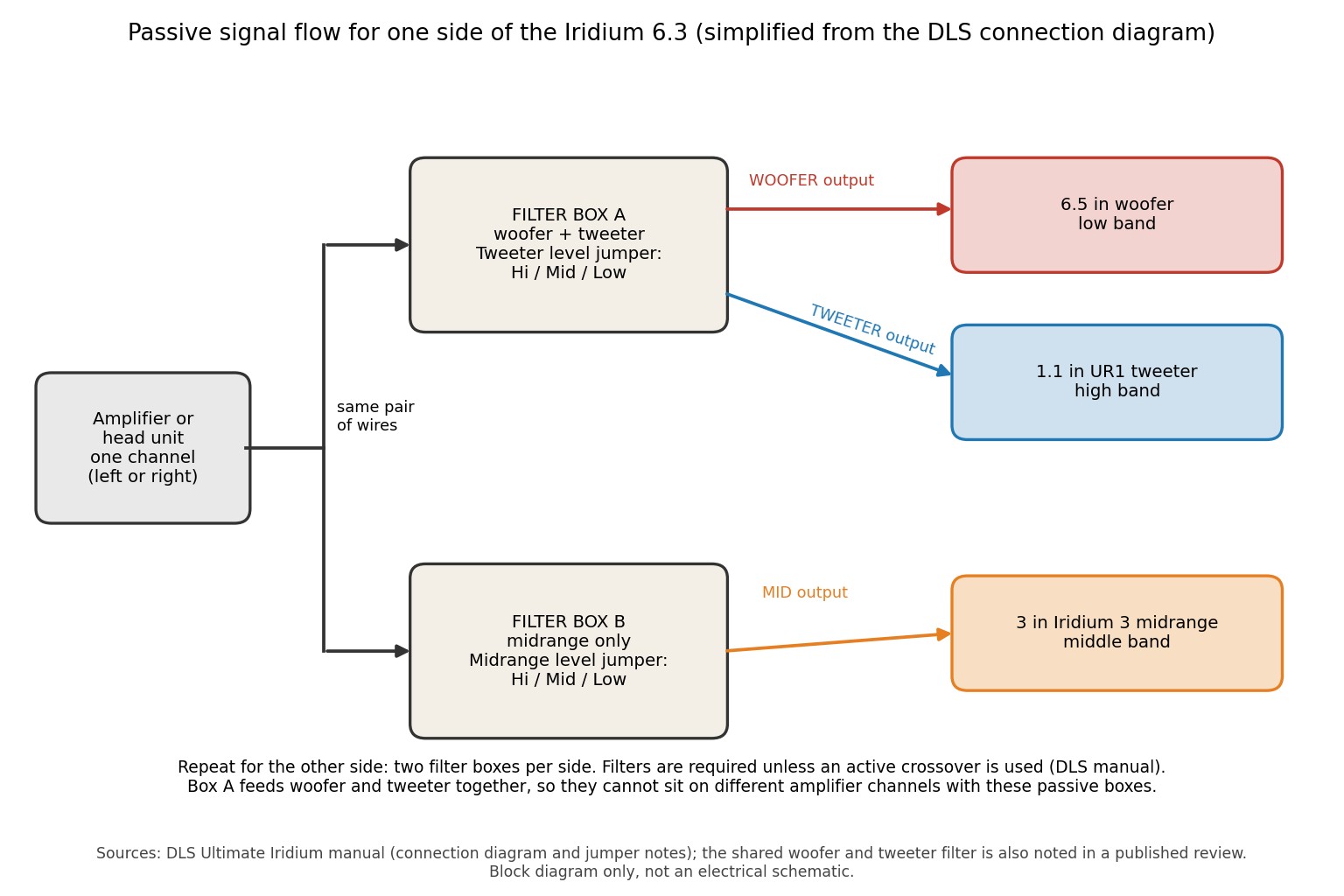
The system uses passive filter boxes. One box serves the midrange, and one serves the woofer and tweeter. The listed crossover points are 400 Hz between woofer and midrange, and 5,500 Hz between midrange and tweeter, with selectable midrange and tweeter level in three steps. These switch settings let you trim for cabin response and speaker position.
Installation and setup notes
Safety: disconnect the battery negative terminal before running power or speaker cables, and fuse any new power wire close to the battery. Before cutting a door card, dash or kick panel, check for airbags, wiring harnesses and the window path. Keep volume at a level that does not damage hearing while you tune.
- Dry-fit all three drivers and both filter boxes before cutting anything, and check the 140 mm woofer hole and 65 mm depth against the window travel.
- Seal the woofer mounting surface. The DLS manual text I retrieved gives about 6 liters as a door-side guide for the 6.5-inch bass driver, so treat the door as an enclosure and stiffen the baffle.
- Check polarity. DLS suggests briefly touching a battery to the speaker terminals; a low-voltage cell such as a 1.5 V AA battery is a safer choice than a car battery. The cone should move outward when the positive terminal is connected to the speaker plus.
- Mount the filter boxes where they stay dry and cannot rattle, and use quality speaker cable.
- Start with the level switches in a middle position and the midrange and tweeter pointed toward the listening area.
DLS also describes active operation for the Iridium midrange, with a high-pass slope of 18 to 24 dB per octave. If you go active, bypass the passive boxes entirely and level-match each channel.
What to check and how it should perform
The 91 dB rating is a claim by the manufacturer under its own test conditions. The table below is a simplified calculation, not a measurement. It assumes free-field output at 1 m, 4 ohm load, no power compression, no crossover loss and no cabin gain.
| Power (W) | Voltage (V rms, 4 ohm) | Current (A rms) | Estimated SPL at 1 m (dB) |
|---|---|---|---|
| 1 | 2.0 | 0.50 | 91.0 |
| 10 | 6.3 | 1.58 | 101.0 |
| 25 | 10.0 | 2.50 | 105.0 |
| 50 | 14.1 | 3.54 | 108.0 |
| 75 | 17.3 | 4.33 | 109.8 |
| 100 | 20.0 | 5.00 | 111.0 |
| 160 | 25.3 | 6.32 | 113.0 |
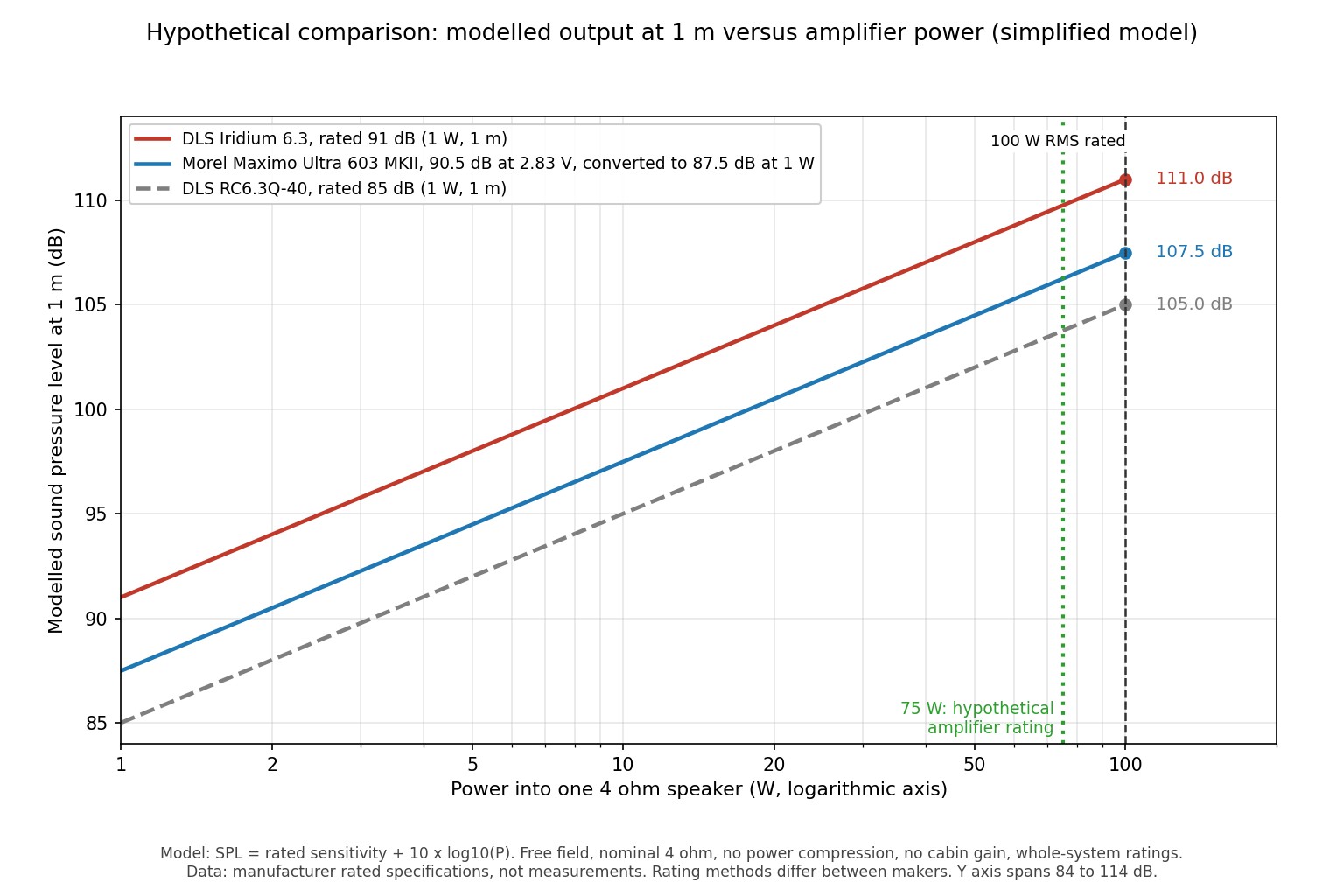
The model shows that going from 100 W to 160 W adds only about 2 dB, so extra power buys little loudness. A 75 W amplifier gives about 17.3 V rms and 4.3 A at 4 ohms and an estimated 109.8 dB in this idealised case. Real drivers lose output as the voice coil heats, so use the numbers to compare, not to predict.
A forum owner reported running a similar set from about 40 W per channel with good results, which is consistent with the efficiency figure but remains an anecdote.
Pros and cons
Pros
- High rated sensitivity of 91 dB, so a modest amplifier is enough.
- Separate midrange and tweeter allow placement choices.
- Selectable midrange and tweeter levels help tune the balance.
- Shallow midrange and 65 mm woofer depth suit many locations.
- Active use is documented by DLS.
Cons
- Three drivers and two filter boxes mean more wiring and mounting effort.
- The midrange has a rated excursion of only plus or minus 0.5 mm.
- Version naming (6.3 and 6.3i) is confusing, and I could not confirm current production.
- No independent measurements are included here.
Who it is for and not for
Good fit: an installer with the space to mount a separate midrange, a 50 to 100 W per channel amplifier, and the patience to tune levels. It also suits someone who may later move to active crossovers.
Poor fit: a buyer who wants a drop-in replacement for factory speakers, a very low budget, or a set with a confirmed new warranty.
Alternatives
| Option | Rated sensitivity | Power (nominal / max) | Notes |
|---|---|---|---|
| DLS Iridium 6.3 | 91 dB | 100 W / 160 W | 6.5 in woofer, 3 in class dome mid, 28 mm tweeter |
| DLS Reference RC6.3Q-40 (listed by a retailer) | 85 dB | 100 W / 150 W | 6.5 in woofer, 63 mm mid, 25 mm tweeter, 40 Hz to 22 kHz |
| Iridium 8.3 (larger DLS sibling) | Not verified | Not verified | 8 in woofer; check the current DLS data |
| A good 2-way component set | Varies | Varies | Simpler install, no separate midrange |
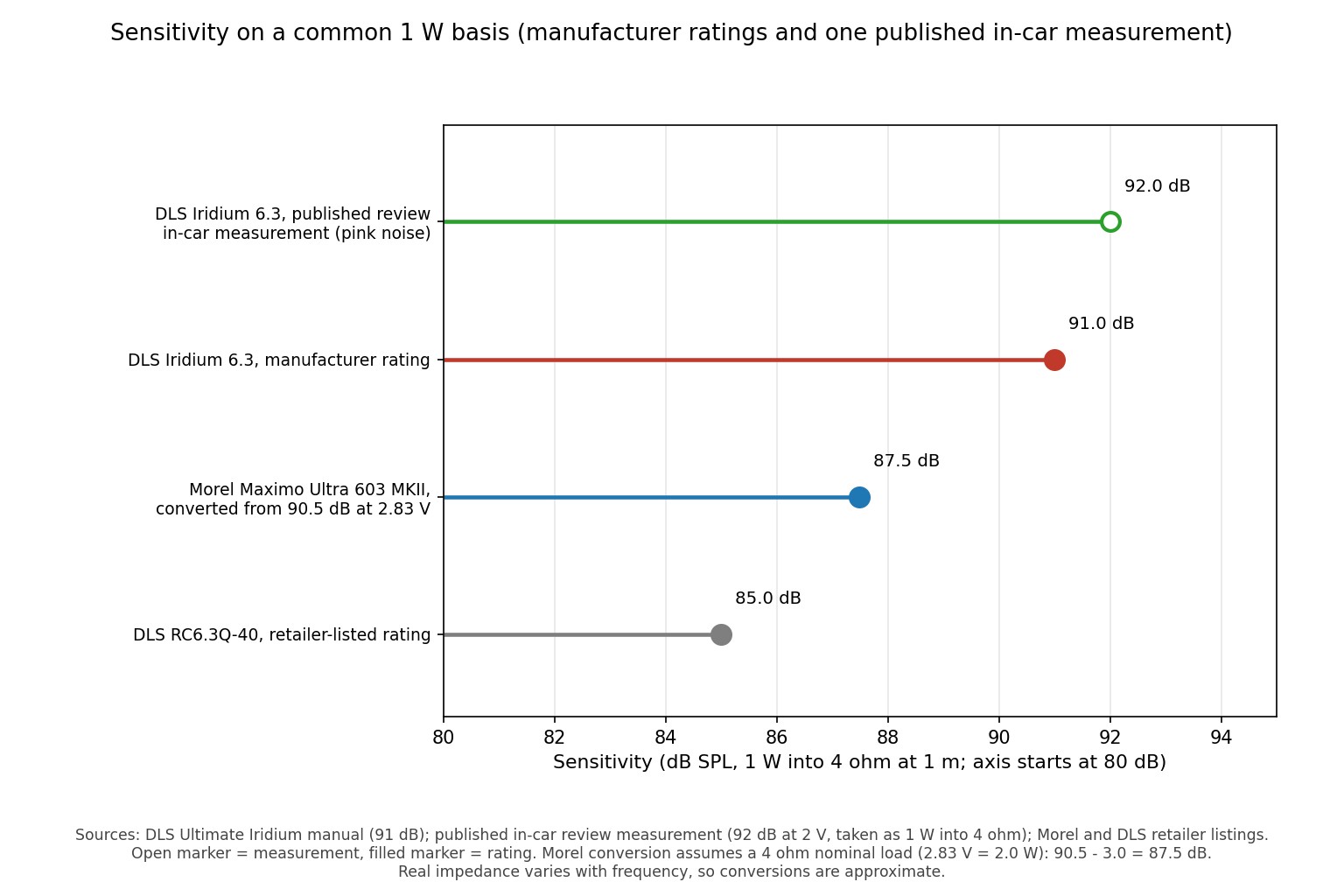
The 6 dB gap between 91 dB and 85 dB means the 85 dB set needs about 3.98 times the power for the same output in this simple model. Sensitivity numbers from different brands are not always measured the same way, so compare within a brand first.
Buying advice
Because availability looks limited, expect to buy used. Confirm which version you are getting, that all three drivers and both filter boxes are included, and ask for clear photos of the cones and surrounds. Check that the grilles, mounting hardware and cables are present, and test each driver with a small battery if possible.
Common mistakes
- Cutting before dry-fitting, which can foul the window path.
- Crossing the midrange too low or driving it too hard given its small rated excursion.
- Mixing passive filter boxes with an active crossover.
- Reversing polarity on one driver and losing midbass.
- Treating the model numbers as measurements.
Final verdict
On paper the Iridium 6.3 is an efficient, flexible three-way set for installers who want placement control. Its value depends on a careful install and a good version at a fair used price. I would not buy it without confirming the version and seeing all components. Add your own listening or measurement notes if you own a set, since this review is based on published data only.
Sources and further reading
- DLS Ultimate Iridium speaker systems manual (PDF)
- DLS Ultimate Iridium 3 midrange manual
- Retailer listing for the Iridium 6.3i
- Retailer listing for the DLS Reference RC6.3Q-40
Last reviewed: October 2026
DLS Iridium 6.3 Frequently Asked Questions
What power does the DLS Iridium 6.3 need?
DLS rates the system at 100 W nominal and 160 W maximum into 4 ohms. With a 91 dB sensitivity rating, an amplifier delivering roughly 50 to 100 W per channel is a sensible range. Lower power can work well if you do not need very high volume.
What is the difference between the Iridium 6.3 and the 6.3i?
DLS literature and retailer listings use both names, and the headline figures I found (100 W, 160 W, 91 dB, 4 ohms) are the same for both. One listing describes an improved version with a die-cast basket. I could not find an official change list, so confirm the exact version with the seller.
How deep and wide is the woofer cutout?
DLS lists a 140 mm mounting hole and a 65 mm mounting depth for the 6.5-inch woofer. The midrange is listed with a 95 mm hole and 35 mm depth. Always measure your own door or panel, including the window path, before cutting.
Can I run the Iridium 6.3 with an active crossover?
DLS describes active use for its Iridium midrange, with a high-pass slope of 18 to 24 dB per octave. In that case you bypass the passive filter boxes and set levels with your processor or amplifiers. Never wire the passive boxes and an active setup together.
Is a 3-way set better than a 2-way set?
Not automatically. A dedicated midrange can cover the vocal range with less strain on the woofer, but it needs more space, more wiring and careful placement. A well installed 2-way set often beats a poorly installed 3-way set.
Does 91 dB sensitivity mean it is loud?
It means the system is fairly efficient, so each watt produces more output than a typical 85 dB design. Every 3 dB needs about double the power for the same loudness, so 91 dB versus 85 dB is roughly four times the power advantage. Real in-car output also depends on the cabin and installation.
Are the Iridium 6.3 still made?
I could not confirm current production status from the manufacturer. Retailer listings and forum sales suggest many buyers find them on the used market. Check availability, condition and that all three drivers and both filter boxes are included.
Do I need a sealed enclosure for the woofer?
The DLS manual text I retrieved gives enclosure guidance for the 6.5-inch bass driver, including about 6 liters for a door-side installation. Doors are not sealed boxes by default, so stiffening and sealing the baffle is worthwhile. Follow the DLS manual for your mounting location.