Speaker Design
Infinite Baffle Speakers: How They Work and How to Set One Up
Published October 5, 2026
How an infinite baffle speaker works, what driver and rear volume it needs, how to set one up in a car or a room, and how it compares with sealed and ported boxes.
An infinite baffle is the simplest idea in speaker enclosure design and one of the easiest to get wrong. Instead of building a box around a driver, you mount the driver so that its rear wave goes into a volume so large that the driver barely notices it is there. In car audio that volume is usually the trunk, and the driver sits in a rigid baffle between the trunk and the cabin. At home it can be a driver mounted in a wall between two rooms.
This guide explains what "infinite baffle" really means, why the idea works, what kind of driver suits it, how to set one up in a car, and where installations usually fail. The calculations use the same Thiele/Small parameters as any other enclosure, so if those are new to you, the guide on speaker enclosure design covers them first.
The short version: an infinite baffle works when the air behind the driver is many times larger than the driver's own Vas, so the box adds almost no stiffness and the driver behaves much as it would on its own. It needs a driver built for it (a stiff suspension, low Fs, plenty of Xmax and a moderate to high Qts), a rigid and airtight baffle, and a high-pass filter to protect the cone. The reward is bass that reaches low and rolls off gently, with no box taking up space.
What "infinite baffle" actually means
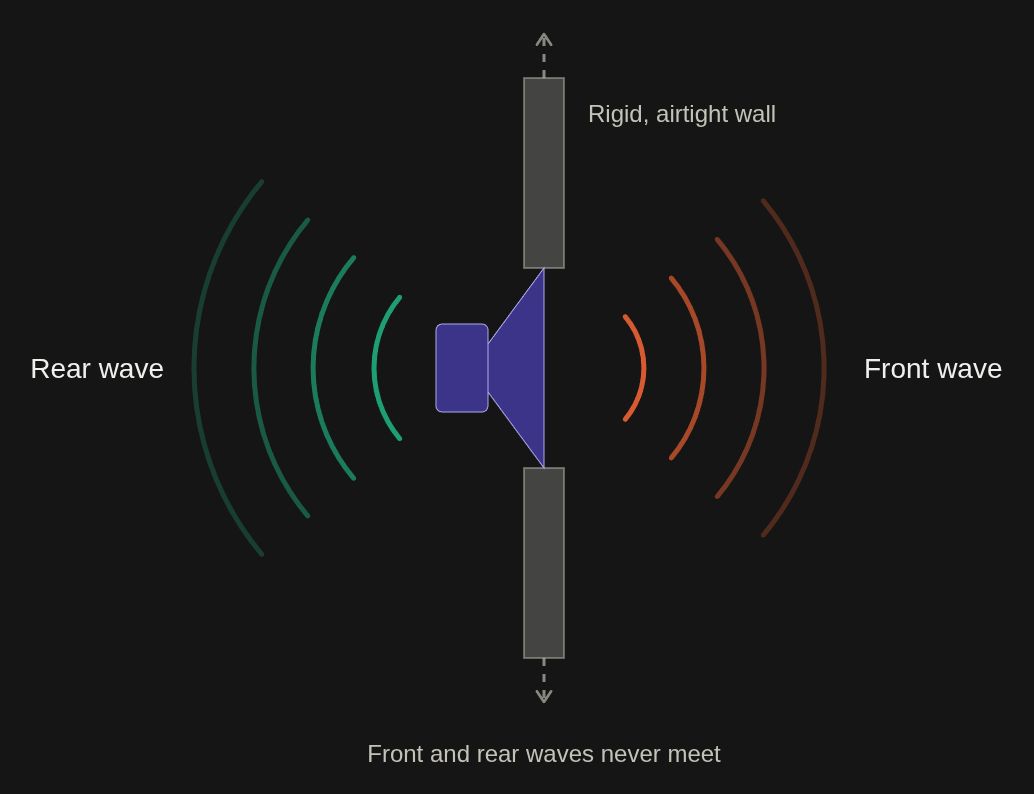
The textbook infinite baffle is a flat wall that extends forever in every direction. A driver mounted in it can never have its front wave and rear wave meet, so the two cannot cancel at low frequencies. Nobody builds that, but the principle is useful: separate the front wave from the rear wave completely, and give the rear wave nowhere to push back.
The practical version has two requirements:
- Separation. The baffle must be rigid and airtight, so no air can pass from the rear of the driver to the front except through the driver itself.
- Volume. The enclosed space behind the driver must be large compared with the driver's Vas, so that the air spring it creates is negligible. If the volume is too small, you simply have a very large sealed box with a stiffer, higher-Q result than you expected.
Infinite baffle, free air, open baffle and sealed boxes
These terms are often mixed up. Here is how they differ:
| Setup | What happens to the rear wave | Air spring behind the cone |
|---|---|---|
| Infinite baffle | Trapped in a very large sealed volume, such as a trunk or a room | Negligible, so Qtc is close to Qts and Fc is close to Fs |
| Sealed box | Trapped in a box sized to the driver | Significant, and it sets Qtc and Fc |
| Open baffle | Allowed to escape into the room, where it cancels the front wave at low frequencies | None |
| "Free air" subwoofer | Depends on how it is installed. The term is used for drivers designed for infinite baffle use, and it does not mean the driver needs no baffle | Depends on the installation |
The last row catches many people out. A driver sold as "free air" still needs its rear wave isolated from its front wave. Hung in open air with nothing around it, it would lose most of its bass to cancellation, like any other driver.
Why it works: the air spring and Vas
Every sealed system has two springs: the driver's own suspension and the air trapped behind the cone. Vas describes how soft the suspension is, expressed as a volume of air with the same stiffness. When the box volume (Vb) is small compared with Vas, the air is the stiffer spring and dominates the result. When Vb is large compared with Vas, the suspension dominates and the air adds very little.
The standard sealed-box relationships show this directly:
Fc = Fs × √(1 + Vas ÷ Vb)
Qtc = Qts × √(1 + Vas ÷ Vb)
As Vb grows relative to Vas, the square root approaches 1, so Fc approaches Fs and Qtc approaches Qts. That limit is the infinite baffle. The table shows how quickly the box effect fades:
| Rear volume ÷ Vas | Fc and Qtc multiplier | What it means |
|---|---|---|
| 1 | 1.41 | The box is as stiff as the suspension. Fc and Qtc rise by about 41 percent. |
| 2 | 1.22 | A clear but modest increase, about 22 percent. |
| 4 | 1.12 | The box effect is small, about 12 percent. |
| 10 | 1.05 | Nearly a true infinite baffle. The box adds about 5 percent. |
There is no sharp line where a large sealed box becomes an infinite baffle. A rear volume of several times Vas is commonly treated as good enough, and the gains beyond that are small.
Worked example (hypothetical driver)
Take an imaginary subwoofer with Fs = 24 Hz, Qts = 0.55 and Vas = 90 litres, a driver with a fairly stiff suspension. Here is what different rear volumes do to it:
| Rear volume | Volume ÷ Vas | Fc | Qtc | Character |
|---|---|---|---|---|
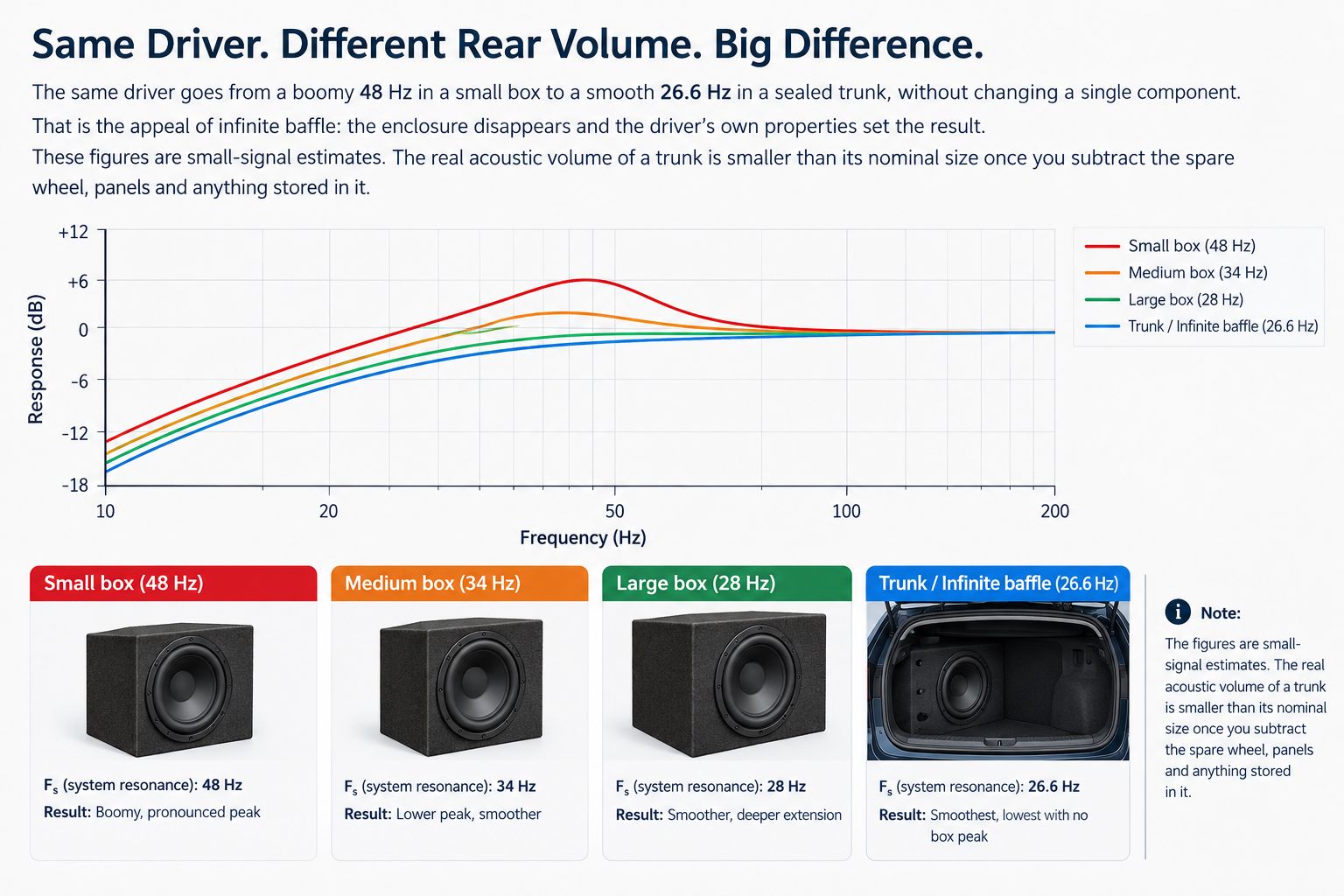
| 30 litres (small sealed box) | 0.33 | 48 Hz | 1.10 | Peaky and boomy, with little deep bass |
| 60 litres (sealed box) | 0.67 | 37.9 Hz | 0.87 | Warm, with a bump around Fc |
| 150 litres (large sealed box) | 1.67 | 30.4 Hz | 0.70 | Flat and controlled |
| 400 litres (sealed trunk) | 4.44 | 26.6 Hz | 0.61 | Deep, smooth and gently rolled off |
| True infinite baffle (limit) | very large | 24 Hz | 0.55 | The driver on its own |
The same driver goes from a boomy 48 Hz in a small box to a smooth 26.6 Hz in a sealed trunk, without changing a single component. That is the appeal of infinite baffle: the enclosure disappears and the driver's own properties set the result. These figures are small-signal estimates. The real acoustic volume of a trunk is smaller than its nominal size once you subtract the spare wheel, panels and anything stored in it.
Choosing a driver for infinite baffle
Because the enclosure no longer shapes the response, the driver has to do it alone. These are the properties to look for:
| Parameter | What to look for | Why it matters |
|---|---|---|
| Vas | Well below the rear volume you actually have, ideally several times smaller | Keeps the air spring negligible. A driver with a large Vas needs an enormous space to behave this way. |
| Qts | Moderate to high. Manufacturers commonly suggest above about 0.6, and some use 0.7 as the line | There is no box to raise the Q, so Qts alone sets the shape of the response. Around 0.5 to 0.7 gives a smooth roll-off. |
| Fs | Low, ideally in the low to mid 20s of Hz or lower | Fc stays close to Fs, so a low Fs means deep bass. |
| Xmax | High | With no air spring limiting travel, the cone moves further at low frequencies. |
| Construction | Stiff suspension, heavy cone, strong motor | These drivers are built to control themselves without a box. Check that the manufacturer states the driver is suitable for infinite baffle use. |
These are guidelines, and sources draw the lines in different places. A driver with a lower Qts can work in infinite baffle if its Fs is also low. A very low Qts, around 0.3, leaves the system over-damped: the response begins to fall at a higher frequency than the Fs suggests, so you lose the deep bass you wanted.
Two mistakes are common. The first is choosing a driver because it was designed for a small sealed box or a ported box and then putting it in a trunk. Those drivers are matched to a particular box and often have a low Qts. The second is treating the power rating as a measure of what the driver can take. In infinite baffle the limit is often how far the cone can travel at low frequencies, not heat, so a high rating does not remove the need for a filter.
Setting up an infinite baffle in a car
The trunk as the enclosure
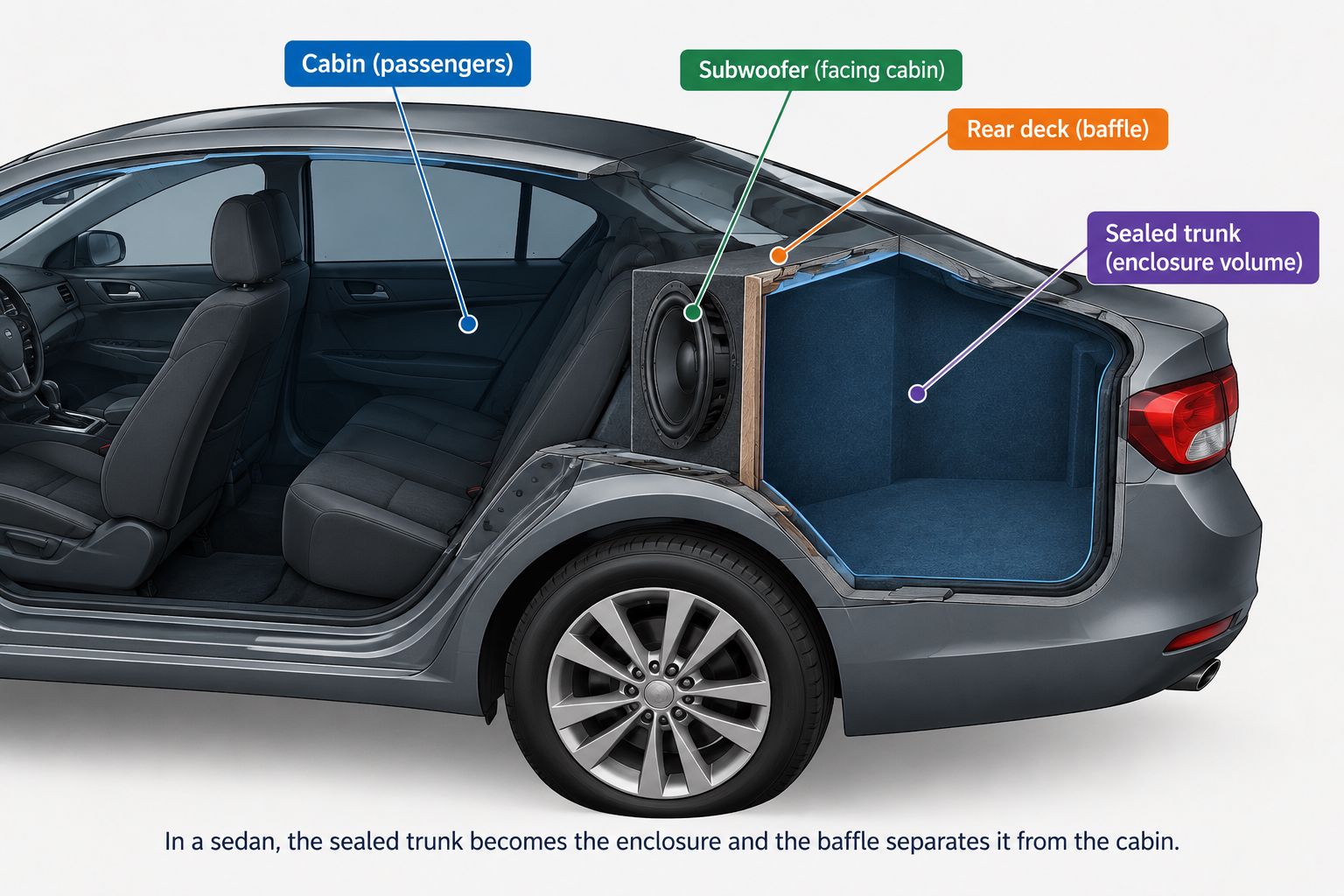
The classic installation uses a sedan. The driver is mounted in a rigid baffle at the rear seat back or the rear deck, facing into the cabin, and the sealed trunk behind it is the enclosure. The sound the driver radiates forward fills the cabin, and the sound it radiates backward goes into the trunk.
Cars with a cargo area open to the cabin, such as hatchbacks and SUVs, are harder. There is no natural wall between the two spaces, so you would have to build a sealed bulkhead and a separate sealed chamber behind it. In many of those vehicles a conventional sealed or ported box is the more practical choice.
Building the baffle
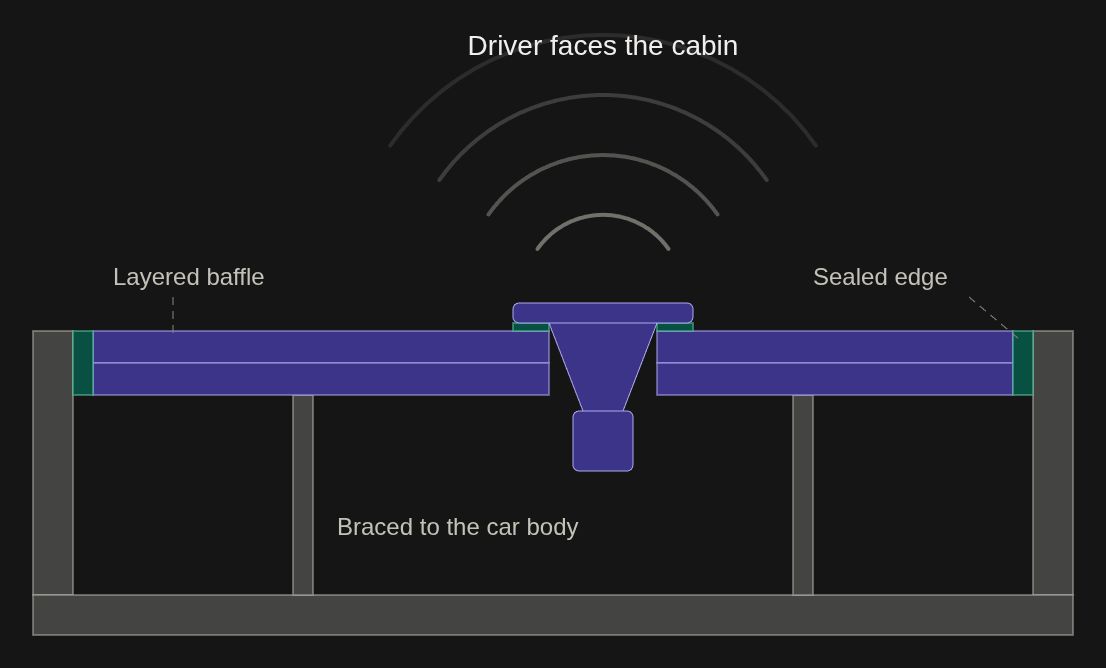
- Make it rigid. Use 3/4 in (18 to 19 mm) MDF or plywood at minimum, and consider two layers glued together, since the baffle carries the driver's motor and any flex wastes energy. Thin factory sheet metal moves with the cone, so reinforce it or replace the section with your own panel.
- Brace it to the car. The baffle's job is to stay still. Fix it firmly to the car's structure with braces that run to solid points.
- Seal every edge. Use closed-cell foam tape or sealant between the baffle and the car body, and seal the driver cutout, terminals and any wiring pass-throughs.
- Leave room behind the driver. The cone, magnet and basket need clearance in the trunk, and nothing stored there should be able to press against the motor.
- Secure it properly. A heavy baffle with a heavy driver is a hazard if it comes loose in hard braking or a collision. Avoid cutting or drilling near seat belt anchors, fuel lines or wiring harnesses, and have a professional install it if you are unsure about structural parts.
Sealing the trunk from the cabin
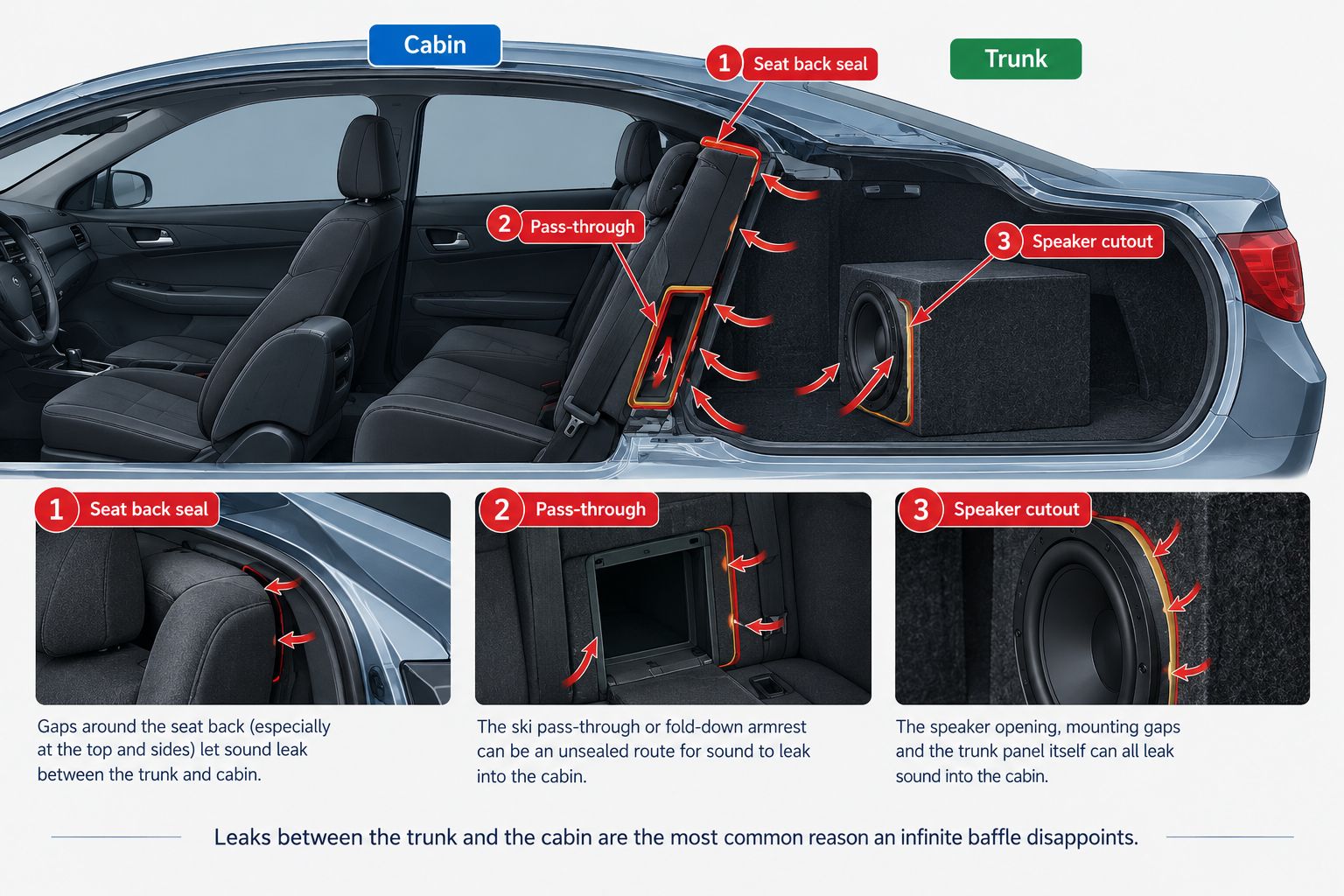
Air that leaks from the trunk to the cabin lets the rear wave reach the front, which is exactly what the baffle exists to prevent. Check these common leak points:
- The rear seat back, its folding mechanism and any gaps between the seat and the body.
- The ski pass-through, if the car has one.
- Cutouts for factory rear speakers, which open straight into the trunk.
- Seat belt holes, wiring grommets and the openings around the third brake light.
- The edges of the rear shelf where it meets the window and the pillars.
Two simple checks help. For the first, park in a dark garage, put a bright light in the trunk, close the lid and look for light showing into the cabin. Never climb into the trunk to do this. For the second, play a low test tone at modest volume and hold your hand near the suspect gaps, listening for hissing or feeling for moving air. Fill gaps with foam, sealant or butyl tape.
Leaks from the trunk to the outside matter less, but they still change the behaviour. Some installers add a small trunk vent deliberately to get closer to a true infinite baffle. Treat it as an experiment you can measure and judge by ear, and keep the vent clear of the cabin side.
Cabin gain and the high-pass filter
A car cabin is a small closed space and it reinforces low frequencies. The effect varies by vehicle, but it is often noticeable below roughly 60 Hz. A sealed or infinite baffle system rolls off gently, at 12 dB per octave below Fc, and cabin gain can rise at a similar rate, so the two often combine into bass that stays usable well below the driver's resonance. That is one reason infinite baffle works so well in cars and can seem less impressive in a large room.
The other side of the coin is cone movement. With no air spring behind it, the cone can travel a long way below Fs, especially with music that has very low or infrasonic content. Set a high-pass filter close to Fs (many installers start near it or slightly below), then check the setting by measurement or simulation for your driver and amplifier power. Do not rely on the cone's apparent sound to tell you it is safe, because a cone can hit its limits before it sounds strained.
Infinite baffle at home
The same principle works indoors. A driver is mounted in a wall, and the room or space on the other side becomes the enclosure. A closet, a utility room or an adjoining room can all work if it is large enough and sealed. Doors, gaps, ducts and electrical outlets all leak, so the practical challenge is airtightness. Check local building and fire rules before cutting into a wall, and keep in mind that the space behind the wall has to stay closed for the system to work as designed.
Strengths and limits
- Strengths: no box to build or fit, so storage space is kept. A smooth, gradual 12 dB per octave roll-off. Bass that extends close to the driver's own Fs. Results that do not depend on a precise box volume.
- Limits: it needs a driver made for it. It needs an airtight baffle and sealed trunk, which takes careful work. The cone has no air spring to control it, so excursion and a high-pass filter matter. It suits sedans and enclosed spaces better than hatchbacks and open cargo areas.
Infinite baffle compared with sealed and ported
| Feature | Infinite baffle | Sealed box | Ported box |
|---|---|---|---|
| Box to build | None, uses the trunk or a room | Yes, sized to the driver | Yes, usually larger |
| What sets the response | The driver's own Qts and Fs | Box volume sets Qtc and Fc | Box volume and tuning |
| Roll-off below the limit | 12 dB per octave | 12 dB per octave | 24 dB per octave |
| Cone control at very low frequencies | Driver suspension only | Air spring helps | Poor below tuning |
| Main difficulty | Sealing and rigidity | Easy | Port design and tuning |
| Best suited to | Sedans, drivers made for it, tidy installs | Most drivers, tight spaces | Output, drivers with low Qts |
Measuring and checking the result
An impedance sweep with free software such as Room EQ Wizard (REW) and a suitable measurement interface shows a single peak at the system resonance. In a well-done infinite baffle that peak sits close to the driver's Fs, a little above it. If it sits well above what the calculation predicts, the usable rear volume may be smaller than you assumed, or the driver may not be broken in yet. Then measure the response at the listening position, listen at a range of volumes and watch the cone at high levels.
Common mistakes
- Using a driver that was not designed for it. A low-Qts driver for a small box becomes over-damped, and a driver with a soft suspension needs more rear volume than a trunk can give.
- Leaks into the cabin. Even small gaps around the seat back, pass-through or speaker cutouts can undo the baffle.
- A flimsy baffle. A baffle that flexes or rattles adds distortion and wastes output.
- Overestimating the trunk volume. The spare wheel, panels and cargo reduce the acoustic space.
- No high-pass filter. Without an air spring, the cone can exceed its limits below Fs.
- Trusting a power rating. A high rating does not tell you the driver can reach full power at low frequencies.
- Copying a hatchback or SUV build from a sedan. An open cargo area is not a sealed enclosure.
Sources and further reading
The explanations and worked examples above were written for this guide. These references are listed for readers who want the underlying mathematics or manufacturer guidance.
- R. H. Small, "Closed-Box Loudspeaker Systems" (Journal of the Audio Engineering Society, 1972).
- J. Ernest Benson, Theory & Design of Loudspeaker Enclosures, Prompt Publications, 1996.
- MTX Audio, Mobile audio subwoofer enclosure design, for manufacturer guidance on infinite baffle drivers.
- Rod Elliott, Loudspeaker Enclosure Design Guidelines, Elliott Sound Products.
Last reviewed: October 2026.
Infinite baffle speakers FAQ
What is an infinite baffle speaker?
It is a driver mounted so that its rear wave goes into a volume so large, compared with the driver's Vas, that the air behind it adds almost no stiffness. The driver behaves much as it would on its own, with a system resonance close to its free-air Fs. In cars the trunk is usually the enclosure and a rigid baffle separates it from the cabin.
Is infinite baffle better than a sealed box?
Neither is better in every case. Infinite baffle needs no box and lets the driver's own properties set the response, but it needs a driver made for it and a carefully sealed baffle and trunk. A sealed box suits a wider range of drivers and tight spaces, and its volume lets you shape the response.
What should I look for in a driver for infinite baffle?
Look for a stiff suspension and a Vas well below the rear volume you actually have, a low Fs, a high Xmax and a moderate to high Qts. Many manufacturers suggest a Qts above about 0.6, though some use 0.7. Check that the manufacturer says the driver is suitable for infinite baffle use.
How much space does an infinite baffle need?
The rear volume should be several times the driver's Vas. As a guide, a volume four times Vas changes Fc and Qtc by only about 12 percent, and ten times Vas changes them by about 5 percent. Remember that the usable volume of a trunk is smaller than its nominal size once the spare wheel, panels and cargo are taken out.
Does the trunk have to be airtight?
The path between the trunk and the cabin must be airtight, because any leak lets the rear wave reach the front and cancel bass. Check the rear seat back, any ski pass-through, factory speaker cutouts, wiring grommets and the edges of the rear shelf. Leaks to the outside of the car matter less but still change the behaviour.
Do I need a high-pass filter with an infinite baffle subwoofer?
Yes, it is strongly recommended. With no air spring behind it, the cone can travel a long way below the driver's Fs, so a high-pass filter set close to Fs helps protect it. Confirm the setting by measurement or simulation for your driver and amplifier power.
Is a free-air subwoofer the same as an infinite baffle subwoofer?
In practice, yes. Free air is a name given to drivers designed for infinite baffle use. It does not mean the driver can work with no baffle. A driver hung in open air with nothing around it still loses bass to front and rear cancellation.