Car Amplifiers
Lanzar OPTI4000D Review: Specs, Wiring and Power Limits
Published October 8, 2026
A specification-based review of the Lanzar OPTI4000D monoblock: rated power at 4, 2 and 1 ohm, current draw, wire size, gain setting and what to check before buying.
This Lanzar OPTI4000D review looks at a class D monoblock subwoofer amplifier from Lanzar's OptiDrive range. The maker rates it at 2,000 W RMS into 4 ohms, 3,000 W into 2 ohms and 4,000 W into 1 ohm, a very large figure for one channel. It is discontinued: as of October 14, 2026, Sonic Electronix lists it among its discontinued Lanzar monoblocks, and no direct successor is confirmed. The sections below work out what the ratings imply for current draw, cable size and subwoofer matching, then list what to check before buying a used or leftover unit.
Lanzar OPTI4000D ratings and what is missing from them
Lanzar's OPTI owner's manual covers several models, and retail listings agree on the three headline ratings. The manual text available online is an imperfect scan, so confirm values against the printed manual for your unit. The rating conditions are the weak point: the supply voltage, test frequency and distortion limit behind the 4,000 W figure are not stated in the manual text available. Listings add a 0.1% THD figure, a 90 dB signal-to-noise figure, a 10 kilohm input impedance and a 20 Hz to 250 Hz response. One listing also quotes a 3,000 W "max" figure at 4 ohms, so treat maximum and RMS numbers as different things.
The CTA-2006 standard shows why this matters. It calls for a 14.4 V supply (tolerance +0/-5%), a 1% THD+N limit and a 50 Hz test tone for subwoofer amplifiers, and it requires any departure, such as higher distortion or a bridged connection, to be published with the rating. BestCarAudio's 2023 article on the standard's latest revision adds an editorial view that 12.5 V is closer to real-world conditions. Lanzar's manual states none of these conditions for this model, so the ratings are best read as a ceiling.
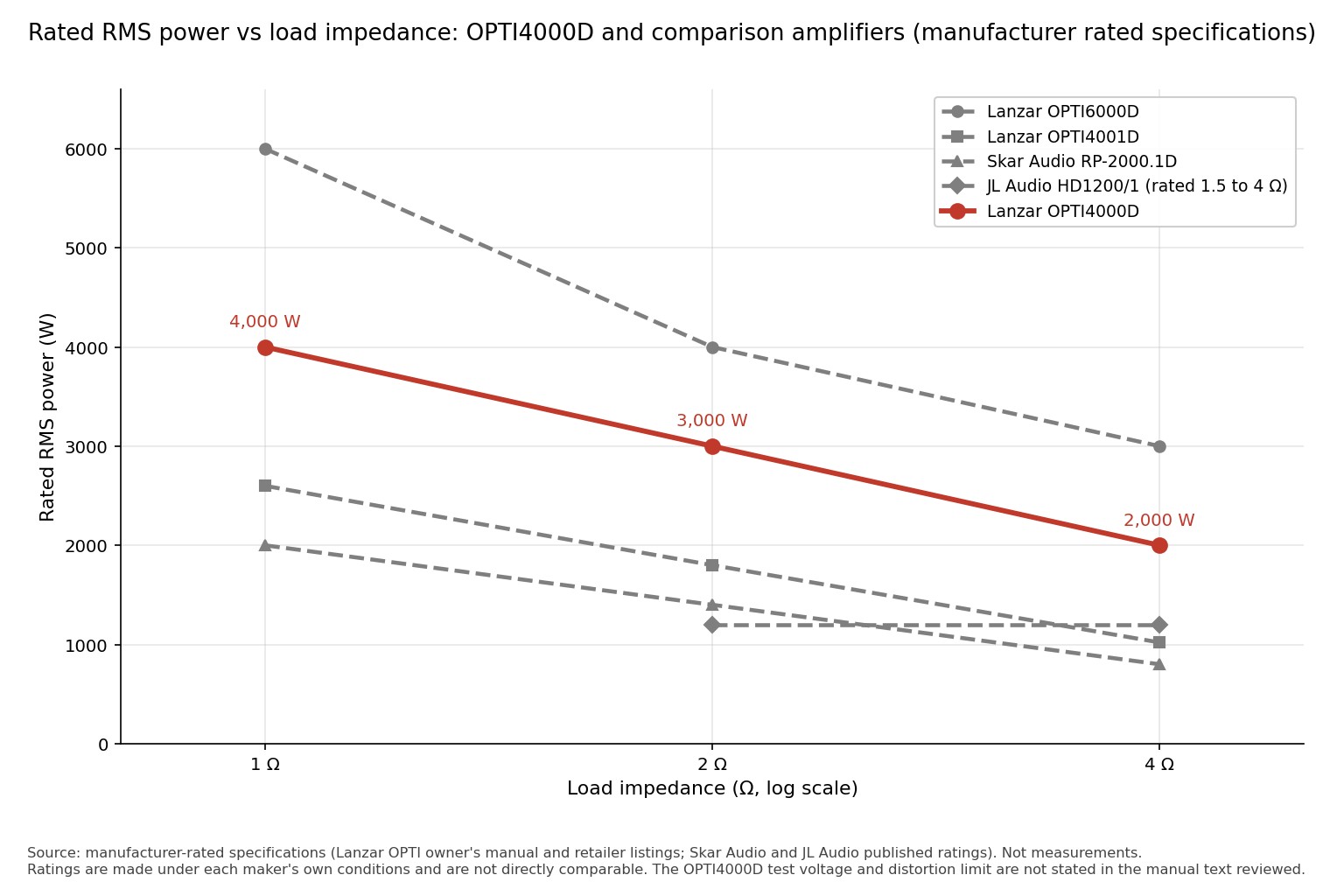
Figure 1 plots the three ratings against other published ratings. Each maker tests under its own conditions, so the lines show scale, not a ranking.
Lanzar OPTI4000D design and features
The manual describes a class D design with a regulated PWM power supply and MOSFET switching, and says the amplifier holds rated power across a wide range of battery voltages. That is a marketing claim; no voltage range or test data accompanies it. The low-pass filter runs from 50 Hz to 250 Hz at 24 dB per octave per the manual, although one listing gives a 50 to 150 Hz range. Listings also show a variable subsonic filter (15 to 40 Hz), a 0 to 180 degree phase control, a remote level knob input and protection against thermal overload and speaker shorts.
The manual describes RCA line outputs for feeding a second amplifier without a splitter, plus a master and slave switch for bridging two amplifiers of the same model number. No combined power rating for that mode is confirmed. Bass boost range, damping factor, weight, efficiency, fuse rating and operating voltage range are not confirmed in the sources available.
Size is the main fitting issue. Many listings show 11.4 x 2.8 x 10.2 in, but a forum poster in 2006 reported that Lanzar's website had the dimensions wrong and that the manual gives 10.08 x 2.12 x 23.3 in (about 256 x 54 x 592 mm). That figure is secondhand, so measure the actual unit before cutting a panel or building a rack.
What the Lanzar OPTI4000D ratings imply
Voltage is the square root of power times load, and current is the square root of power divided by load. Applied to the rated figures, they show what the output stage must produce at each load.
| Load | Rated RMS power | Output voltage (RMS) | Output voltage (peak) | Output current (RMS) |
|---|---|---|---|---|
| 4 Ω | 2,000 W | 89.4 V | 126.5 V | 22.4 A |
| 2 Ω | 3,000 W | 77.5 V | 109.5 V | 38.7 A |
| 1 Ω | 4,000 W | 63.2 V | 89.4 V | 63.2 A |
A peak of about 126 V at 4 ohms is far above battery voltage, so the amplifier must boost the supply internally. Going from 4 ohms to 1 ohm doubles the power (3 dB) while output current nearly triples.
Safety: with a loud test tone, the speaker terminals can carry tens of volts RMS. Do not touch bare terminals or speaker wire while a tone plays, and keep the volume low until the gain is set. Prolonged high-level bass can also damage hearing.
Battery current at rated output
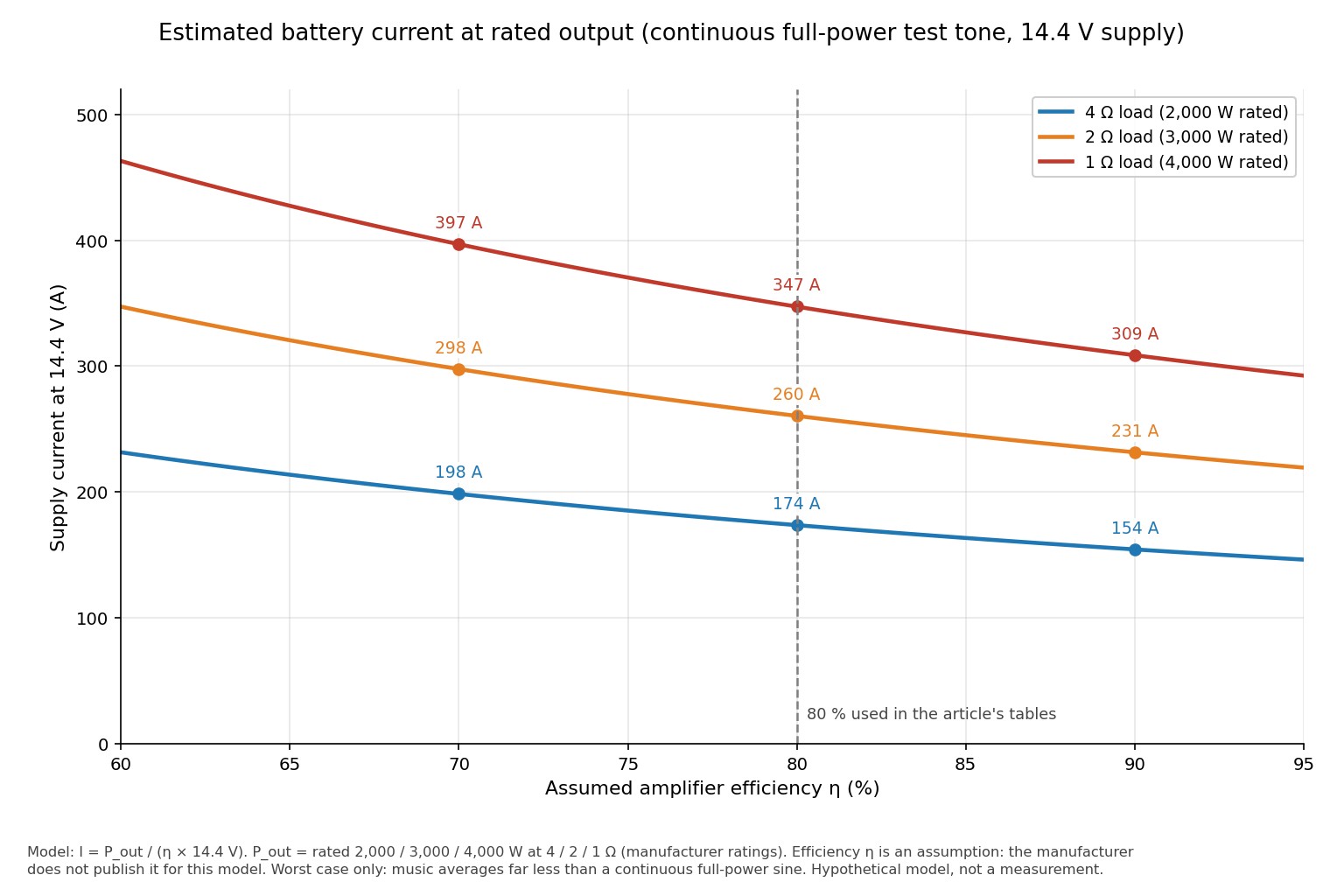
Supply current is output power divided by efficiency, divided by supply voltage. The maker's efficiency figure was not found, so the table assumes 70, 80 and 90 percent at 14.4 V. These are assumptions, not specifications.
| Load | Rated output | 70% efficiency | 80% efficiency | 90% efficiency |
|---|---|---|---|---|
| 4 Ω | 2,000 W | 198 A | 174 A | 154 A |
| 2 Ω | 3,000 W | 298 A | 260 A | 231 A |
| 1 Ω | 4,000 W | 397 A | 347 A | 309 A |
These are worst-case figures for a continuous full-power tone. Music is different: if average output were one-eighth of the 4 ohm rating (250 W) at a constant 80 percent efficiency, the average draw would be about 22 A. The peaks still have to come from the battery and cables.
What a sagging supply could do
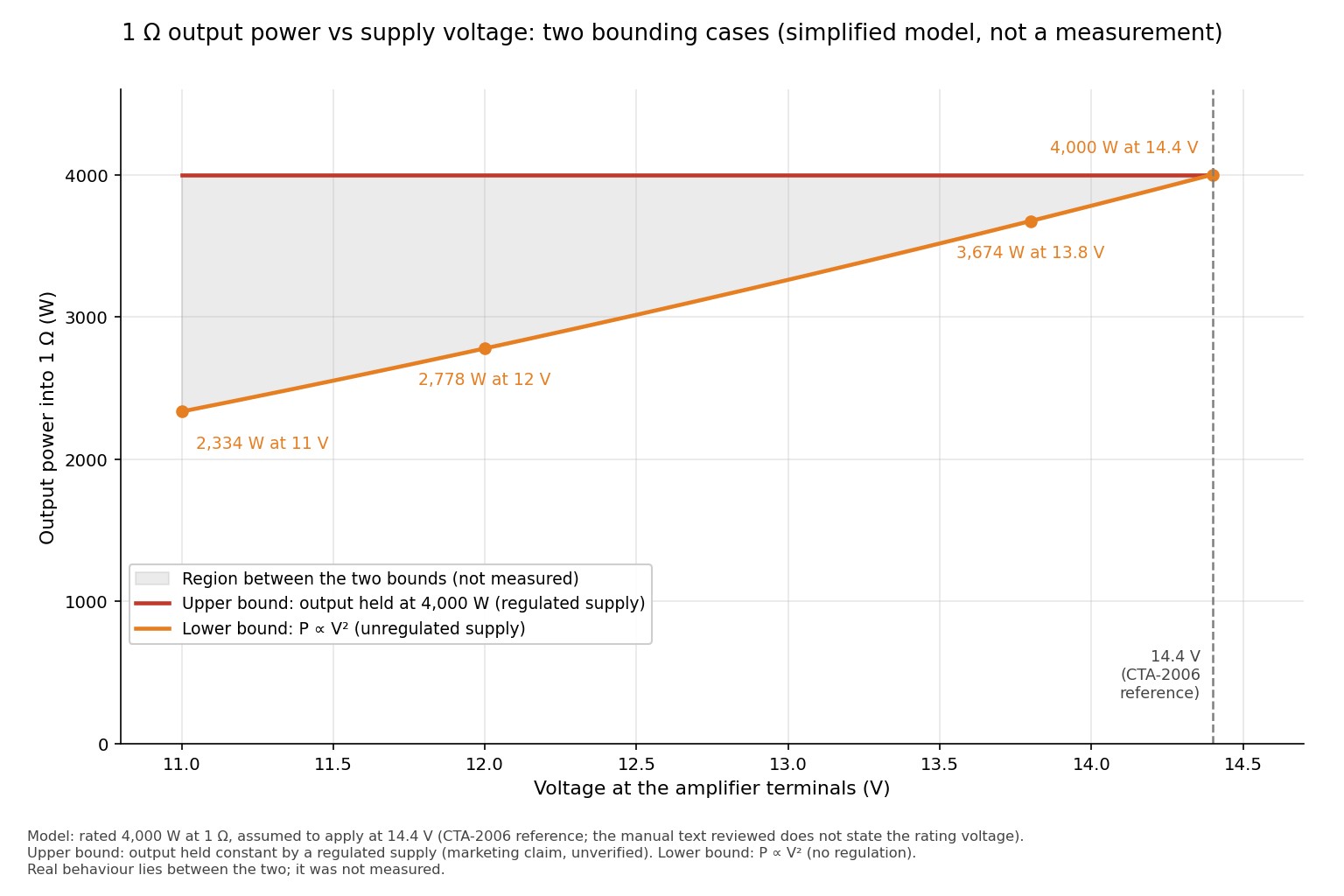
One forum poster noted that some 4,000 W amplifiers from other brands are rated at 17 V and that it was unclear whether Lanzar used 14.4 V or 17 V. Figure 3 bounds the 1 ohm output for two extremes: a perfectly regulated supply that holds 4,000 W, and an unregulated one where power scales with the square of voltage. At 12 V the bounds are 2,778 W and 4,000 W; at 13.8 V they are 3,674 W and 4,000 W. The real amplifier lies somewhere between, and the curve is not published.
Owner and forum reports
A forum thread dated April 2006 includes a poster's claim that SPL enthusiasts had bench-tested OPTI4000D units at 4,500 W to 5,700 W at 13.5 V, without naming the load or the source. That is a secondhand anecdote from nearly twenty years ago and is not evidence of measured output. Another poster with experience of the OptiDrive line called it good value and fairly reliable, and better suited to low-impedance SPL builds than to sound-quality builds. No independent lab measurements of this model were found, and the only distortion figure quoted by listings, 0.1%, says little about behavior near full power.
Lanzar OPTI4000D wiring and installation
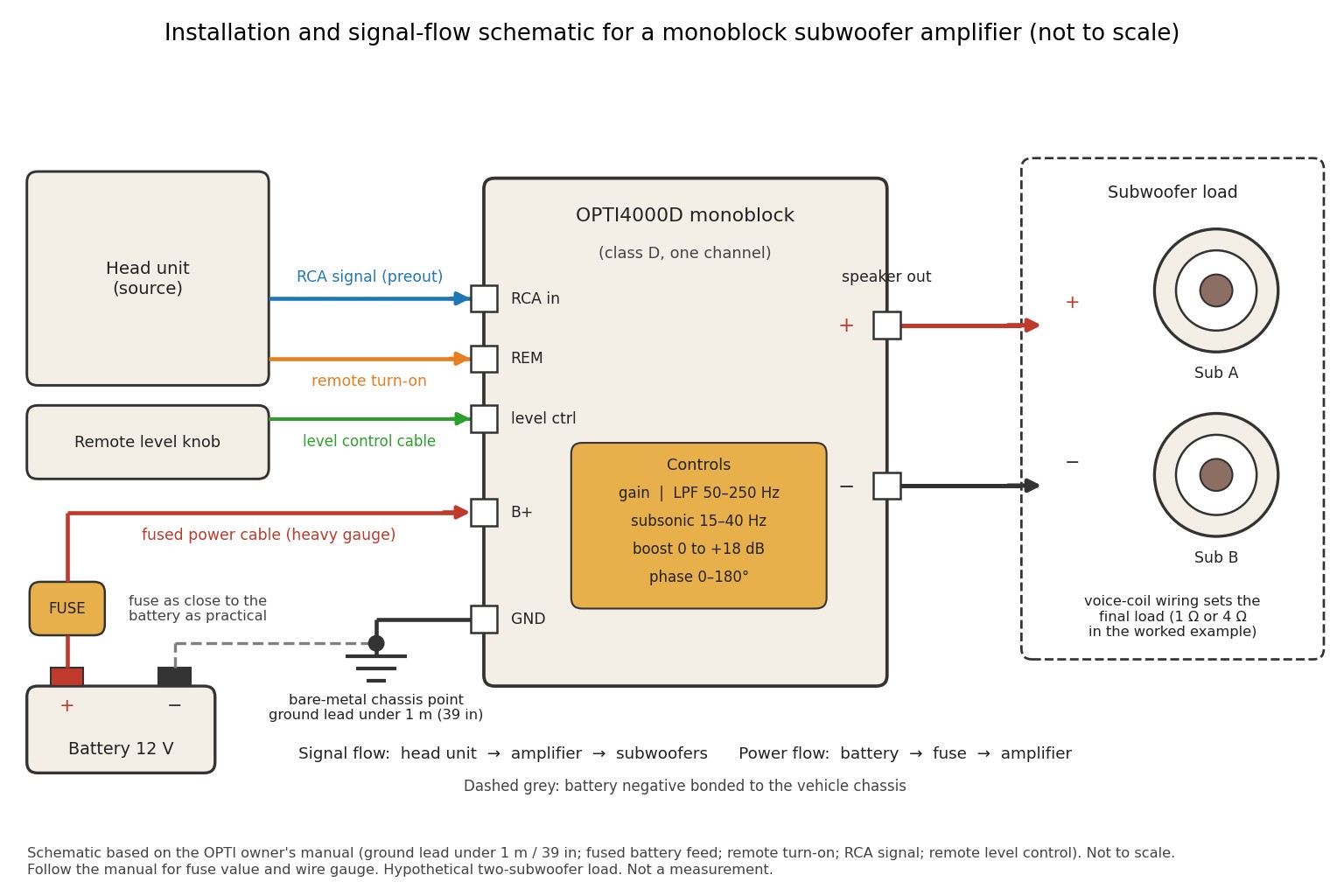
Safety: a circuit like this can carry hundreds of amps, and a shorted power cable is a fire risk. Disconnect the battery negative terminal before working, fuse the positive cable close to the battery, protect the cable where it passes through metal, and wear eye protection when drilling or cutting panels.
- Plan the mount. Allow for a length of up to 592 mm and leave airflow around the chassis, as the manual asks.
- Fuse and cable. The fuse rating for this model is not confirmed, so take it from the label or the printed manual. For context, JL Audio specifies a 100 A fuse and 2 AWG copper minimum for its 1,200 W HD1200/1, and Skar lists a 200 A fuse for its 2,000 W RP-2000.1D. The OPTI4000D's rated output is higher than both.
- Ground. The manual calls for a ground lead under 1 m (39 in) to bare chassis metal. Remove paint at the contact point.
- Signal and remote. Run RCA cables away from the power cable. The manual's troubleshooting notes call for at least 13.8 V at the remote terminal and battery power at the positive terminal.
- Set the gain with a meter, as described below.
Cable size and voltage drop
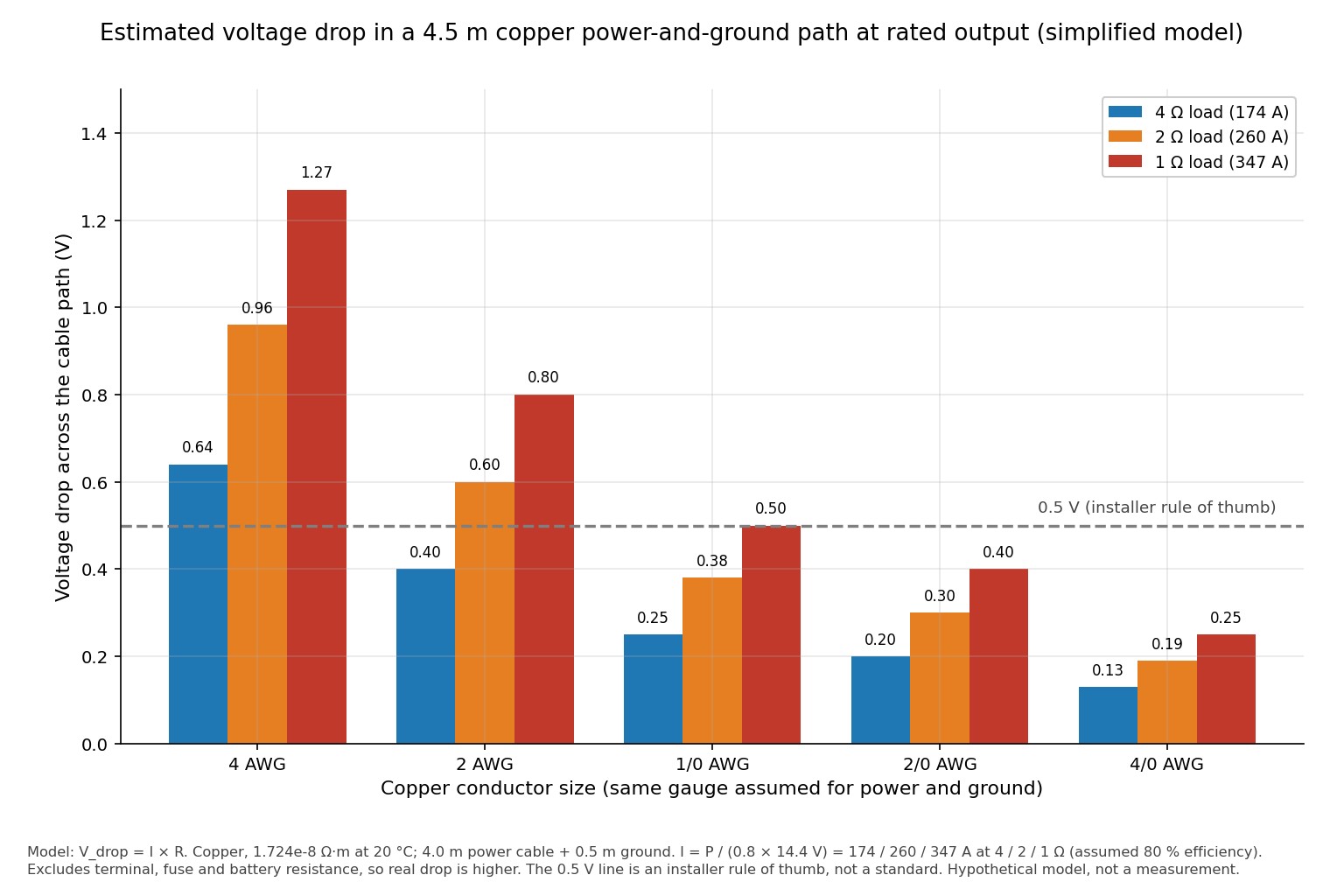
Voltage lost in the cable never reaches the amplifier. The table assumes copper, a 4.0 m power cable plus a 0.5 m ground, and the 80 percent currents above.
| Copper cable | Path resistance (mΩ) | Drop at 4 Ω (174 A) | Drop at 2 Ω (260 A) | Drop at 1 Ω (347 A) | Heat in cable at 1 Ω |
|---|---|---|---|---|---|
| 4 AWG | 3.67 | 0.64 V | 0.96 V | 1.27 V | 442 W |
| 2 AWG | 2.31 | 0.40 V | 0.60 V | 0.80 V | 278 W |
| 1/0 AWG | 1.45 | 0.25 V | 0.38 V | 0.50 V | 175 W |
| 2/0 AWG | 1.15 | 0.20 V | 0.30 V | 0.40 V | 139 W |
| 4/0 AWG | 0.72 | 0.13 V | 0.19 V | 0.25 V | 87 W |
At full rated output into 1 ohm, a 4 AWG path would drop more than a volt and waste about 442 W as heat; even 1/0 AWG dissipates about 175 W. Terminals, fuse holders and the battery add resistance, so these are lower bounds. Copper-clad aluminum has higher resistance than the copper assumed here. Follow the cable maker's current ratings.
Matching the Lanzar OPTI4000D to subwoofers
Take two hypothetical dual 4 ohm subwoofers, each rated 1,000 W RMS. Voice-coil wiring sets the final load, and the amplifier's rated maximum follows from it.
| Wiring | Final load | Rated maximum | Per subwoofer | Share of 1,000 W | Gain target for 2,000 W |
|---|---|---|---|---|---|
| Coils parallel, subs parallel | 1 Ω | 4,000 W | 2,000 W | 200% | 44.7 V |
| Coils series, subs parallel | 4 Ω | 2,000 W | 1,000 W | 100% | 89.4 V |
| Coils parallel, subs series | 4 Ω | 2,000 W | 1,000 W | 100% | 89.4 V |
| Everything in series | 16 Ω | No rating published | Not applicable | Not applicable | Not applicable |
At 1 ohm the amplifier's rated maximum is twice what these subwoofers can take, so only the gain setting protects them. At 4 ohms the maximum equals the subwoofers' combined rating and the supply current is lower (174 A against 347 A at 80 percent efficiency). The gain targets use the same formula: 44.7 V at 1 ohm and 89.4 V at 4 ohms for 2,000 W.
Setting the gain with a meter
- Disconnect the speaker wires, set the gain to minimum, and set the filters where you intend to run them. Leave bass boost off.
- Play a 50 Hz test tone with the head unit's tone controls flat and raise the volume to the loudest point at which it still plays cleanly. Many installers start near three-quarters volume, which is a field rule of thumb.
- With a true-RMS AC voltmeter across the speaker terminals, raise the gain until the reading equals the target voltage. Keep each tone short.
- Turn the system off before touching any wiring, then reconnect the speakers.
A sine tone is not music and meter accuracy varies, so this protects subwoofers better than setting the gain by ear but is not a guarantee.
Lanzar OPTI4000D vs Skar RP-2000.1D vs JL Audio HD1200/1
| Amplifier | 4 Ω | 2 Ω | 1 Ω | Notes |
|---|---|---|---|---|
| Lanzar OPTI4000D | 2,000 W | 3,000 W | 4,000 W | Rating voltage not stated; discontinued |
| Skar Audio RP-2000.1D | 800 W | 1,400 W | 2,000 W | Rated at 14.4 V; 2,800 W peak at 1 ohm; 200 A fuse; 1/0 gauge terminals; remote knob included; working voltage 8.5 to 14.4 V per the Newegg listing |
| JL Audio HD1200/1 | 1,200 W | 1,200 W | Not rated | 1,200 W from 1.5 to 4 ohms at both 14.4 V and 12.5 V; 100 A fuse; 2 AWG minimum; 6.6 lb |
The Skar is the closest 1 ohm design, with ratings tied to 14.4 V. The JL Audio offers a far lower number that its maker states holds at both 14.4 V and 12.5 V. Only the OPTI4000D leaves its rating voltage unpublished.
Lanzar OPTI4000D price and buying a used unit
The OPTI4000D is discontinued, so purchases are used or leftover stock. A current price could not be confirmed. For reference, an eBay seller listing captured around December 2025 showed a new unit at $499 with a 30-day return window, and the Skar and JL Audio listings above showed $349 and $1,499.99 at their sellers on a recent visit. Prices change often, so check the current listing. Some links on this page are affiliate links; they never affect our ratings. As an Amazon Associate I earn from qualifying purchases.
Before buying, check these points:
- Ask for the exact model label and the measured length, and compare it with the manual's figure.
- Look at the terminals and heatsink for heat damage, and ask for photos of the label.
- Prefer sellers who offer returns, since a used amplifier of this age has no manufacturer warranty.
- Ask whether the remote level knob, manual and mounting hardware are included.
- Budget for cable, fuse and electrical upgrades before the amplifier itself.
Who the Lanzar OPTI4000D suits and who should skip it
It suits someone with a heavy-duty electrical system, large subwoofers rated near the amplifier's output and a use case where output matters more than refinement. Skip it if the car has a stock electrical system, space is tight, the build needs a documented rating at a stated voltage, or a warranty matters. In those cases a modern amplifier with ratings at both 14.4 V and 12.5 V, such as the JL Audio above, is the lower-risk route.
Lanzar OPTI4000D final verdict
On paper the OPTI4000D is a powerful, flexible subwoofer amplifier with a useful filter set. The paper does not show the voltage and distortion behind the 4,000 W figure, how it behaves at low battery voltage or how it measures. If you can supply the current, set the gain carefully and match the subwoofers' power handling, it can make sense as a used purchase. If you need verified, voltage-stable output, look at amplifiers that publish ratings at more than one voltage. More guides are in car amplifiers, car subwoofers and the wider car audio section.
Sources and further reading
Ratings are manufacturer or retailer ratings, not measurements. Images were drawn from those ratings and simple models.
- Lanzar OPTI owner's manual on ManualsLib: shared manual that lists the OPTI4000D; features, wiring and troubleshooting pages (scanned text).
- BestCarAudio, April 14, 2023: how the CTA-2006-D standard defines amplifier power tests.
- Sonic Electronix discontinued Lanzar monoblocks: discontinued status.
- ecoustics forum thread, April 2006: dimension discrepancy and bench-test claims; anecdotal and secondhand.
- CarAudio.com forum thread on OPTI amplifiers: installer opinion about rating and use; anecdotal.
- Online Car Stereo customer comments: owner opinion; anecdotal and undated.
- eBay seller listing for a new OPTI4000D: price and return terms at the time of capture; not a current price.
- Retailer listing copy mirrored on a third-party site: filter, THD and dimension claims; secondhand.
- Skar Audio RP-2000.1D listing on Newegg: ratings, fuse and terminal details.
- JL Audio HD1200/1 listing at Car Toys: ratings at 14.4 V and 12.5 V, fuse and wire requirements.
Lanzar OPTI4000D questions answered
How much power does the Lanzar OPTI4000D make?
The maker rates it at 2,000 W RMS into 4 ohm, 3,000 W into 2 ohm and 4,000 W into 1 ohm. The manual text reviewed does not give the test voltage or distortion limit, and no verified independent measurement was found. Forum-relayed bench figures were lower at 1 ohm because the test supply ran out.
Is the OPTI4000D stable at 1 ohm?
It carries a power rating at 1 ohm, so 1 ohm is within its rated range. Some listings mention 0.5 ohm operation, but that was not confirmed for this model. Do not wire below the lowest load in the manual.
What wire gauge does the OPTI4000D need?
It depends on cable length and the current you expect. In a simple model with a 4.5 m copper path and 347 A at 1 ohm, 4 AWG drops about 1.27 V while 1/0 AWG drops about 0.50 V. Follow the manual and the cable maker's current ratings, and fuse the positive cable near the battery.
How big is the Lanzar OPTI4000D?
The manual gives 10.08 in wide, 2.12 in high and 23.30 in long. Many listings show 11.4 by 2.8 by 10.2 in, which forum posters say is wrong. Measure the unit before planning a mount.
How do I set the gain on this amplifier?
A common method is to play a 50 Hz tone, disconnect the speakers and raise the gain until a true-RMS meter reads the square root of target power times load. For 2,000 W into 4 ohm that is 89.4 V. This is a field method with limits, and the terminals can carry dangerous voltage.
Is the OPTI4000D discontinued?
At least one major US retailer lists it among discontinued Lanzar monoblocks. Used and leftover units may still be sold. The original release date was not confirmed.
What subwoofers suit a 4,000 W rated amplifier?
Match the subwoofers' combined RMS rating to what the amplifier delivers at the final impedance. In the hypothetical example, two 1,000 W subs on a 4 ohm load pair with the 2,000 W rating. At 1 ohm the same subs would face twice their rating unless the gain is set low.
Is it a good choice for sound quality?
No independent distortion or noise measurements could be verified. The manual lists 0.1 percent THD at 1 W into 4 ohm, which says little about high-power behaviour. Forum installers commonly describe the line as output-focused, so judge it by a listening test if sound quality is the priority.