Car Speakers
Memphis M1104 Review: 10-Inch M1 Subwoofer Specs and Setup
Published October 8, 2026
A specification-based review of the Memphis M1104 10-inch subwoofer: 300 W RMS, dual 4 ohm wiring, amp matching, gain setting and the specs that could not be verified.
This Memphis M1104 review covers a 10-inch component subwoofer from the older Memphis Audio M1 series. The listing confirmed for this guide is the dual-voice-coil 15-M1104D, rated at 300 W RMS and 600 W peak with a listed sensitivity of 86.08 dB. It is discontinued: as of October 14, 2026, WoofersEtc marks it as discontinued, and no successor is confirmed. The sections below explain what the figures mean, how to wire it and match an amplifier, and why the missing enclosure data limits any box recommendation.
Memphis M1104 ratings and missing data
The published figures come from a retailer listing of Memphis's specifications, not a manufacturer data sheet, so check them against the label on any unit you consider. The listing gives 300 W RMS and 600 W peak, 86.08 dB sensitivity, a 66 oz magnet and a 5.5 in (about 140 mm) mounting depth. Its feature line reads "single or dual 4 ohm voice coils". The 15-M1104D is the dual-coil version; a separately listed single-coil 15-M1104 is not confirmed. The test conditions for the peak figure and the reference conditions for sensitivity are not stated, so 1 W at 1 m is assumed here.
Not found for this model: Fs, Qts, Vas, Xmax, cutout diameter, displacement, recommended enclosure volumes and a manufacturer data sheet. Third-party databases carry parameters for other Memphis models but none for the M1104. The original release date is also not confirmed.
Memphis M1104 build and features
The listing describes a high-density foam surround, a Kevlar-reinforced paper cone, a custom-cast vented "M" basket, a bolt-through modular motor and a matte silver finish. These are marketing descriptions, and no thermal or excursion data accompanies them. The 5.5 in mounting depth is the only physical dimension available. It is deeper than the 4.6 in (117 mm) listed for the JL Audio 10W1v3-4, a driver sold for tight spaces, so check the space behind your mounting surface. Use the driver itself as a template before cutting any panel.
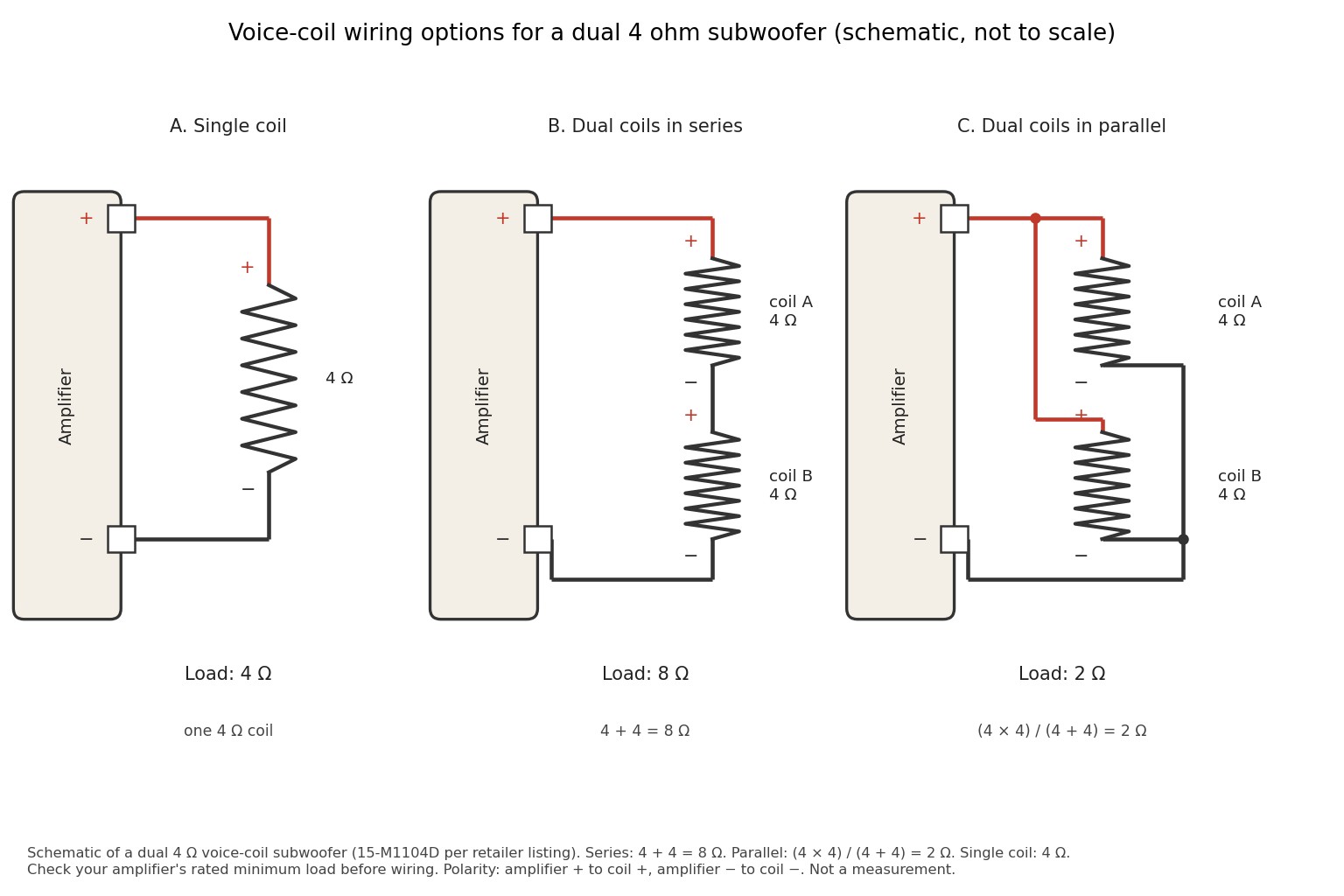
The dual-coil version has two 4 ohm coils. Wired in series they present 8 ohms, and wired in parallel they present 2 ohms, which gives more choice when picking an amplifier.
What the Memphis M1104 ratings imply
Power handling
Use the 300 W RMS figure for matching. The 600 W peak figure is a short-burst number with unstated conditions and is not a safe continuous target. Subwoofers are usually damaged by sustained overpower or clipped signals, so the practical aim is an amplifier output at or below the RMS rating in normal use.
How loud 86.08 dB is
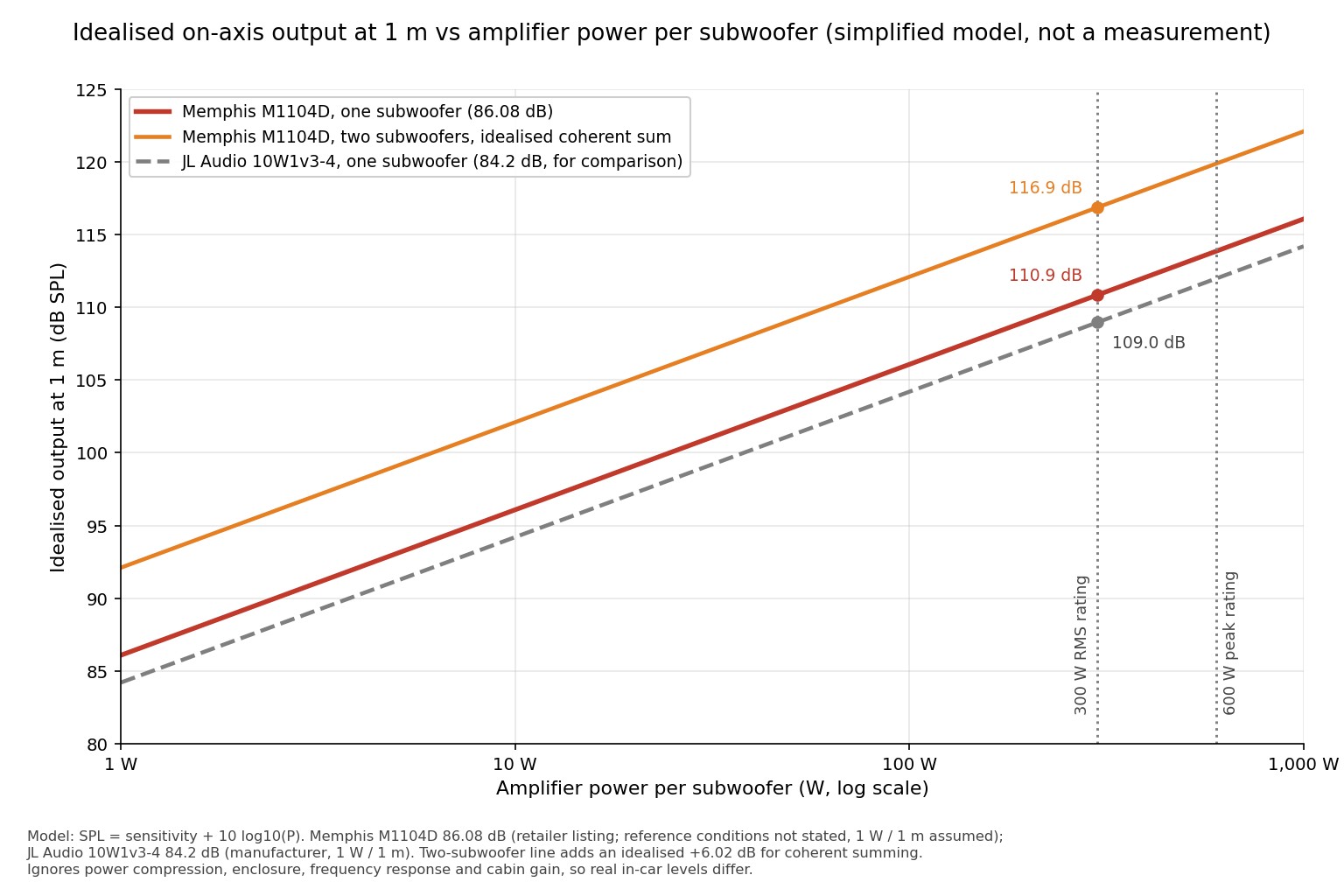
Sensitivity states output at 1 m for 1 W, and each doubling of power adds about 3.01 dB. At 300 W the idealised figure is about 110.9 dB at 1 m for one subwoofer, and about 116.9 dB for two driven at 300 W each if they add perfectly. The JL Audio 10W1v3-4 (84.2 dB at 1 W / 1 m, 300 W RMS per its listing) comes to about 109.0 dB under the same model, a gap of 1.9 dB.
Treat that gap with caution. Makers state sensitivity under different conditions, the M1104's reference conditions are unpublished, and real output depends on the enclosure, the frequency, power compression and the cabin. The model shows scale, not what you will hear.
Memphis M1104 enclosure: what is known
An enclosure is designed from Fs, Qts and Vas, and none was found for this driver. Without them a sealed or ported volume cannot be calculated honestly. Other Memphis 10-inch drivers show how recommendations cluster but do not transfer: retailer listings give 0.75 cu ft sealed and 1.5 cu ft ported for the MB1024, 0.7 and 1.6 for the M7 Series M71012, and 0.75 and 1.6 for the MOJO Pro MJP1022. Each number belongs to a different driver, so none should be applied to the M1104.
Owners have two sound routes. Look for the printed specification sheet or the original packaging. Otherwise measure Fs, Qes, Qms and Vas with an impedance sweep and a known test volume, then model sealed and vented alignments in a free simulator before cutting wood, and state where the data came from.
Memphis M1104 wiring and amplifier matching
Safety: disconnect the battery negative terminal before wiring, fuse the positive cable close to the battery, protect cable at body panels, and wear eye and ear protection when cutting panels. Sustained loud bass can damage hearing, and speaker terminals can carry tens of volts during a loud test tone.
Wiring the voice coils
Series wiring adds the coil impedances (4 + 4 = 8 ohms). Parallel wiring gives 2 ohms (4 x 4 divided by 4 + 4). Keep polarity consistent, amplifier positive to coil positive and negative to negative, and check the amplifier's minimum rated load before choosing parallel.
Matching an amplifier
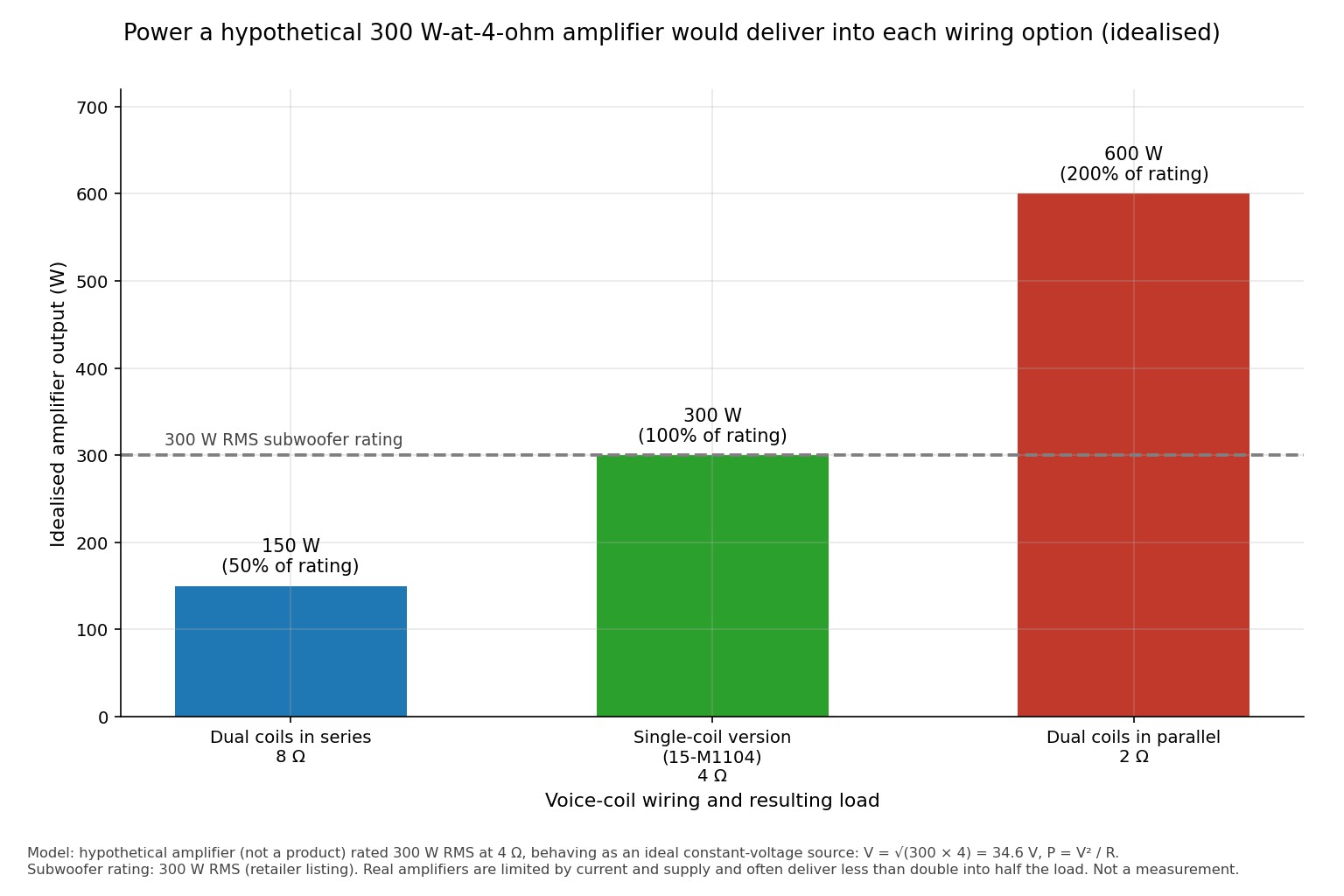
The load decides how much power an amplifier delivers. Take a hypothetical amplifier rated 300 W RMS at 4 ohms and assume an ideal constant-voltage source: 150 W into 8 ohms, 300 W into 4 ohms and 600 W into 2 ohms. Real amplifiers are limited by current and supply voltage, so check the rating at each load instead of assuming a doubling.
| Wiring | Final load | Hypothetical amplifier output | Share of 300 W RMS | Gain target for 250 W |
|---|---|---|---|---|
| Dual coils in series | 8 Ω | 150 W | 50% | 44.7 V |
| Single coil or one coil used | 4 Ω | 300 W | 100% | 31.6 V |
| Dual coils in parallel | 2 Ω | 600 W | 200% | 22.4 V |
Series wiring keeps the hypothetical amplifier at half the rating and leaves room for a larger amplifier. Parallel wiring pushes the same amplifier to twice the subwoofer's RMS rating, so only the gain setting protects the driver.
Power cable and current
Supply current is output power divided by efficiency and supply voltage. The efficiencies are assumptions, and the figures are worst-case for a continuous full-power tone.
| Case (assumed efficiency) | Supply current at 14.4 V |
|---|---|
| 300 W output, class D (80%) | 26 A |
| 300 W output, class AB (55%) | 38 A |
| 600 W output, class D (80%) | 52 A |
| 600 W output, class AB (55%) | 76 A |
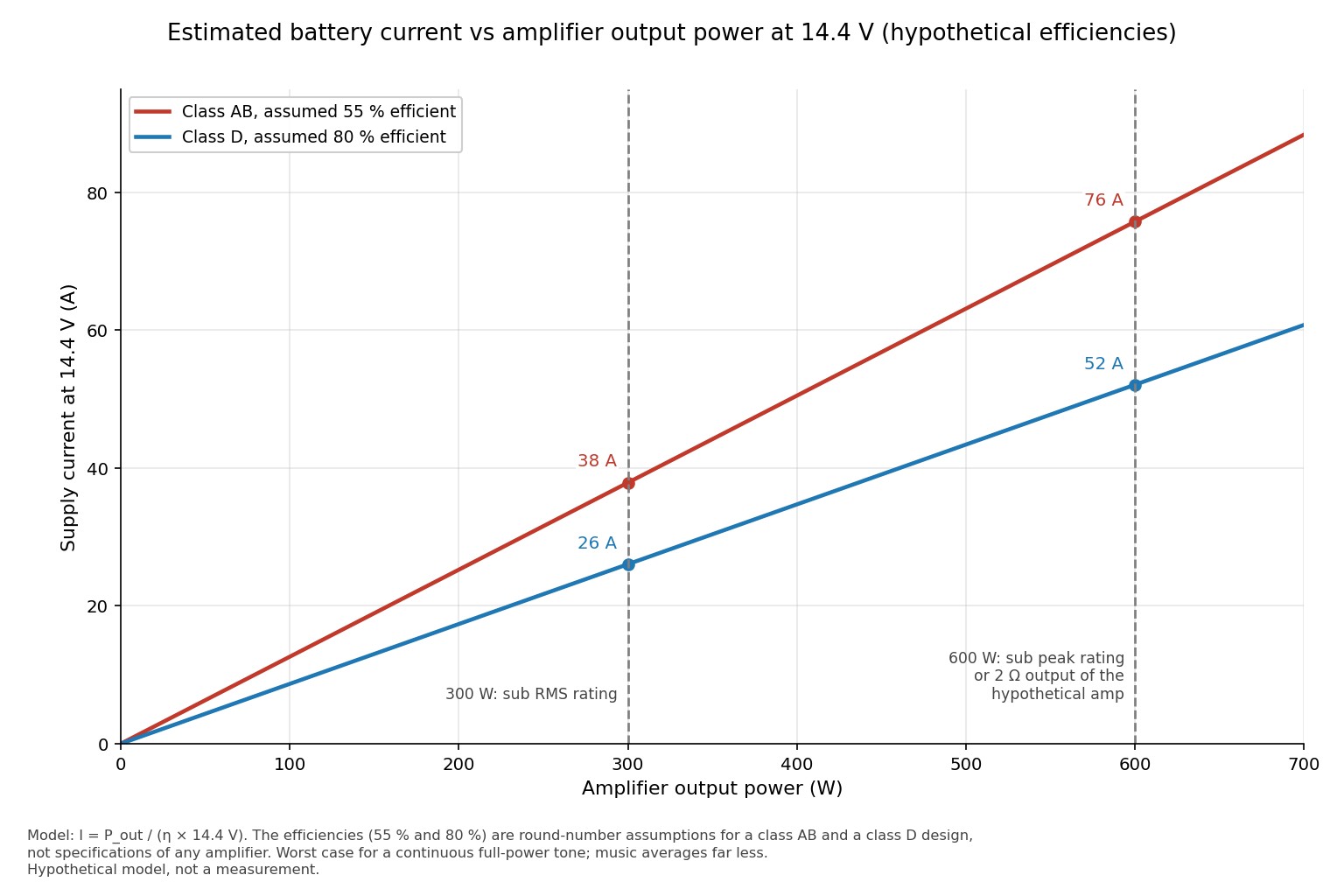
Voltage lost in the cable never reaches the amplifier. The table assumes copper, a 4.0 m power cable plus a 0.5 m ground, and the currents above.
| Copper cable | Path resistance (mΩ) | Drop at 26 A | Drop at 38 A | Drop at 52 A | Drop at 76 A |
|---|---|---|---|---|---|
| 8 AWG | 9.27 | 0.24 V | 0.35 V | 0.48 V | 0.70 V |
| 6 AWG | 5.83 | 0.15 V | 0.22 V | 0.30 V | 0.44 V |
| 4 AWG | 3.67 | 0.10 V | 0.14 V | 0.19 V | 0.28 V |
In this model 8 AWG drops 0.70 V at 76 A, while 4 AWG drops 0.28 V. Terminals and fuse holders add resistance, so real drops are higher. Take the fuse value from the amplifier's manual and the cable's rating.
Setting the gain with a meter
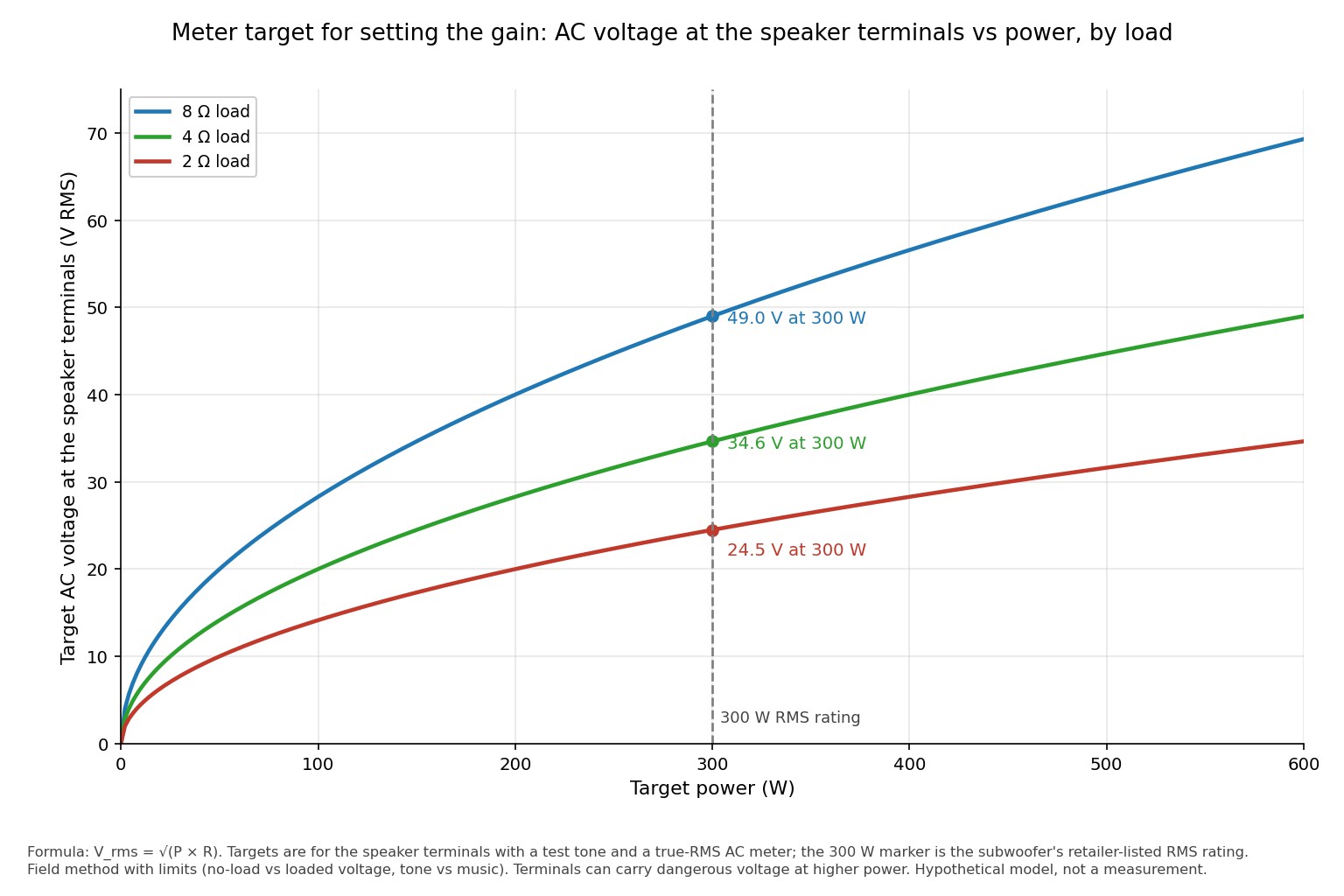
Gain is a level match between head unit and amplifier, not a volume control. A common field method uses a test tone and a true-RMS AC meter, aiming at a voltage equal to the square root of power times load.
- Disconnect the speaker wires, set the gain to minimum and bass boost to zero, and set the filters where you intend to run them.
- Play a 50 Hz tone with the head unit's tone controls flat and raise the volume to the loudest level at which it stays clean. Many installers start near three-quarters volume, which is a field rule of thumb.
- With the meter across the speaker terminals, raise the gain to the target: for 250 W, 44.7 V at 8 ohms, 31.6 V at 4 ohms and 22.4 V at 2 ohms. Keep tones short.
- Switch everything off before reconnecting the speakers.
A sine tone is not music and meter accuracy varies, so this protects a driver better than setting the gain by ear but is not a guarantee.
Memphis M1104 vs MB1024 vs JL Audio 10W1v3-4
| Subwoofer (10 in) | RMS / peak | Sensitivity | Fs | Qts | Xmax | Maker's enclosure advice |
|---|---|---|---|---|---|---|
| Memphis 15-M1104D | 300 / 600 W | 86.08 dB | Not found | Not found | Not found | Not found |
| Memphis MB1024 | 500 / 1,000 W | Not listed | Not confirmed | Not confirmed | Not confirmed | Sealed 0.75 cu ft; ported 1.5 cu ft |
| JL Audio 10W1v3-4 | 300 W RMS | 84.2 dB | 26.15 Hz | 0.446 | 0.45 in (11 mm) | Not on the listing reviewed |
The MB1024 offers selectable 2 or 4 ohm impedance and more power handling, and it comes with box volumes from the retailer. The JL Audio is the closest match on RMS rating and publishes the parameters needed to model a box, at a 4.6 in mounting depth against the M1104's 5.5 in. The M1104's advantage is limited to a higher sensitivity figure whose conditions are unpublished, so the two are not directly comparable. A newer model with a data sheet saves the measuring work.
Memphis M1104 price and buying used
As of October 14, 2026, WoofersEtc lists the 15-M1104D as discontinued, with a listed price of $169.99 against a $225.99 retail figure and a brand-new condition. A discontinued listing may not reflect what is actually available. Prices change often, so check the current listing. Some links on this page are affiliate links; they never affect our ratings. As an Amazon Associate I earn from qualifying purchases.
Before buying a used or leftover unit, check these points:
- Confirm which version it is, since single-coil and dual-coil units wire differently, and read the rating off the label.
- Inspect the foam surround for cracking, crumbling or glue failure, which is common on older foam surrounds.
- Press the cone gently and evenly; it should move smoothly with no scraping.
- Check the terminals, the basket and the dust cap for damage or repairs.
- Ask for the original specification sheet and for return terms, since a used driver has no manufacturer warranty.
Who the Memphis M1104 suits and who should skip it
It suits someone who already owns one or can buy a used unit cheaply, and who can obtain the data sheet or measure the driver. Skip it if a documented enclosure recommendation matters, the install is very compact, or more than 300 W RMS is wanted. A currently sold driver with published parameters, such as the JL Audio above, is the lower-risk choice in those cases.
Memphis M1104 final verdict
The M1104 is a reasonable 10-inch subwoofer on its listed figures, but the information around it is thin. The 300 W RMS rating and dual-coil flexibility make amplifier matching simple, while the absence of published enclosure data means any box rests on data you find or measure yourself. If you can get that data, it can be a workable used option. For documented specifications, choose a supported model. More guides are in car subwoofers, car amplifiers and the wider car audio section.
Sources and further reading
Ratings are retailer or manufacturer figures, not measurements. Images were drawn from those figures and simple models.
- WoofersEtc listing for the 15-M1104D: ratings, features, discontinued status and price.
- Online Car Stereo listing for the Memphis MB1024: 500 W RMS, 1,000 W peak and box volumes.
- Crutchfield page for the Memphis MB1024: selectable 2 or 4 ohm impedance.
- Bassjunkies listing for the JL Audio 10W1v3-4: published parameters, depth and sensitivity.
- Electronic Express listing for the Memphis M71012: box volumes for a different Memphis 10 in driver.
- Online Car Stereo listing for the Memphis MJP1022: box volumes for another Memphis 10 in driver.
- SpeakerBoxLite Memphis Audio database: third-party parameters for other Memphis models; user data, unverified, and no M1104 entry.
Memphis M1104 questions answered
What are the main specs of the Memphis M1104?
Retailer listings give 300 W RMS and 600 W peak power, 86.08 dB sensitivity, a 66 oz magnet and a 5.5 in mounting depth. It comes with a single or dual 4 ohm voice coil. No Thiele/Small parameters or enclosure volumes were found.
What is the difference between the M1104 and the M1104D?
The 15-M1104 has one 4 ohm voice coil, and the 15-M1104D has two 4 ohm coils. The dual-coil version can be wired for 8 ohm in series or 2 ohm in parallel. The other listed figures are the same.
How much amplifier power does the M1104 need?
Aim for an amplifier that delivers about 250 to 300 W at your final load. The 600 W peak figure should not be used for matching. Setting the gain with a meter helps keep a larger amplifier from overpowering it.
What enclosure size should I use?
No manufacturer volume could be found for this model. Do not borrow a size from another driver. Look for the original spec sheet or measure Fs, Qes, Qms and Vas, then model the box.
How should I wire the dual voice coils?
In series the two 4 ohm coils present 8 ohm, and in parallel they present 2 ohm. Choose the option that suits your amplifier's rating at that load. Keep amplifier positive to coil positive on both coils.
How loud can the M1104 get?
A simple model from the 86.08 dB rating gives about 110.9 dB at 1 m with 300 W. That ignores power compression, the enclosure and the cabin, so real levels differ. Use it for scale, not prediction.
Is the Memphis M1104 still sold?
One retailer lists the 15-M1104D as discontinued. Used units may still turn up. The original release date was not confirmed.
How deep is the M1104?
The listed mounting depth is 5.5 in, which is about 140 mm. The cutout diameter was not found, so use the actual driver as a template.