Car Head Units
Pioneer DEH-P7700MP Review: Is This OEL Head Unit Still Worth Buying?
Published October 8, 2026
A look back at the Pioneer DEH-P7700MP: its MOSFET50 amp, OEL display, Easy EQ and three preouts, and whether it still makes sense in a car today.
Few car stereos from the mid 2000s still get asked about the way this one does, so this Pioneer DEH-P7700MP review looks at what the unit offers and who it still suits. It is a single DIN CD receiver with a motorized face, a glowing blue display and a surprisingly deep set of outputs. Some of that has aged well. Some has not.
Start with what Pioneer actually put in the box, because the spec sheet explains most of the unit's personality.
What the DEH-P7700MP is
The DEH-P7700MP sits in Pioneer's DEH-P series, the step-up range from the basic CD receivers of the period. It replaced the DEH-P7600MP and was in turn succeeded by the DEH-P7800MP. It plays audio CDs plus CD-R and CD-RW discs, and those discs can hold MP3 and WMA files. There is no USB port and no Bluetooth, which tells you straight away how old the design is.
The face is the part people remember. It flips down on a motor, can be detached and carried off, and wears an Organic EL display with blue keys. Retailers of the time made a lot of the animated graphics and screensaver options, and owners still mention that the blue matches blue interior lighting better than darker Pioneer displays from the same family did.
Specs at a glance
| Feature | DEH-P7700MP |
|---|---|
| Chassis | 1 DIN, detachable motorized face |
| Built-in amplifier | MOSFET50, 22 watts RMS and 50 watts peak per channel, 4 channels |
| Disc formats | CD, CD-R, CD-RW, with MP3 and WMA files |
| Tuner | Supertuner IIID, 18 FM and 6 AM presets |
| Equalizer | Easy EQ with five preset curves and a 7 band graphic EQ |
| Preamp outputs | Three pairs (front, rear, subwoofer), 2.2 volts |
| Other connections | Front auxiliary input, satellite radio and iPod adapter support (accessories required) |
| CD frequency response | 5 to 20,000 Hz |
| CD signal to noise ratio | 94 dB |
| FM sensitivity | 8 dBf |
Treat the figures as manufacturer and retailer numbers. Nothing here comes from a bench test.
The built-in amplifier: honest expectations
Twenty two watts RMS per channel is the number to remember. The 50 watt figure is a peak rating that describes a brief burst rather than what the unit delivers while you drive. Every head unit amplifier of this class works the same way.
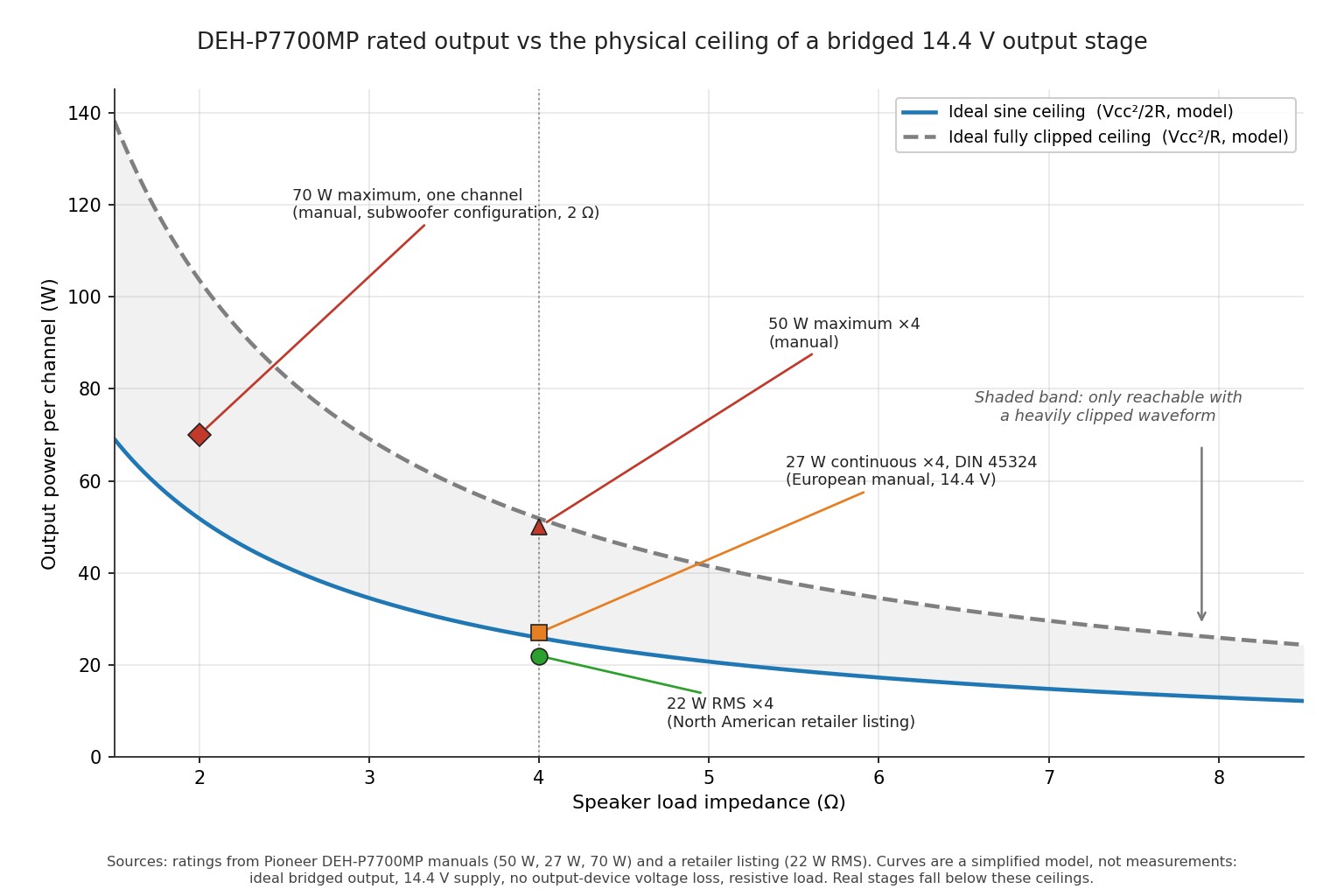
So what does 22 watts get you? Plenty for factory speakers and for efficient aftermarket coaxials. A pair of door speakers rated for 20 to 50 watts RMS will sound fine at normal listening levels. Push the volume near the top on a noisy highway and the amp runs out of room first, which is the usual sign that an external amplifier would help.
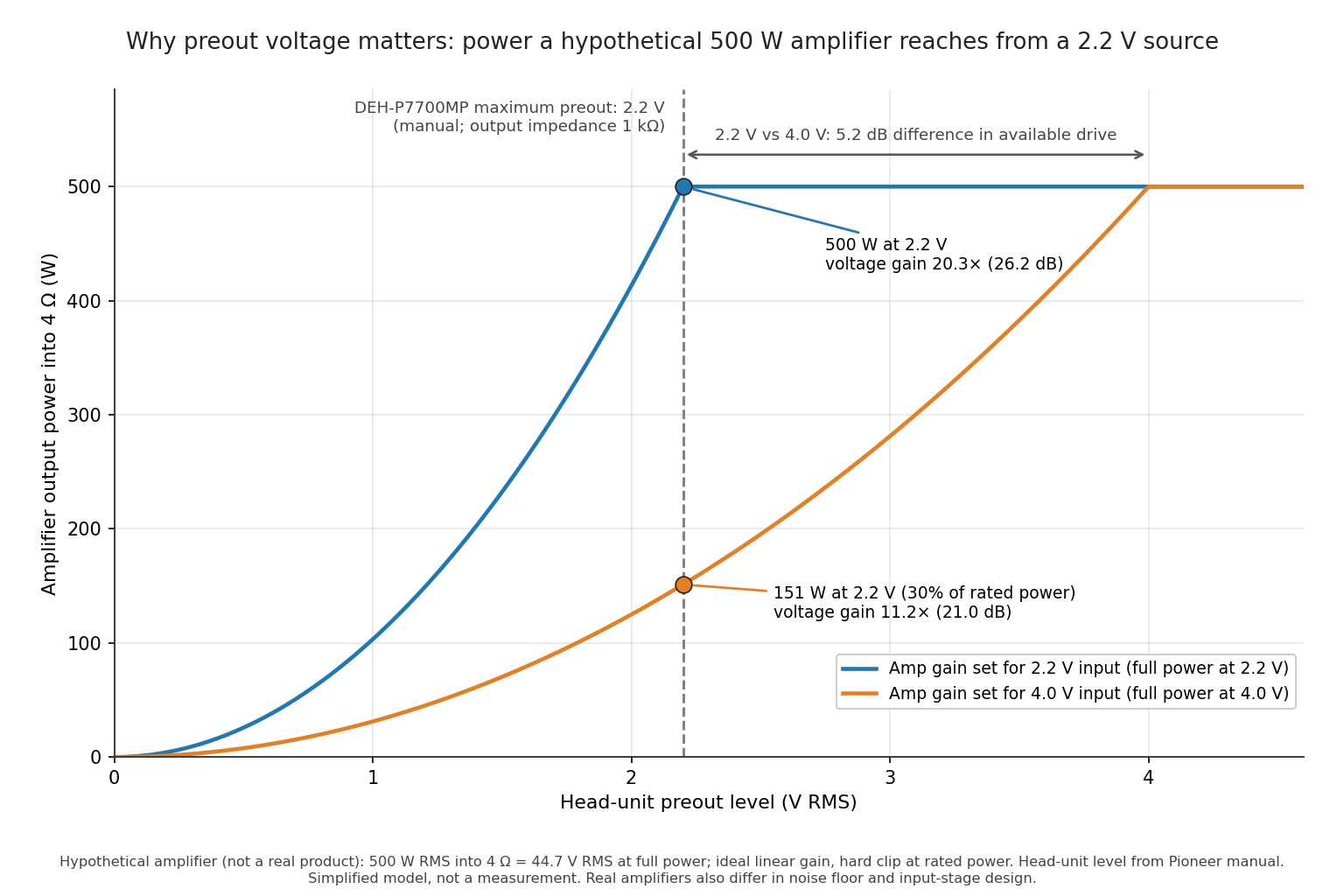
That is where the three pairs of preamp outputs matter. At 2.2 volts they are decent rather than exceptional; higher voltage outputs reject noise a little better over long cable runs, but 2.2 volts is perfectly workable with a short, well-shielded RCA run and a correctly set amplifier gain.
Sound controls and the Easy EQ
Presets first, graphic EQ when you want more
Easy EQ is Pioneer's friendly layer on top of a 7 band graphic equalizer. You pick one of five preset curves, then adjust it if the preset is close but not right. Most owners will never need to go further than that, and that is the point.
Loudness and subwoofer control
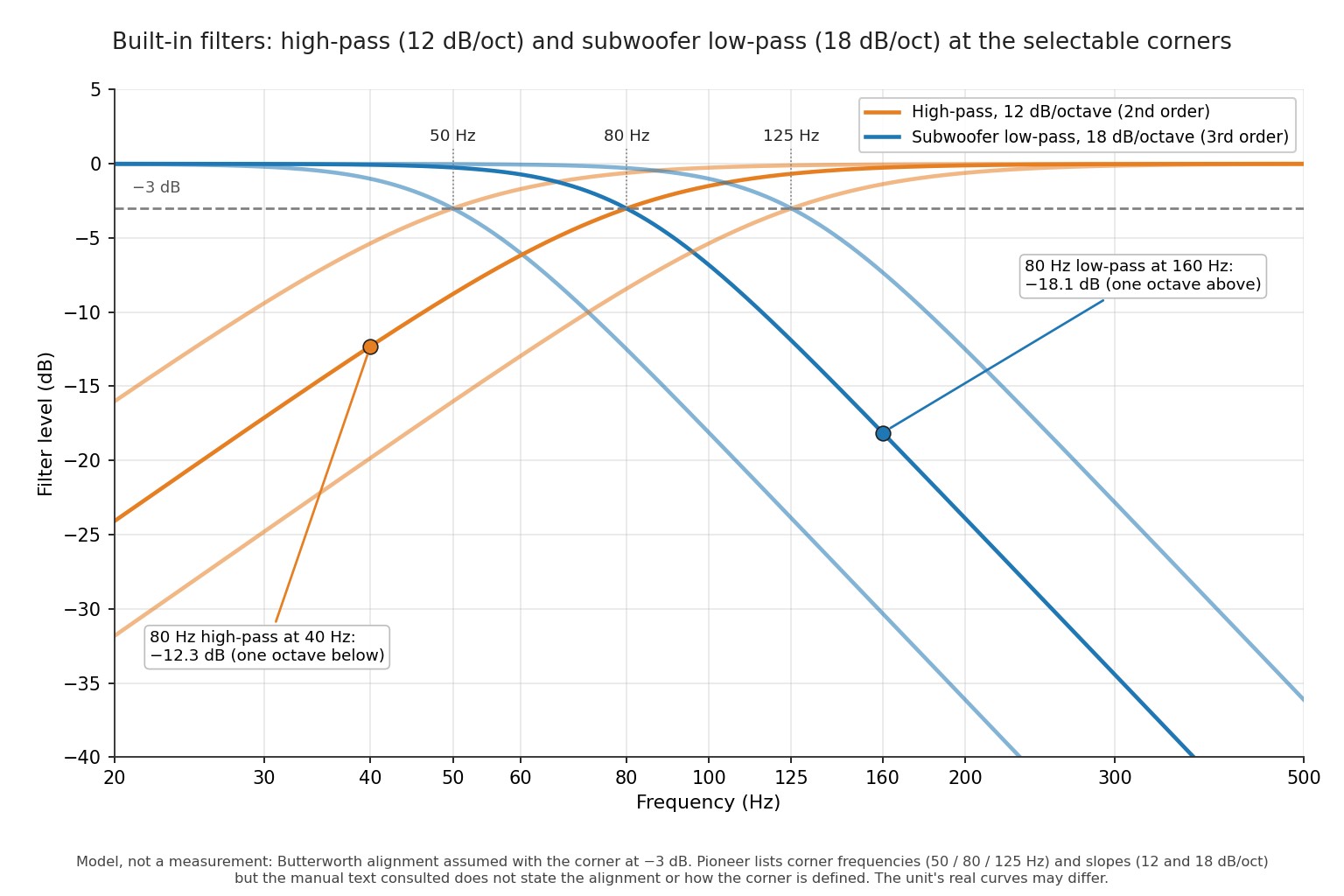
Loudness restores some low and high frequency weight at quiet volumes. It is handy at night and fatiguing at full tilt, so use it sparingly. The subwoofer output has its own level control and a low pass filter, which means a powered sub can be wired straight from the unit without a separate controller for basic setups.
One practical note: the equalizer shapes the signal feeding the built-in amp and the preamp outputs alike, so a heavy bass boost can overload a small amp or a small speaker before it sounds loud. Keep boosts modest, a few steps at most.
Radio, discs and everything else
The Supertuner IIID tuner was a selling point in its day, and Pioneer tuners from this era do have a reputation for holding weak stations well. Eighteen FM presets and six AM presets give you plenty of room. Reception also depends heavily on the antenna and its connection, so a bad mast or a loose lead can make any tuner sound poor.
Disc handling is the part that dates it most. Burning a CD of MP3 or WMA files is still possible, but you have to burn it, carry it and keep it clean. A scratched disc will skip, and the player cannot do what a modern phone connection does. If you rely on streaming, the front auxiliary input is the closest thing to a modern lifeline. It takes a plain cable from a phone or music player.
The unit is also ready for satellite radio and for an iPod through optional Pioneer adapters. Check that any adapter you buy matches this model and the player you own, since those accessories were tied to specific generations of hardware.
Installing it
The DEH-P7700MP uses Pioneer's standard connector layout for the period, so a matching wiring harness adapter saves a lot of cutting and splicing. Most vehicles from the era also have an aftermarket dash kit available for single DIN receivers. Always confirm the kit for your exact vehicle before you buy.
Wiring basics
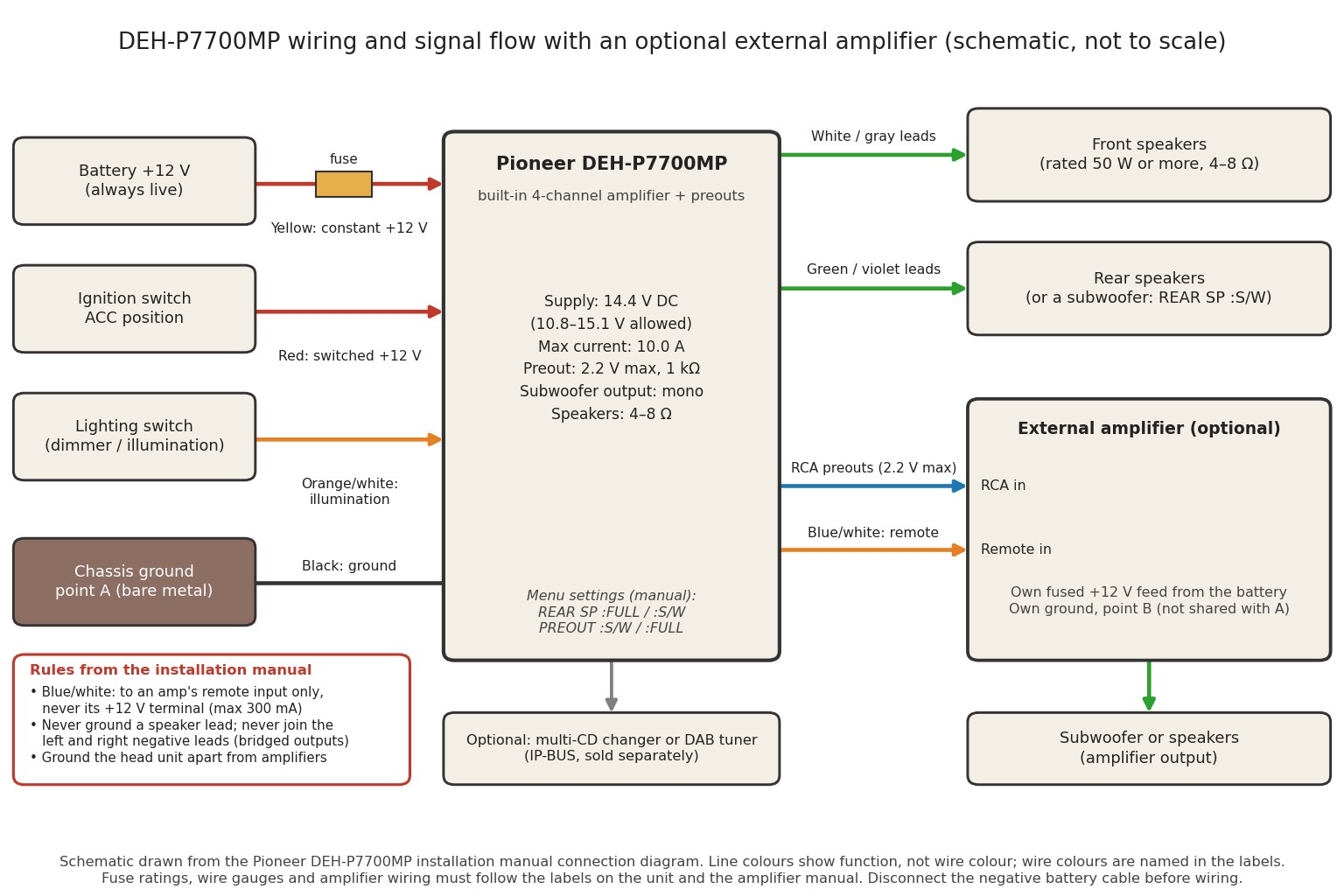
- Yellow goes to a constant 12 volt supply so the clock and presets survive with the key off.
- Red goes to a switched accessory supply so the unit turns on with the ignition.
- Black goes to a clean bare metal chassis ground.
- Blue with white goes to the remote turn on lead of any external amplifier.
- Orange with white carries the illumination signal, so the display dims with your headlights.
Verify each wire against the diagram printed on the unit or in the manual before you connect anything. Vehicle harnesses vary, and a swapped constant and accessory wire is the single most common cause of presets that keep resetting.
Strengths and weaknesses
What it does well
- Three pairs of preamp outputs make it easy to build a front, rear and sub amplifier setup.
- The display looks distinctive and is easy to read at night.
- Easy EQ gets most people to a good sound without much effort.
- The detachable face discourages theft and the front auxiliary input still works with any phone that has a headphone jack.
Where it falls short
- No USB, no Bluetooth and no hands free calling.
- The OEL panel is a display technology that can fade with long use, so a used unit deserves a close look at brightness and uneven patches.
- The motorized face is a moving part. Listen for grinding when it opens and closes, because that is where age tends to show.
- Peak power numbers flatter the amp. Do not plan around 50 watts.
Who should buy one today
If you are restoring a car from the 2000s and want period correct gear, the DEH-P7700MP is a good fit. It looks right, it sounds clean at sensible volumes, and it gives you the outputs to add amplifiers later. It also suits anyone who likes discs and simply wants a better player than the factory radio.
If you want wireless calls, map apps or streaming in a daily driver, skip it. A current single DIN or double DIN receiver will do all of that, and the gap in convenience is large. Adding a cheap Bluetooth adapter to the auxiliary input is possible, but it never feels as tidy as built in support.
When buying used, ask for photos of the lit display, confirm the face opens and closes smoothly, and ask whether the detachable face and its carrying case come with it. Without the face, the head unit cannot be used, so a listing that leaves it out is a poor deal.
Verdict
The Pioneer DEH-P7700MP is a well equipped CD receiver for its time, with a strong output section and a display that still draws comments. Its limits are the ones you would expect from hardware built before phones took over the dashboard. Buy it for a project car or a disc loving setup, pair it with an external amplifier if you want real volume, and look elsewhere if connectivity matters most.
Answers Before You Buy One
What power does the Pioneer DEH-P7700MP produce?
Its built-in MOSFET50 amplifier is rated at 22 watts RMS and 50 watts peak per channel across four channels. The RMS figure is the realistic one for everyday listening.
Does the DEH-P7700MP have Bluetooth or USB?
No. It has a front auxiliary input, CD playback with MP3 and WMA files, and support for optional satellite radio and iPod adapters.
How many preamp outputs does it have?
Three pairs, for front, rear and subwoofer, each at 2.2 volts. That makes it easy to add one or more external amplifiers.
Can it play MP3 and WMA files?
Yes, from CD-R and CD-RW discs burned with those files, as well as standard audio CDs.
What is Easy EQ?
Easy EQ is Pioneer's simplified equalizer. You choose from five preset curves and can adjust them using the 7 band graphic equalizer underneath.
Do I need an external amplifier?
Not for factory or efficient speakers at normal volumes. If you want higher volume, more headroom or a subwoofer, an external amplifier fed from the preamp outputs is the better route.
Does the DEH-P7700MP have a detachable face?
Yes. The motorized face flips down and can be removed and taken with you to deter theft. The unit will not operate without it.
What type of display does it use?
An Organic EL display with blue illumination and animated graphics. On used units, check for dimming or uneven patches.
Is it a single DIN or double DIN unit?
Single DIN. Most vehicles from the period have a single DIN dash kit available, but confirm the kit for your exact vehicle.
What replaced the DEH-P7700MP?
Pioneer's next model in the line was the DEH-P7800MP. The DEH-P7700MP itself replaced the DEH-P7600MP.
Can I stream music from my phone to it?
Only through the front auxiliary input with a cable, or by adding a Bluetooth adapter to that input. There is no built in wireless audio.
What should I check when buying a used one?
Check that the face opens and closes smoothly, that the display is bright and even, that the CD drive reads discs, and that the detachable face and carrying case are included.