Car Amplifiers
Zed Audio Leviathan Review: Specs, Versions, Setup and Buying Advice
Published October 9, 2026
A research-based look at the six-channel Zed Audio Leviathan: how its three versions differ, what it asks of your electrical system and who it still suits.
The Zed Audio Leviathan is a six-channel, full-range class D car amplifier built by Zed Audio Corporation in Simi Valley, California. All six channels have the same rated power, and they are arranged as three pairs that each have their own crossover, so one chassis can run a tri-amplified system with subwoofers. This article explains what the amplifier is, how its three rated versions differ, what it asks of a car's electrical system, how to set it up, and who should still consider one.
Short version: On paper, and in the one published bench test of the original model, the Leviathan is an efficient and flexible amplifier whose ratings were met and exceeded. Its limits are practical. It has no built-in DSP, no balanced or high-level inputs for factory radios, and three different power ratings share one name. I could not confirm that new units are currently on sale or what they cost. It suits a hands-on builder who knows exactly which version they have and wants an active system from one chassis. It is a poor fit for plug-and-play installs or anyone who needs warranty support.
How this review was done: this is a specification-and-research review. Specifications come from Zed Audio's own manuals dated 2010, 2011 and 2013. Measured results come from a published bench test of the first-generation unit and a magazine review. The author has not installed, tested or listened to this amplifier, so nothing here is first-hand. Worked examples use computed models and hypothetical speakers, and each is labelled as such.
Key specifications (manufacturer-rated)
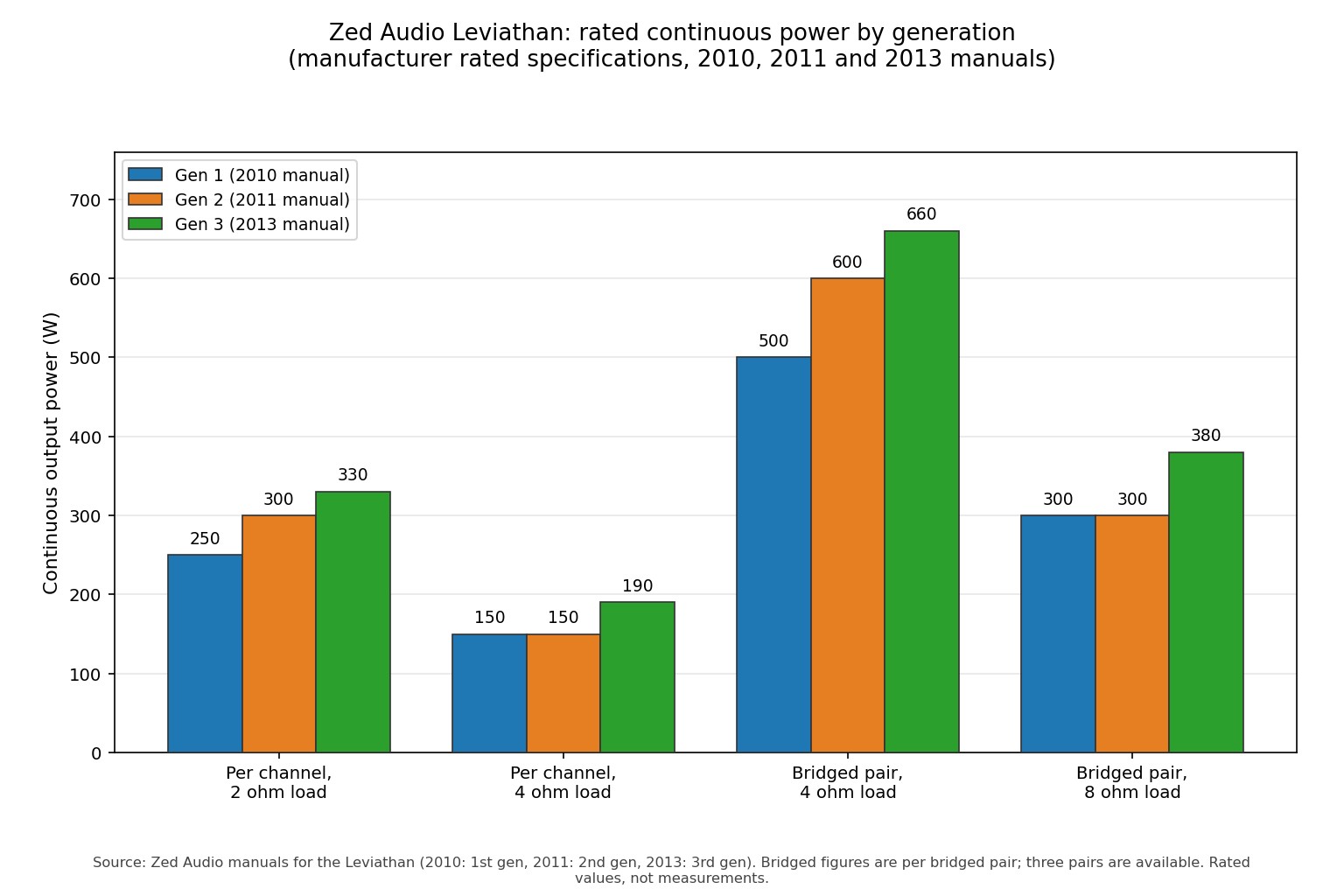
Zed's manuals call the 2010 model the first generation, the 2011 model the second and the 2013 model the third. Retail listings often write these as Leviathan, II and III. The table lists only values printed in those manuals.
| Specification | 1st generation (2010 manual) | 2nd generation (2011 manual) | 3rd generation (2013 manual) |
|---|---|---|---|
| Continuous power per channel, 4 ohm | 150 W | 150 W | 190 W |
| Continuous power per channel, 2 ohm | 250 W | 300 W | 330 W |
| Continuous power per channel, 6 ohm / 8 ohm | not listed | not listed | 125 W / 100 W |
| "Typical" power per channel at 1% THD, 4 ohm | 175 W | 180 W | 235 W |
| Bridged pair, 4 ohm (three pairs available) | 500 W | 600 W | 660 W |
| Bridged pair, 8 ohm | 300 W | 300 W | 380 W |
| Minimum load | 2 ohm per channel, 4 ohm per bridged pair | ||
| Frequency response at rated power, 4 ohm | 10 Hz to 25 kHz, -0.5 dB | 10 Hz to 30 kHz, -0.1 dB | 10 Hz to 30 kHz, -0.1 dB |
| Distortion, 20 Hz to 20 kHz, 4 ohm | below 0.2% (typically below 0.05%) | ||
| Noise below rated output (30 kHz limited) | -98 dB | -100 dB | -100 dB |
| Channel separation at 2 kHz / damping factor at 20 Hz | above 80 dB / above 80 | ||
| Input level for rated power into 4 ohm | 0.25 V to 8.6 V | ||
| Input impedance at 2 kHz | 37 kohm | 47 kohm | 14 kohm unbalanced, 7 kohm balanced (see note below) |
| Current, sine wave, 4 ohm | 105 A | 94 A | 94 A |
| Current, music, 4 ohm | 30 A | 18 to 28 A | 18 to 28 A |
| Idle current | below 2 A | below 1.5 A | below 1.5 A |
| Fuse rating, 4 ohm / 2 ohm load | 20 to 25 A / 60 A | 30 to 40 A / 40 to 80 A | 30 to 40 A / 40 to 80 A |
| Size (W x H x L) | 247 x 55 x 410 mm (9.7 x 2.1 x 16.1 in) | ||
| Shipping weight | 6.8 kg (15 lb) | 5.9 kg (13 lb) | 5.9 kg (13 lb) |
| Preamplifier ICs / output MOSFET rating per channel | Burr-Brown / 29 A | National Semiconductor / 50 A | National Semiconductor / 50 A |
Three cautions about these numbers. First, third-party listings sometimes quote different figures for the same generation, so use the manual rather than a seller's description. Second, the third-generation table lists a balanced input impedance, yet the text in the same manual says the Leviathan does not offer balanced inputs. Ask Zed which is correct before relying on either. Third, shipping weights vary between manuals, and the published bench test lists a much lower weight of 3.16 kg (7 lb), so weigh a unit before planning a tight mounting location.
Three versions under one name
Between the first and second generations, the 4 ohm rating stayed at 150 W while the 2 ohm rating rose from 250 W to 300 W and the bridged 4 ohm rating from 500 W to 600 W. The 2011 manual also lists wider crossover ranges, a change of preamplifier chip, and output MOSFETs that Zed says have one third of the on-resistance of the earlier parts. The 2013 manual repeats that same list of improvements and raises the ratings again to 190 W at 4 ohm. It does not describe hardware changes beyond the ratings, so whether the third generation is a re-rating or a re-tune is not stated.
The 2 ohm to 4 ohm ratio is a quick way to read the power supply's behaviour. A perfectly stiff supply doubles power when the load halves. Computed from the manual figures, the ratio is 1.67 for the first generation, 2.00 for the second and 1.74 for the third. The third generation is therefore 0.61 dB short of a perfect doubling at 2 ohm, and the first is 0.79 dB short. Differences of that size are far below what listeners normally notice, so treat them as a description of the supply rather than a flaw.
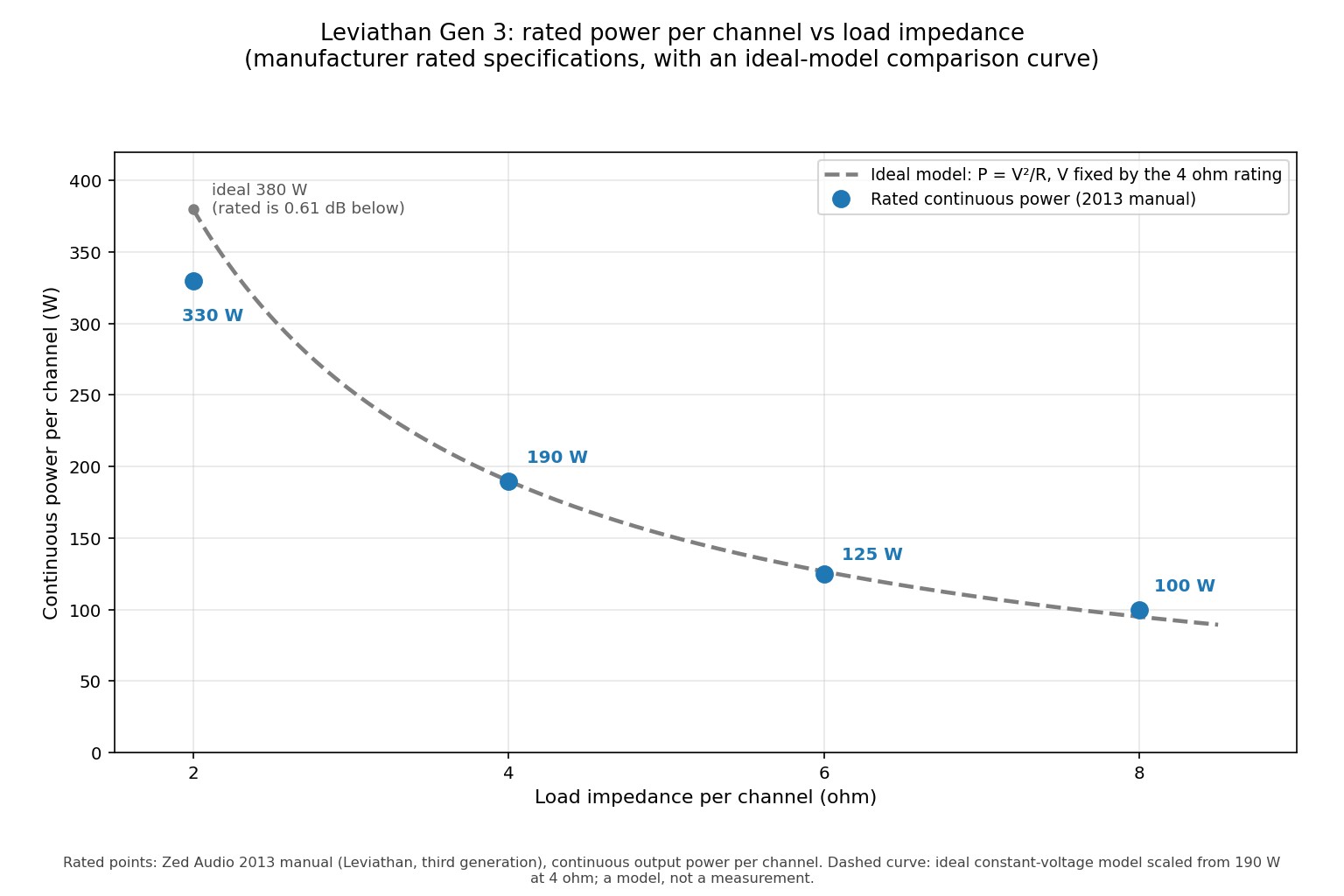
The third-generation ratings imply a nearly constant output voltage: 28.3 V RMS at 8 ohm, 27.4 V at 6 ohm, 27.6 V at 4 ohm and 25.7 V at 2 ohm. That is what a regulated supply should do. It also shows why Zed's own advice is to prefer loads of 4 ohm or higher. The 2 ohm rating exists, in Zed's words, because real 4 ohm speakers have impedance dips, not because the company recommends running low-impedance loads.
Design and features
The Leviathan is a full-range class D design. Zed says its switching carrier runs at roughly 400 to 500 kHz in the later generations and that the feedback loop is taken after the output filter, which the company argues keeps the response independent of the load. Those are the manufacturer's claims about its own design, and the manuals do not publish test data that separates them from the rest of the circuit. The first-generation manual also describes seventeen regulated internal supplies, twelve 110 A power-supply MOSFETs, a two-stage supply that Zed says improves efficiency, and a preamplifier section with its own isolated supply that feeds the power stage in balanced form to avoid ground-loop noise.
Practical features worth knowing:
- A clipping LED on every channel, plus protection against short circuits, DC and overheating. In later models the ZED logo flashes in protection mode.
- RCA inputs only. The 2013 manual states that the Leviathan does not offer balanced inputs. Factory radios with speaker-level outputs need a separate line output converter.
- No built-in equaliser, no line outputs and no DSP. All crossovers are analog.
- Three bridgeable pairs. Any or all pairs can be bridged, and the manual lists more than a dozen channel configurations.
- No internal fuse in the unit that the published bench test examined. The manual's diagrams show a fuse at the battery.
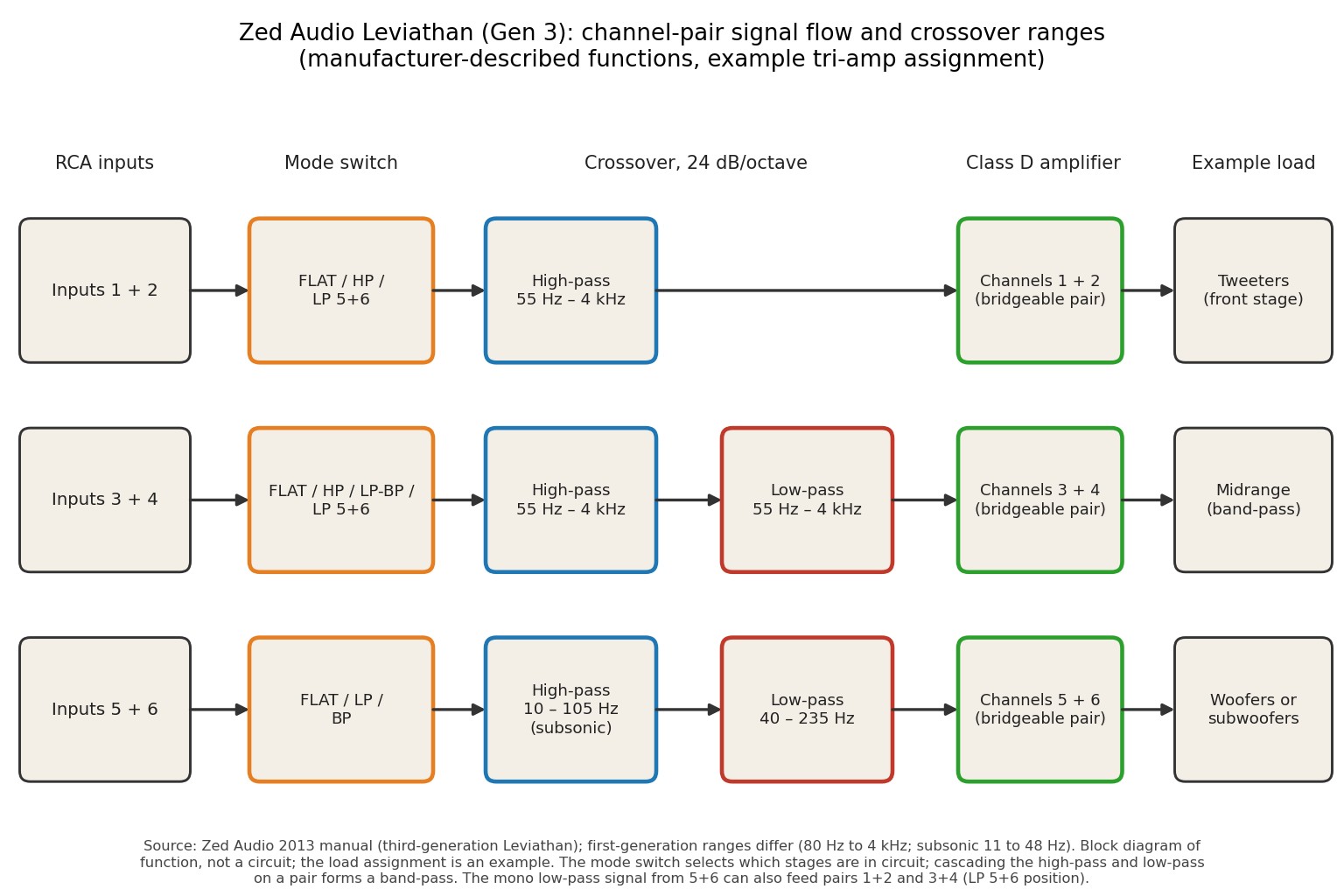
The crossovers are 24 dB per octave and set per pair. The ranges changed between generations:
| Crossover | 1st generation | 2nd and 3rd generation |
|---|---|---|
| Pair 1+2, high-pass | 80 Hz to 4 kHz | 55 Hz to 4 kHz |
| Pair 3+4, high-pass and low-pass | 80 Hz to 4 kHz each | 55 Hz to 4 kHz each |
| Pair 5+6, low-pass | 40 to 240 Hz | 40 to 235 Hz |
| Pair 5+6, high-pass | subsonic filter, 11 to 48 Hz | 10 to 105 Hz (usable as a subsonic filter) |
Cascading a high-pass and a low-pass on a pair gives a band-pass. The mono low-pass signal from pair 5+6 can also feed pairs 1+2 and 3+4, so all six channels can drive subwoofers. A typical active layout uses pair 1+2 for tweeters, pair 3+4 for midranges and pair 5+6 for woofers. The wider ranges of the later models allow a four-way layout with pair 5+6 handling the lower midrange.
What published measurements show
The only detailed bench test I found is a 2009 review of the first-generation unit by Paul Sonoda, hosted on Zed Audio's own site, so it is a manufacturer-supplied document and not an independent publication. It tested at 14.4 V with less than 1% distortion plus noise. Power and efficiency numbers were taken with two stereo channels or one bridged channel driven, not all six at once.
| Condition | Rated | Measured | Measured vs rated |
|---|---|---|---|
| Per channel, 4 ohm | 150 W | 186.3 W | +24.2% (+0.94 dB) |
| Per channel, 2 ohm | 250 W | 285.6 W | +14.2% (+0.58 dB) |
| Bridged pair, 4 ohm | 500 W | 571.2 W | +14.2% (+0.58 dB) |
The same test reported efficiency of 85.4% at full power into 4 ohm with two channels driven, 73.5% into 2 ohm and into a bridged 4 ohm load, and 73.3% at one third power with all six channels in stereo. The lowest figure was 66.8%, at one third of bridged power with all channels driven. Signal-to-noise was 76.5 dBA by the CEA-2006 method, which references 1 W, and 98.4 dBA when referenced to maximum power. In a separate system test the reviewer drove four channels at about 149 W each into 4 ohm together with a bridged pair at just over 540 W.
A magazine review in PASMAG reported that the amplifier exceeded its rated power at 4 ohm and 2 ohm, with a response that was flat from below 10 Hz to above 20 kHz. It measured crosstalk of -61 dB, which it called very good, compared with the manual's figure of more than 80 dB. The test conditions were not stated, so the two numbers are not directly comparable. Both reviewers described the sound favourably, but those are subjective impressions of the first-generation unit, and no measurements of the second or third generation were found.
Installation and electrical planning
Safety: Disconnect the negative battery terminal before wiring. Fit the main fuse within 300 mm (12 in) of the battery, use the fuse rating in the manual for your version and load, and never replace it with a larger one to stop it blowing. A larger fuse protects nothing and can leave the cable or amplifier to fail first. If you are not confident with high-current wiring or cutting panels, have a professional installer do the work. Loud playback can damage hearing permanently.
Mounting, power and grounding
Zed recommends mounting the amplifier with the heatsink fins vertical and with room for airflow, using either the supplied feet or M4 bolts into the underside. It also says to keep every class D amplifier well away from the radio antenna. The manuals specify a ground wire of #8 or larger, no longer than 1 m (39 in), bolted to bare, rust-free chassis metal. The power connector accepts copper up to 7 mm (0.275 in) in diameter, speaker wire should be at least #14, and the remote lead needs more than 3 V. The 2013 manual states that #8 power wire is sufficient for a 5 m run. Wire sizing still depends on the vehicle, the run length and the cable's own ampacity rating, so check the cable you buy against the fuse you fit.
Zed also says not to turn the level up before switching the amplifier on, because its start-up checks can read a high signal as a fault and shut it down. If that happens, the manual says to power off for more than five seconds and try again.
How much current to plan for
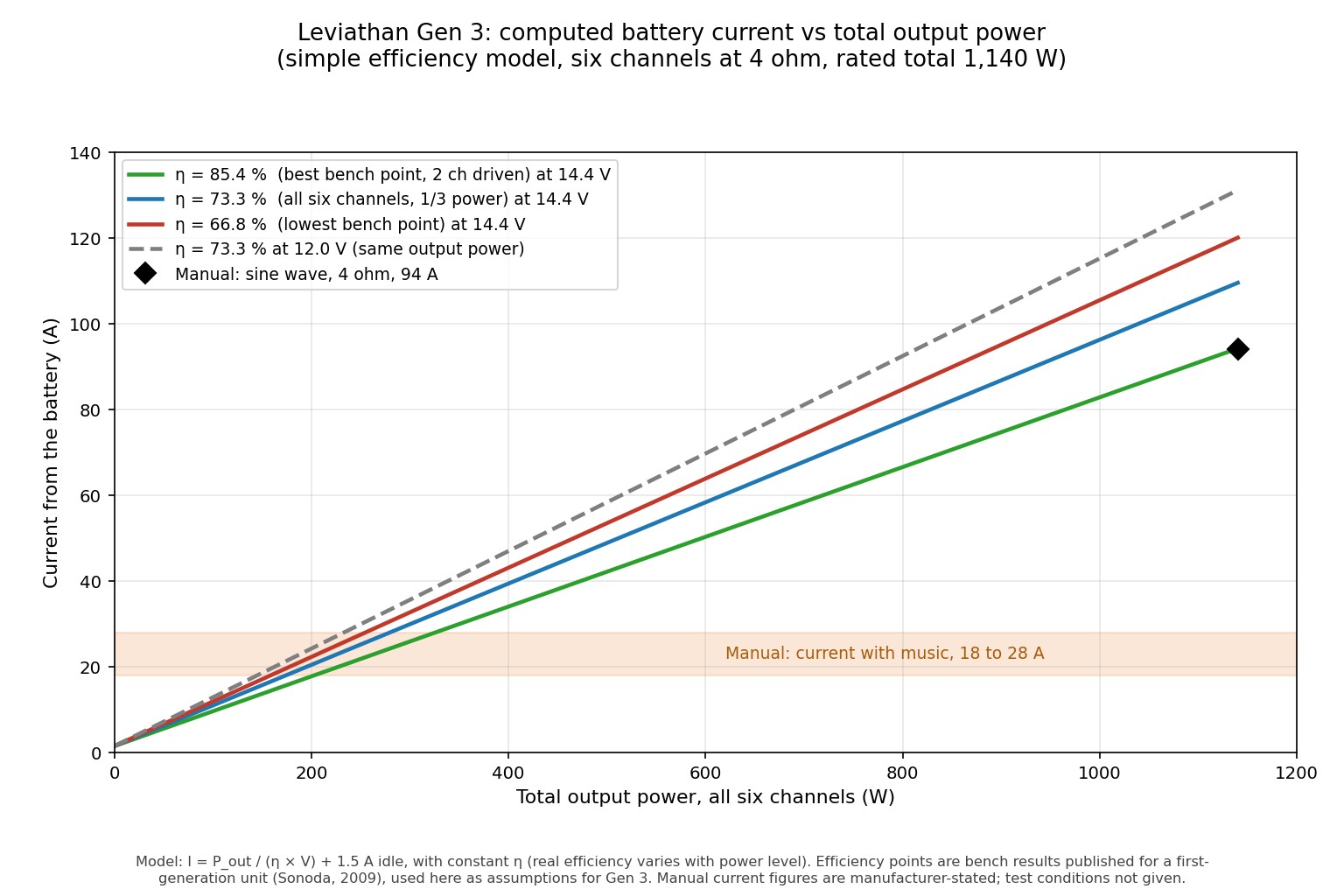
The manual figures for the later models are 94 A with a continuous sine wave and 18 to 28 A with music, both into 4 ohm. As a check, the table below converts the third-generation rating into battery current with a simple model: current equals output power divided by efficiency and voltage, plus 1.5 A of idle current. The efficiencies are the first-generation bench points above, used here as assumptions. This is a hypothetical calculation, not a measurement of any particular unit.
| Scenario (six channels at 190 W into 4 ohm, 1,140 W total) | Battery voltage | Assumed efficiency | Computed current |
|---|---|---|---|
| Best bench efficiency | 14.4 V | 85.4% | 94.2 A |
| All channels, one third power | 14.4 V | 73.3% | 109.5 A |
| Lowest bench efficiency | 14.4 V | 66.8% | 120.0 A |
| All channels, one third power | 12.0 V | 73.3% | 131.1 A |
The first row lands almost exactly on the manual's 94 A figure, which suggests the manual's sine-wave number assumes a high efficiency. Because the supply is regulated, a sagging battery makes the amplifier draw more current for the same output, as the last row shows. For music, the manual's 18 to 28 A range corresponds to roughly 170 to 280 W of average output, or about 15% to 25% of the full six-channel rating, if efficiency is near 73%. Real efficiency is lower at low power, so the true average output is probably less.
Setting the levels
The level controls match the amplifier's gain to the source. The manual's rated-power input range of 0.25 V to 8.6 V works out to a gain of about 110 times (40.8 dB) at the most sensitive setting and about 3.2 times (10.1 dB) at the least sensitive. The table below is a hypothetical example: a head unit with a 2 V or 4 V preout, and speakers rated at the power shown into 4 ohm. The target is the voltage that delivers the speaker's power rating, not the amplifier's.
| Hypothetical speaker rating (4 ohm) | Target voltage (RMS) | Gain needed, 2 V preout | Gain needed, 4 V preout |
|---|---|---|---|
| Tweeters, 50 W | 14.1 V | 7.07 times (17.0 dB) | 3.54 times (11.0 dB) |
| Midrange, 100 W | 20.0 V | 10.0 times (20.0 dB) | 5.00 times (14.0 dB) |
| Woofers, 190 W | 27.6 V | 13.8 times (22.8 dB) | 6.89 times (16.8 dB) |
Every row falls inside the amplifier's range, which is why per-pair level controls are useful in an active system. Zed's own method is simpler: set the amplifier level to minimum, turn the head unit to about three o'clock, then raise the amplifier until the music is as loud as you want, starting with the woofer pair. Treat clipping LEDs as a limit. If you check voltage with a meter and a test tone, disconnect the speakers first and keep the tone short.
Bridging
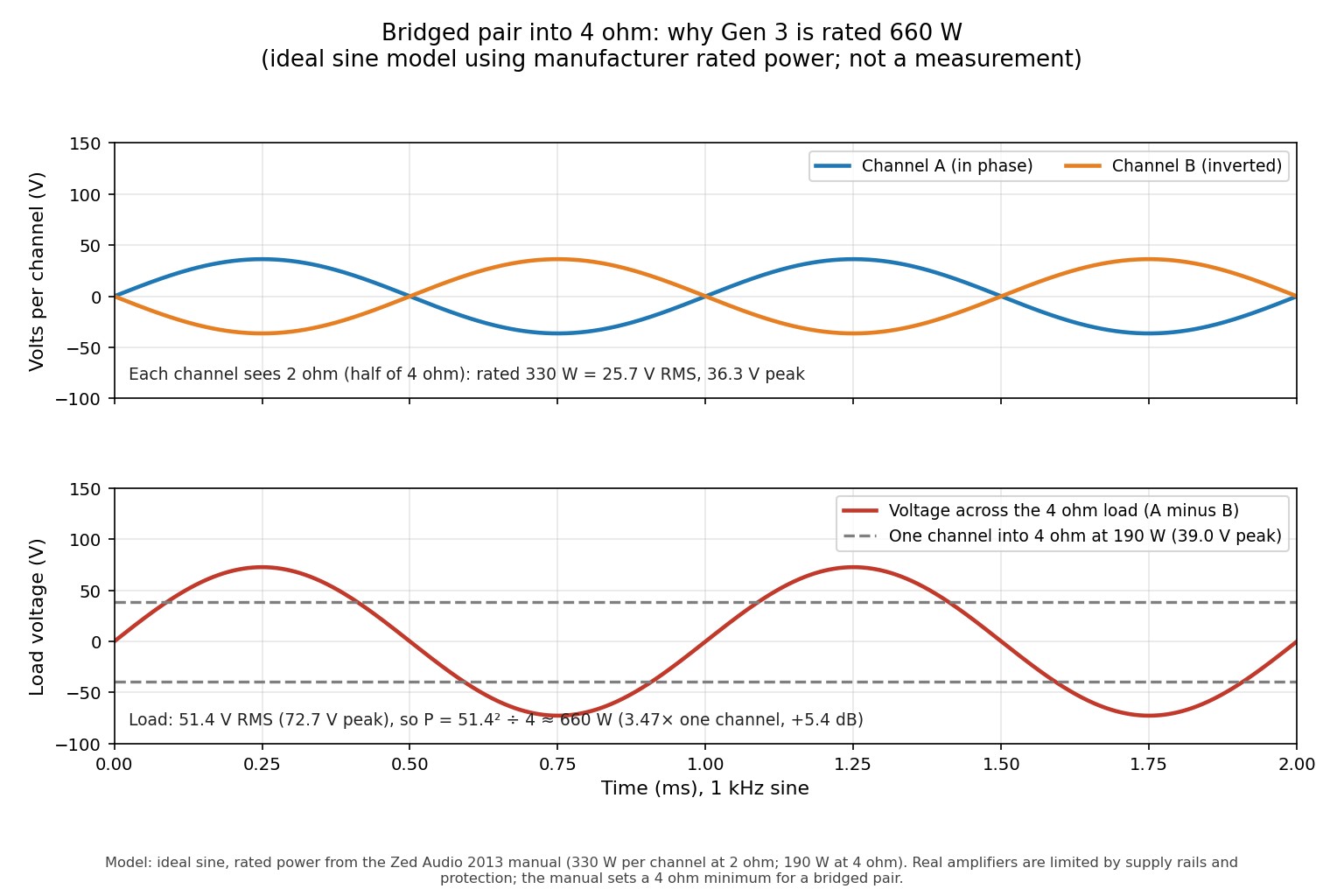
Bridging drives one speaker from two channels in opposite polarity, so the voltage across the load is the difference between them. Each channel sees half the load impedance, which is why the minimum bridged load is 4 ohm and why the bridged rating equals twice the per-channel 2 ohm rating. Using the third-generation ratings, each channel delivering 330 W into 2 ohm produces 25.7 V RMS. The bridged pair produces 51.4 V RMS across a 4 ohm speaker, which is about 660 W, or 3.47 times one channel into 4 ohm.
Both inputs of a bridged pair need the same signal, which means a Y-adapter on the RCA inputs. Follow the manual's terminal diagram for the speaker connections, and check the speaker's actual impedance first, because a bridged load below the 4 ohm minimum is outside the rating. The 2013 manual adds a note that 3 ohm bridged loads on pair 5+6 are acceptable when channels 1 to 4 run in band-pass or high-pass mode.
What to check and how it should perform
- Remote turn-on: the remote terminal must see more than 3 V, or the amplifier will not start.
- Protection indicator: if it lights, disconnect the speaker leads and cycle the power. If it stays lit with nothing connected, the manual treats the amplifier as faulty. If it clears, look for a shorted speaker or cable.
- Clipping LEDs: they should flicker only on the loudest peaks. Steady lighting means the level or the source is too high.
- Heat: Zed's rule of thumb is that the amplifier is fine if you can keep a hand on the chassis comfortably. Use that cautiously, because a heatsink can still be hot enough to burn.
- Noise: remove the RCA plugs. If a hiss disappears, the source is responsible. Alternator whine usually points to a poor ground or a signal cable run next to power wiring.
Used units deserve extra care. Forum owners report an early turn-on pop that was later fixed and a unit that needed three failed capacitors repaired, but these are isolated anecdotes and not a failure rate. Zed's 2010 manual gives a 90-day warranty, extended to two years on registration, that applies only to the original purchaser and is not transferable. Terms may have changed, so confirm the current policy and service options with Zed before paying for a second-hand unit.
Pros and cons
Pros
- Six channels with equal rated power, so no weak channels in a multi-way system.
- Per-pair analog crossovers allow a tri-amp or four-way layout from one chassis.
- One published bench test of the first generation exceeded its ratings and showed high efficiency for a car amplifier.
- Three independently bridgeable pairs give a choice between six channels and three stronger ones.
- Regulated supply, so output does not depend on battery voltage in the manual's description.
Cons
- Three versions share one name, with different ratings and crossover ranges.
- RCA inputs only, with no high-level inputs and no DSP.
- Current sine-wave draw is high at 94 A or more, so the wiring and fuse must be right.
- Only first-generation measurements are public, and the rest rests on manufacturer ratings.
- New availability, current price and service terms are unconfirmed.
Who it is for, and who it is not
Good fit: builders running an active three-way or four-way system who want six equal channels, comfortable loads of 4 ohm or higher, and the patience to configure analog crossovers. It also suits cars with limited electrical capacity, where an efficient amplifier helps.
Poor fit: buyers who need a factory radio hookup without extras, a tuning-by-laptop DSP workflow, sub-2 ohm loads, or a new amplifier with a clear warranty. Zed is blunt about not recommending very low impedances and says its amplifiers are not meant for high-SPL competition.
Alternatives
Rated power figures follow each maker's own test method, so a "100 W" and a "150 W" from different brands are not strictly comparable. Specifications below are as published by each manufacturer, except where noted.
| Amplifier | Channels and rated power | Processing | Notes |
|---|---|---|---|
| Zed Audio Leviathan, 3rd generation | 6 x 190 W at 4 ohm, 6 x 330 W at 2 ohm | Analog crossovers per pair | RCA inputs; availability unconfirmed |
| Zed Audio Draconia III | 4 x 175 W at 4 ohm, 4 x 250 W at 2 ohm | Analog crossovers, sub mode with subsonic filter and 40 Hz boost | Balanced inputs per the 2013 manual; availability unconfirmed |
| Zed Audio Minotaur III | 1 x 750 W at 4 ohm, 1 x 1,300 W at 2 ohm | Analog crossovers, 48 dB per octave high-pass | Mono sub amplifier; Zed suggests pairing it with a Leviathan |
| MMATS HiFi-6150D | 6 x 150 W at 4 ohm, 6 x 275 W at 2 ohm | Analog; see maker's manual | US-built; maker page lists it from US$1,149 when checked in October 2026 |
| Helix M SIX DSP | 6 x 100 W at 4 and 2 ohm, 3 x 200 W bridged at 4 ohm | Integrated DSP with PC software | Maker data as reproduced by retailers; confirm on the maker's site |
| Helix P SIX DSP Ultimate | Up to 145 W at 4 ohm (all channels), up to 285 W at 2 ohm (channels C to F) | Integrated 12-channel DSP | Maker data as reproduced by retailers; confirm on the maker's site |
Another route is a separate DSP with two or three smaller amplifiers. It costs more and takes more space, but it adds time alignment and equalisation that the Leviathan does not provide.
Buying advice
Start by confirming availability. Zed's current site lists service, restoration and consulting pages and a downloads page, but I found no price or store page for the amplifiers, and a search-indexed retailer listing for the Leviathan III showed it as unavailable. Historical retail prices of US$599 (2009) and US$695 (a magazine listing) are not current. When looking at a second-hand unit, ask for photos of the label and serial number, match them to the right manual, and check that all six channels and all three bridged modes work. Budget for a proper fuse, power wire and a pair of Y-adapters.
Common mistakes
- Assuming every Leviathan has the same rating. The generation decides the power, the crossover ranges and the fuse.
- Setting level by ear until the head unit is near maximum, instead of matching gain to the speakers' power rating.
- Treating the amplifier's rating as a target for small speakers. A 50 W tweeter needs about 14 V, not 27 V.
- Fitting a much larger fuse than the manual allows.
- Bridging into a load below 4 ohm, or bridging without feeding both inputs the same signal.
- Mounting the amplifier close to the antenna or the radio's wiring.
- Comparing watt figures between brands without checking the test conditions.
Final verdict
The Leviathan is an interesting, flexible amplifier with a clear design philosophy: regulated supply, equal channels, analog crossovers and a preference for loads of 4 ohm or higher. The evidence for its performance is real but narrow, since it is a manufacturer-hosted bench test of the first generation, and every other number is a rating. The deciding factors today are availability, service and exactly which version you are buying. If you can resolve those, it is a sensible way to run a multi-amplified system from one chassis. If you cannot, a current six-channel amplifier with built-in DSP will probably be easier to live with.
Sources and further reading
- Zed Audio Corporation, Instruction and Installation Manual, 2010 (first-generation Leviathan and Kronos).
- Zed Audio Corporation, Instruction and Installation Manual, 2011 (second-generation Leviathan).
- Zed Audio Corporation, Instruction and Installation Manual, 2013 (third-generation Leviathan, Draconia III, Minotaur III, RA).
- Paul Sonoda, Amplifier Review: ZED Audio Leviathan, November 2009 (bench test of the first generation, hosted by Zed Audio).
- PASMAG, ZED Audio Leviathan (magazine review of the first generation).
- MMATS Pro Audio, HiFi-6150D product page.
Last reviewed: October 2026
Zed Leviathan Questions Before You Buy
How many channels does the Zed Audio Leviathan have?
Six. All channels have the same rated power and are arranged as three pairs, each with its own crossover, so one chassis can run a tri-amplified system including subwoofers.
How many versions of the Zed Leviathan are there?
Zed's manuals dated 2010, 2011 and 2013 describe three generations, often listed by sellers as Leviathan, II and III. Their 4 ohm ratings are 150 W, 150 W and 190 W per channel, so confirm which version you have.
How much power does the third-generation Leviathan make?
The 2013 manual rates it at 190 W per channel into 4 ohm and 330 W per channel into 2 ohm. A bridged pair is rated at 660 W into 4 ohm.
Can the Zed Audio Leviathan be bridged?
Yes. Any or all of the three pairs can be bridged. The minimum bridged load is 4 ohm, and both inputs of the pair need the same signal, which means a Y-adapter on the RCA inputs.
Does the Leviathan have built-in DSP?
No. It uses analog 24 dB per octave crossovers set per pair, and it has no built-in equaliser, no line outputs and no time alignment. Buyers who want those need a separate processor.
Can I connect a Leviathan to a factory radio?
Only with help. The inputs are RCA only, and the 2013 manual says there are no balanced inputs. A factory radio with speaker-level outputs needs a separate line output converter.
What fuse does the Leviathan need?
For the second and third generations, the manuals list 30 to 40 A for a 4 ohm load and 40 to 80 A for 2 ohm. The first generation lists 20 to 25 A and 60 A. Fit the fuse within 300 mm (12 in) of the battery and never go above the manual's rating.
How much current does the Leviathan draw?
For the later models the manuals give 94 A with a continuous sine wave and 18 to 28 A with music, both into 4 ohm. The first generation lists 105 A and 30 A. Idle draw is below 1.5 A on later models.
What are the Leviathan's crossover ranges?
On the second and third generations, pairs 1+2 and 3+4 cover 55 Hz to 4 kHz, and pair 5+6 has a low-pass from 40 to 235 Hz. The first generation starts higher, at 80 Hz on the upper pairs.
Is it safe to run the Leviathan into 2 ohm loads?
It is rated for 2 ohm per channel, but Zed itself recommends loads of 4 ohm or higher. The 2 ohm rating exists mainly because real 4 ohm speakers dip in impedance.
Does the Leviathan sound good for a class D amplifier?
Two published reviews of the first generation described the sound favourably. Those are subjective impressions, and no listening or bench results for the second or third generation were found.
Is the Zed Audio Leviathan still sold new?
I could not confirm it. Zed's site lists service and downloads pages but no store page for the amplifiers, so check availability and price with the company before you plan a build.
What warranty does a used Leviathan have?
Zed's 2010 manual gives 90 days, extended to two years on registration, for the original purchaser only and not transferable. Terms may have changed, so confirm the current policy before buying second-hand.