AudioControl · The EPICENTER PRO
AudioControl EPICENTER PRO Review: Bass Restoration Compared
Bass restoration processor and line driver with ParaBASS, a 24 Hz subsonic filter and an ACR-4 remote. Verified specs, rivals and buying advice at $199.
Pros
- ParaBASS Sweep (27 to 63 Hz) and Wide controls shape the restored bass to the vehicle or enclosure tuning
- Switchable maximum output voltage (5 V, 7.5 V or 10 V) helps match amplifier inputs and restrain bursts
- 24 Hz PFM subsonic filter protects ported subwoofers and saves amplifier power, with a bypass option
- Balanced or unbalanced inputs and a GND, ISO or 200 ohm ground switch help troubleshoot noise
- Input gain and output level each have a Max LED to guide gain setting
- Dual-knob ACR-4 dash remote included, separately controlling bass effect and output level
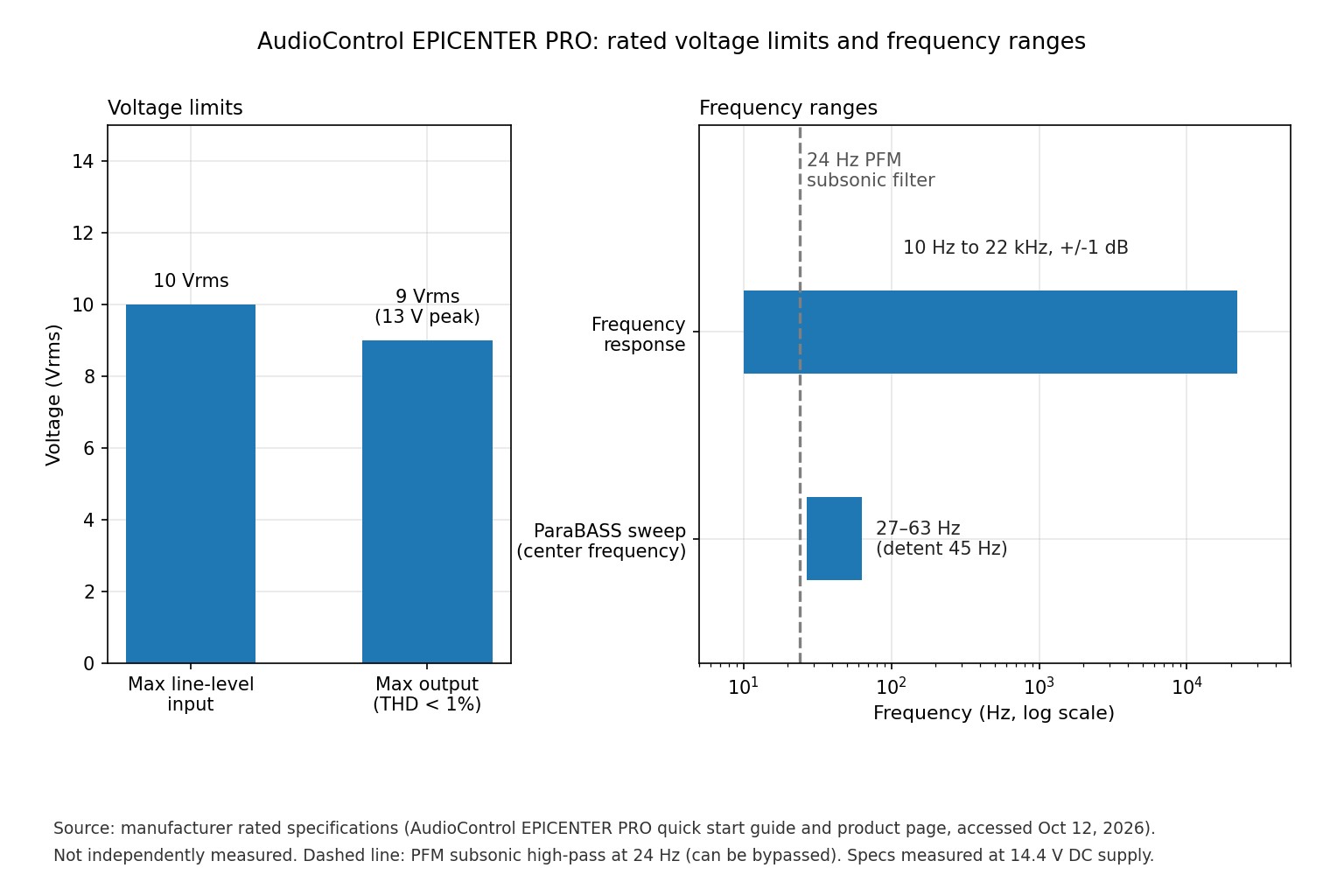
- Built-in line driver delivers up to 9 Vrms (13 V peak) at 150 ohms output impedance
Cons
- Line-level inputs only, so a factory radio without RCA outputs needs a line output converter first
- No load selection, despite a claim to the contrary in the Amazon listing text
- The ACR-4 must stay connected; without it there is no bass effect and no volume attenuation
- Published THD (0.03%), signal-to-noise (above 105 dB) and output (9 Vrms) are weaker on paper than the cheaper original EPICENTER
- No independent measurements found, and the effect depends heavily on the source material
- Warranty is 1 year and AudioControl's manual excludes purchases from unauthorized resellers, including marketplace sellers
Specifications
| Current draw / fuse | 300 mA / 1 A fuse within 18 in of the connection point |
|---|---|
| Dimensions / weight | 8 x 5.5 x 1.2 in without connectors / 1.68 lb |
| Frequency response | 10 Hz - 22 kHz, +/-1 dB |
| Gain controls | Input gain and output level, each with a Max LED |
| Ground isolation | GND / ISO (default) / 200 ohm switch |
| Inputs | Line-level RCA, balanced or unbalanced (switchable); max 10 Vrms; 7 kohm |
| Maximum output voltage switch | 5 V (default), 7.5 V or 10 V |
| Outputs | Line-level RCA; max 9 Vrms (THD under 1%), 13 V peak; 150 ohm |
| PFM subsonic filter | High-pass, 24 Hz or bypass |
| ParaBASS | Sweep 27 - 63 Hz center frequency (45 Hz detent); Wide control |
| Power supply | High-headroom PWM switching |
| Remote | ACR-4 dual-knob dash control included (outer: bass effect, inner: output level); must stay connected |
| Signal-to-noise ratio | Above 105 dB |
| THD | 0.03% (14.4 V supply; other conditions not stated) |
| Turn-on | 12 V remote turn-on input |
| Type | Bass restoration processor and line driver with ParaBASS equalization |
Verdict
The EPICENTER PRO suits drivers with a full-range RCA source and a subwoofer amplifier who want to restore and shape missing bass. Its main strengths are ParaBASS control, a switchable maximum output voltage, a 24 Hz subsonic filter and an included dual-knob remote. The compromises are line-level inputs only, a remote that must stay connected, weaker published distortion and noise figures than the cheaper original EPICENTER, and no independent measurements. At $199 it is reasonably priced for the control it offers.
The AudioControl EPICENTER PRO is a bass restoration processor and line driver for aftermarket car audio systems. It analyzes the harmonics in the upper bass and midrange of a signal, synthesizes lower notes that the recording or source has lost, and feeds them back into the signal path ahead of your amplifier. Is it worth buying? If you already have a line-level source and a subwoofer amplifier, and your system sounds thin at the bottom, it is a well-featured tool at $199 (verified on AudioControl's website on October 12, 2026, the same price as the Amazon listing). If you are working from a factory radio with no RCA outputs, or you want the lowest possible price, another product may fit better.
This page rates the unit 4.0 out of 5 using the rubric explained near the end. The verdict, pros, cons and full specification list appear in their own boxes on this page, so the text below focuses on how the unit works, what the evidence says and what to check before buying.
How this review was made
I have not bought, installed, listened to or measured the EPICENTER PRO. This is a specification and research review. It draws on AudioControl's product page and 2025 quick start guide, AudioControl's pages for the original EPICENTER and the EPICENTER Micro PRO, retailer listings, and owner ratings, which are anecdotal. I searched for independent laboratory measurements and found none, so every performance figure below is the manufacturer's claim.
One correction matters for shoppers: the Amazon listing text says the unit has onboard load selection switches (20 ohm, 60 ohm, 20 kohm). AudioControl's manual and product page show line-level RCA inputs only, and load selection is a feature of the Micro PRO. I follow the manufacturer's documents.
Design and build
AudioControl lists the EPICENTER PRO at 8 by 5.5 by 1.2 inches without its connectors and 1.68 lb (0.76 kg). The Amazon listing shows larger package-style dimensions, which I take to include packaging. It mounts with built-in tabs and self-tapping screws, and uses a high-headroom switching power supply. The housing material is not stated in the sources I reviewed, so I make no claim about it.
The unit has an Input Gain knob and an Output Level knob, each with a Max LED, ParaBASS Sweep and Wide knobs, a power terminal block, RCA inputs and outputs, and switches for input grounding, ground isolation, the PFM subsonic filter and maximum output voltage. A yellow LED flickers with the amount of bass restoration the unit is producing, and a red LED shows power. The included ACR-4 is a dual-knob dash control that mounts under the dash with four screws or flush in a custom 9/32 inch hole, and it connects with the supplied cable.
Features and usability
The core is AudioControl's patented Bass Maximizer circuit. According to the manual, it reproduces missing low notes by detecting harmonics in the upper frequency range and dropping down a few octaves. The ParaBASS controls shape that effect: Sweep moves the center frequency between 27 Hz and 63 Hz (45 Hz at the detent), and Wide changes how broad the filter is. AudioControl suggests narrowing it around the tuning frequency of a ported enclosure, or widening it around 50 to 60 Hz for a more natural sound.
Gain structure and output control
The unit accepts up to 10 Vrms and has a built-in line driver that delivers up to 9 Vrms (13 V peak) with a 150 ohm output impedance. A Maximum Output Voltage switch offers 5 V, 7.5 V and 10 V; the default of 5 V suits most amplifiers, and AudioControl says to set it first, based on your amplifier's maximum input. Input gain and output level are set in two stages using the Max LEDs. Inputs can be balanced (the default) or unbalanced, which is a troubleshooting option if you hear noise, and a ground isolation switch offers GND, ISO (the default) and 200 ohm.
Subsonic filter and the ACR-4
The PFM filter is a 24 Hz high-pass that can be bypassed. AudioControl strongly recommends leaving it on, especially with ported subwoofer enclosures, because infrasonic content wastes amplifier power and can damage drivers. The ACR-4's outer knob controls the amount of bass effect and the inner knob controls output level. The manual is blunt about one limitation: the ACR-4 must stay connected, because without it the unit gives no bass effect and no volume attenuation, and an ACR-1 will severely attenuate the output. AudioControl also lists an EPICENTER Link feature for connecting to its EPIC monoblock, EPICFIVE and EPICBIGFOUR amplifiers; the harness is not in the in-box list I saw.
What is missing
There are no speaker-level inputs, no load selection and no signal-sensing turn-on in AudioControl's documents; the unit uses a 12 V remote turn-on connection. A factory radio without RCA outputs needs a line output converter first, or you should consider the Micro PRO, which adds speaker-level inputs and load selection at a higher price.
Sound and performance
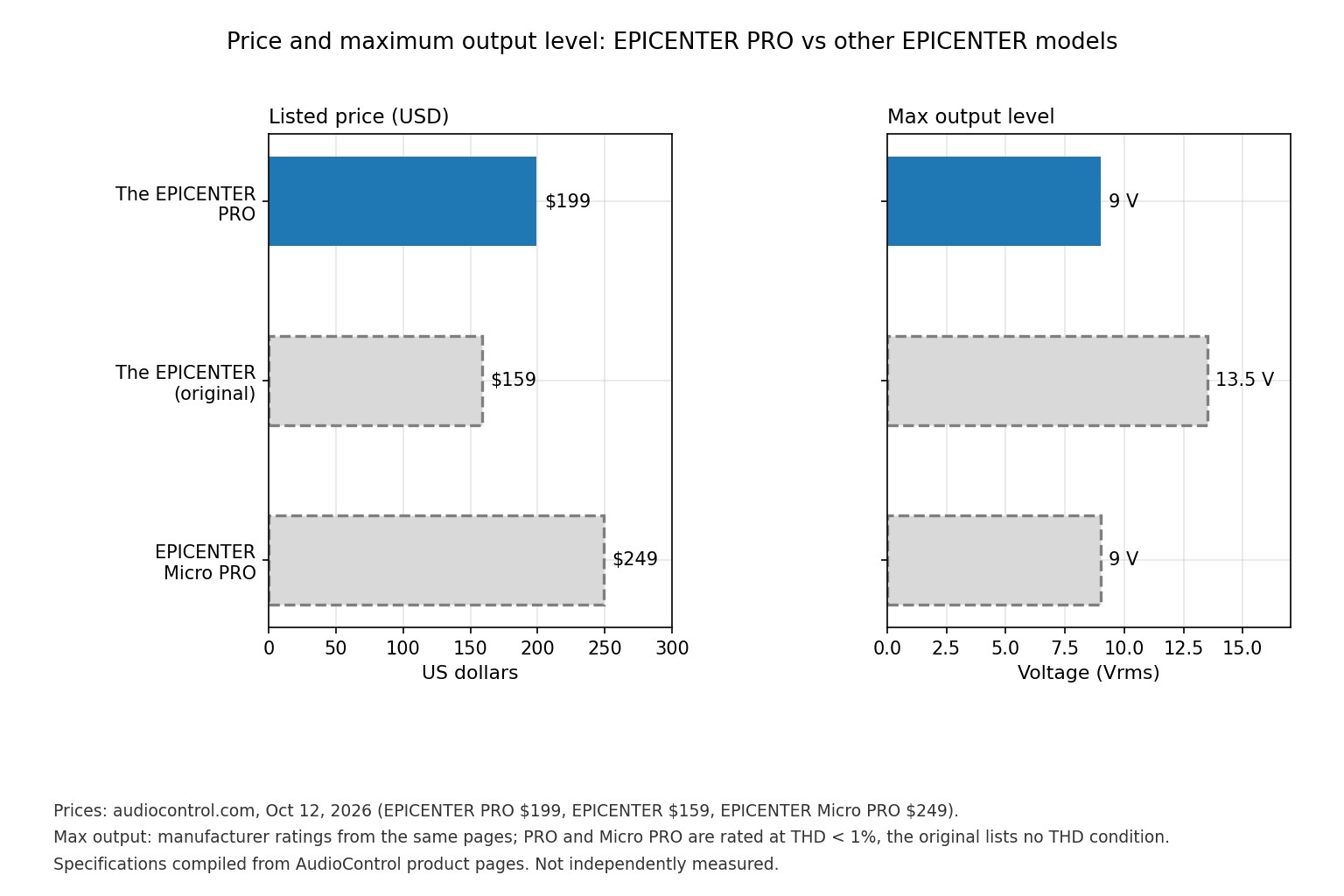
I did not listen to this unit, so this section rests on published figures and attributed reports. AudioControl lists a frequency response of 10 Hz to 22 kHz (plus or minus 1 dB), total harmonic distortion of 0.03%, a signal-to-noise ratio above 105 dB and a maximum output of 9 Vrms at under 1% distortion, with measurements taken at a 14.4 V supply. The original EPICENTER at $159 lists 13.5 Vrms output, 0.003% distortion, 110 dB signal-to-noise and 10 Hz to 100 kHz response. On paper, then, the PRO's numbers are less impressive than the older, cheaper unit. The test conditions differ and are not fully published, so I would not read much into the gap, but it shows that the PRO's appeal is control and features rather than headline specifications.
How the effect behaves is worth understanding. AudioControl's manual says the restoration ramps up as frequencies descend and needs a full-range signal; if you can only supply a low-passed signal, the unit loses much of its impact. It also warns that modern music that already has plenty of bass may sound distorted with the effect up, in which case you should turn it down. Bass restoration synthesizes content rather than equalizing what is there, so results will vary with the music and the system.
Owner feedback is positive but small in scale. AudioControl's own store shows 4.9 out of 5 from 10 reviews, one dealer's page shows 56 reviews with 88% at five stars, and the Amazon listing showed 4.8 out of 5 from 68 ratings. Some retailer review counts include reviews labeled as being for a previous EPICENTER version, so treat those totals carefully. None of this is measured evidence.
Setup, installation and daily use
Install the EPICENTER PRO after the source and before any crossover, equalizer or digital signal processor. Following the manual, connect +12 V and ground with insulated 14 to 18 AWG wire to the battery or a verified ground, put a 1 A fuse within 18 inches of the connection point, and connect the remote terminal to a head unit remote turn-on or switched 12 V source. Disconnect the battery negative before wiring, use grommets where wires pass through metal, and check for fuel lines, brake lines and wiring before drilling.
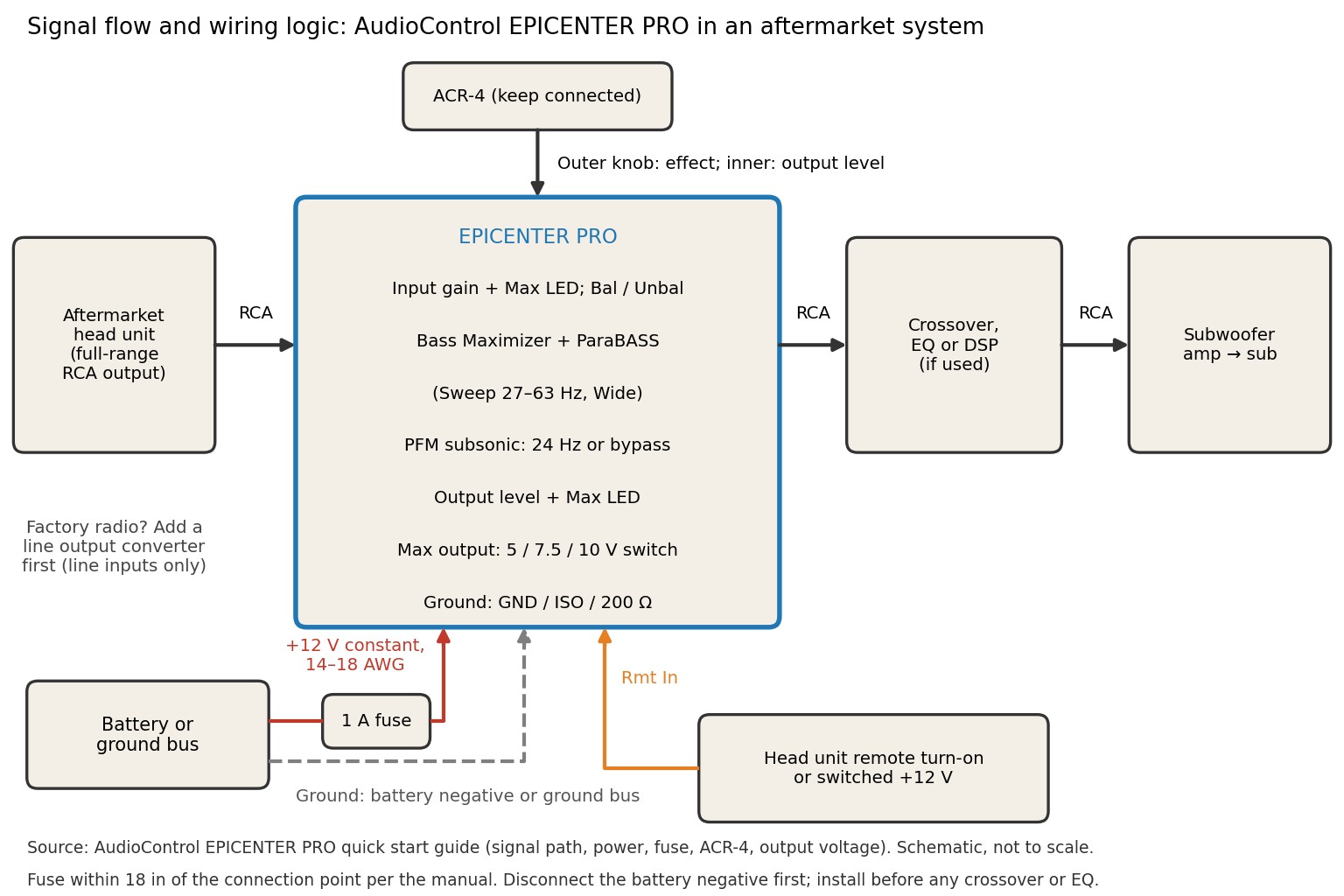
The setup order matters. Set the maximum output voltage first, leave the PFM filter at 24 Hz, then set the input gain by playing a bass-heavy track at the source's maximum undistorted volume (or about 75% if you cannot measure it) and raising the gain until the Max LED just flickers. Next adjust ParaBASS by ear, then set the output level the same way with the amplifier disconnected to protect your ears. If you hear alternator whine, try the other ground isolation positions with the unit off, then the unbalanced input setting. If distortion appears, reduce the ACR-4 effect, re-engage the PFM filter, lower the maximum output voltage or raise the Sweep frequency. Keep volume sensible while tuning, as high sound pressure can cause permanent hearing loss.
How it compares
The closest alternatives are AudioControl's own original EPICENTER and EPICENTER Micro PRO, and budget bass processors such as the Soundstream BX-10. I used manufacturer and retailer listings and tested none of them.
| Feature | EPICENTER PRO | EPICENTER (original) | EPICENTER Micro PRO | Soundstream BX-10 |
|---|---|---|---|---|
| Price (USD) | $199 (AudioControl, Oct 12, 2026) | $159 (AudioControl, Oct 12, 2026) | $249 (AudioControl, Oct 12, 2026) | Varies widely: about $57 on one marketplace listing, $166.85 at another retailer |
| Inputs | Line-level RCA only | Line-level RCA, 2 channels | Line-level and speaker-level (40 V / 400 W) | Balanced inputs listed |
| Load selection | None | None | 20 / 60 ohm, 20 kohm | None listed |
| Max output level | 9 Vrms (THD under 1%) | 13.5 Vrms | 9 Vrms (THD under 1%) | 13.5 V (peak or RMS not clear) |
| Output voltage switch | 5 / 7.5 / 10 V | Not listed | Up to 10 V | Not listed |
| THD | 0.03% | 0.003% | 0.03% | 0.003% (listing) |
| Signal-to-noise | Above 105 dB | 110 dB | Above 105 dB | 130 dB (retailer listing) |
| Frequency response | 10 Hz to 22 kHz, +/-1 dB | 10 Hz to 100 kHz | 10 Hz to 22 kHz, +/-1 dB | 10 Hz to 100 kHz (listing) |
| Subsonic filter | 24 Hz or bypass | PFM filter | 24 Hz, 15 Hz or bypass | PFM filter (listing) |
| Dash remote | ACR-4 dual knob included | ACR-1 included | ACR-4 dual knob included | Dash remote included |
| Turn-on | Remote in | Remote in | Remote in, GTO, audio sense | Not confirmed |
| Dimensions | 8 x 5.5 x 1.2 in | 8 x 5.5 x 1.2 in | 8 x 3 x 1 in | Not confirmed |
The original EPICENTER is the obvious comparison: it lists a higher output and lower distortion for $40 less, but has no output voltage switch, no dual-knob remote and, per AudioControl's page, a one-knob ACR-1. The Micro PRO is a more expensive route if you need to connect a factory radio directly. The Soundstream BX-10 is a budget alternative with similar headline numbers on some retailer listings, but prices and specifications vary by listing and I could not confirm them from a manufacturer page.
Who should buy it and who should skip it
It is a reasonable fit if:
- You have an aftermarket head unit or other full-range RCA source and a subwoofer amplifier.
- You want to shape the restored bass to a ported enclosure or your cabin acoustics.
- You want a dash knob that separately controls effect and level.
- You value a subsonic filter and a maximum output voltage limit to protect subwoofers and amplifiers.
Consider skipping it if:
- You are keeping a factory radio without RCA outputs; you need a line output converter first, or the Micro PRO.
- You care most about the best published distortion and noise figures; the cheaper original EPICENTER lists better ones.
- You prefer an unprocessed signal; this unit adds synthesized bass.
- You do not want a remote that must stay connected for the unit to work.
Buying advice
Check the seller before anything else. AudioControl's manual states that products from unauthorized resellers, including third-party sellers on marketplaces such as Amazon, eBay or Best Buy, are not covered by its warranty, and that coverage applies when you buy from AudioControl, Stinger or an authorized dealer. Warranty length is one year; five years applies only when the unit is installed with a Stinger power management kit by a factory-direct authorized retailer. Confirm who sells your listing.
Confirm your source is line-level, since the Amazon listing's mention of load selection is not supported by AudioControl's documents. The box contains the processor, the ACR-4, a remote cable and the manual; budget for RCA cables, power wire, a fuse and a ground connection. The Amazon listing shows November 5, 2025 as the date first available, so this is a recent model with limited long-term ownership history.
Final thoughts
The EPICENTER PRO earns a rating of 4.0 out of 5. The rubric weights performance and function at 40%, features and usability at 20%, build quality and design at 15% and value for the price at 25%. Features score highest because ParaBASS, the output voltage switch, the subsonic filter and the dual-knob remote give real control. Performance scores 4.0 on the strength of the design and owner feedback, held back by the absence of independent measurements. Build scores 3.5 because construction details are not confirmed. Value scores 3.5 because $199 buys more control than the $159 original but with weaker published numbers. These scores are provisional and based on research only.
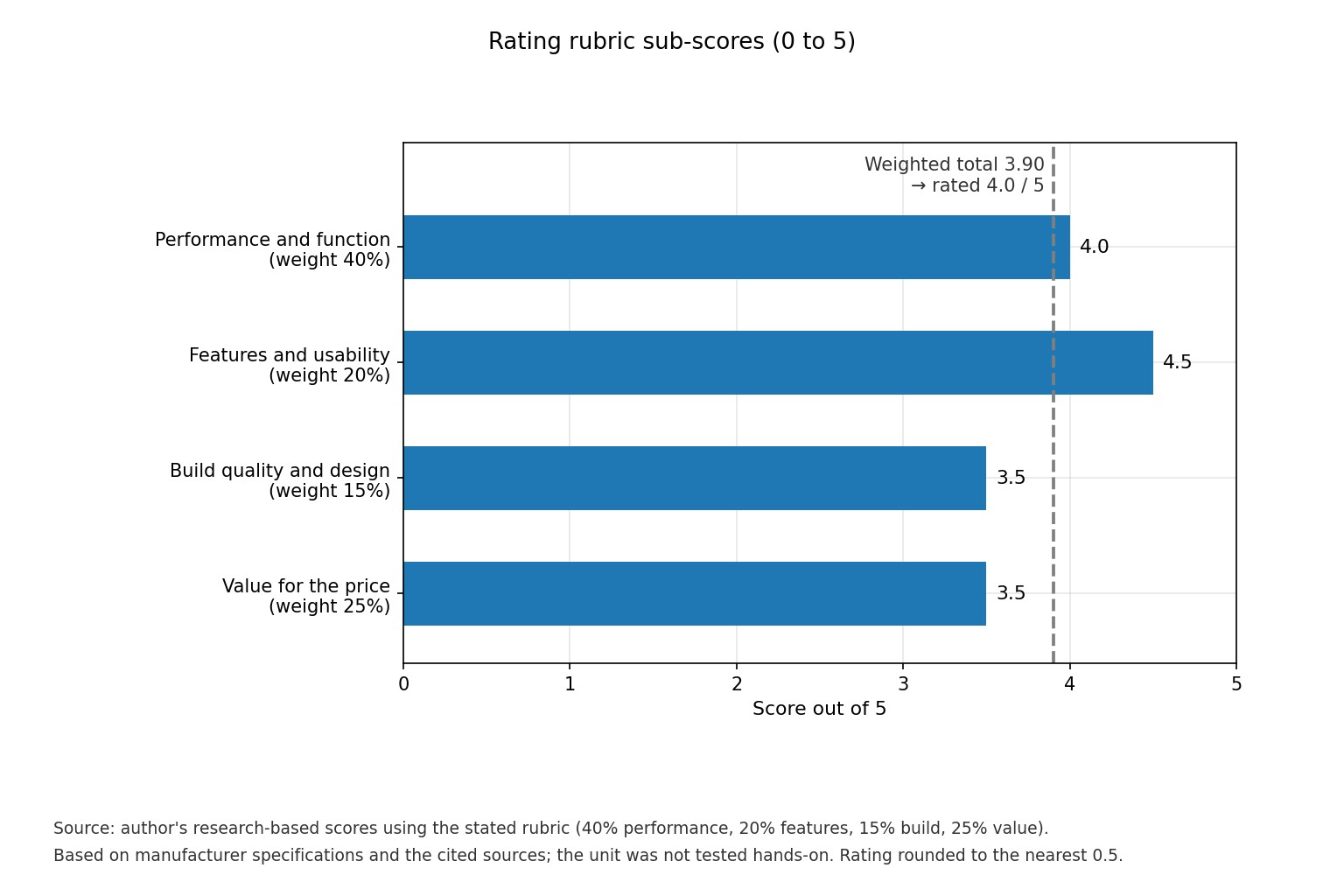
| Criterion | Weight | Score (0-5) | Weighted points |
|---|---|---|---|
| Performance and function | 40% | 4.0 | 1.600 |
| Features and usability | 20% | 4.5 | 0.900 |
| Build quality and design | 15% | 3.5 | 0.525 |
| Value for the price | 25% | 3.5 | 0.875 |
| Total | 100% | 3.90, rounded to 4.0 | 3.900 |
Some links on this page are affiliate links; they never affect our ratings.
Sources and further reading
- AudioControl EPICENTER PRO product page (price and specifications, accessed October 12, 2026)
- AudioControl EPICENTER PRO quick start guide and manual
- AudioControl original EPICENTER product page
- AudioControl EPICENTER Micro PRO product page
- Soundstream BX-10 retailer listing
- Soundstream BX-10 at OnlineCarStereo
- Dealer listing with customer review distribution (anecdotal)
AudioControl EPICENTER PRO FAQ
What does the AudioControl EPICENTER PRO do?
It analyzes the upper bass and midrange harmonics in a signal and synthesizes missing lower bass notes, then feeds them back into the signal path. It also acts as a line driver, raising the signal level for your amplifier. It does not act as a simple bass boost or equalizer.
Can I connect a factory radio to the EPICENTER PRO?
Not directly. The unit has line-level RCA inputs only, so a factory radio without RCA outputs needs a line output converter first. The EPICENTER Micro PRO adds speaker-level inputs and load selection for that situation.
Does the EPICENTER PRO have load selection switches?
No, not according to AudioControl's manual and product page. Some Amazon listing text mentions 20 ohm, 60 ohm and 20 kohm load selection, but those switches belong to the Micro PRO. Rely on the manufacturer's specifications.
Does the ACR-4 remote have to stay plugged in?
Yes. AudioControl says that without the ACR-4 connected, the EPICENTER PRO has no bass effect and no volume attenuation. It also says an ACR-1 should not be used, because it severely attenuates the output.
What is the difference between the EPICENTER PRO and the original EPICENTER?
The PRO adds a line driver, a switchable maximum output voltage, a bypassable subsonic filter and a dual-knob ACR-4 remote. AudioControl lists the original at $159 with higher output (13.5 Vrms) and lower distortion (0.003%) than the PRO's 9 Vrms and 0.03%. The original uses a one-knob ACR-1 remote.
Where does the EPICENTER PRO go in the signal chain?
AudioControl says to install it after the source and before any crossover, equalizer or DSP. It works best with a full-range signal, and a low-passed signal loses much of its effect. If your head unit has a low-pass filter you cannot bypass, set it as high as it goes.
What output voltage should I choose on the EPICENTER PRO?
AudioControl says to match the switch to your amplifier's maximum input voltage, using 5 V, 7.5 V or 10 V. The default is 5 V, which it says suits most amplifiers. Check your amplifier's specifications if you are unsure.
What warranty does the EPICENTER PRO have?
AudioControl's manual gives one year from purchase from a factory-direct authorized retailer, or five years when installed with a Stinger power management kit by such a retailer. Products from unauthorized resellers, including marketplace third-party sellers, are not covered. Confirm who sells your listing before buying.