AudioControl · The Epicenter (Concert Series)
AudioControl Epicenter Review: Bass Restoration Explained
The AudioControl Epicenter is a $159 RCA-level bass restoration processor with ParaBass and a dash remote. Research-based review of specs, setup and who needs it.
Pros
- Purpose-built bass restoration circuit from AudioControl, with ParaBass Sweep (27 to 63 Hz) and Width controls
- Listed specifications are strong: 0.003% THD, 10 Hz to 100 kHz response and balanced inputs up to 15 Vrms
- Includes a PFM subsonic filter (33 Hz factory) with optional 25 to 45 Hz modules to protect the subwoofer
- Jumper-selectable Bass Output Control from 2.5 V to 10 V to match amplifier input and speaker size
- ACR-1 dash remote included, with an LED that follows the restoration level
- Draws only 150 mA and uses a 1 A fuse, so power wiring is simple
Cons
- RCA inputs only, so factory radios without preamp outputs need an adapter or the Micro models
- Subsonic filter changes need the chassis opened and a separate module, and jumpers are inside the case
- Must be fed a full-range signal ahead of any crossover or it can sound garbled
- AudioControl's page and the 1998 manual disagree on noise, output units and warranty
- No independent measurements found; sound claims rest on the manufacturer and owner comments
- A look-alike Soundstream BX-10X lists similar headline specifications at about $60
Specifications
| Bass Output Control | 2.5, 5 (factory), 7.5 or 10 V by internal jumper (manual) |
|---|---|
| Dimensions | 8 in W x 5.5 in D x 1.2 in H |
| Frequency response | 10 Hz to 100 kHz (manual: plus or minus 1 dB) |
| Inputs | 1 pair RCA (2 channels), balanced, up to 15 Vrms, 10 kohm |
| Outputs | 1 pair RCA (2 channels), 150 ohm, up to 13.5 Vrms (page); manual lists 13.5 V peak |
| PFM subsonic filter | 33 Hz factory module; optional 25, 30, 35, 40, 45 Hz modules sold separately |
| Para-Bass Sweep | 27 Hz to 63 Hz, 40 Hz factory (manual) |
| Para-Bass Width | Wide factory setting; range listed as 30 Hz to 250 Hz (manual) |
| Power | High headroom PWM switching supply; 150 mA draw; 1 A fuse recommended |
| Remote | ACR-1 dash remote included |
| Signal-to-noise ratio | 110 dB on AudioControl's page; the 1998 manual lists -130 dB |
| Total harmonic distortion | 0.003% (AudioControl) |
| Type | Bass restoration processor (RCA level) |
| Warranty | 1 year per AudioControl's page; the 1998 manual describes 5 years if dealer-installed |
| Weight | 1.8 lb (0.8 kg) on AudioControl's page; the manual lists 1.7 lb |
Verdict
The Epicenter is a bass restoration processor for systems with full-range RCA sources and aftermarket subwoofer amplifiers, with ParaBass tuning, a subsonic filter and an included ACR-1 dash remote. Its strength is a purpose-built circuit with strong listed specifications from the original maker. Its main compromise is RCA-only inputs and a subsonic filter you change by swapping a module inside the case. At AudioControl's $159 price it is fair, though a look-alike sells for about $60.
Is the AudioControl Epicenter worth buying? If you already run an aftermarket subwoofer amplifier and listen to material that sounds thin in the low end, it is one of the few dedicated bass restoration boxes still sold by its original maker, and $159 direct from AudioControl is a fair price for it. If your source only has speaker-level outputs, or you expect it to fix a weak subwoofer or an underpowered amp, look elsewhere. The Epicenter reshapes the signal; it does not add power or cone area.
This review covers the Concert Series model, listed by AudioControl as The EPICENTER Bass Restoration Processor. The company also sells the Epicenter PRO and the Micro versions, so check which one your listing actually shows. The verdict, pros, cons and specification table appear in their own fields on this page, so I will focus on how the device works, what the evidence says, and where it fits.
How this review was made
This is a specification and research review. I did not buy, install, listen to or measure an Epicenter, and nothing below claims hands-on use. I read AudioControl's product page and its Concert Series owner's manual, then compared them with retailer listings and question-and-answer threads, and checked a sibling model and a look-alike on retailer pages. Owner comments are anecdotal and labelled as such. I found no independent lab measurements, so statements about sound come from the manufacturer, retailer listings and owner reports, not from my own ears.
What it does
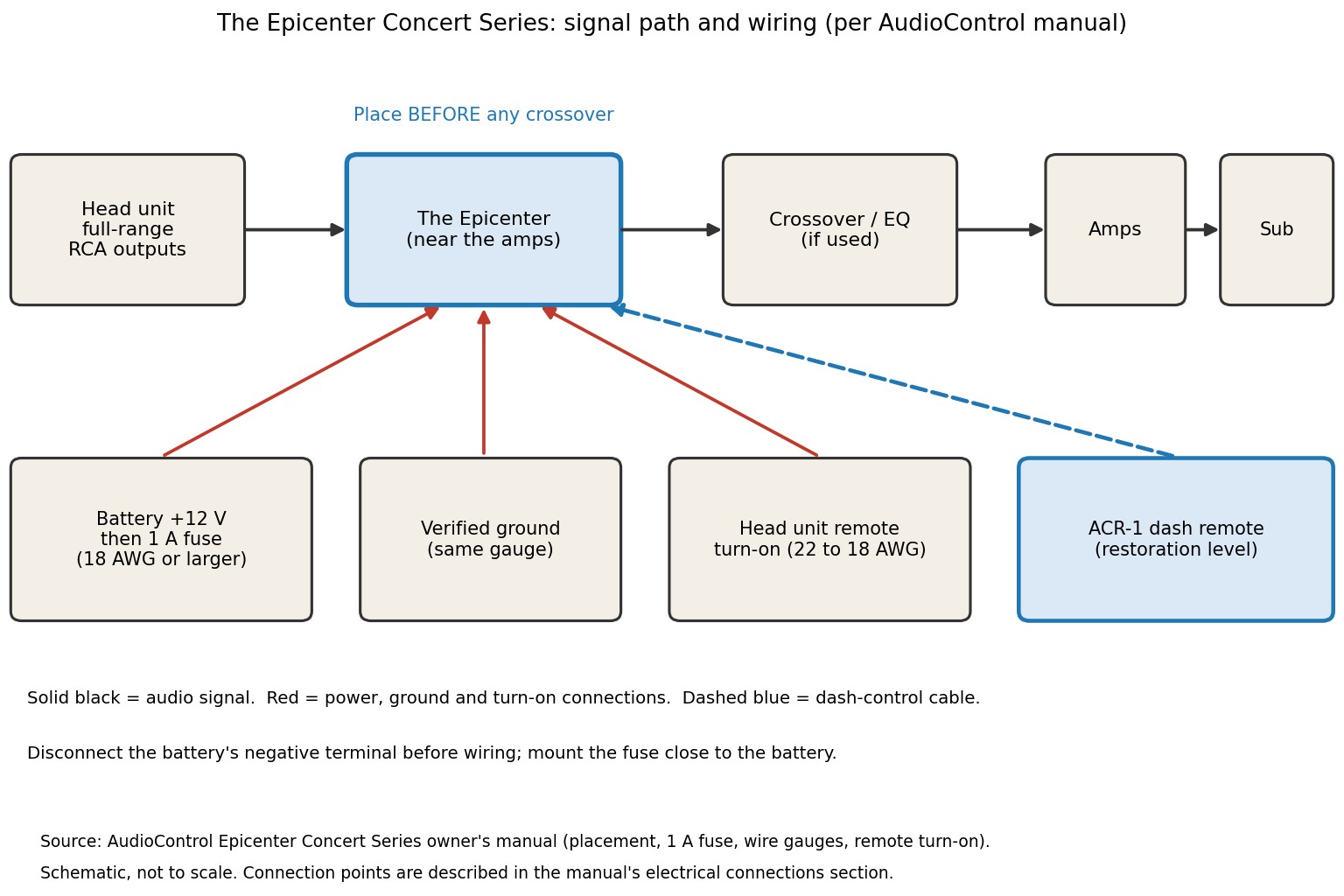
AudioControl says the Epicenter analyses the incoming signal from your source unit, recreates bass tones that were lost in recording or processing, and feeds that low-frequency information back into the signal. The manual describes the mechanism more plainly: the circuit looks at harmonics in the upper bass range and uses them to rebuild notes a few octaves lower. It is a synthesis circuit, not a simple bass boost, which is why placement in the signal chain matters so much. AudioControl's own guidance says to put the Epicenter ahead of any equalizer and crossover, and that feeding it only a subwoofer-band signal will likely sound garbled.
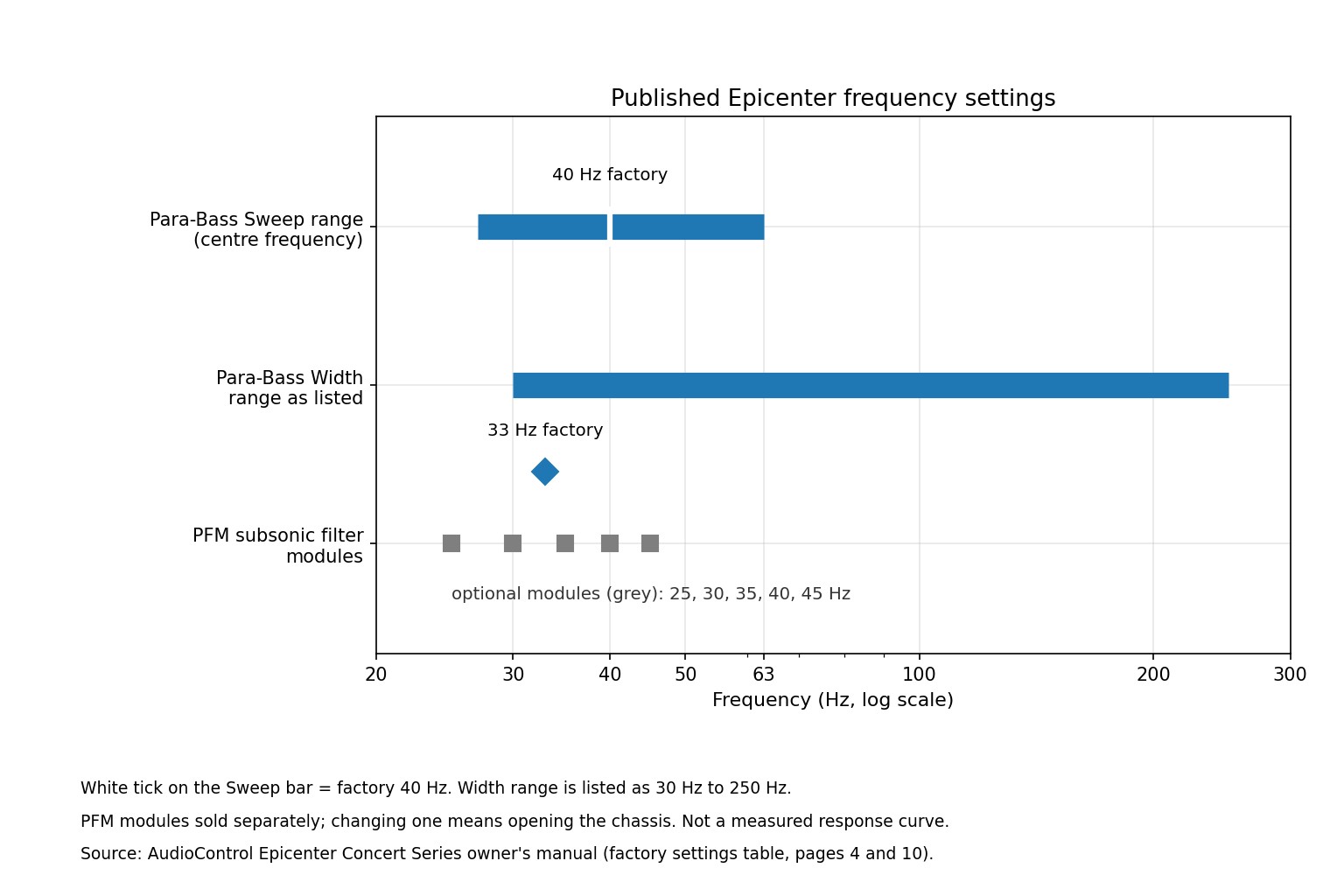
The controls fit that job. Para-Bass is a single-band parametric equalizer for the restored bass, with a Sweep control for the centre frequency (listed as 27 to 63 Hz, factory 40 Hz) and a Width control. A PFM subsonic filter protects the subwoofer from very low content, shipped at 33 Hz. A Bass Output Control jumper inside the chassis sets maximum output voltage. A dash-mounted ACR-1 remote, included in the box, adjusts the amount of restoration, and its LED brightens as you add more.
Design and build
The chassis measures 8 inches wide, 5.5 inches deep and 1.2 inches high, and AudioControl lists the weight at 1.8 lb (the older manual says 1.7 lb). A backlit logo on the case flashes when the bass maximization circuit is active. The manual says to mount the unit almost anywhere in the vehicle except the front bumper or radiator, and it is normally placed in the trunk near the amplifiers. The ACR-1 remote mounts under the dash with a bracket or flush through a custom hole, and its LED can be switched between green and amber by turning a plug.
I could not find independent teardown or durability testing. AudioControl's store shows 5 out of 5 from a small number of reviews, and several Best Buy reviews carry a note that the reviewer received promotional consideration, so I treat those scores cautiously.
Features and usability
The inputs are two-channel RCA, balanced, and tolerate up to 15 Vrms. A retailer Q and A confirms the Concert Series has no speaker-level inputs, which matters if your car has a factory radio: AudioControl's Micro and Micro PRO models add speaker-level inputs for that situation. Inside the case are jumpers for balanced or unbalanced input and for ground isolation, which can help if you hear alternator whine. Changing the subsonic filter means removing the top of the chassis and swapping a module (25, 30, 35, 40 or 45 Hz modules are sold separately, according to the manual). That is more hands-on than newer designs with a switch, and it is a real usability cost.
AudioControl also advertises Epicenter Link, which connects an Epicenter to its EPIC monoblock, EPICFIVE and EPICBIGFOUR amplifiers. I did not verify how that connection works beyond the manufacturer's description.
Sound and performance
AudioControl lists total harmonic distortion of 0.003 percent, frequency response of 10 Hz to 100 kHz and a signal-to-noise ratio of 110 dB, with a 13.5 Vrms maximum output and 150 ohm output impedance. The 1998 manual gives some figures differently: signal-to-noise of -130 dB and a 13.5 V peak output, and a response tolerance of plus or minus 1 dB. The current page and the old manual disagree on two items, so treat the noise and output numbers as manufacturer claims, not as audited measurements.
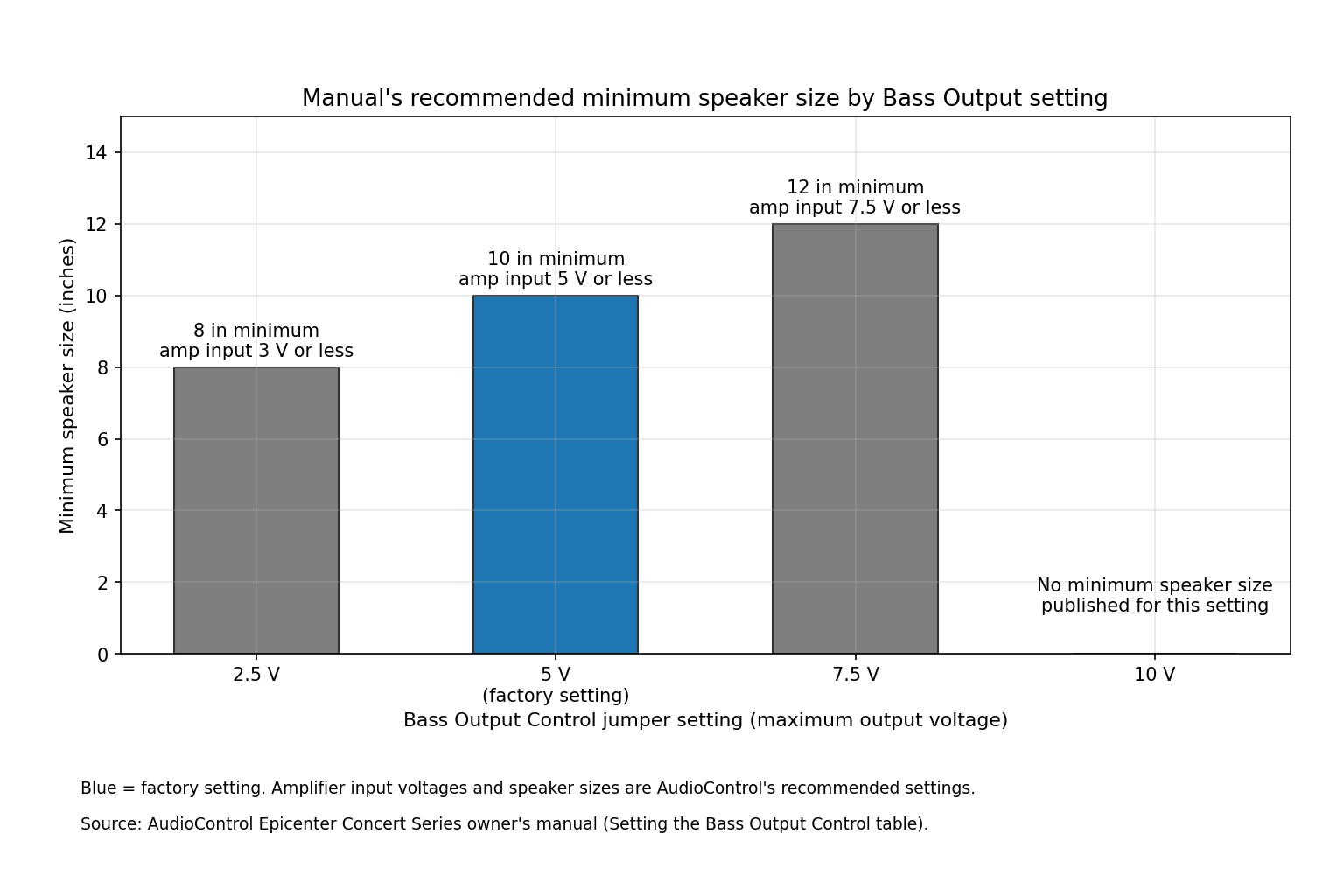
The Bass Output Control deserves a closer look because it is where users can get into trouble. The manual's guidance is to pick a setting that suits the amplifier's input voltage and your speaker size: 2.5 V for amps with 3 V inputs or less and speakers of 8 inches or larger, 5 V (the factory setting) for 5 V or less and 10 inches or larger, and 7.5 V for 7.5 V or less and 12 inches or larger. For 10 V the manual offers no size guidance, only an exclamation. Its troubleshooting advice for distortion is to turn the dash control down, raise the PFM frequency or lower the output setting.
What owners report is positive but subjective. Retailer reviews say it restores low end on compressed or older files and on bass-light material. A Crutchfield Q and A answer from an owner says it works mostly below 50 Hz and will not put more bass into door speakers, and another answer says the knob restores bass rather than raising overall level. AudioControl's Epicenter amplifier, which uses the same circuit, was described by a PASMAG writer as enjoyable when used properly. None of this is measured, and the effect depends on your source material, your subwoofer and how you set it.
Setup, installation and daily use
The manual's quick install is short. Put the Epicenter between a full-range source and the amplifiers, before any crossover. Connect remote turn-on from the head unit using 22 to 18 gauge wire, +12 V from a constant source fused at 1 A using 18 gauge wire or larger, and a ground of the same gauge to the battery negative, a ground bus or a verified ground. The manual warns that the factory head unit ground is not a good one. It also suggests turning down equalizer bass and any loudness or bass tone controls before enabling the Epicenter.
Safety and wiring notes. Disconnect the battery's negative terminal before connecting power, and place the fuse close to the battery as a general good practice. Before drilling any mounting hole, make sure there is no fuel tank or wiring behind the panel, as the manual warns. Check behind the dash for wiring and airbag components before cutting a flush-mount hole for the remote, and route the remote cable away from pedals and moving parts. AudioControl recommends having an authorized dealer do the installation, and its manual ties a longer warranty to dealer installation.
How it compares
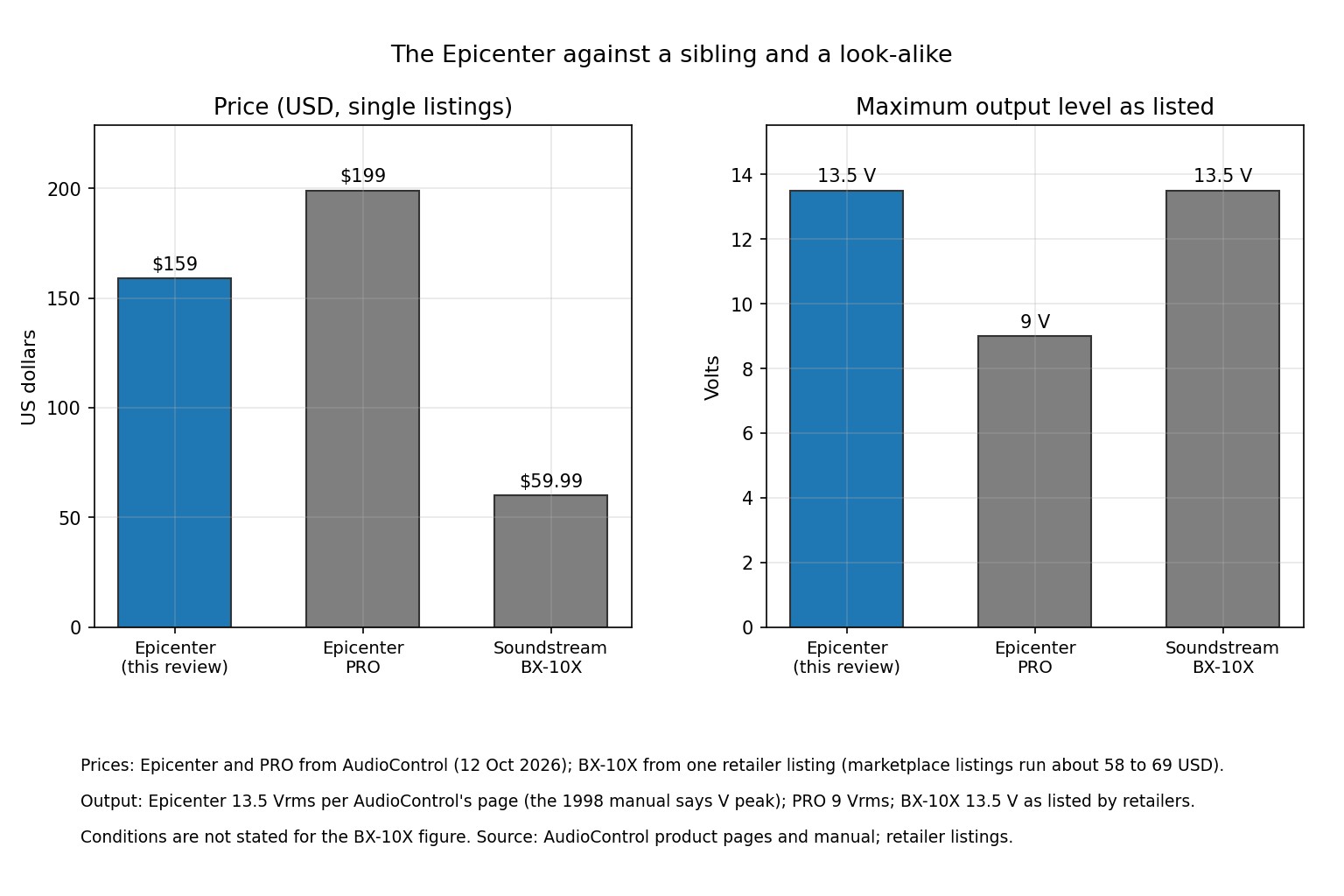
The closest comparisons are AudioControl's own siblings and a look-alike from Soundstream. The PRO adds a line driver, a switchable subsonic filter, selectable output voltage and a dual-knob remote, but lists a lower maximum output (9 Vrms) and higher distortion (0.03 percent). The Micro and Micro PRO add speaker-level inputs for factory radios. The Soundstream BX-10X lists similar headline specifications, including 13.5 V output, 10 Hz to 100 kHz response and a 27 to 63 Hz sweep, at a fraction of the price.
| Model | Inputs | Subsonic filter | Max output as listed | Remote | Price seen |
|---|---|---|---|---|---|
| AudioControl Epicenter | RCA only, balanced, up to 15 Vrms | Module, 33 Hz factory | 13.5 Vrms | ACR-1 (single knob) | $159 (AudioControl) |
| AudioControl Epicenter PRO | RCA, up to 10 Vrms, built-in line driver | 24 Hz or bypass | 9 Vrms (13 V peak) | ACR-4 (dual knob) | $199 (AudioControl) |
| AudioControl Epicenter Micro PRO | Speaker-level and RCA | 24 Hz, 15 Hz or bypass | 9 Vrms (13 V peak) | ACR-4 (dual knob) | Varies by seller |
| Soundstream BX-10X | RCA, plus high-level harness | PFM subsonic filter, frequency not stated | 13.5 V (conditions not stated) | Dash remote included | about $60 (one retailer) |
I could not find a head-to-head test of the Epicenter and the BX-10X, so I cannot say whether they sound alike. The price gap is real, though, and it is the main reason this review does not rate the Epicenter's value higher.
Who should buy it and who should skip it
Buy it if you have an aftermarket subwoofer amplifier, a source with full-range RCA outputs, and music that sounds light in the bottom octaves. It also suits anyone who wants a recognised, still-supported unit with a parametric control and a dash remote. Skip it if your only source is a factory radio without preamp outputs (look at the Micro models), if your subwoofer or amplifier is undersized, or if you would rather spend $159 on a stronger subwoofer. If you mostly want a cheap trial of the idea, the BX-10X is the lower-cost route, with the caveat that its sound is untested here.
Buying advice
AudioControl's own store lists the Concert Series Epicenter at $159 with a one-year manufacturer warranty, and the 1998 manual describes a five-year warranty if an authorized dealer installs it. Confirm which terms apply to you before buying. Returns at AudioControl go through a return authorization number, case by case. Look at the exact product name on any marketplace or bundle page, since older Plus and InDash versions and retailer kits with RCA cables also appear. Confirm that the Concert Series is what you are buying, and that you have the RCA cables, power wire, fuse and ground wire the install needs. I could not verify Amazon's price or availability, so check the listing and seller.
Final thoughts
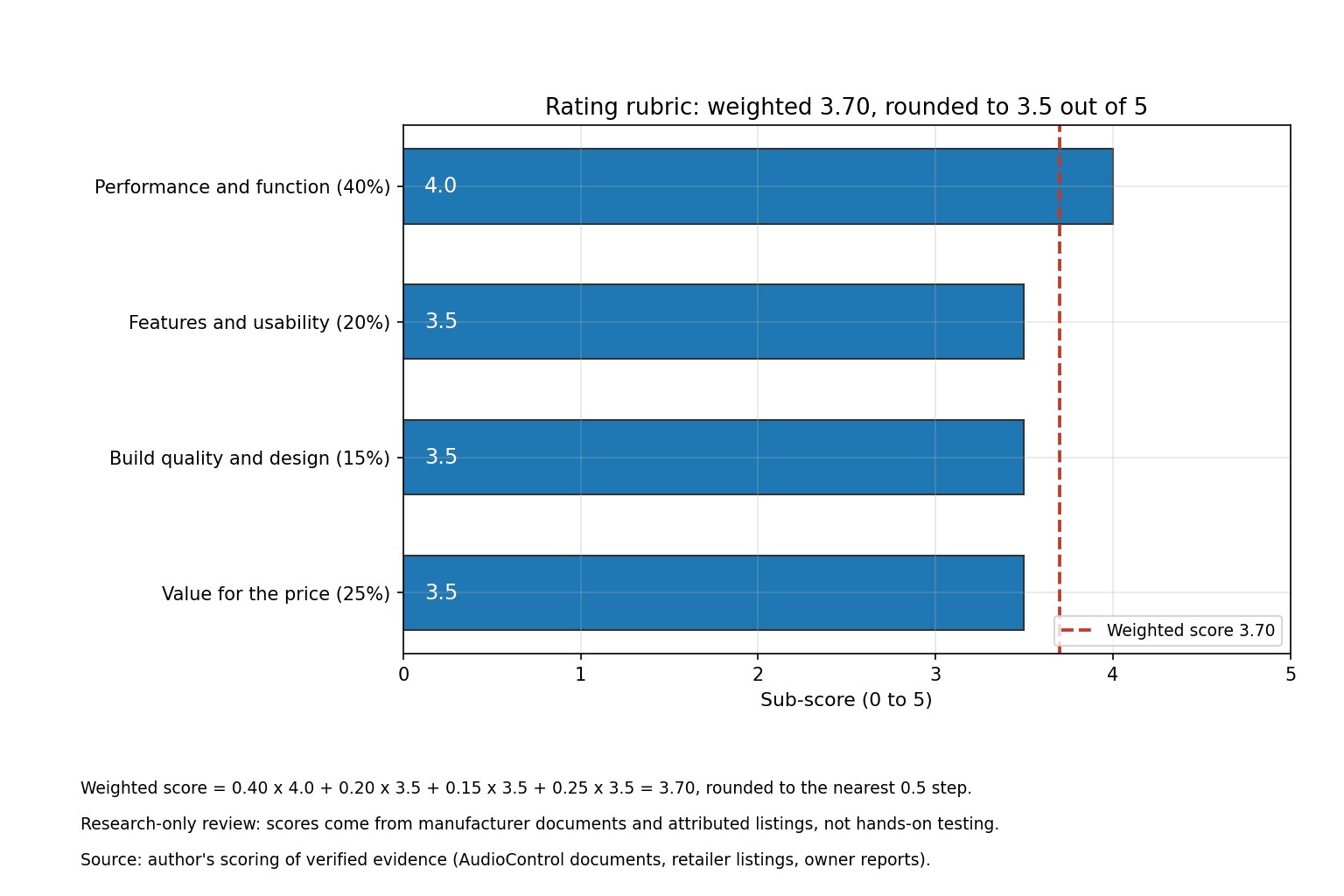
I rate the Epicenter 3.5 out of 5. The rubric weights performance and function at 40 percent, features and usability at 20 percent, build quality and design at 15 percent and value at 25 percent, giving a weighted 3.70 that rounds to 3.5. Function earns 4.0 because the specifications are strong and the design purpose is clear. The other three sit at 3.5: features and usability are held back by RCA-only inputs and an internal module for the subsonic filter, build evidence is thin, and value is dented by the $199 PRO above it and a roughly $60 look-alike below it. A 4.5 would need independent measurements and hands-on testing.
| Category | Weight | Score |
|---|---|---|
| Performance and function | 40% | 4.0 |
| Features and usability | 20% | 3.5 |
| Build quality and design | 15% | 3.5 |
| Value for the price | 25% | 3.5 |
| Weighted total | 100% | 3.70 (rounded to 3.5) |
Some links on this page are affiliate links; they never affect our ratings.
Sources and further reading
- AudioControl Epicenter product page (price, specifications, warranty)
- AudioControl Epicenter Concert Series manual (settings, install, factory options)
- AudioControl Epicenter PRO product page
- AudioControl Epicenter processors overview (placement guidance)
- Crutchfield Epicenter listing (owner questions and answers)
- Quality Mobile Video Soundstream BX-10X listing
- PASMAG on the AudioControl Epicenter 1200 amplifier
AudioControl Epicenter FAQ
What does the AudioControl Epicenter actually do?
It analyses harmonics in the incoming signal and recreates low bass notes that were lost in recording or processing, then feeds them back into the signal. It is a restoration circuit, not a simple bass boost. It does not add amplifier power or cone area.
Does the Epicenter work with a factory radio?
The Concert Series has RCA inputs only, so it needs a source with full-range preamp outputs or a line output converter ahead of it. AudioControl's Micro and Micro PRO models add speaker-level inputs for factory systems. Check which model your listing shows.
Where should the Epicenter go in the signal chain?
AudioControl says to install it before any crossover and, if you use one, before the equalizer. It needs a full-range signal. If you send it only a subwoofer-band signal it will likely sound garbled.
Which Bass Output Control setting should I use?
The factory setting is 5 V. The manual recommends 2.5 V for amps with 3 V input or less and speakers of 8 inches or larger, 5 V for 5 V or less and 10 inches or larger, and 7.5 V for 7.5 V or less and 12 inches or larger. Start with the factory setting and lower it if the system distorts.
What is the difference between the Epicenter and the Epicenter PRO?
The PRO adds a built-in line driver, a switchable subsonic filter, selectable output voltage and a dual-knob ACR-4 remote. Its listed maximum output is 9 Vrms against 13.5 Vrms on the Concert Series. AudioControl lists the PRO at $199 and the Concert Series at $159.
Is the Epicenter worth the money?
At $159 it is reasonable if you have an aftermarket subwoofer amp and bass-light music. A Soundstream BX-10X lists similar headline specs for about $60, but I found no head-to-head test. It will not fix an underpowered or undersized subwoofer.
What fuse and wire does the Epicenter need?
The manual calls for 18 gauge wire or larger fused at 1 A for +12 V, and the same gauge for ground. Remote turn-on uses 22 to 18 gauge wire. Disconnect the battery negative before wiring, and avoid using the factory head unit ground.
What warranty does the Epicenter have?
AudioControl's current product page lists a one-year manufacturer warranty. The older manual describes five years if installed by an authorized dealer. Confirm the terms with your seller before you buy.