AudioControl · LC6i
AudioControl LC6i Review: Six-Channel LOC With Summing
Six-channel active line output converter with internal summing, 9.5 V output and 400 W inputs. Specs, newer alternatives and buying advice at $139.87.
Pros
- Internal summing combines four or six crossed-over factory channels into full-range outputs
- AutoMode feeds channel 2 to channel 3 outputs when no channel 3 signal exists, giving four or six outputs
- Accepts 400 W per channel at 4 ohms and delivers up to 9.5 Vrms output
- One level control per channel pair plus a Maximized LED for level matching
- GTO signal sensing with a 12 V remote input as backup, and a 1 A relay remote output
- Ground jumper offers isolated, 200 ohm or direct ground options
Cons
- Appears to be discontinued and is absent from AudioControl's current lineup
- No AccuBASS circuit, despite some retailer pages claiming one
- 20 kohm input only, with no load selection for factory amplifiers that need a speaker load
- Summing and ground settings are internal jumpers, and summing ships off; owners report losing fader and balance when summed
- No signal-to-noise figure or frequency-response tolerance published and no independent measurements found
- Warranty is one year unless installed by an authorized US dealer, and requires an authorized-dealer purchase
Specifications
| Channel handling | Jumper-selected summing of 4 or 6 inputs to 2 channels; AutoMode 2-in to 4-out or 4-in to 6-out |
|---|---|
| Current draw / fuse | 200 mA / 1 A recommended fuse |
| Dimensions / weight | 5.8 x 4.7 x 1.2 in, 1.4 lb (2017 manual; some retailers list 8 x 6 x 1.2 in, 2.0 lb) |
| Frequency response | 10 Hz - 22 kHz (tolerance not stated) |
| Ground isolation | Internal jumper: isolated (default), 200 ohm or ground |
| Input impedance | 20 kohm |
| Max output level | 9.5 Vrms |
| Output gain | +/-12 dB |
| Power supply | High-headroom PWM switching |
| Preamp outputs | 3 pairs (6 channels), RCA, one level control per pair |
| Remote level control | ACR-1 input for channel 3 output; ACR-1 sold separately |
| Remote output | 12 V relay output, 1 A max |
| Speaker-level inputs | 3 pairs (6 channels), 400 W per channel at 4 ohms |
| THD | 0.01% (measured at 14.4 V DC supply per manual; other conditions not stated) |
| Turn-on | GTO signal sensing (can be disabled) or 12 V remote input |
| Type | Active 6-channel speaker-level to RCA line output converter with internal summing |
Verdict
The LC6i suits drivers with a factory system that splits tweeter, midrange and woofer signals and who need internal summing and up to six outputs. Its main strengths are summing, AutoMode and 9.5 V output. The main compromises are that it appears to be discontinued, lacks AccuBASS and load selection, and has only manufacturer-published performance figures. At $139.87 it is a fair price for the summing, but the newer LC7i lists more features at $149.
This AudioControl LC6i review comes down to one question: is channel summing worth buying a model that Sonic Electronix labels discontinued? The LC6i is an active six-channel line output converter (LOC). It takes speaker-level signals from a factory radio or factory amplifier and turns them into RCA-level signals for aftermarket amplifiers. Its main trick is internal summing, which merges several crossed-over factory channels into one full-range signal. If the factory system splits tweeter, midrange and woofer feeds, that is a real reason to buy. If the factory radio already sends full-range left and right signals, the unit does more than the job needs. Sonic Electronix lists it at $149.99, and AudioControl's current converter lineup now shows newer models in its place.
The page rates the LC6i 3.5 out of 5 using the rubric near the end. The verdict, pros, cons and specification list sit in their own boxes, so the text here covers how the unit works, how it stacks up against three alternatives and what to check before ordering.
As an Amazon Associate I earn from qualifying purchases; affiliate links on this page never affect the ratings.
AudioControl LC6i design and build
The manual gives the LC6i's size as 5.8 by 4.7 by 1.2 inches and its weight as 1.4 lb. AudioControl's archived product page lists 8 by 6 by 1.2 inches and 2.0 lb for the same model, which looks like a packaging or older-revision figure. Confirm the footprint before choosing a tight mounting spot; the manual's numbers are used throughout this page. The power supply is a high-headroom switching design, and the chassis mounts with self-tapping screws after the installer marks the holes and drills pilot holes. Housing material is not confirmed.
The top panel carries one level knob per channel pair, a red Power LED, a Maximized LED that flickers when the signal approaches clipping, and green LEDs that show whether channels 2 and 3 are summed. The jumpers for summing, AutoMode, GTO sensing and ground isolation sit under a cover that comes off with power disconnected. Settings change by moving a jumper, not by flipping a front-panel switch.
What the AudioControl LC6i does: inputs, outputs and turn-on
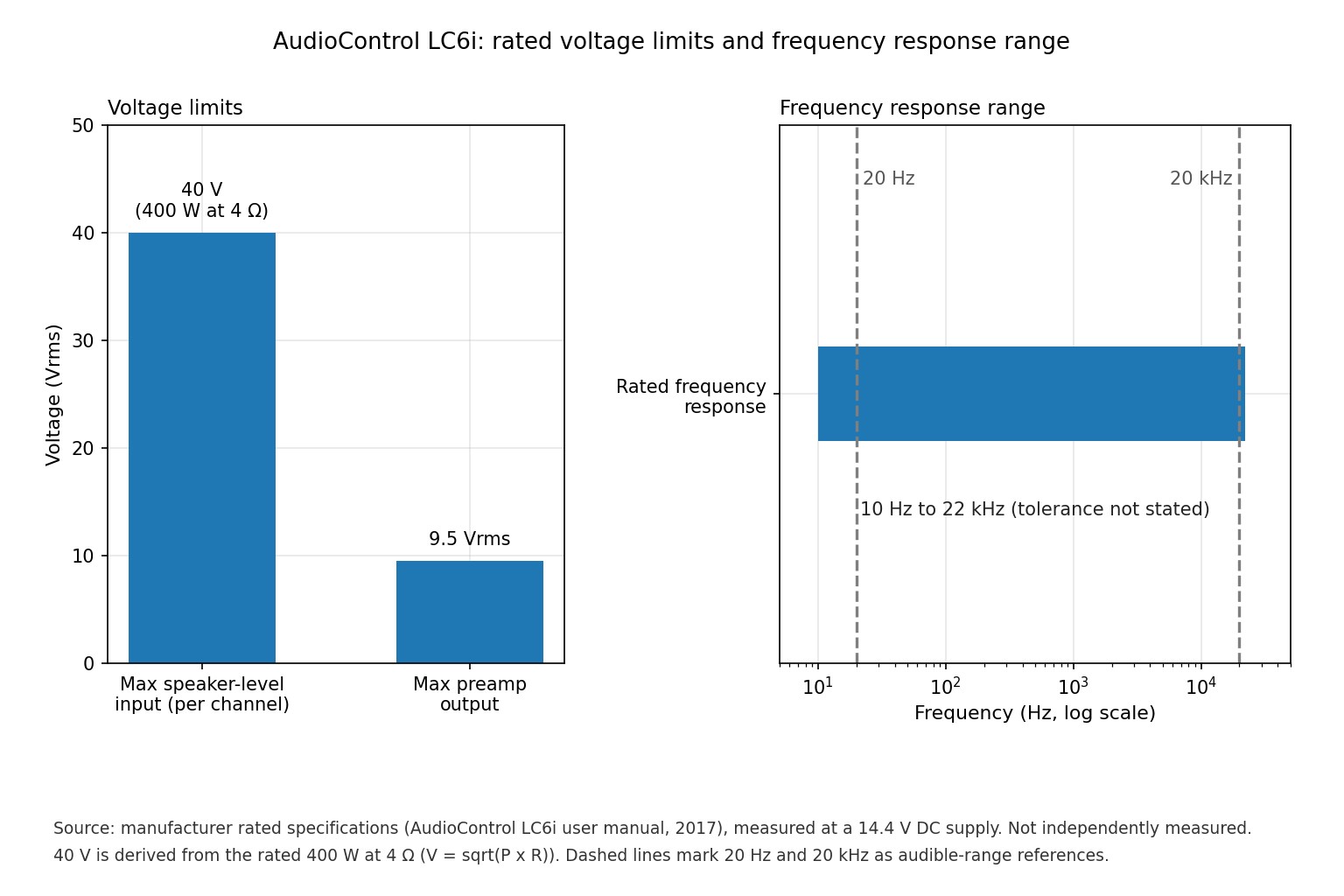
The unit has three pairs of speaker-level inputs (six channels) and three pairs of RCA outputs. The manual rates each input for 400 W at 4 ohms with a 20 kohm input impedance, and rates maximum output at 9.5 Vrms with an output gain of plus or minus 12 dB. The rated figures work out to a 40 V ceiling per input (the square root of 400 W x 4 ohms), and a 12 dB swing in either direction is a voltage factor of roughly 0.25 to 4. Our calculation from the rated figures puts a full-strength 40 V input about 12.5 dB above the 9.5 Vrms output ceiling, which is why the manual has the installer level-match with the output knobs before connecting amplifiers.
Summing and AutoMode
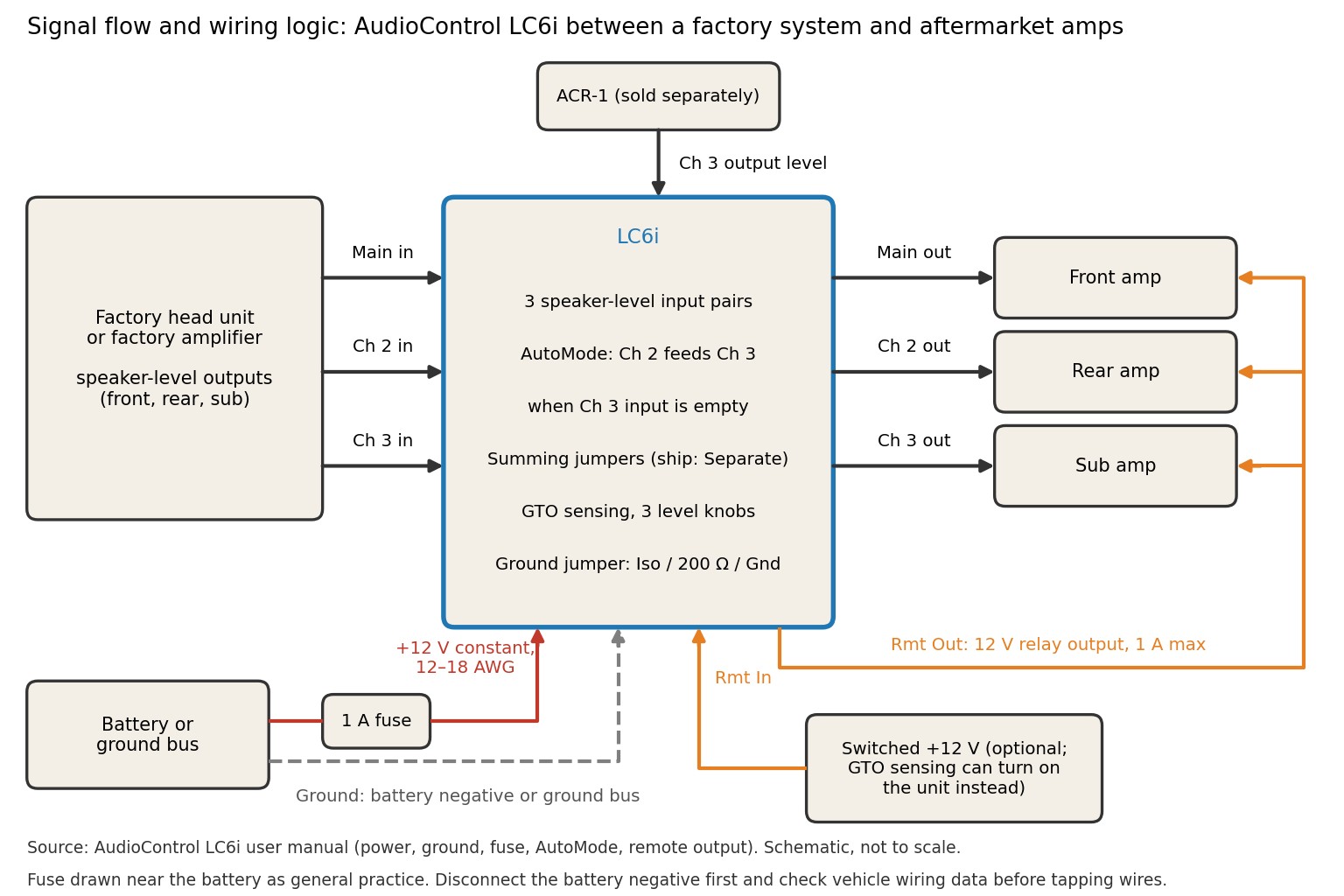
Summing is the reason to consider this unit. Many factory systems send separate, filtered signals to tweeters, midrange drivers and woofers. According to the manual, the LC6i can sum four or six of those inputs into two channels, giving a full-range output without extra cables. Internal jumpers decide whether channels 2 and 3 are summed into the main outputs or kept separate, and the unit ships set to Separate. The green indicator LEDs show which channels are being summed, so a quick look confirms the setting after installation.
AutoMode covers the opposite problem, where the car needs more outputs than the factory source provides. When nothing is connected to the channel 3 inputs, the channel 2 signal is routed to the channel 3 outputs automatically. Two inputs become four outputs, and four inputs become six. A jumper disables the feature. AudioControl's product page also says the unit leaves the factory volume and steering-wheel controls in use, which is a marketing claim rather than a rated figure.
Turn-on, grounding and remote output
GTO signal sensing powers the unit up when it detects a signal on the main speaker-level inputs and shuts it off when the signal stops. A 12 V Remote In is the alternative, and the GTO circuit can be disabled with a jumper. The manual warns that a factory navigation or phone interface can route audio away from the outputs the unit is sensing, and the unit may then switch off intermittently. Its fix is a 12 V trigger wire to Remote In. A relay-operated Remote Out supplies up to 1 A to switch on amplifiers and processors, and the manual says it must not serve as their main power. The ground jumper offers isolated (the factory setting), 200 ohm or direct ground connections to deal with alternator noise.
What the AudioControl LC6i does not list
The manual and the product page for the LC6i do not list AccuBASS, load selection or an included dash remote. AudioControl's page for a newer six-channel converter does list AccuBASS. The optional ACR-1 dash control is sold separately and adjusts the channel 3 output. That output is full range, so it may need a crossover if it feeds a subwoofer. With a fixed 20 kohm input and no load switch, the LC6i has no way to present a speaker-like load to a factory amplifier, and the PRO-series converters in the table below add exactly that.
AudioControl LC6i rated performance
The manual rates frequency response at 10 Hz to 22 kHz with no stated tolerance, and total harmonic distortion at 0.01%. The manual states that all specifications are taken at a 14.4 V supply. It gives no signal-to-noise figure for the LC6i, while AudioControl does list one for its newer PRO-series converters (above 124 dB on one of them). A response range without a tolerance and a distortion figure without a noise figure say less than they first appear to. Our research found no independent lab measurements for this model.
A converter cannot add content that the factory source never supplied. Its practical benefit is a clean, high-level signal that lets the installer run amplifier gains low, and the manual repeats that advice to keep hiss down. The level-matching steps are short: set the factory volume to about three quarters, raise the LC6i output knobs until the Maximized LED starts to flicker, then set amplifier gains and listen. The manual rates current draw at 200 mA, so at 14.4 V the unit draws about 2.9 W by our calculation, and the recommended 1 A fuse is five times the rated draw.
Installing the AudioControl LC6i, with safety notes
The manual puts the LC6i in the signal path after the factory radio or amplifier and before any aftermarket amplifiers or processors. It asks for a mounting spot with reach to the level controls, away from heat, spills and moisture. Check for fuel lines, brake lines and wiring behind any surface before drilling. Disconnect the battery negative before wiring. Run 12 to 18 gauge wire from the +12 V terminal to a constant 12 V source, fused at 1 A, and run the ground terminal to the battery negative or another verified ground. The manual specifically rejects the factory head unit ground. A factory wiring diagram identifies the speaker wires, and polarity has to match.
A fitment checklist before buying or mounting:
- The factory source or factory amplifier must output amplified speaker-level signals. A preamp-level signal produces low output, according to the manual.
- A wiring diagram should confirm which speaker wires carry tweeter, midrange, woofer or full-range feeds.
- The car needs a constant 12 V source and a verified ground within reach, plus a 1 A fuse.
- The mounting spot needs room for the 5.8 by 4.7 by 1.2 inch body, the connectors and access to the knobs.
- A factory radio with navigation or a phone interface calls for a 12 V feed to Remote In instead of relying on GTO sensing.
- The aftermarket amplifiers must allow gains at minimum during level matching.
If pops occur at turn-on or turn-off, the manual suggests using the LC6i Remote Out to switch the amplifiers so everything powers up together. If the output is low, the manual points to a preamp-level connection and suggests raising the LC6i gain or adding a line driver. Keep the volume sensible while level matching, because the manual notes that high sound pressure can cause permanent hearing loss. Daily use is simple once the levels are set. The factory volume still controls overall loudness, and an ACR-1 adjusts the channel 3 output.
How the AudioControl LC6i compares
The closest alternatives are the AudioControl LC7i, the AudioControl LC7i PRO and, for a four-channel setup, the PAC Audio LPA-E.4. The first two come from the same maker and share the six-channel layout, while the PAC Audio LPA-E.4 trades two channels for load selection and a bass boost.
| Feature | AudioControl LC6i | AudioControl LC7i | AudioControl LC7i PRO | PAC Audio LPA-E.4 |
|---|---|---|---|---|
| Price (USD) | $149.99 (Sonic Electronix) | $149 (AudioControl) | $359 (AudioControl) | $129 (Abt) |
| Channels | 6 in / 6 out | 6 in / 6 out | 6 in / 6 out (4 main, 2 bass) | 4 in / 4 out, or 2 in / 4 out |
| Max speaker-level input | 400 W per channel at 4 ohms | 400 W per channel at 4 ohms | 40 Vrms / 400 W (20 kohm setting) | 40 V / 400 W at 20 kohm |
| Max output | 9.5 Vrms | 8.5 Vrms | 9.5 Vrms | 9.5 V |
| Channel summing | Yes (jumpers) | Yes | Not listed | Not listed |
| AccuBASS | Not listed | Yes | Yes | Not listed (12 dB bass boost on channels 3 and 4) |
| Load selection | Not listed | Not listed | 20 ohm / 60 ohm / 20 kohm | 20 ohm / 60 ohm / 20 kohm |
| Dash remote | ACR-1 optional | ACR-1 optional | ACR-1 included | Not listed |
| Frequency response | 10 Hz to 22 kHz | 10 Hz to 22 kHz | 20 Hz to 20 kHz | 10 Hz to 20 kHz |
| THD | 0.01% | 0.01% | 0.01% | Below 0.01% |
| Signal-to-noise | Not published | Not published | Above 124 dB | Above 110 dBA at 6.4 V output |
| Current draw | 200 mA | 350 mA | 330 mA | 110 mA |
| Recommended fuse | 1 A | 2 A | 2 A | Not confirmed |
| Price per channel (our calculation) | $25.00 | $24.83 | $59.83 | $32.25 |
The AudioControl LC7i lists AccuBASS, summing and a 2 A fuse rating at $149, with a lower 8.5 Vrms output ceiling than the LC6i's 9.5 Vrms. Sonic Electronix labels the AudioControl LC7i discontinued as well, while AudioControl's own site lists it. The AudioControl LC7i PRO adds load selection, three turn-on modes and an included ACR-1, and costs $359. The PAC Audio LPA-E.4 lists load selection at $129 but gives only four channels and no summing. The per-channel row divides each listed price by its channel count, and the prices come from different sellers.
Who should buy the AudioControl LC6i, and who should skip it
It is a reasonable fit if:
- The factory system sends filtered tweeter, midrange and woofer channels that need to be summed into full-range signals.
- The car needs up to six outputs from two or four factory channels, so AutoMode does the work.
- The installer is comfortable moving internal jumpers and level matching by the manual's method.
Consider skipping it if:
- The factory source already supplies full-range left and right signals and only two channels are needed; a simpler two-channel converter covers that.
- The factory amplifier expects a speaker load, because the LC6i lists no load selection.
- A warranty-backed purchase matters and the seller is not an authorized AudioControl dealer.
- Bass restoration is part of the plan, since the LC6i does not list it.
AudioControl LC6i price and what to check before buying
Sonic Electronix lists the AudioControl LC6i at $149.99 and labels it discontinued. Prices change often, so check the current listing. AudioControl's current converter lineup carries other models, and the company has not named a successor in the pages reviewed here.
Check the colour first: Crutchfield lists a black LC6i and Sonic Electronix a white one. Next comes the warranty. The manual gives one year, or five years if an authorized United States dealer installs the unit, and it requires purchase from an authorized dealer, a warranty card returned within 15 days and a kept receipt. Sonic Electronix's comparison table shows five years for the LC6i, but the manual's conditions come first. The current page for the AudioControl LC7i lists one year. Confirm the seller, the warranty terms in writing and whether an ACR-1 is in the box, since the manual says it is sold separately. Budget for power wire, a 1 A fuse, RCA cables and a way to tap the factory speaker wires; the box holds the speaker and power connectors. Finally, confirm that the car needs summing at all, because a factory system with full-range outputs may need only a two-channel converter.
Final verdict and score for the AudioControl LC6i
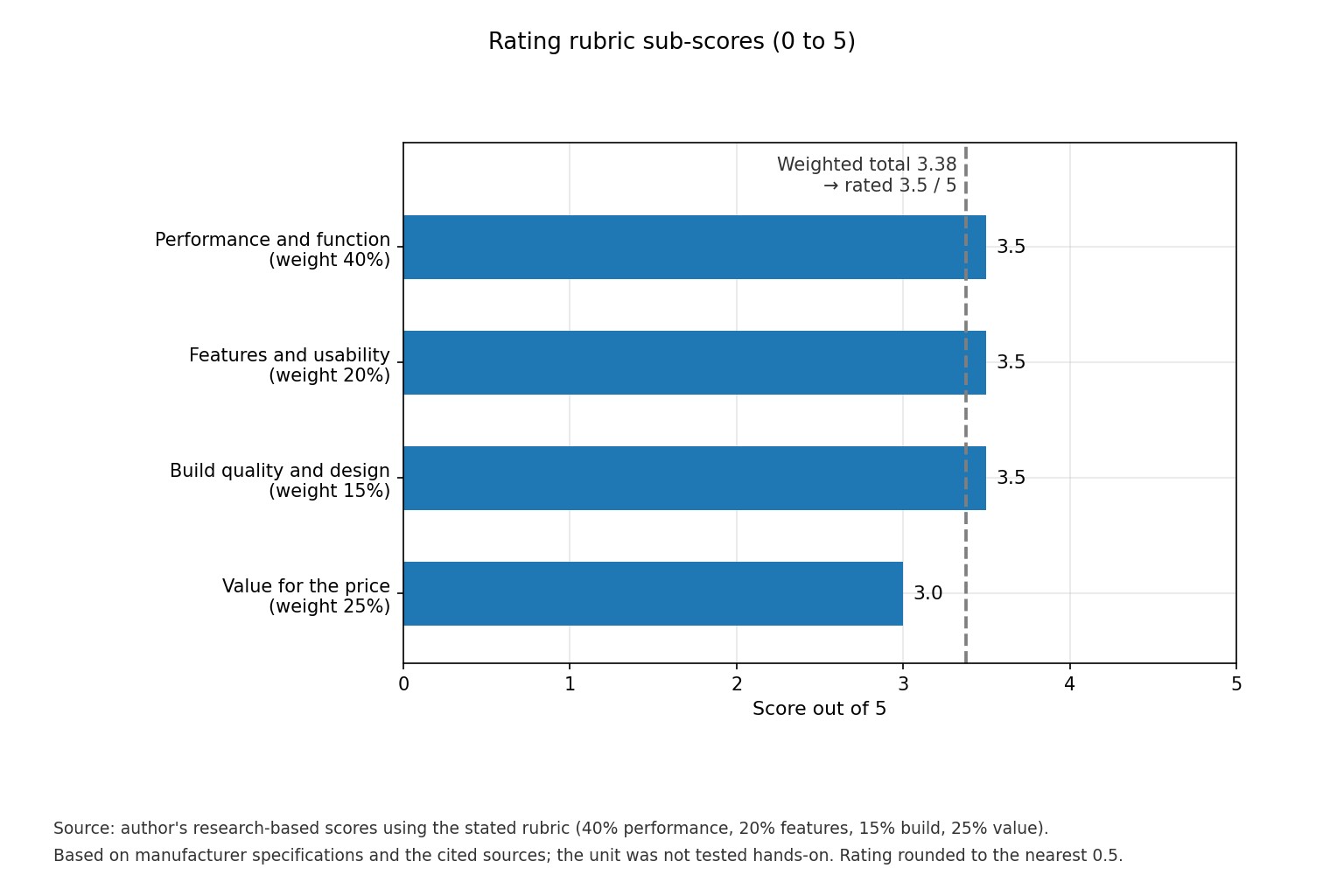
The LC6i earns 3.5 out of 5. The rubric weights performance and function at 40%, features and usability at 20%, build quality and design at 15% and value for the price at 25%. Performance and features each score 3.5: the summing and AutoMode design suits OEM integration, but the rated figures carry no tolerance or noise number and the unit lists no AccuBASS or load selection. Build scores 3.5 because a switching supply, ground-isolation options and a removable cover are documented, while the housing material is not confirmed. Value scores 3.0: Sonic Electronix lists the LC6i at $149.99, while AudioControl lists the AudioControl LC7i at $149 with AccuBASS and a 2 A fuse rating, though with a lower output ceiling.
| Criterion | Weight | Score (0-5) | Weighted points |
|---|---|---|---|
| Performance and function | 40% | 3.5 | 1.400 |
| Features and usability | 20% | 3.5 | 0.700 |
| Build quality and design | 15% | 3.5 | 0.525 |
| Value for the price | 25% | 3.0 | 0.750 |
| Total | 100% | 3.375, rounded to 3.5 | 3.375 |
Our research score is based on the rated figures and documented details above.
Sources and further reading
- AudioControl LC6i user manual (specifications, jumpers, wiring, warranty terms)
- AudioControl LC6i archived product page (feature list, alternate dimensions and weight)
- AudioControl LC7i product page (price, summing, AccuBASS, fuse rating, warranty)
- AudioControl LC7i PRO product page (price, load selection, signal-to-noise, included remote)
- Sonic Electronix LC6i vs LC7i comparison (LC6i price, discontinued labels, white version)
- Crutchfield LC6i listing (black version)
- PAC Audio LPA-E.4 retailer listing (price and specifications)
AudioControl LC6i FAQ
What does internal summing do on the AudioControl LC6i?
Summing combines several factory channels into two full-range channels. This helps when a factory system sends separate filtered signals to tweeters, midrange drivers and woofers. The LC6i ships with summing off and uses internal jumpers to enable it for channels 2 and 3.
Is the AudioControl LC6i discontinued?
It appears so. Sonic Electronix labels it discontinued and AudioControl's current converter lineup lists the LC2i, LC2i PRO, LC7i and LC7i PRO instead. I did not find an official discontinuation notice, so confirm availability with the seller.
What is the difference between the LC6i and LC7i?
Per AudioControl's pages, the LC7i lists AccuBASS bass restoration, which the LC6i does not. The LC7i lists a lower 8.5 Vrms maximum output than the LC6i's 9.5 Vrms, and a 2 A recommended fuse against 1 A. AudioControl lists the LC7i at $149, though it showed out of stock on October 12, 2026.
Does the LC6i have AccuBASS?
No, not according to AudioControl's manual and feature list. Some retailer pages and manual summaries credit it with AccuBASS, but those claims do not match the manufacturer's documents. AudioControl presents AccuBASS as a feature of the newer LC7i and PRO models.
Do I need a remote turn-on wire for the LC6i?
Not always. The LC6i can switch on by sensing a signal at its main speaker-level inputs, and it also has a 12 V remote input. AudioControl says a factory navigation or phone interface can cause intermittent switch-off with signal sensing, and in that case a remote wire is the fix.
Will I lose fader and balance control if I sum channels?
One Crutchfield customer reports exactly that. Summing merges several channels into the main outputs, so independent front and rear control is likely to be affected. Test this on your vehicle before permanent installation.
Does the LC6i include a bass remote knob?
No. AudioControl's ACR-1 dash control is sold separately. It adjusts the channel 3 output, which is full range, so you may need a crossover if that output feeds a subwoofer.
What warranty does the LC6i have?
AudioControl's 2017 manual gives one year, or five years if an authorized United States AudioControl dealer installs it. It requires purchase from an authorized dealer and a warranty card sent within 15 days. Ask the seller to confirm the terms in writing before buying.