Audison · bit One HD Virtuoso
Audison bit One HD Virtuoso Review: Built for OEM Integration
Research review of Audison's 13-output car DSP: 12 speaker-level inputs, FIR mode and digital output, about $1,780 in the US, with newer rivals ahead on specs.
Pros
- 12 speaker-level inputs plus 6 RCA, an AUX pair and 2 optical inputs suit most factory systems
- De-EQ, De-Time and De-Phase processing is aimed at cleaning up factory-amplified signals
- RVA lets you add a digital source and keep volume control from the factory head unit
- FIR crossover and EQ mode is available on up to 9 outputs
- Two AD Link ports allow an all-digital connection to compatible Audison amplifiers
- Rated 0.004% THD at 1 kHz with 104 to 110 dBA signal-to-noise depending on the input (manufacturer figures)
- DRC MP remote controller with display, volume knob and joystick is supplied
Cons
- Tuning software is Windows only, and Audison's datasheet lists Windows XP through 10 but not Windows 11
- Rated signal-to-noise trails current Helix DSPs on paper (104 to 110 dBA versus 111 to 128 dB), though test conditions differ
- FIR mode drops the output count from 13 to 9 channels
- Owners report limited EQ flexibility and distance-based delay that cannot be linked in groups (anecdotal)
- Maximum output is 4 V, half the 8 V listed for Helix DSPs
- About $1,780 in US listings, and no independent lab measurements were found
Specifications
| Bandwidth | 10 Hz to 44 kHz (-3 dB) |
|---|---|
| Channels | 12 inputs, 13 analog outputs in IIR mode (9 in FIR mode) |
| Crossover | Linkwitz, Butterworth, Bessel and FIR types; slopes up to 48 dB/oct (Bessel up to 36) |
| Digital outputs | 2 x AD Link (link 1 Ch1-8; link 2 Ch9-13 in IIR mode, Ch9 only in FIR mode) |
| Dimensions (W x H x D) | 148 x 43.6 x 233 mm (5.82 x 1.7 x 9.17 in) |
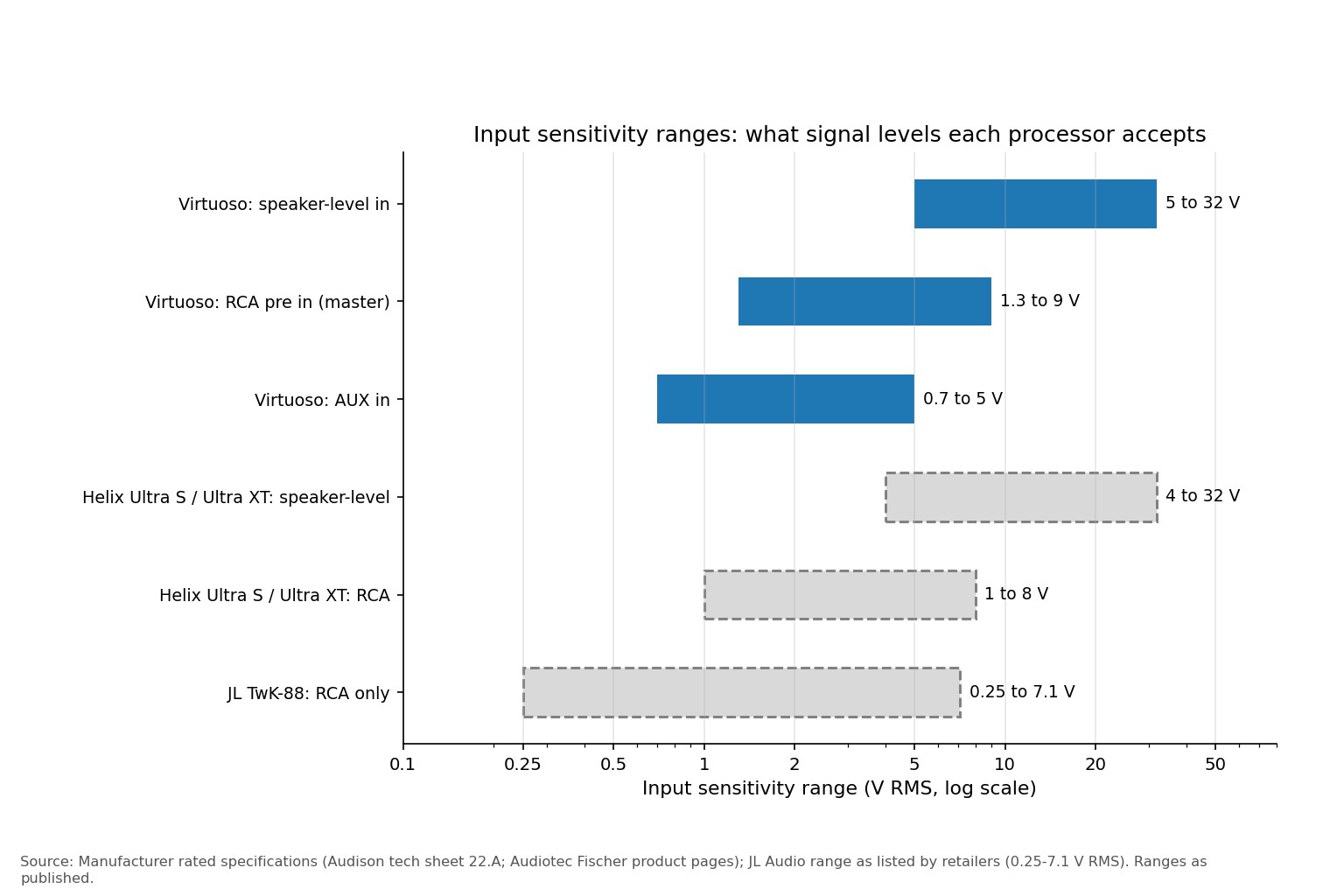
| Input sensitivity | Speaker-level 5-32 V RMS, RCA pre/master 1.3-9 V RMS, AUX 0.7-5 V RMS |
| Inputs | 12 speaker-level, 6 RCA, AUX L/R, 2 x optical S/PDIF (up to 192 kHz / 24-bit) |
| Max output level | 4 V at 0.1% THD |
| Power | 11-15 V DC, 2 A fuse, 0.75 A idle current |
| Processing | 24-bit / 96 kHz floating point (Analog Devices SHARC DSP) |
| Signal-to-noise (A-weighted, 4 V output) | 104 dBA (2 V master input), 105 dBA (2 V AUX), 110 dBA (optical) |
| THD | 0.004% at 1 kHz, 1 V RMS output |
| Time alignment | 0-22 ms in 0.04 ms steps (1.4-756 cm) |
| Type | Car audio digital signal processor (DSP) |
| Weight | 1.775 kg (3.9 lb) |
Verdict
The Audison bit One HD Virtuoso suits owners who keep a factory head unit and want 12 speaker-level inputs, 13 outputs and an optional digital link to Audison amplifiers. Its main strength is OEM integration (De-EQ, De-Time, De-Phase and remote aux volume control); its main compromise is that 2020-era hardware lists lower signal-to-noise figures than current Helix processors, and owners report limited tuning flexibility. At about $1,780 in the US it costs more than an open-box Helix DSP Ultra S listing, so it makes most sense when those integration features are needed.
The Audison bit One HD Virtuoso is worth buying if you are keeping a factory head unit, especially one with a multi-channel factory amplifier system, and you want a 13-output processor that can also feed compatible Audison amplifiers digitally. It is a harder sell if you mainly want the best rated specifications per dollar: a Helix DSP Ultra S was seen at about $1,600 in the US (open-box listing), with higher rated signal-to-noise figures, while the Virtuoso's hardware dates from 2020.
This page covers what the Virtuoso does, where its rated performance sits against current rivals and what to check before paying about $1,780. The verdict, pros and cons and the full specifications appear in their own sections of this page, so they are not repeated here.
How this review was made
This is a specification and research review. I did not install, listen to, measure or own this processor, and nothing below describes personal listening. I compared Audison's technical sheet and product page with retailer listings, rival manufacturers' pages, an industry award list, a 2020 launch note from the Mobile Electronics Association and owner discussions on forums.
Three limits matter. First, I found no independent lab measurements of this unit, so every performance figure is the manufacturer's rating. Second, Audison's web page and its PDF technical sheet list the three signal-to-noise figures in a different order; I used the PDF, and Elettromedia (Audison's parent company) shows the same 104 dBA for the master input in its store listing. Third, BestCarAudio's write-ups of this processor are labelled as sponsored posts, so I treat them as manufacturer-supplied information. Forum comments are anecdotal and are labelled as such.
Design and build
The Virtuoso is a compact box measuring 148 x 43.6 x 233 mm and weighing 1.775 kg, finished in black. Audison's launch material, as reported by the Mobile Electronics Association, lists ELNA Silmic and WIMA capacitors, Burr-Brown OPAx134 SoundPlus op-amps and Cirrus Logic CS4365 and CS4385 converters rated at 114 dB signal-to-noise, with a selectable fast or slow digital filter. Audison's product page names an Analog Devices SHARC floating-point DSP at the core. These are manufacturer component claims; I found no independent teardown.
Power needs are modest: 11 to 15 V DC with a 2 A fuse and 0.75 A idle current, which works out to 9 W at 12 V. The unit is specified for 0 to 55 °C ambient. A cabin parked in direct sun can run hotter, so mount it away from heat sources and sunlight.
Features and usability
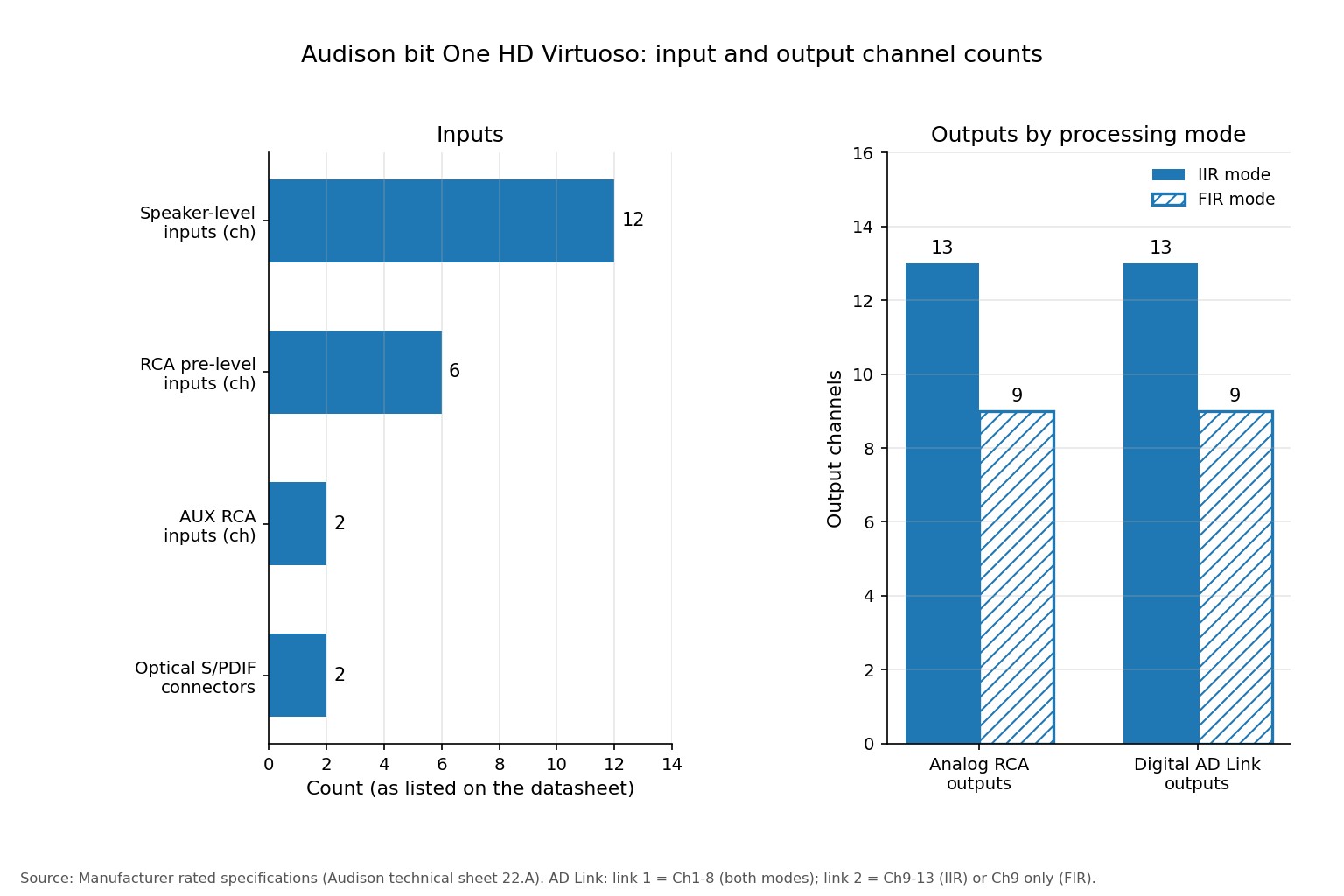
Input flexibility is the headline. The Virtuoso accepts 12 speaker-level channels (5 to 32 V RMS), six RCA pre-level channels, an RCA AUX pair and two optical S/PDIF inputs that take up to 192 kHz / 24-bit. For comparison, the Helix DSP Ultra S lists 8 speaker-level inputs and the JL Audio TwK-88 has none.
Audison's OEM-integration tools, as it describes them, are De-EQ (flattening factory equalization), De-Time (compensating delays in factory outputs), De-Phase, polarity check and USS, which lets the processor work with head units that check for a speaker load. RVA (Remote Volume Aux) lets you select a digital auxiliary source, such as a Hi-Res player, and adjust its volume from the factory head unit while navigation and phone prompts still come through.
On the processing side, crossovers come in Linkwitz, Butterworth, Bessel and FIR types with slopes up to 48 dB per octave, and every output has a parametric equalizer (+12 to -15 dB). Time alignment runs 0 to 22 ms in 0.04 ms steps, and there are dynamic equalization and a parametric bass boost. One firmware supports both FIR and IIR modes, but FIR mode reduces the analog outputs from 13 to 9. A front 3-way stage plus a stereo subwoofer uses 8 outputs, while adding a 2-way rear stage (10 in total) would not fit.
The supplied DRC MP remote adds a display, volume knob and joystick, and the unit is tuned from a Windows PC over micro-USB. Audison's datasheet lists Windows XP through 10; Windows 11 is not listed. Audison's bit Tune auto-calibration tool is a separate accessory. Owners on forums describe it as a shop tool that gives a starting point rather than a finished tune, which is anecdotal.
Sound and performance
Audison rates total harmonic distortion at 0.004% (1 kHz, 1 V RMS output) and bandwidth at 10 Hz to 44 kHz (-3 dB). Signal-to-noise, A-weighted with a 4 V output, is 104 dBA from the 2 V master input, 105 dBA from the 2 V AUX input and 110 dBA from the optical inputs. Channel separation is 80 dBA at 1 kHz and maximum output is 4 V at 0.1% THD. These are manufacturer figures, not measurements from this site.
Audison's own ratings suggest a noise floor that road noise will usually mask, but current rivals list better numbers. Audiotec Fischer rates the Helix DSP Ultra S at 111 dB (analog) and 117 dB (digital) signal-to-noise, 8 V output and THD+N below 0.0008% and 0.0004%. Its NEXT DSP Ultra XT lists 116 dB and 128 dB. The brands use different test conditions, so the figures are not directly comparable, but on paper the Virtuoso trails, and its 4 V output ceiling is half of the Helix's 8 V.
The Virtuoso was named in the EISA 2020-2021 in-car awards, listed under High End Component by The Shop magazine. Owner opinions in the forum threads I found are mixed. Some call it very clean with excellent inputs and outputs, and one says tonally it may be the best-sounding car processor, while others criticize the limited tuning options and the Audison software, including delay that is set by distance and cannot be linked across channel groups. One owner reported scrapping theirs. Treat these as subjective, dated reports rather than test results.
Setup, installation and daily use
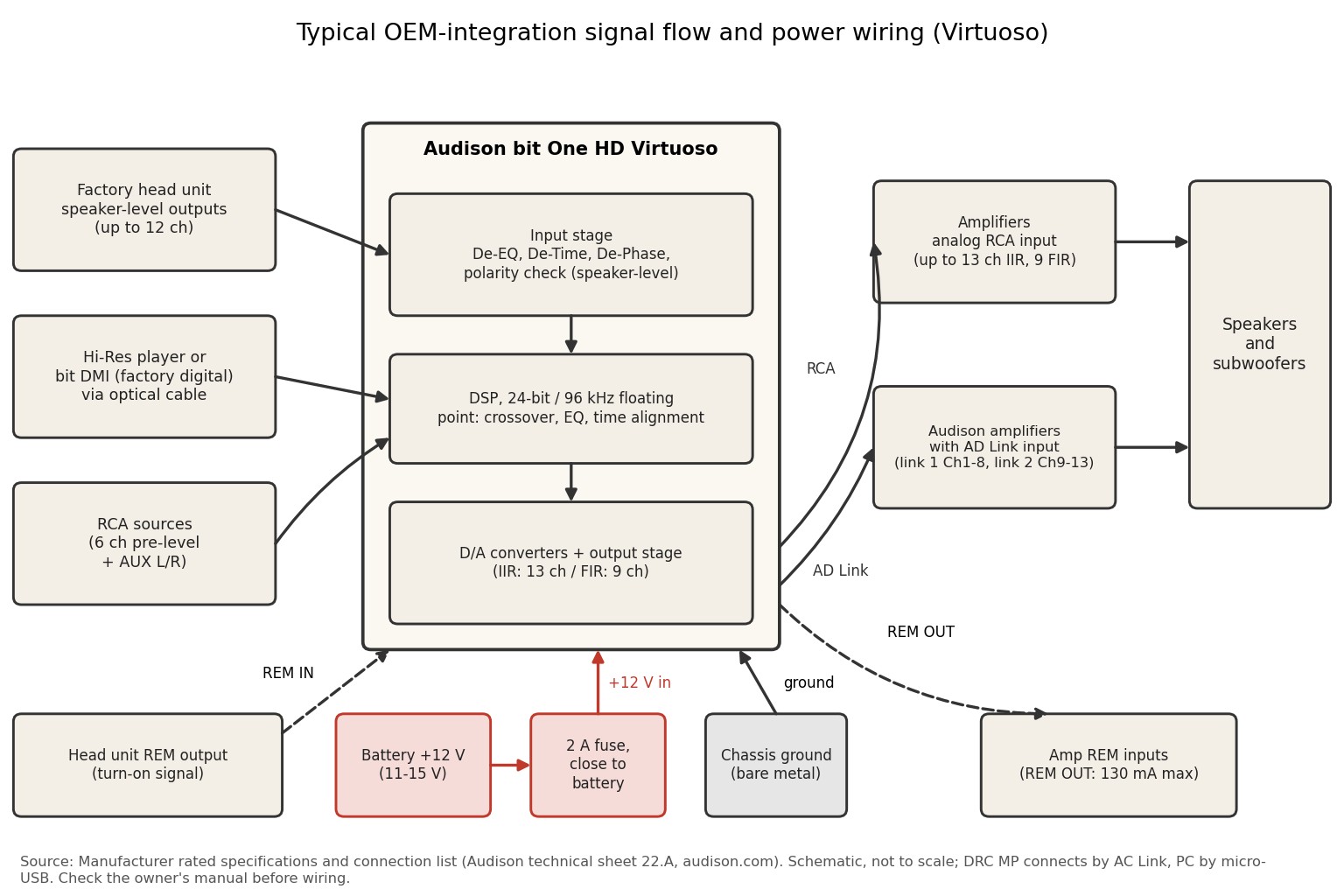
Plan the channel map first: which factory outputs you can tap, whether they are amplified, and which input type matches their signal level. Mount the processor, run +12 V through a fuse, a solid chassis ground and the remote turn-on lead, connect the inputs and outputs, then tune from the PC. In start-stop vehicles, Audison sells an ES3 module because battery voltage can dip below 8 V at engine start and shut the processor down. For cars with a factory digital (MOST) bus, Audison offers the bit DMI interface.
Safety and wiring notes
- Disconnect the battery negative before wiring, and fit the 2 A fuse that Audison specifies on the +12 V feed close to the battery.
- Connect speaker-level factory signals only to the speaker-level inputs and RCA signals to the RCA inputs, and keep each signal inside the listed sensitivity range.
- The remote output is rated at 130 mA. Add up the turn-on current of the amplifiers it drives, and use a relay if the total is higher.
- Identify factory speaker wires with a meter or wiring diagram before tapping them, and never splice into airbag wiring.
- Set crossovers and gains at low volume before raising it. A tuned system can reach damaging levels and can overload tweeters.
Day to day, the DRC MP handles volume, source and presets. Everything else needs the Windows software, so most owners will want a professional tune or a Windows laptop and a measurement microphone.
How it compares
The table lists verified figures from manufacturer pages and retailer listings. The Helix DSP Ultra S and the JL Audio TwK-88 are the closest like-for-like processors on price and features; the Helix NEXT DSP Ultra XT is the newer step up.
| Model | Listing price | Outputs | Inputs | Processing | S/N analog / digital | Distortion | Max output |
|---|---|---|---|---|---|---|---|
| Audison bit One HD Virtuoso | US$1,779.99 | 13 (IIR), 9 (FIR) | 12 speaker-level, 6 RCA + AUX pair, 2 optical | 24-bit / 96 kHz floating point | 104 / 110 dBA | 0.004% THD (1 kHz, 1 V out) | 4 V (0.1% THD) |
| Helix DSP Ultra S | about US$1,600 (open-box listing) | 12 | 8 speaker-level, 8 RCA, optical + coax | 64-bit fixed point, 96 kHz | 111 / 117 dB(A) | <0.0008% / <0.0004% THD+N | 8 V |
| Helix NEXT DSP Ultra XT | EUR 2,199 (EU listing) | 16 | 12 speaker-level, 8 RCA, optical + coax + USB-C | 64-bit fixed point, 96 kHz | 116 / 128 dB(A) | ≤0.0004% / ≤0.0003% THD+N | 8 V |
| JL Audio TwK-88 | US$549.99 | 8 | 8 RCA, optical + coax | 24-bit / 48 kHz | 98 dB (digital not published) | 0.02% THD+N at rated output | 4 V RMS |
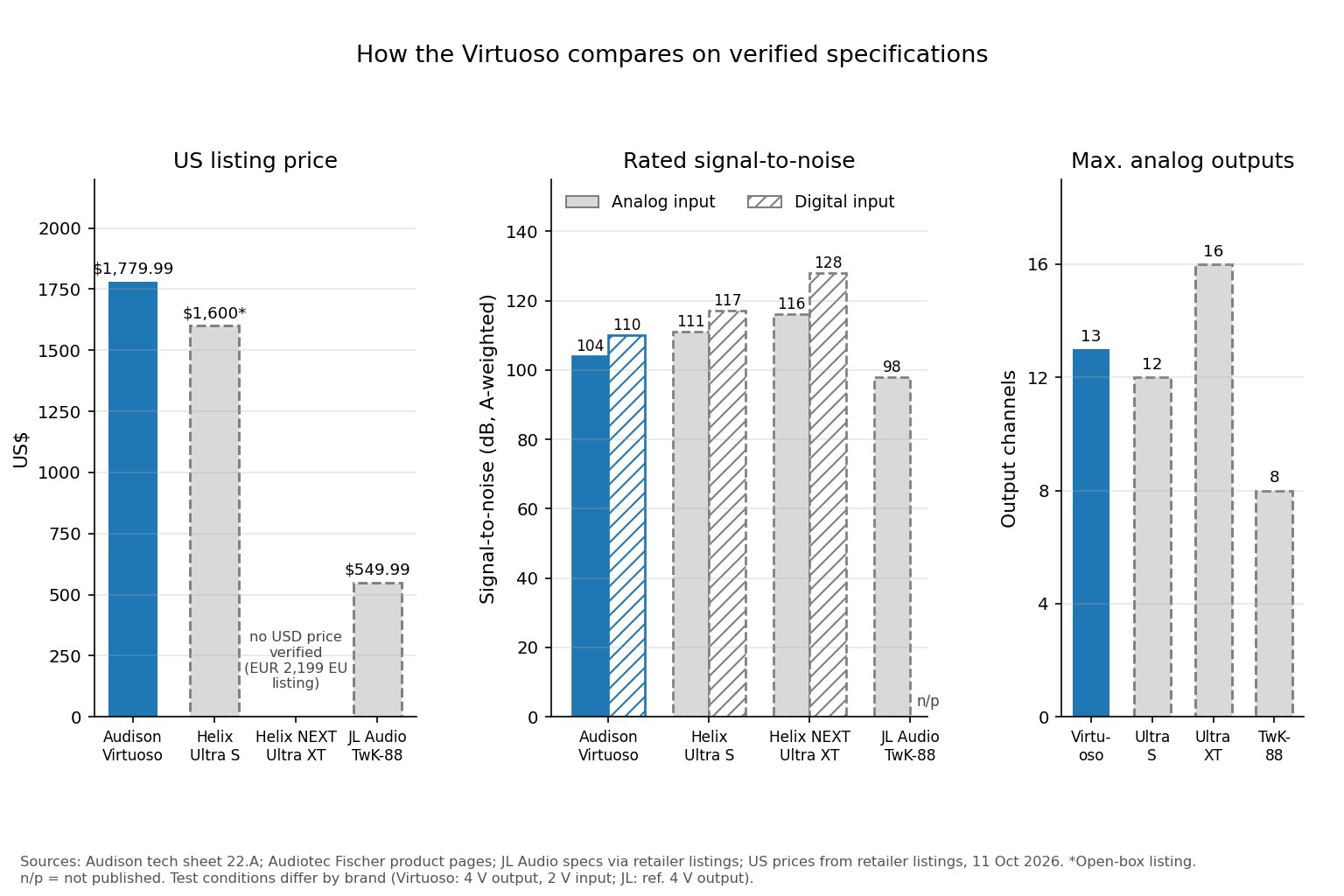
The TwK-88 costs about 31% of the Virtuoso's listing price, but it has no speaker-level inputs, so it suits cars where RCA outputs already exist. The Virtuoso's strongest card against the Helix models is input breadth for factory systems and the AD Link digital path to Audison amplifiers.
Who should buy it and who should skip it
Buy it if you are integrating with a factory system and need many speaker-level inputs, you own or plan to buy Audison amplifiers with AD Link inputs, you want a digital auxiliary source with factory volume control, or your installer prefers FIR crossovers and already knows Audison's software.
Skip it if you want the highest rated specifications per dollar, you do not have a Windows PC, you need more than 9 outputs in FIR mode, you want a processor that is easy to self-tune, or your car already has RCA outputs and a budget DSP such as the TwK-88 would cover your needs.
Buying advice
Price context. On 11 October 2026, Sound of Tri-State listed the Virtuoso at $1,779.99 and Abt at $1,949.99 with a call-for-availability note, about $170 apart. The Mobile Electronics Association reported a launch MAP of $1,699.99 in January 2020. Prices vary by dealer and region, so recheck before buying.
Model status. The Virtuoso is still listed as current on Audison's site, which shows only this model and the smaller bit Ten in its processor range. The original bit One HD is the earlier version. Audison's page lists software 3.1.0.0 and firmware 3.1.1.344 for download.
What to check. Confirm the seller is an authorized Audison dealer, the warranty (US retailers checked list one year; Audison says registering adds one more year), the return policy and whether the DRC MP remote is in the box. Budget for accessories you may need: Toslink cables, the bit DMI for factory digital systems, the C2O for coaxial or analog-to-optical conversion, the ES3 for start-stop vehicles, the SPM4 passive mixer for active factory multi-way systems and the ECK DRC cable extension for long vehicles. Also budget for professional tuning.
Final thoughts
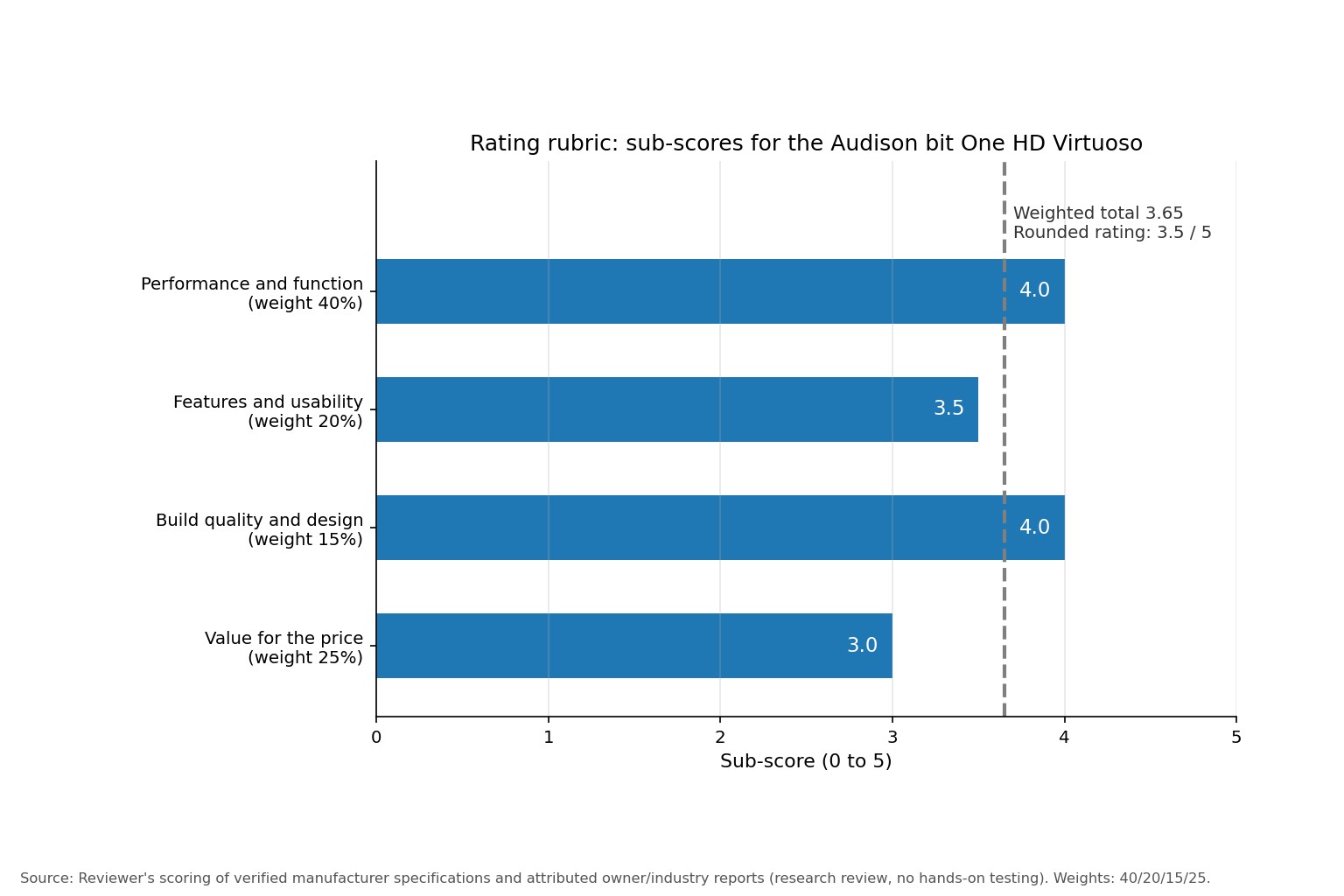
The Virtuoso earns 3.5 out of 5. It is a capable integration processor with broad inputs, FIR mode and a digital path to Audison amplifiers, held back by 2020-era rated specifications, FIR channel limits, Windows-only software, owner complaints about tuning flexibility and a price above comparable Helix listings. The rating is based on verified specifications and attributed reports, not hands-on testing. The rubric weights are performance and function 40%, features and usability 20%, build quality and design 15%, and value for the price 25%.
| Criterion | Weight | Score | Basis |
|---|---|---|---|
| Performance and function | 40% | 4.0 | Strong rated distortion and I/O; trails newer Helix figures on paper |
| Features and usability | 20% | 3.5 | Rich OEM tools and DRC MP; Windows-only software and tuning complaints |
| Build quality and design | 15% | 4.0 | Audio-grade parts claimed; no independent teardown |
| Value for the price | 25% | 3.0 | Priced above an open-box Helix Ultra S with lower rated S/N |
| Weighted total | 100% | 3.65 | Rounded to the nearest half step: 3.5 |
Sources and further reading
- Audison bit One HD Virtuoso product page
- Audison Virtuoso technical sheet (PDF)
- Audiotec Fischer: Helix DSP Ultra S
- Audiotec Fischer: Helix NEXT DSP Ultra XT
- The Shop: EISA 2020-2021 in-car winners
- DIY Mobile Audio forum: Virtuoso versus Helix DSP Ultra S (owner opinions)
- Sound of Tri-State: Virtuoso listing
- Sound of Tri-State: JL Audio TwK-88 listing
Audison bit One HD Virtuoso FAQ
Is the Audison bit One HD Virtuoso worth buying?
It is worth considering if you keep a factory head unit and need 12 speaker-level inputs, 13 outputs and Audison's OEM tools such as De-EQ and remote aux volume. If you mainly want the highest rated specifications per dollar, current Helix processors list better signal-to-noise figures at similar or lower US prices. No independent lab tests of the Virtuoso were found, so the performance figures are the manufacturer's.
What is the difference between the bit One HD and the bit One HD Virtuoso?
Audison's 2020 launch notes describe upgraded analog-path parts in the Virtuoso, including ELNA Silmic and WIMA capacitors, Burr-Brown op-amps and Cirrus Logic converters, plus a selectable digital filter and built-in USS. They also list software changes such as pass-through input configuration, automatic routing and improved De-EQ with phase analysis. If you only use the digital AD Link outputs, the analog upgrades matter less.
Does it work with a factory stereo?
That is its main job. The 12 speaker-level inputs accept 5 to 32 V RMS, and the processor adds De-EQ, De-Time, De-Phase, polarity check and a speaker-load simulator for head units that monitor their outputs. Compatibility still varies by vehicle, so ask your installer, and check Audison's bit DMI list if your car uses a factory digital (MOST) bus.
Do I need a Windows computer to set it up?
Yes, based on Audison's datasheet. It lists Windows XP, Vista, 7, 8 and 10 for the tuning software, connected by micro-USB, and does not list Windows 11 or macOS. Check with Audison or your dealer before buying if you do not have a compatible PC.
How many channels can use FIR filters?
FIR mode supports up to 9 outputs, compared with 13 in IIR mode. A front 3-way stage plus a stereo subwoofer uses 8 outputs, so adding a 2-way rear stage would exceed the FIR limit. Plan the channel map before choosing a mode.
Is there a newer Audison model?
Audison's processor page in October 2026 lists only the bit One HD Virtuoso and the smaller bit Ten, so no successor was found. The competitive picture has moved, though: Helix now sells the NEXT DSP Ultra XT with 16 outputs and higher rated signal-to-noise figures.
How does it compare with the Helix DSP Ultra S?
On paper the Virtuoso has more outputs (13 versus 12) and 12 speaker-level inputs versus 8, plus Audison's AD Link digital output. The Helix lists 111 dB analog and 117 dB digital signal-to-noise, 8 V output and lower distortion figures, but the brands test differently. The Helix was seen at about $1,600 as an open-box US listing.
What warranty does it have?
The US retailers checked list one year of parts and labor. Audison says registering the product online adds one more year, and an EU store listing shows three years. Confirm the terms with the seller, since they depend on the dealer and region.