Helix · DSP Ultra
Helix DSP Ultra Review: 12-Channel Car DSP, Now Replaced
Research review of the Helix DSP Ultra, a 12-output car audio processor now replaced by the Ultra S: verified specs, install notes, rivals and who should buy.
Pros
- 12 RCA outputs with 8 V maximum level, plus 8 virtual channels for group EQ across multi-way speakers
- Eight high-level inputs accept 4 to 32 V and use an ADEP.3 circuit for factory radios that monitor their speaker outputs
- Published SNR of 117 dB (digital input) and 111 dB (analog input), A-weighted
- Stores 10 sound setups and tolerates supply dips down to 6 V for up to 5 seconds
- Input Signal Analyzer and 5-band input EQ help correct factory-processed signals
- HEC expansion slot accepts optional Bluetooth or USB audio modules
Cons
- Listed in the manufacturer's product archive and replaced by the DSP Ultra S, so stock and support are less certain
- Input sensitivity is set with trimmers inside the case, and a jumper must be removed for high-level settings above 11 V
- No built-in Bluetooth, USB audio, display or volume control for the digital inputs
- No independent bench measurements found; performance figures are manufacturer specifications
- Digital inputs accept stereo PCM only, and the sound effects work only with Virtual Channel Processing enabled
- About 33% more expensive than the 10-output DSP PRO MK3 at the same retailer, which also offers Virtual Channel Processing
Specifications
| Analog inputs | 8 x RCA (1 to 8 V) or 8 x high-level (4 to 32 V) |
|---|---|
| Crosstalk | > 90 dB |
| DSP and converters | 2 x 64-bit Analog Devices DSPs (2.4 billion MAC/s), 96 kHz sampling, AKM 32-bit A/D and D/A |
| Digital inputs | 1 x optical S/PDIF (12 to 96 kHz), 1 x coaxial S/PDIF (12 to 192 kHz), stereo PCM only |
| Dimensions (H x W x D) | 40 x 177 x 170 mm (1.58 x 6.97 x 6.69 in) |
| Expansion | HEC slot for Bluetooth, USB audio and similar modules (sold separately) |
| Frequency response | 10 Hz to 44 kHz (manufacturer figure, conditions not stated) |
| IM distortion | < 0.002 % digital input, < 0.004 % analog input |
| Operating voltage | 9.6 to 18 V (down to 6 V for max. 5 s); current draw 650 mA |
| Order number | HP51229 |
| Outputs | 12 x RCA line outputs, 8 V maximum; 1 x remote out (500 mA max) |
| SNR (A-weighted) | 117 dB digital input, 111 dB analog input |
| Sound setups | 10 memory slots |
| THD+N | < 0.0004 % digital input, < 0.001 % analog input (level and frequency not stated) |
| Type | 12-output car audio digital signal processor |
| Virtual channels | 8 virtual channels between 8 inputs and 12 outputs |
Verdict
The Helix DSP Ultra is a 12-output car audio processor suited to complex active systems and factory-amplifier integration, with published SNR of 111 to 117 dB and flexible virtual-channel routing. Its main compromise is age: the manufacturer has archived it, the DSP Ultra S replaces it, and no independent bench measurements turned up. At €1,199 from one EU retailer it only makes sense if you need more than 10 outputs; otherwise the DSP PRO MK3, listed at €899 there, covers most systems for less.
Is the Helix DSP Ultra worth buying today? For a car system that really uses 11 or 12 processed outputs, or one that has to sit behind a factory amplifier, it remains a capable processor on paper. For most buyers it is a harder sell. Audiotec Fischer now lists it in its product archive, the DSP Ultra S has taken its place, and the 10-output DSP PRO MK3 was listed 300 euros cheaper (about 25% less) at the one retailer where both could be compared.
The Ultra is a 12-output car audio digital signal processor with eight analog inputs that take either RCA or speaker-level signals. It arrived around the start of 2020 and sits between the older DSP PRO line and the newer NEXT DSP ULTRA XT. This page covers the original Ultra only. If you are shopping for the current model, read the Ultra S sections of the comparison below as well.
How this review was made
This is a specification and research review. Nobody involved in writing it installed, listened to or measured the processor, so there are no first-hand sound impressions here. Everything comes from the manufacturer's product page and installation manual, a Car&Hifi magazine test that Audiotec Fischer hosts as a reprint, a sponsored product spotlight on BestCarAudio.com (used only for feature descriptions), owner posts on a DIY Mobile Audio forum (labeled as anecdotal), and retailer listings checked on 12 Oct 2026.
I looked for independent bench measurements, such as distortion sweeps from a lab or a measurement-focused site, and found none for this model. Every noise and distortion figure below is therefore a manufacturer specification. The rating at the end rests on that evidence and says so.
Design and build
The Ultra measures 40 x 177 x 170 mm (1.58 x 6.97 x 6.69 in). Weight is not stated on the pages I checked. The Car&Hifi test opened the case and described a clean, logical board layout: one 8-channel A/D converter and two 6-channel D/A converters from AKM, two Analog Devices ADAU1452 DSP chips, and Texas Instruments op-amps at the inputs and outputs. That is a magazine's view of the internals, not a durability test, and I found no long-term reliability data.
Several important controls live inside the case. The manual puts the eight input-sensitivity trimmers, a three-position ground-lift switch and a load jumper behind a side panel held by five Phillips screws. On the outside you get a status LED, a clipping LED, a control button, a USB port, an Auto Remote switch and screw-terminal plugs for power and high-level wiring. Holding the control button for more than five seconds erases the stored setups, and the unit then stays silent until you load a new one.
The manual asks for a dry mounting spot with airflow, away from heat sources, fixed to a solid surface after checking what sits behind it. The warranty follows legal requirements, and Audiotec Fischer recommends an authorized dealer install the unit for full warranty coverage.
Features and usability
The headline feature is Virtual Channel Processing (VCP). Eight virtual channels sit between the inputs and the 12 outputs, so one equalizer can shape a whole multi-way speaker group without disturbing the individual crossovers. Car&Hifi counted 8 inputs, 8 virtual channels and 12 outputs, which adds up to 28 processed channels. The manual adds that the sound effects (RealCenter, Augmented Bass Processing, StageEQ) work only while VCP is switched on.
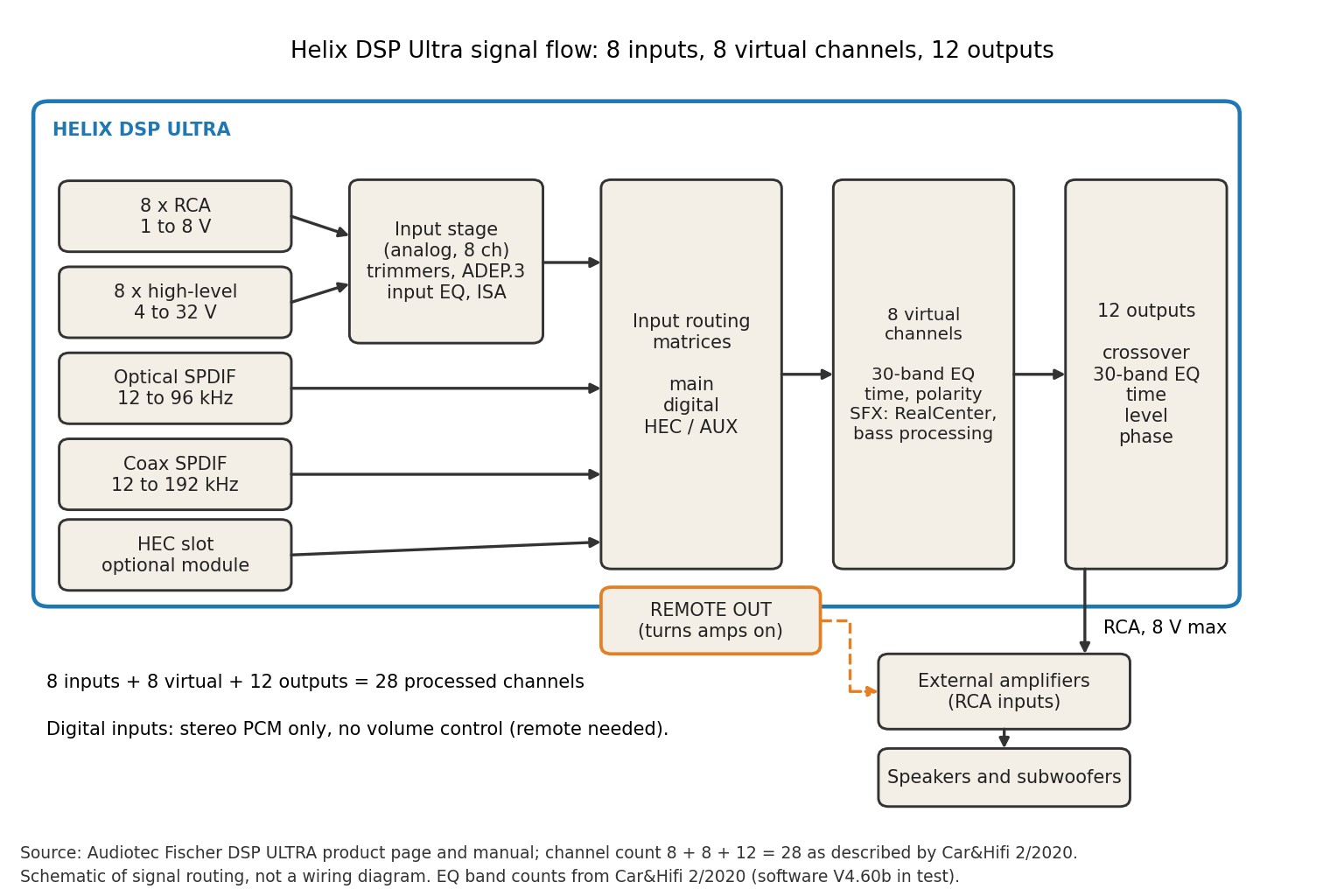
According to the Car&Hifi test, each output has 30 parametric EQ bands, crossovers from 6 to 42 dB per octave in Bessel, Butterworth, Chebyshev and Linkwitz types, and time alignment in 0.01 ms steps. Inputs get a 5-band EQ and an Input Signal Analyzer for spotting what a factory radio has done to the signal. That test used software V4.60b, and the manufacturer now points to DSP PC-Tool 5, so check current software behavior before relying on those figures.
Day-to-day niceties include ten stored setups, a Power Save Mode that switches off connected amplifiers after 60 seconds of silence, automatic turn-on from the high-level inputs, and operation through engine-start voltage dips. The manufacturer also describes TuneEQ, an automatic EQ correction that uses a measurement microphone.
The trade-offs are practical. There is no screen, so everything is configured on a computer over USB. The digital inputs carry no volume information, meaning an unregulated signal reaches your amplifiers at full level unless you add a remote control. And they accept uncompressed stereo PCM only, so Dolby and MP3 streams will not work. Bluetooth or USB audio needs an optional HEC card.
Sound and performance
With no independent measurements available, the numbers come from Audiotec Fischer. It specifies signal-to-noise ratio of 117 dB on the digital input and 111 dB on the analog input, both A-weighted. Total harmonic distortion plus noise is under 0.0004% (digital) and under 0.001% (analog), and the company gives frequency response as 10 Hz to 44 kHz from a 96 kHz sampling rate. It does not publish the test level or frequency behind those figures. For scale, 0.001% corresponds to roughly -100 dB relative to the signal.
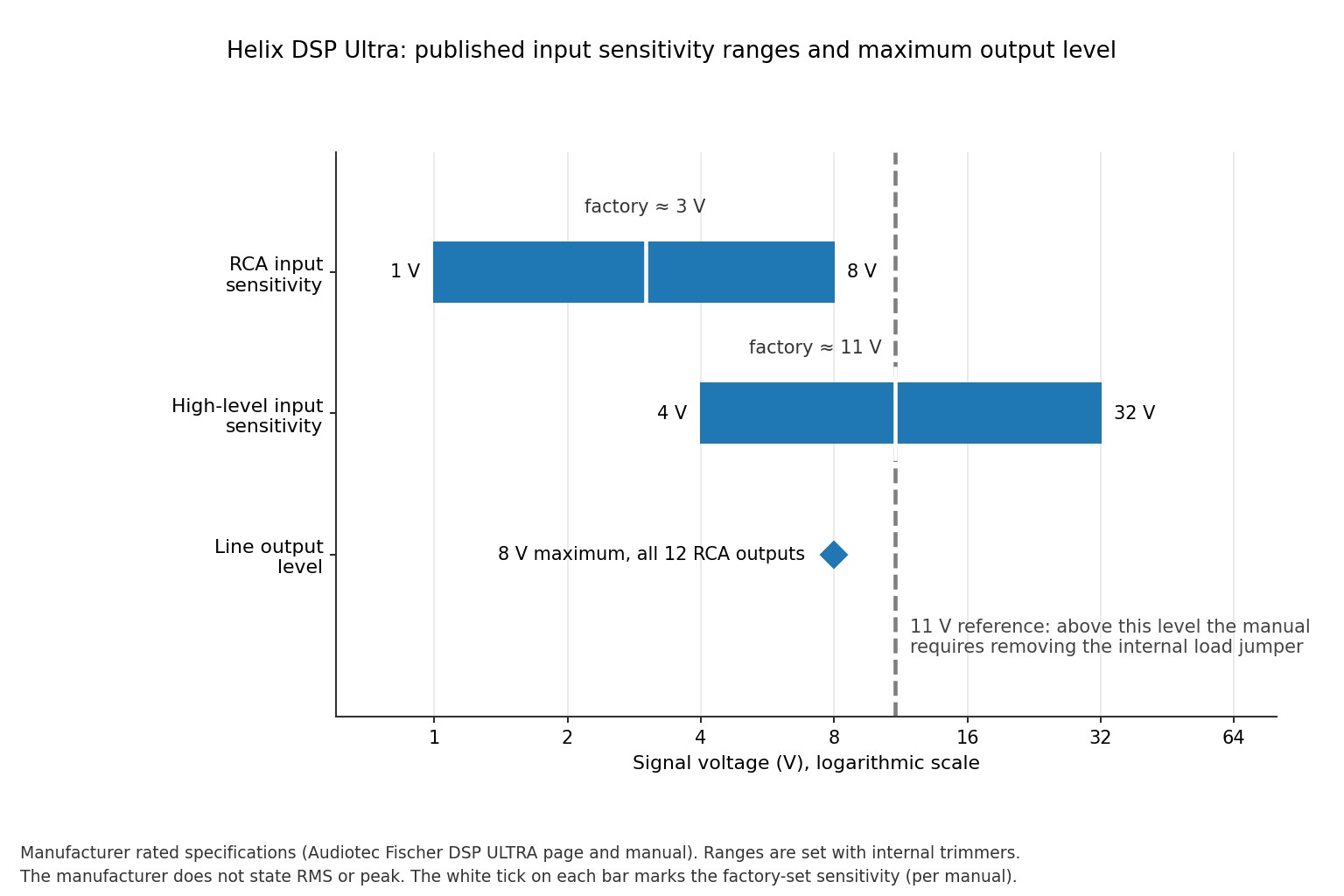
The 8 V maximum output is generous for a car processor. In principle it lets an installer set amplifier gain lower, which can help noise performance, although the benefit depends on the amplifiers you use. One DIY Mobile Audio poster who moved from a DSP.3S to an Ultra reported having to turn up gain slightly because the Ultra outputs 8 V instead of 6 V.
What did the press conclude? Car&Hifi gave the unit a highlight designation and focused its praise on build quality, routing flexibility and the input analysis tools rather than on listening impressions. Owner reports are anecdotal. One forum owner switched from a DSP.3 because it could not handle the high output of a factory radio, while another who owned both noticed little beyond the virtual channels and extra EQ options. A third, who upgraded to the Ultra S from a decade-old DSP PRO, said the newer unit is better but not dramatically so.
Setup, installation and daily use
Treat this as a job for a trained installer. Disconnect the battery negative terminal first, as the manual instructs. Put a main fuse on the battery positive lead no more than 30 cm from the battery, sized for the total current of the whole system. The manual gives no fuse rating for the processor itself, and it draws about 650 mA (roughly 7.8 W at 12 V), so the fuse is dictated by your amplifiers.
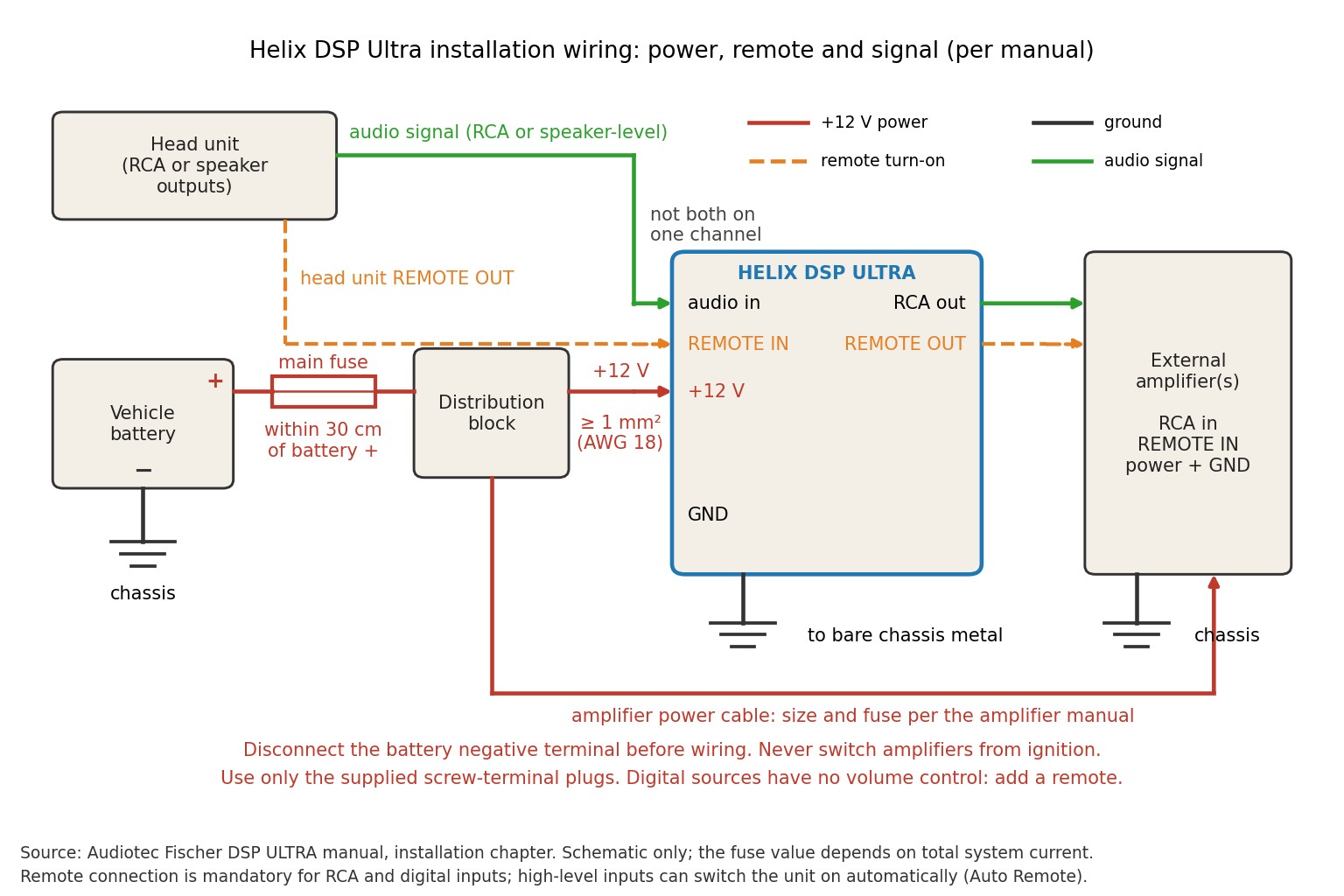
- Use the supplied screw-terminal plugs and at least 1 mm² (AWG 18) wire for the processor's power leads. Ground to bare, unpainted chassis metal.
- Connect the processor's REMOTE OUT to every amplifier. Never switch amplifiers from the ignition or any other signal.
- A remote input is mandatory with RCA or digital sources. High-level inputs can turn the unit on automatically if the radio has BTL output stages.
- Set each input trimmer with amplifiers disconnected: play a 1 kHz full-scale tone at about 90% radio volume and lower sensitivity until the clipping LED goes out.
- For any high-level setting above 11 V, remove the internal load jumper. Do not use the high-level and RCA inputs of the same channel together.
- Install the software before connecting USB, keep radio volume at minimum on first start, and leave amplifiers disconnected until the basic setup is saved. In active systems a wrong crossover can destroy speakers.
Cars with a bus-connected radio may keep it running invisibly for up to 45 minutes after you leave, according to the manual, and Power Save Mode is switched on in the default setup.
How it compares
The table lists manufacturer specifications only. Test conditions differ, so treat the noise and distortion columns as a rough guide rather than a ranking. Prices are listings seen on 12 Oct 2026, in the currencies shown, and are not directly comparable.
| Model | Inputs and outputs | SNR (published) | Distortion (published) | Setups stored | Price listing seen |
|---|---|---|---|---|---|
| Helix DSP Ultra (reviewed) | 8 RCA or high-level + 2 digital, 12 out | 111 dB analog, 117 dB digital | < 0.001% THD+N analog | 10 | €1,199 (audiokauppa.fi, incl. VAT); €1,300 at 2020 launch |
| Helix DSP Ultra S (successor) | Same as Ultra, 12 out | 111 dB analog, 117 dB digital | < 0.0008% THD+N analog | 10 | $1,600 (ResoNix, listed open-box) |
| Helix DSP PRO MK3 | 8 RCA or high-level + 2 digital, 10 out | 111 dB analog, 116 dB digital | < 0.001% THD+N analog | 10 | €899 (audiokauppa.fi); $1,250 sale (ResoNix) |
| miniDSP C-DSP 8x12 V2.0 | 8 in, 12 out | 115 dB (input type not stated) | 0.0007% THD+N | 4 presets | $550 (manufacturer listing, shown as on order) |
| Audison bit One HD Virtuoso | 12 in + 2 optical, 13 out | 104 dBA (4 V out, 2 V input) | 0.004% THD at 1 kHz, 1 V RMS out | Not confirmed | $2,145 (OnlineCarStereo.com) |
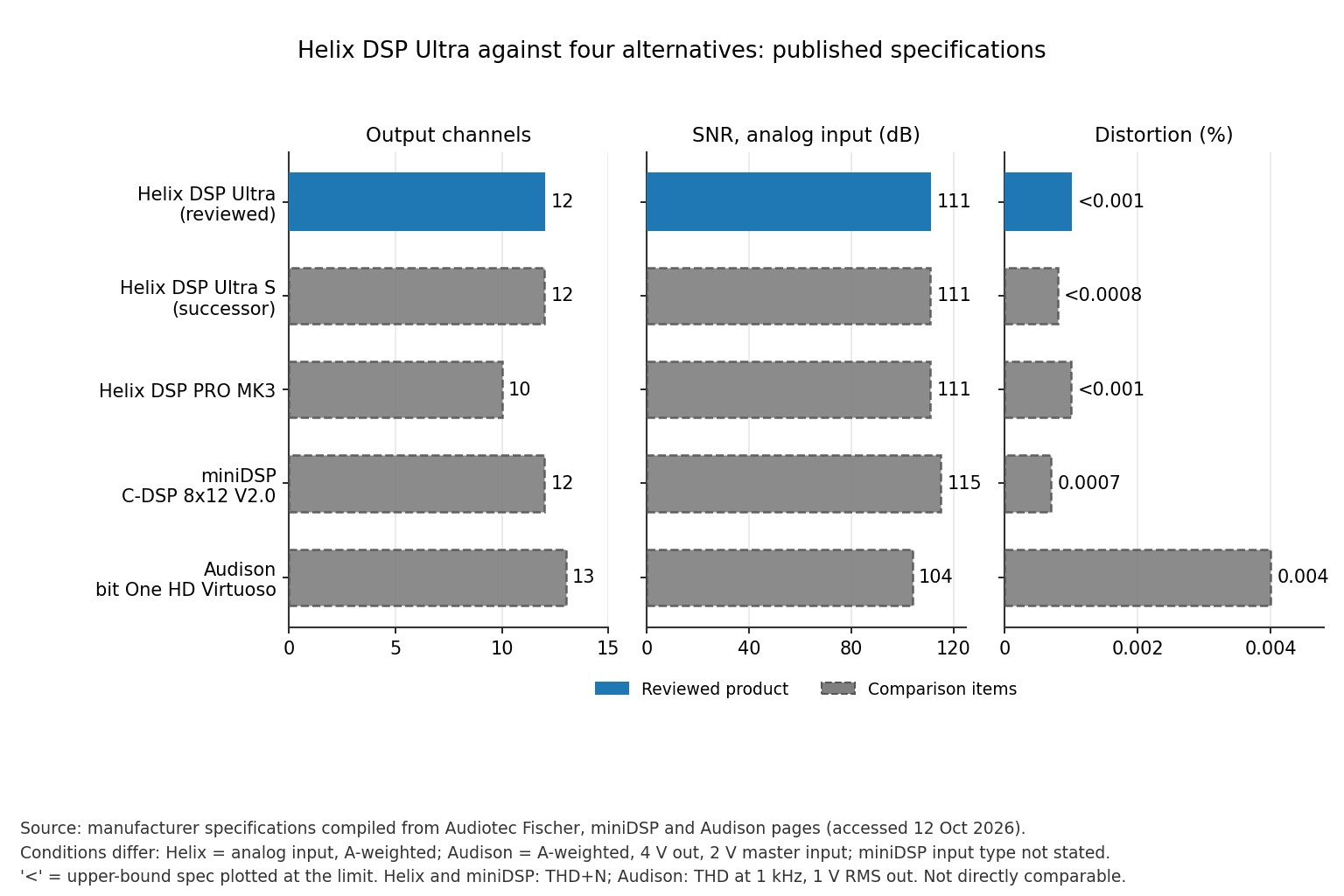
The real decision is channel count. A 3-way active front plus coaxial rear and one subwoofer channel needs 9 outputs, which a 10-output PRO MK3 handles. Swap the rear for a 2-way pair and you need 11. Add a stereo subwoofer pair to that and you need 12. A 3-way front, 2-way center, coaxial rear and one sub also needs 11. Anything past 10 is where the Ultra, its successor or the miniDSP earns its place.
Against the Ultra S, the manufacturer claims a redesigned analog input stage, new op-amps and lower distortion limits. The analog THD+N ceiling drops 20% (0.001% to 0.0008%), and the analog IMD ceiling drops 25%. The S also swaps the Control Input for a Smart Control Port and adds dynamic loudness and remote tone control.
Who should buy it and who should skip it
Buy it if you need 11 or 12 outputs, you are integrating behind a factory radio or amplifier that outputs up to 32 V, you want group EQ across multi-way speakers, and a trained installer will handle the setup. A reasonably priced new or well-documented unit from a dealer that honors the warranty makes this more attractive.
Skip it if your layout fits in 10 outputs, you want the current model with support, you expect built-in streaming or a display, or you plan to install it yourself without car-audio experience. In those cases the DSP PRO MK3, the Ultra S or a cheaper processor is likelier to suit you.
Buying advice
Price context first. The only retailer where I could see both on the same day listed the Ultra at €1,199 and the PRO MK3 at €899, a gap of 300 euros. The Ultra's launch price in Car&Hifi was €1,300, so the listing sits 101 euros under that. Other stores I checked showed it out of stock or no longer available, and the US dealer Abt pointed shoppers to the Ultra S instead. Prices include Finnish VAT and will differ by country.
Before paying, check the following:
- Whether the listing is the original Ultra or the Ultra S. One US retailer page for the S carries the original Ultra's order number, HP51229.
- Warranty terms and whether the seller is an authorized dealer, because the manufacturer ties full coverage to proper installation.
- Accessory compatibility. The Ultra uses a Control Input for remotes, newer models use a Smart Control Port, and the manual says HEC cards are model-specific. Confirm that any remote or module you want works with the Ultra.
- What else you will need: amplifiers, RCA cables, a remote if you use digital inputs, a measurement microphone for tuning, and installer time.
- Return policy, especially for used or open-box units.
Final thoughts
The rating below is 4.0 out of 5. It is a research-based score, built from specifications and attributed reviews rather than hands-on use, using the site's weighted rubric. It is capped by the lack of independent measurements, by the Ultra's archived status and by a price that is hard to justify when the PRO MK3 covers most layouts.
| Category | Weight | Sub-score | Adds | Basis |
|---|---|---|---|---|
| Performance and function | 40% | 4.0 | 1.60 | Strong published noise and distortion figures, but no independent measurements |
| Features and usability | 20% | 4.5 | 0.90 | Deep routing and analysis tools; internal trimmers and no display |
| Build quality and design | 15% | 4.0 | 0.60 | Praised internals; no durability data |
| Value for the price | 25% | 3.0 | 0.75 | Archived model, successor available, cheaper 10-output sibling |
| Weighted total | 100% | 3.85 | Rounded to 4.0 / 5 | |
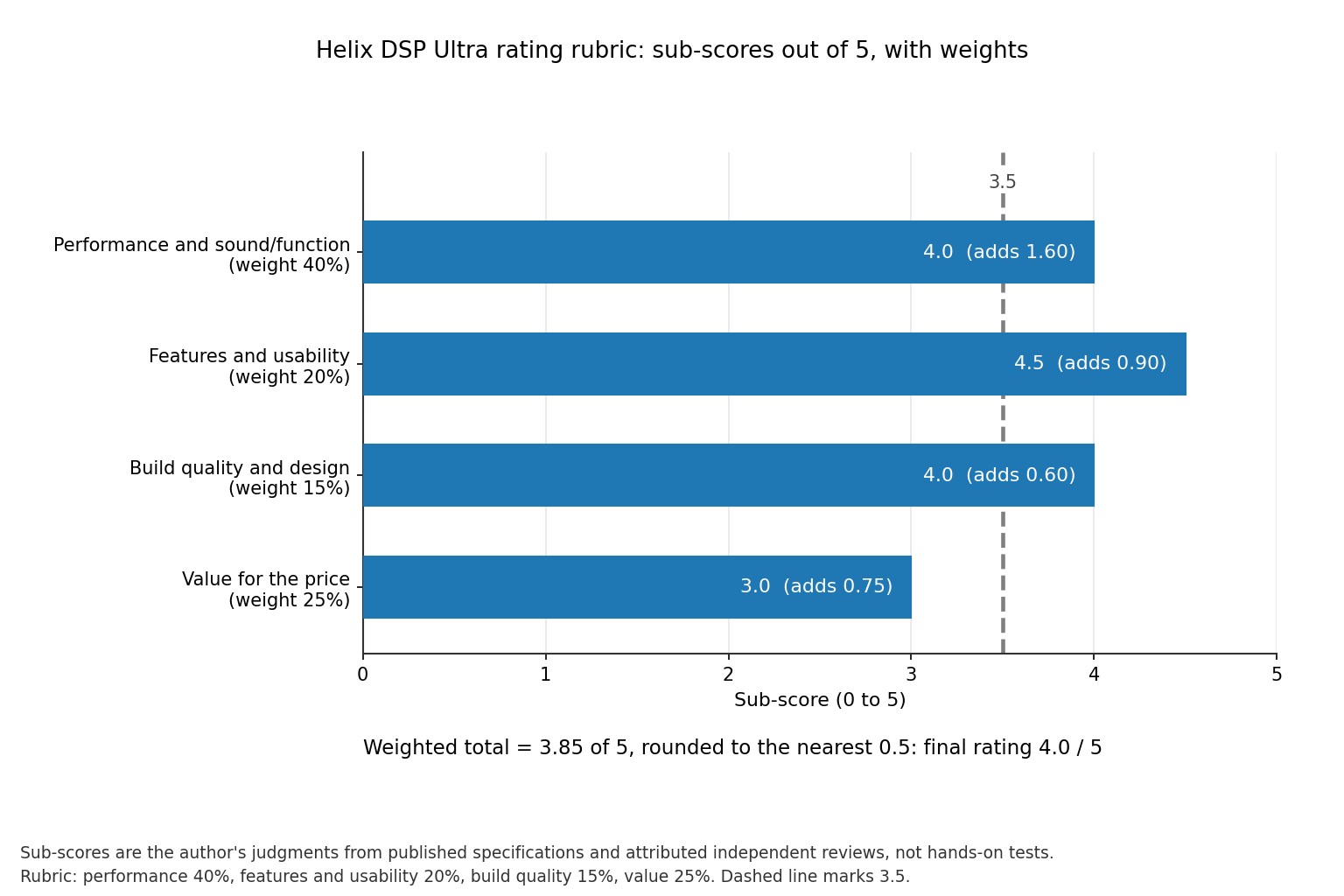
Both scores and the weighted total are computed from the rubric above, so the numbers match the chart.
As an Amazon Associate I earn from qualifying purchases. Some links on this page are affiliate links; they never affect our ratings.
Sources and further reading
- Audiotec Fischer: HELIX DSP ULTRA product page (specifications, features, archive status)
- Audiotec Fischer: DSP ULTRA manual (installation, wiring, setup notes)
- Car&Hifi 2/2020 single test, English reprint hosted by the manufacturer
- BestCarAudio.com: Product Spotlight, Helix DSP Ultra (sponsored post, feature description only)
- Audiotec Fischer: HELIX DSP ULTRA S product page
- Audiotec Fischer: HELIX DSP PRO MK3 product page
- DIY Mobile Audio forum: Helix DSP.3 vs Ultra (owner anecdotes)
Helix DSP Ultra FAQ
Is the Helix DSP Ultra discontinued?
Audiotec Fischer files it under its product archive and presents the DSP Ultra S as the follow-up. Some retailers still list it, and one Finnish store showed it in stock at €1,199 on 12 October 2026. Confirm stock, warranty and return terms before ordering.
What is the difference between the DSP Ultra and the DSP Ultra S?
Both have 12 outputs, 8 inputs and the same DSP power. The manufacturer says the S has a redesigned analog path with lower distortion limits (analog THD+N under 0.0008 % versus under 0.001 %), a Smart Control Port instead of the Control Input, and lower current draw (550 mA versus 650 mA).
Can the Ultra connect to a factory radio without RCA outputs?
Yes. It has eight high-level inputs that accept 4 to 32 V and an ADEP.3 circuit for radios that diagnose their speaker outputs. The manual says the internal load jumper must be removed for settings above 11 V, and that the high-level and RCA inputs of one channel must never be used together.
Does the Ultra include amplification, Bluetooth or USB audio?
No. It is a processor with line-level outputs, so you need external amplifiers. Bluetooth and USB audio require optional HEC modules, and the digital inputs accept uncompressed stereo PCM only, not Dolby or MP3 streams.
Should I buy the Ultra or the DSP PRO MK3?
Both use two 64-bit DSPs and Virtual Channel Processing. The Ultra adds two outputs (12 versus 10) and a wider RCA input range, but cost €300 more at one Finnish retailer on 12 October 2026. Choose it only if your speaker layout needs 11 or 12 outputs.
Do I need a computer to set it up?
Yes. Configuration is done through the DSP PC-Tool software over USB, and the unit has no display. The manual says to install the software before connecting the USB cable. Check operating system support on the manufacturer's download page.
Is it worth choosing over the miniDSP C-DSP 8x12?
On paper the two are close: miniDSP lists 115 dB SNR and 0.0007 % THD+N, against Helix figures of 111 dB and under 0.001 % for the analog path. The Helix offers 10 setup slots, 4 to 32 V high-level inputs and virtual channels, but costs considerably more. If you do not need those features, the cheaper unit deserves a look.