Rockford Fosgate · T500-1bdCP
Rockford Fosgate Power T500-1bdCP Review: 500W Class-BD Bass Amp
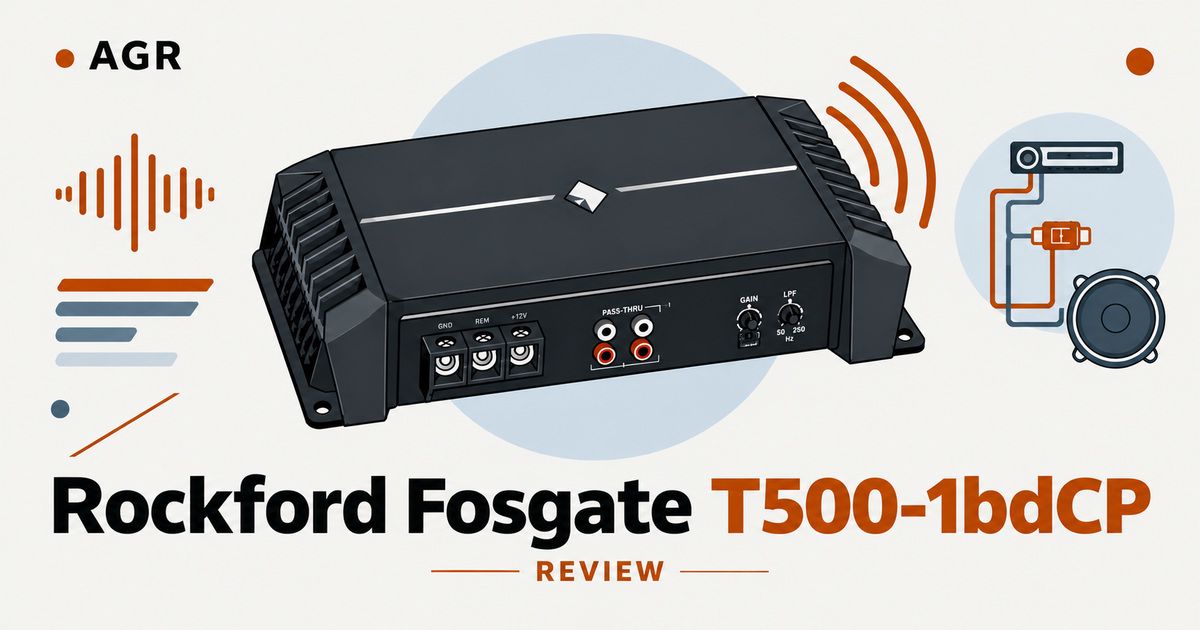
The Rockford Fosgate Power T500-1bdCP delivers 500 watts RMS at 1 or 2 ohms, with Class-BD design, adjustable filters, RCA pass-through and Punch EQ control.
Pros
- Rated 500 W RMS at both 2 Ω and 1 Ω
- Adjustable 35–250 Hz low-pass filter with a 24 dB/octave slope
- Infrasonic filter specified at −3 dB around 28 Hz
- Punch bass boost adjustable from 0 to +18 dB at 45 Hz
- RCA pass-through outputs for system expansion
- Manufacturer-stated two-year parts-and-labor warranty
Cons
- High $549.99 USD reference price for its rated output
- No independent laboratory measurements found for this exact model
- Supplied and retailer dimension descriptions do not reconcile cleanly
- Optional remote bass controller may need to be purchased separately
- 4 AWG wiring is required and the fuse recommendation differs between sources
Specifications
| Channels | 1 mono channel |
|---|---|
| Circuit Topology | Class BD |
| Dynamic Power at 1 Ω | 707 W x 1 (published PowerCube figure) |
| Dynamic Power at 2 Ω | 537 W x 1 (published PowerCube figure) |
| Dynamic Power at 4 Ω | 328 W x 1 (published PowerCube figure) |
| External Fuse Guidance | 100 A per manufacturer manual and Crutchfield; supplied extract conflicts at 80 A; follow exact manual |
| Frequency Response | 20 Hz to 250 Hz, ±0.5 dB |
| Infrasonic Filter | −3 dB at 28 Hz, 12 dB/octave Butterworth |
| Input Sensitivity | 150 mV to 5 V RCA input (manufacturer manual; supplied extract says 4 V) |
| Low-Pass Filter | 35 Hz to 250 Hz, 24 dB/octave Butterworth |
| Operating Voltage | 9 to 16 VDC |
| Punch EQ | 0 to +18 dB at 45 Hz |
| Rated RMS Power at 1 Ω | 500 W x 1 |
| Rated RMS Power at 2 Ω | 500 W x 1 |
| Rated RMS Power at 4 Ω | 300 W x 1 |
| THD + Noise | <1.0% at 4 Ω, 2 Ω and 1 Ω (manufacturer-published) |
Verdict
The T500-1bdCP suits a buyer who needs a mono amplifier rated at 500 watts RMS at 1 or 2 ohms, with useful low-frequency controls and RCA pass-through. Its main strengths are load flexibility and the 35–250 Hz low-pass filter; its main compromise is the $549.99 USD reference price against lower-priced alternatives with similar or greater output. Check the exact model, dimensions, wiring and warranty before committing.
The Rockford Fosgate Power T500-1bdCP review comes down to system fit and price. This single-channel Class-BD amplifier is rated for 300 watts RMS at 4 ohms and 500 watts RMS at either 2 or 1 ohm, with an adjustable low-pass filter, a subsonic filter, RCA pass-through and bass boost. It remains an interesting choice for a system that specifically benefits from its Constant Power design and familiar Power-series controls, but at $549.99 USD it is expensive beside newer amplifiers with similar or higher published output. Rockford Fosgate’s official documentation places the model in the 2010 Power mono-amplifier family; no direct successor to this exact model was confirmed.
As an Amazon Associate I earn from qualifying purchases; affiliate links on this page never affect the ratings.
Rockford Fosgate Power T500-1bdCP design and build
The T500-1bdCP is a mono amplifier intended for subwoofer or low-frequency duty, not a full-range multi-channel replacement for a complete speaker system. Rockford Fosgate identifies its circuit as Class BD and lists MOSFET power-supply and output stages. The listing also specifies a 4-gauge power/ground connection, a screw-terminal speaker output, convection cooling and a two-year parts-and-labor warranty. Those details suggest an installation built around a substantial power cable and secure mounting rather than a tiny plug-and-play add-on.
The chassis needs sensible ventilation, access to its adjustment controls and room for the wires to leave the terminals without sharp bends. The supplied dimension list gives 2.14 × 8.14 × 11.41 inches in height × width × depth order. Crutchfield lists a different orientation and a shorter depth measurement, so those figures do not reconcile cleanly. Anyone planning a tight under-seat or side-panel installation should confirm the manual’s drawing and measure the actual unit with terminal and cable clearance instead of treating either dimension string as a cutout template.
Rockford Fosgate Power T500-1bdCP features and tuning
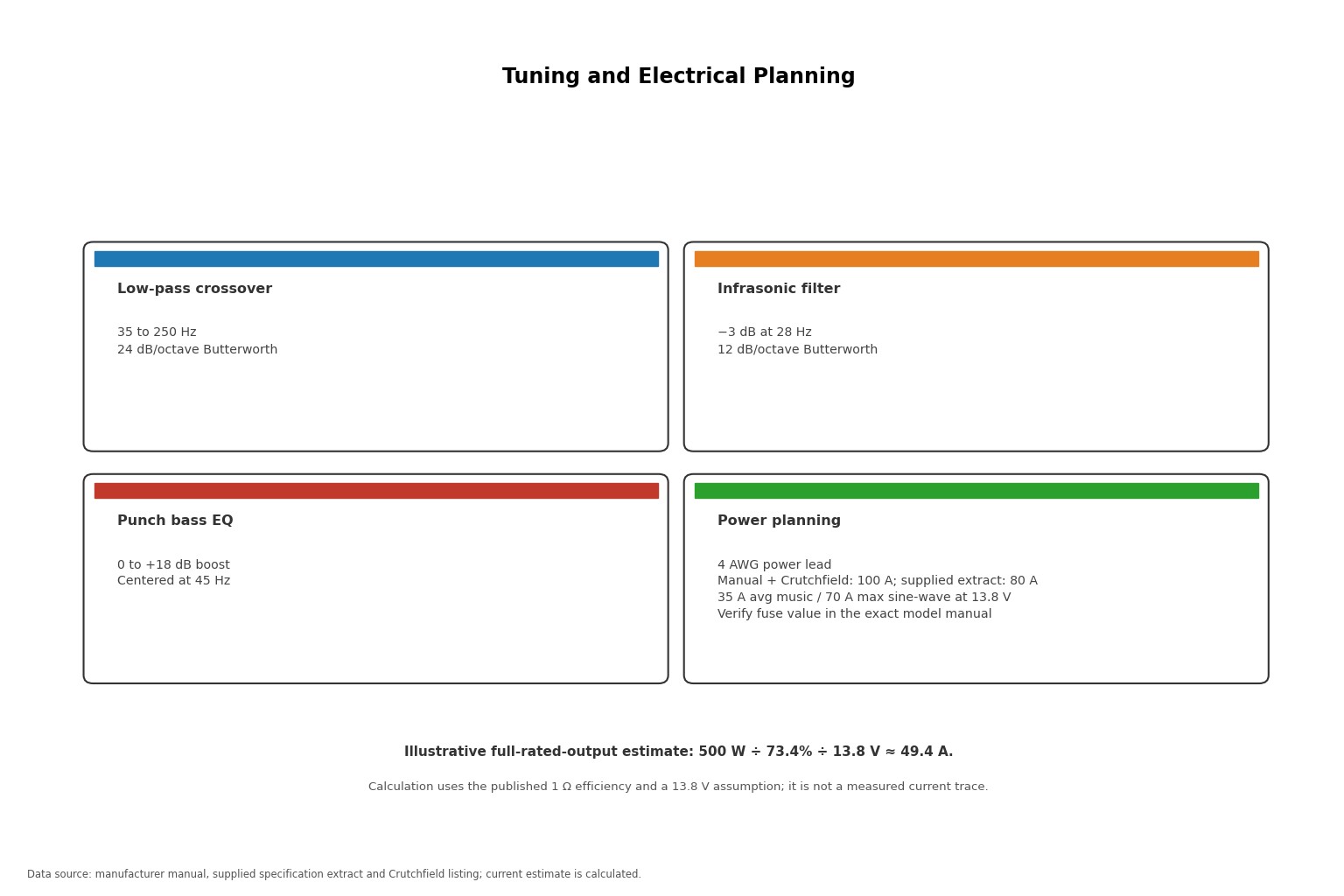
The low-pass filter is adjustable from 35 to 250 Hz with a 24 dB-per-octave Butterworth slope. A separate infrasonic filter is specified at −3 dB around 28 Hz with a 12 dB-per-octave slope. The built-in Punch bass control offers up to 18 dB of boost at 45 Hz. These options cover the basic adjustments needed to integrate a subwoofer with the front speakers, although the steep boost can consume amplifier headroom quickly and should not be treated as free output.
A pair of low-level RCA inputs and a pair of low-level pass-through outputs help it fit into a system with another amplifier. The pass-through is useful when a source has only one preamp output pair, but it does not turn the T500-1bdCP into a multi-channel amp. An optional remote Punch Bass EQ is listed; the manufacturer’s remote compatibility guide identifies this model family, but the exact controller and included accessories should be verified before purchase because the remote is optional, not a guaranteed box item.
The manufacturer manual lists input sensitivity from 150 mV to 5 V, which gives an installer flexibility with different source-unit preamp levels. The supplied specification extract says 4 V at the top end, so the manual value is used here. Gain is a matching control, not a second volume knob. Set it to suit the source signal and intended maximum level; turning the gain or bass boost up indiscriminately can produce clipping or push the subwoofer beyond its safe excursion.
For the exact product page, view the Rockford Fosgate T500-1bdCP listing and confirm the package, seller and warranty before ordering.
Rockford Fosgate Power T500-1bdCP power and performance
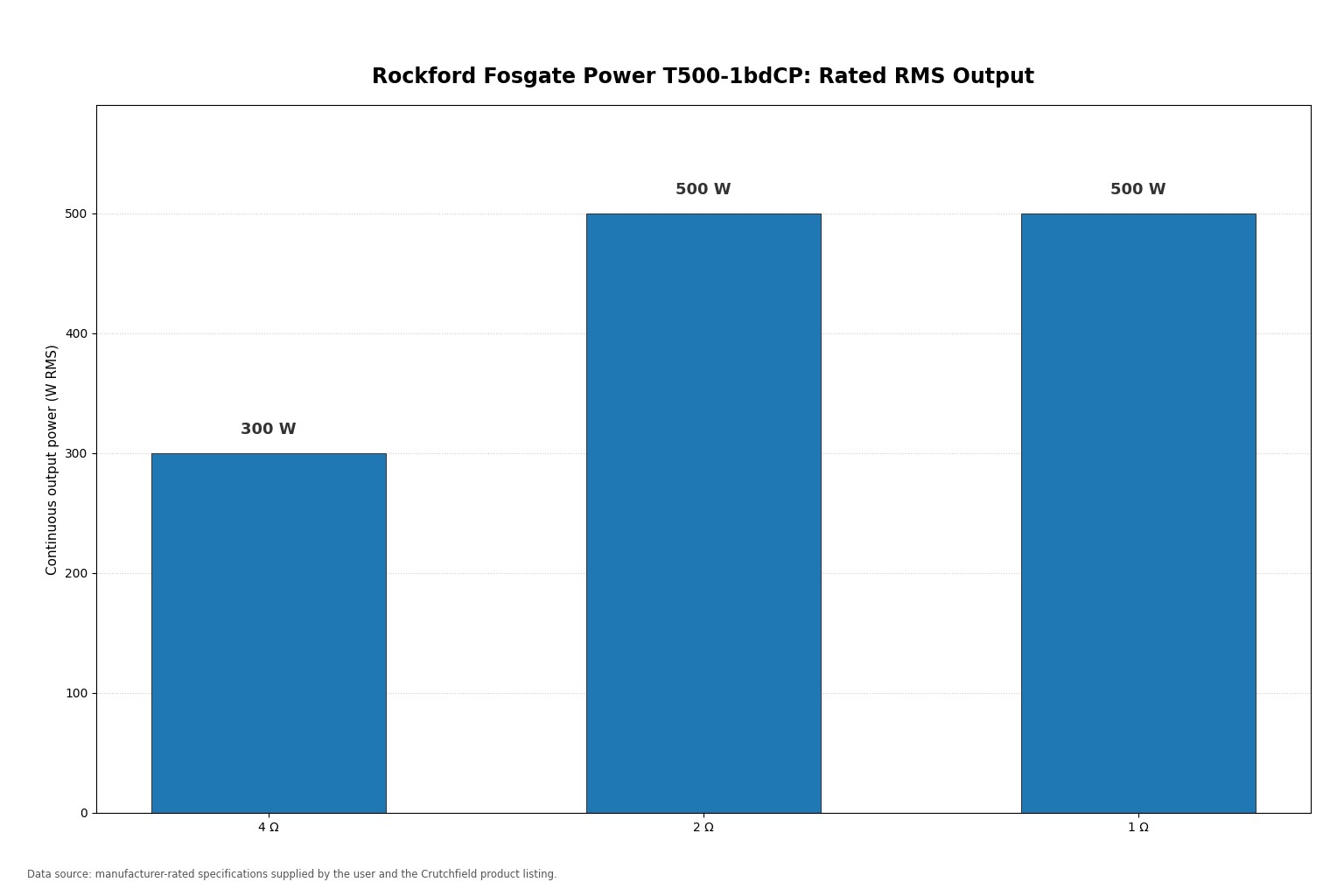
The published continuous ratings are 300 watts at 4 ohms, 500 watts at 2 ohms and 500 watts at 1 ohm. The accompanying dynamic figures are 328, 537 and 707 watts, respectively. Those dynamic values are not continuous ratings and should not be used as the target when matching a subwoofer. The 1-ohm rating gives flexibility for a suitable final voice-coil load, but it does not mean every subwoofer wiring combination is safe; calculate the resulting impedance before connecting anything.
The specifications list total harmonic distortion plus noise below 1.0% at each of the three stated loads and a 20 Hz to 250 Hz response within ±0.5 dB. Average efficiency is listed as 86.2% at 4 ohms, 82.3% at 2 ohms and 73.4% at 1 ohm. Lower efficiency at the lowest impedance means more input energy is lost as heat, reinforcing the need for secure power connections and sensible ventilation. These figures describe the manufacturer’s stated conditions; they do not establish how any individual install will sound or perform.
Our research found no independent lab measurements for this model. For a useful electrical estimate, divide the 500-watt output rating by the published 73.4% efficiency at 1 ohm, then divide by an assumed 13.8-volt supply: 500 ÷ 0.734 ÷ 13.8 ≈ 49.4 amps. This is a calculation from rated values, not a measured current trace. Rockford’s supplied specification lists 35 A average music draw and 70 A maximum sine-wave draw at 13.8 V, so actual demand depends on signal content, load and operating level.
Installing the Rockford Fosgate Power T500-1bdCP
The supplied specification extract calls for 4 AWG power wiring and an 80 A external fuse, but the manufacturer’s 2010 Constant Power manual and Crutchfield’s listing specify a 100 A external fuse for the T500-1bdCP. The manual takes precedence over the conflicting extract; verify the exact model label and manual before installation, and do not choose a fuse by guesswork or assume the fuse and main power leads are included. The supplied specification also lists a 35 A average current draw during music at 13.8 V and a maximum sine-wave draw of 70 A at that voltage. The same material suggests a 75 A alternator, but that should not be read as a universal vehicle requirement: the car’s original electrical load, alternator output at idle, cable length, battery condition and any other amplifiers all affect whether the electrical system has enough reserve. Have an installer assess the whole system if lights dim, voltage falls or multiple high-current devices are fitted.
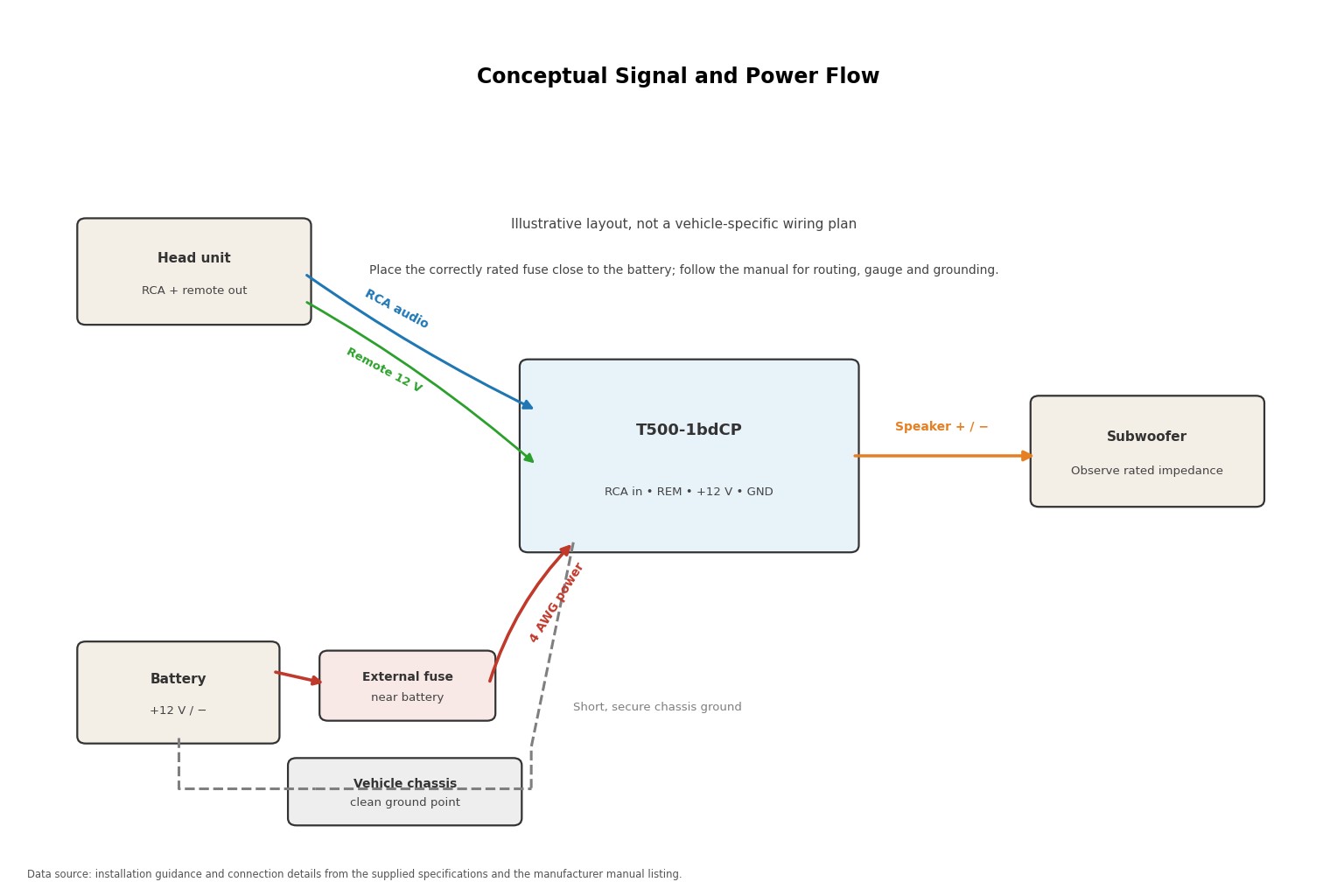
Install the fuse as close to the battery positive terminal as practical, use a cable gauge appropriate to the current and cable run, and make the amplifier ground short and secure to suitable chassis metal. Route signal cables away from high-current power wiring where practical, protect cables from sharp edges and moving parts, and do not allow an unfused power lead to contact the vehicle body. Disconnect the battery according to the vehicle’s service procedure before wiring, taking care around airbag and electronic systems.
Use the wiring diagram below as a signal-flow illustration, not as a vehicle-specific installation map. The remote turn-on lead, RCA signal, fused battery feed, chassis ground and speaker output are distinct connections. Verify positive and negative speaker terminals and the final impedance with the actual voice-coil configuration. The amp is not bridgeable, so treat it as a single mono output stage and do not attempt a bridged connection.
Set the low-pass filter to blend the subwoofer with the main speakers, then set the infrasonic filter with regard to the enclosure type and the subwoofer maker’s recommendations. A vented enclosure may need protection below its tuning frequency; a sealed enclosure behaves differently. Avoid copying a generic knob position without knowing the enclosure and driver limits.
Rockford Fosgate Power T500-1bdCP vs the competition
The closest alternatives for this comparison are KICKER KXA800.1, Alpine S2-A60M, and Rockford Fosgate Punch P500X1bd. The table compares published output at 1 ohm where a manufacturer rating is stated, with current non-Amazon prices from Crutchfield or the manufacturer where confirmed. The amplifiers differ in crossover details, input options and architecture, so the table is a buying comparison rather than a claim that their test conditions or sound are identical.
| Model | Published RMS output at 1 Ω | Key distinction | Listed price |
|---|---|---|---|
| Rockford Fosgate Power T500-1bdCP | 500 W | Class BD, 35–250 Hz low-pass, Punch EQ up to +18 dB | $549.99 USD |
| KICKER KXA800.1 | 800 W | Class D, FIT2 integration, SHOCwave bass restoration and DSP-controlled preamp | $499.95 USD |
| Alpine S2-A60M | 600 W | Class D, 330 W at 4 Ω, 600 W at 2 or 1 Ω | $299.95 USD |
| Rockford Fosgate Punch P500X1bd | 500 W | Class BD, C.L.E.A.N. gain setup and lower price | $429.99 USD |
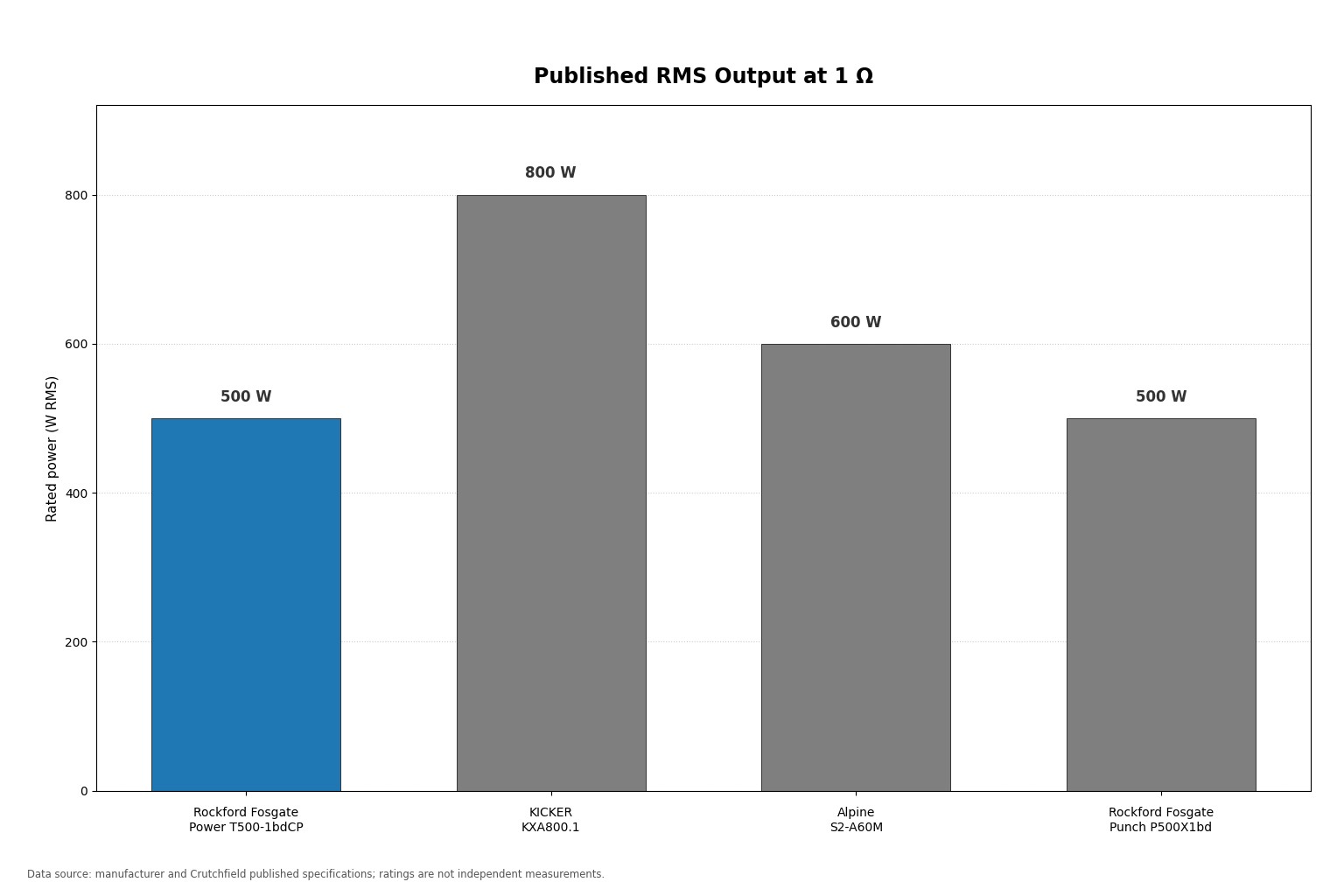
The KICKER KXA800.1 offers 800 W at 1 ohm for about $50 less at the cited prices. The Alpine S2-A60M is rated at 600 W at 1 or 2 ohms for about 55% of the T500-1bdCP reference price. The Punch P500X1bd is also rated at 500 W at 1 ohm and costs $120 less, although its power ratings at higher impedances and its available adjustment features differ. The T500-1bdCP’s case is strongest when its particular Power-series features, existing system layout or verified condition and warranty make it preferable, not because the wattage figure alone beats these alternatives.
Who should buy the Rockford Fosgate Power T500-1bdCP?
It makes the most sense for an enthusiast who already has a suitable subwoofer system, needs a mono amp stable at 1 ohm, wants RCA pass-through and adjustable low-frequency filtering, and has verified wiring and electrical capacity. The 500-watt rating at both 2 and 1 ohms makes impedance planning more flexible than an amp whose output changes sharply across those loads. The product’s two-year parts-and-labor warranty is another practical advantage when the seller can confirm that the unit is eligible and properly covered.
Skip it if the target is the most output per dollar, if 500 W is far above the subwoofer’s power handling, if a compact installation cannot accommodate its body and cable bends, or if the car’s electrical system is already struggling. A lower-priced model can be a better fit when its power, filters and integration options meet the installation. Buyers of used units should verify the exact model badge and terminal condition, ask about the warranty transfer rules, and avoid assuming that the separate T500-1bd has the same specifications as the T500-1bdCP.
Rockford Fosgate Power T500-1bdCP price and pre-purchase checks
The verified non-Amazon retail reference for the T500-1bdCP is $549.99 USD at Crutchfield. Prices change often, so check the current listing. At that figure, it needs a clear installation-specific reason to win over alternatives around $300 to $430 with similar or greater nominal output. This review does not use an Amazon price.
Before buying, confirm the exact T500-1bdCP model rather than the earlier T500-1bd, inspect the serial label and supplied accessories, establish whether the optional remote is included, and get the seller to confirm warranty coverage. Check the current manual for fuse placement, wire gauge, speaker impedance, ventilation and mounting clearances. The product page’s dimensional string and a retailer’s fitment description do not match cleanly, so measure rather than cutting a panel from an unverified dimension alone. If your vehicle uses a factory amplifier or lacks RCA pre-outs, check whether a suitable high-level adapter or integration interface is needed; the supplied T500 specification lists low-level RCA inputs and does not establish built-in high-level input support.
For product details, the Crutchfield product listing is a useful place to cross-check seller information and fitment notes. Those wanting to purchase this specific amplifier can also check the T500-1bdCP listing on Amazon, then confirm the exact model, parts included and applicable warranty before ordering.
Rockford Fosgate Power T500-1bdCP rating breakdown
The rating gives performance and features credit for the documented 1-ohm stability, useful low-frequency filtering, RCA pass-through and 500-watt ratings at both 2 and 1 ohms. Build receives 4.0 because the published design includes substantial power and speaker terminals, MOSFET stages, convection cooling and a stated two-year parts-and-labor warranty. Value scores 2.0: at the verified price, alternatives publish 600 to 800 watts at 1 ohm for the same or lower price, with the Alpine offering 600 W for substantially less; the T500-1bdCP’s special features may not justify the premium for every install.
| Area | Score | Weight | Weighted contribution |
|---|---|---|---|
| Performance and sound/function | 4.0/5 | 40% | 1.60 |
| Features and usability | 4.0/5 | 20% | 0.80 |
| Build quality and design | 4.0/5 | 15% | 0.60 |
| Value at the review price | 2.0/5 | 25% | 0.50 |
| Weighted result | 3.50/5 | 100% | 3.50 |
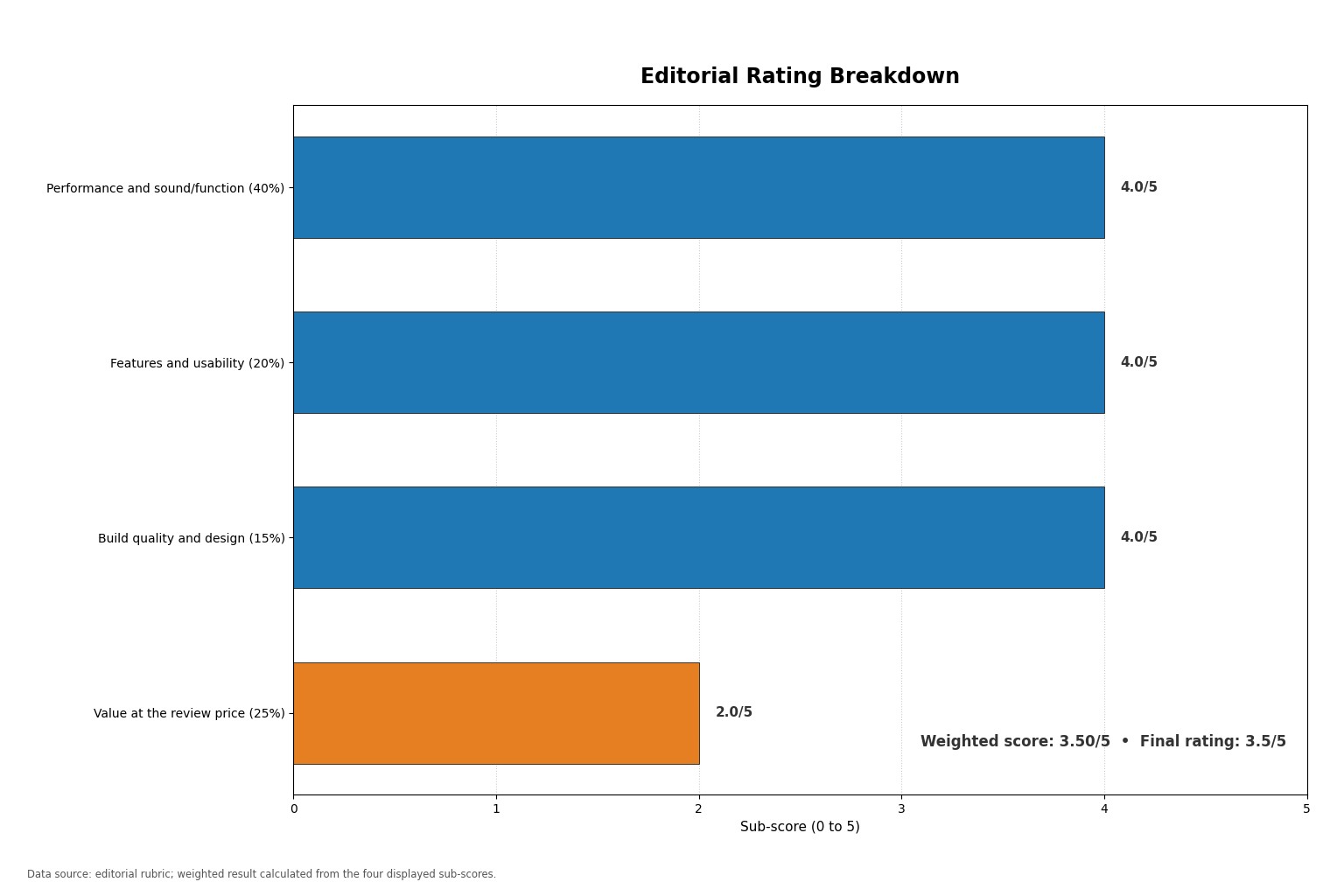
Our research score is based on the rated figures and documented details above. The final score is 3.5/5: it recognizes the useful features and load flexibility, but accounts for its premium price and the absence of independent laboratory results for this exact model.
Sources and further reading
- Official owner’s manual index: model family, installation diagrams and manual access.
- Official 2010 Constant Power manual PDF: RMS output by impedance, dimensions, fuse guidance, input sensitivity and installation diagrams.
- Product specification and price listing: rated power, filters, inputs, wiring, dimensions and retail price.
- Remote bass controller compatibility guide: compatibility context for optional bass remote controls.
- KICKER KXA800.1 product specifications: output by impedance, DSP/integration features, filters and listed manufacturer price.
- Alpine S2-A60M product specifications: rated output, frequency response, dimensions and manufacturer-listed price.
- Punch-series alternative specification: comparison output, filters, installation requirements and price.
- Rockford Fosgate amplifier catalogue: broader current model range and manufacturer-listed amplifier prices for context.
- Amplifier design and power discussion: context on design, circuit features and pricing differences among car amplifiers.
Rockford Fosgate Power T500-1bdCP Buyer Questions
How much RMS power does the Rockford Fosgate Power T500-1bdCP produce?
The published ratings are 300 W RMS at 4 ohms and 500 W RMS at both 2 and 1 ohm. The larger PowerCube figures are dynamic values, not continuous RMS ratings.
Can the T500-1bdCP run a 1-ohm subwoofer load?
Yes, the supplied specifications and retailer listing rate it at 500 W RMS into 1 ohm. Confirm the total impedance created by the subwoofer voice coils and wiring before connecting the load.
What fuse and power wire does this amplifier require?
The supplied specification extract says 80 A, but the manufacturer’s 2010 Constant Power manual and Crutchfield listing specify 100 A for the T500-1bdCP. Follow the correct manual for the exact unit and installation; cable sizing and grounding must also match the vehicle conditions.
Does the T500-1bdCP include a remote bass knob?
The specifications list an optional remote Punch Bass EQ that overrides the built-in Punch Bass EQ. Confirm whether the specific seller package includes the compatible remote before purchase.
What crossover controls are provided?
The low-pass filter spans 35 to 250 Hz with a 24 dB-per-octave Butterworth slope. The infrasonic filter is specified at minus 3 dB around 28 Hz with a 12 dB-per-octave slope, and Punch EQ can add up to 18 dB at 45 Hz.
Is the T500-1bdCP a full-range amplifier?
No. It is a mono amplifier intended for subwoofer or low-frequency duty, with a stated frequency response from 20 to 250 Hz. Use a separate suitable amplifier for full-range speakers.
Is $549.99 USD a good price for this amp?
That is the non-Amazon Crutchfield price reference used for this review, not a guaranteed current price. Alternatives listed around $300 to $430 can deliver similar or greater published power, so the T500-1bdCP makes the strongest case when its particular features fit an existing system.
Are the published dimensions consistent?
Not fully. The supplied specification gives 2.14 × 8.14 × 11.41 inches in height, width and depth order, while the retailer describes a different width, height and depth orientation. Check the manual and actual chassis with terminal and cable clearance before planning a tight mount.