Speaker Design
Aperiodic Speaker Enclosures: How They Work and How to Build One
Published October 8, 2026

How an aperiodic speaker enclosure works, what the resistive vent or membrane does, how it compares with sealed and ported boxes, and how to build and tune one.
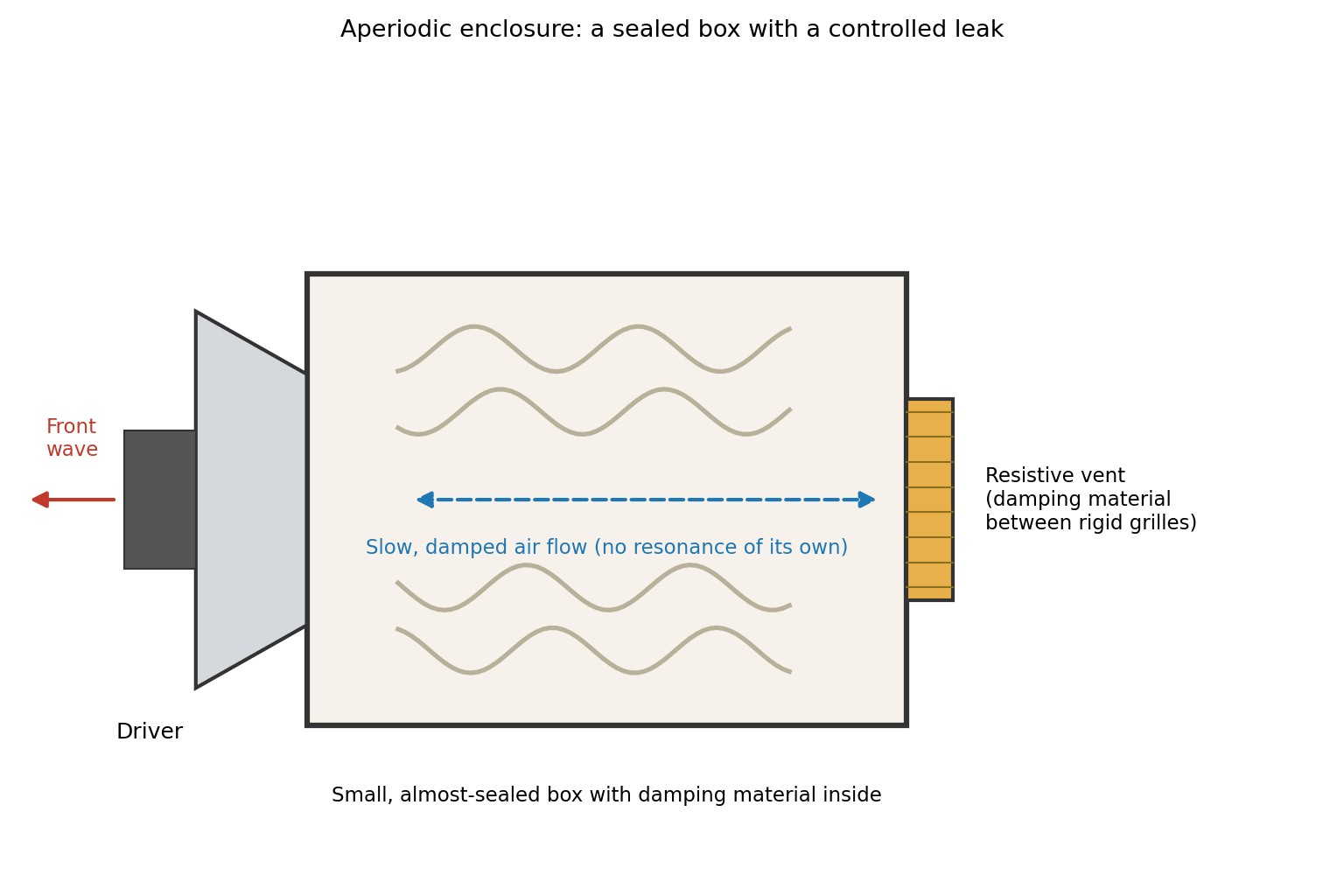
An aperiodic enclosure is a sealed box with a deliberate, controlled leak. The leak is a vent packed with damping material, so air can move slowly between the inside of the box and the outside, but the vent cannot ring like a normal port. The aim is to make a small box behave better than the same box would if it were fully sealed. In car audio the vent is often called an aperiodic membrane, and the idea turns up in trunk subwoofer builds, door midbass pods and kick panels as well as in home speakers.
This guide explains what "aperiodic" means, how the leak changes the way the driver behaves, what you gain and what you give up, how to choose a driver, how to make or buy the vent, and how to tune it by measuring the impedance curve. The calculations use the same Thiele/Small parameters as any other enclosure, so if those are new to you, the guide on speaker enclosure design covers them first.
The short version: an aperiodic enclosure is a small, nearly sealed box with a resistive vent. The vent lets some pressure escape, which lowers the system Q, flattens the impedance peak and removes the boomy hump a too-small sealed box produces. The price is a higher -3 dB point than a larger sealed box would give, and a final roll-off of about 18 dB per octave instead of 12. It works best with a driver whose Qts is already fairly low, and it has to be tuned by measurement, because the vent's resistance depends on the material you use.
What "aperiodic" actually means
"Periodic" refers to a resonance with a definite frequency, like the tuning of a bass-reflex port. An aperiodic vent is so resistive that the air in it has no resonance of its own, so there is no tuning frequency to set and no port note to hear. The vent only leaks. That is why an aperiodic box is sometimes described as half sealed box and half infinite baffle, or, less kindly, as a "leaky box".
Terms you will see
| Term | What it means |
|---|---|
| Aperiodic enclosure or box | A sealed box with a resistive vent, so the driver is damped by a controlled leak |
| Aperiodic membrane or AP membrane | The car-audio name for the vent: an air-permeable panel, usually damping material held between rigid grilles |
| Resistive vent, resistive port, acoustic resistor | General names for the same part. Dynaudio sells one as the Variovent and Scan-Speak sells one as a flow resistance vent |
| Para-aperiodic | The name Sonus Faber uses for its own variant, which reviewers describe as leakier than a conventional aperiodic box |
Where the idea came from
The aperiodic enclosure is credited to the British designer E. J. "Ted" Jordan, who described the approach in the 1950s while working at Goodmans. His acoustic resistance unit let a small cabinet leak air in a controlled way. The name never caught on, but the principle did, and modern resistive vents are used by a number of driver and speaker makers. In car audio the idea reached hobbyists later, mostly through forum builds, where it is still a niche approach.
How it works
A sealed box has two springs: the driver's own suspension and the air trapped behind the cone. In a small box the air is the stiffer spring, so it pushes the system resonance (Fc) and the system Q (Qtc) up. A high Qtc gives a peak in the response around Fc and a tall impedance peak, which is the boomy, one-note sound people associate with a box that is too small.
An aperiodic vent bleeds a little of that pressure away. Because the vent is resistive, it removes energy instead of storing it, so it acts like extra damping on the cone. You can describe the result with the usual sealed-box relationships, with one extra loss term for the leak:
Fc = Fs × √(1 + Vas ÷ Vb)
Qec = Qes × √(1 + Vas ÷ Vb)
Qmc = Qms × √(1 + Vas ÷ Vb)
1 ÷ Qtc ≈ 1 ÷ Qec + 1 ÷ Qmc + 1 ÷ QL
QL is the Q of the box losses. In the sealed-box literature a value of about 7 is the usual starting assumption for an ordinary box, and a well-sealed box can measure higher. A resistive vent lowers QL, and the lower QL goes, the more damping you add. Damping material inside the box also adds to the losses. This is a simplified, single-frequency description, and the real behaviour of a vent changes with frequency, so treat the numbers as a guide and confirm them by measuring.
The leak also adds one more stage to the high-pass behaviour of the system. A sealed box rolls off at 12 dB per octave below Fc. With a resistive vent the final roll-off is third order, about 18 dB per octave, which sits between a sealed box (12) and a bass-reflex box (24).
Worked example (hypothetical driver)
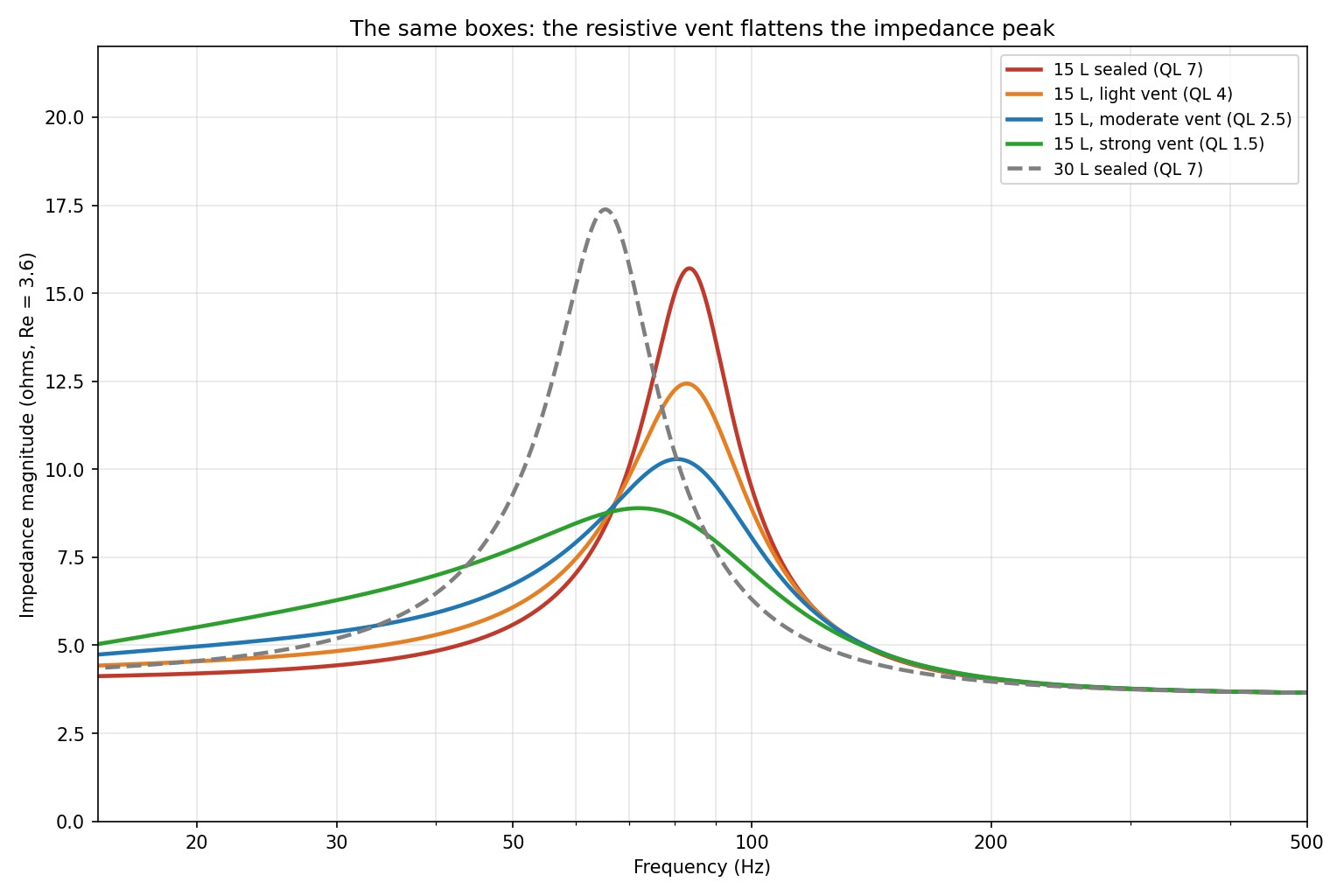
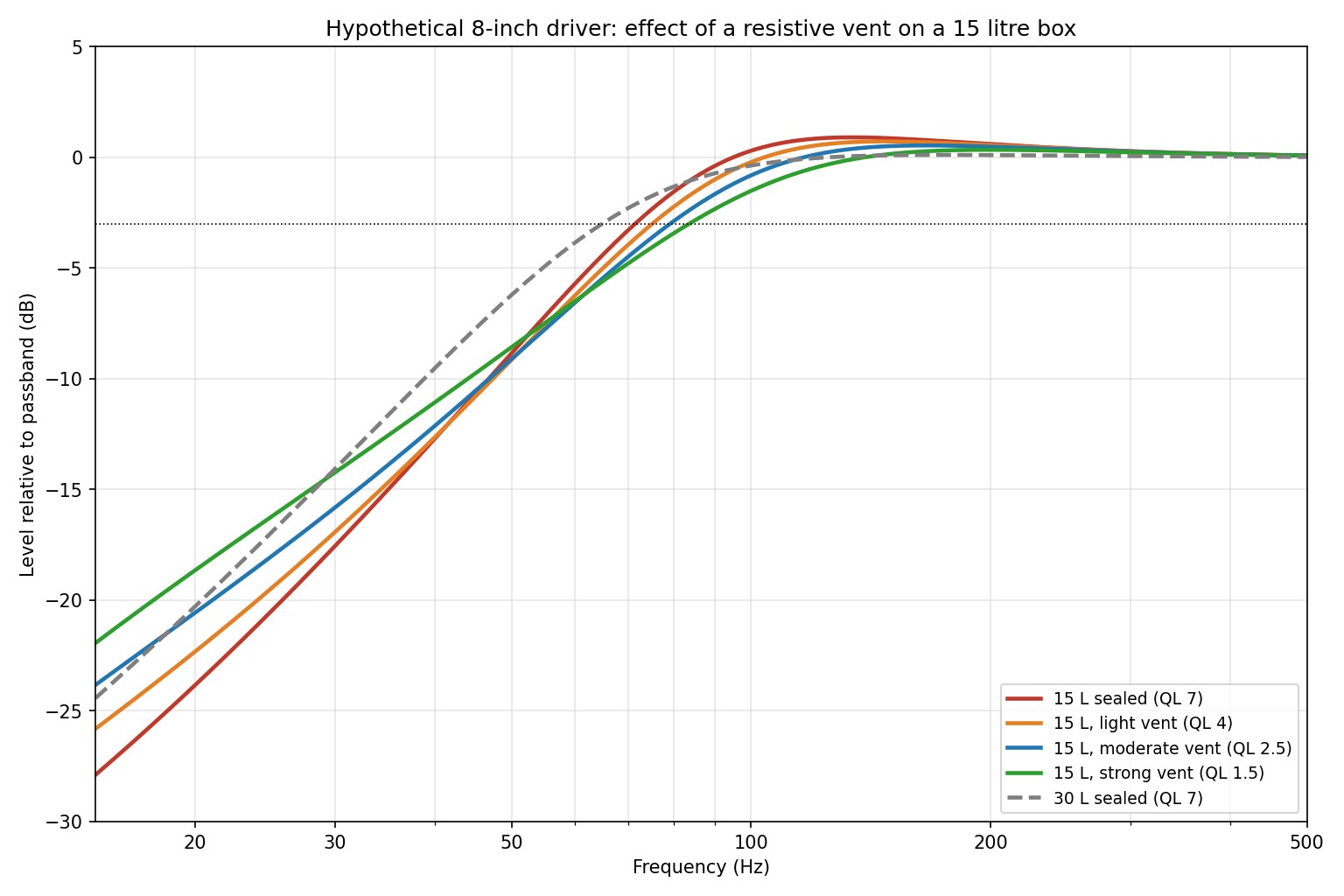
Take an imaginary 8-inch driver with Fs = 40 Hz, Qes = 0.55, Qms = 4.0 (so Qts is about 0.48) and Vas = 50 litres, in a 15 litre box. The box alone puts Fc at about 83 Hz. The table shows what different amounts of leakage do. The figures come from a simplified model that treats the leak as a constant loss and ignores the vent's mass and its own radiation, so they show the trend rather than a prediction for a real box.
| Setup | Qtc (approx.) | Impedance peak (× Re) | -3 dB point | Level at 30 Hz |
|---|---|---|---|---|
| 15 L sealed (QL = 7) | 0.88 | 4.4 | 71 Hz | -17.5 dB |
| 15 L, light vent (QL = 4) | 0.80 | 3.5 | 75 Hz | -16.9 dB |
| 15 L, moderate vent (QL = 2.5) | 0.72 | 2.9 | 79 Hz | -15.8 dB |
| 15 L, strong vent (QL = 1.5) | 0.60 | 2.5 | 83 Hz | -14.2 dB |
| 30 L sealed (QL = 7), for comparison | 0.71 | 4.8 | 65 Hz | -14.1 dB |
The impedance column is the peak impedance as a multiple of the voice coil's DC resistance Re, and the level column is relative to the passband.
Read the table in three steps. First, the vent brings Qtc from 0.88 down to about 0.72 and cuts the impedance peak almost in half, which is the "tamed" behaviour aperiodic boxes are known for. Second, the cost is a higher -3 dB point: 79 Hz for the moderate vent against 71 Hz for the plain sealed box. Third, the 15 litre box with the moderate vent lands close to a 30 litre sealed box at 30 Hz (within about 2 dB) but its -3 dB point is some 14 Hz higher. In other words the vent makes a small box behave, it does not turn it into a big one.
What an aperiodic enclosure does not do
- It does not add output. The vent removes the peak, so the box sounds cleaner and tighter, but nothing is boosted. A bass-reflex box is the design that adds output near its tuning frequency.
- It does not extend the -3 dB point below that of a bigger sealed box. One manufacturer says its vent makes the driver see a box about a fifth larger. That describes the extra damping, not a lower cutoff, and the table above shows the -3 dB point rising as the vent opens up.
- It gives the cone less control at very low frequencies. The leak lets pressure escape, so the air spring helps the suspension less. Deep content can drive the cone further than it would travel in a sealed box, so a high-pass filter set near Fs (or the box's -3 dB point) is a sensible precaution.
Choosing a driver for an aperiodic enclosure
| Parameter | What to look for | Why it matters |
|---|---|---|
| Qts | Low to moderate. Some installers use about 0.45 or below as a rule of thumb for trunk subwoofers | The vent only lowers Q. A driver whose Qtc in your box is far above 0.7 needs a very leaky vent, which raises the -3 dB point and wastes output. That 0.45 figure is a field rule of thumb, not a standard. |
| Vas | Sized to the box you actually have | The ratio of Vas to box volume sets Fc and the starting Qtc before any leak is added. |
| Xmax | Generous | The leak reduces how much the air spring limits cone travel at low frequencies. |
| Cone and suspension | Stiff, well-controlled, good power handling | The driver has to control itself with less help from the box. Installers who build these boxes often prefer stiff lightweight cones. |
The usual mistake is picking a driver that needs a large box and hoping the vent will rescue a tiny one. A vent can tame a box that is somewhat too small. It cannot make a high-Qts driver work properly in a very small volume.
The vent: buy one or make one
Ready-made vents
Dynaudio and Scan-Speak both sell resistive vents for DIY builders. Scan-Speak's 290001, for example, is listed at 130 mm in diameter with a 110 mm cutout. Builders who use the commercial vents generally follow a rule of thumb on count: one vent for cabinets up to about 50 litres, two for roughly 50 to 80 litres and three or more beyond that. These are guideline numbers from builders, so check the vent maker's own data sheet for your driver and volume.
Making your own membrane
The membrane used in car audio is simple in principle: an air-permeable layer sandwiched between two rigid, perforated panels. The layer is usually fibreglass insulation, open-cell foam or polyester wadding. The panels hold the layer in place and keep it from flexing or blowing out.
- Area and thickness set the leak. A larger area, a thinner layer or a looser material leaks more. A smaller area, a thicker layer or a denser material leaks less.
- Start too tight and open it up. It is easier to add holes or remove a layer than to add resistance without rebuilding.
- Keep the frame rigid and airtight around the membrane. The only air path should be through the damping material.
- Contain loose fibres. If you use fibreglass, wear gloves and a mask when handling it, and cover it with fabric or mesh so fibres cannot escape into the cabin.
- Add damping material inside the box too. A common guide is to fill a good part of the volume, roughly 60 percent, while leaving a clear path from the driver to the vent.
Using an aperiodic enclosure in a car
Trunk subwoofer with an aperiodic membrane
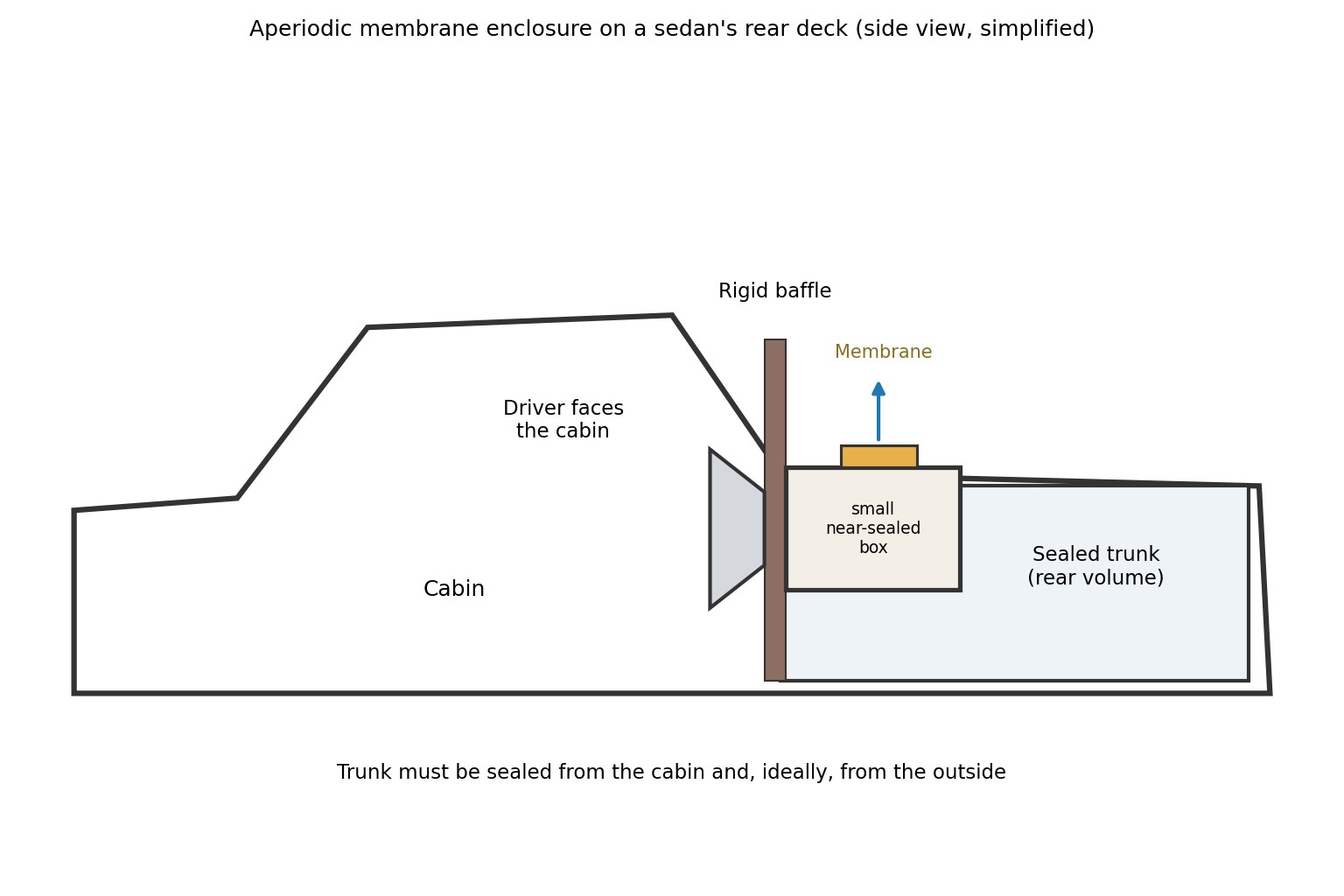
The car-audio version borrows the infinite baffle layout. The driver sits in a rigid baffle between the cabin and the trunk, facing the cabin, and a small, almost sealed box sits around the back of the driver. The membrane in that box vents into the trunk. For it to work as intended, the trunk has to be sealed from the cabin as carefully as in an infinite baffle install, and ideally sealed from the outside as well. Installers who have built these describe them as hard to tune and easy to get wrong, so expect more than one attempt.
Door and kick-panel midbass
Aperiodic pods are also used for midbass drivers in doors and kick panels, where there is not room for a conventional sealed box. A small pod with a vent can flatten the impedance peak and make the bass more predictable than an unenclosed driver, although nobody should expect it to match a large sealed box.
- Keep the vent away from water. Door cavities collect moisture. Do not place the membrane in the path of drain holes, and keep damping material from getting wet, because that harms both the material and the metal around it.
- Brace the baffle and the door skin. A flexing panel wastes energy and adds rattles. Treat the door metal as part of the enclosure.
- Remember the cabin. A car cabin reinforces low frequencies, so a box that rolls off earlier than a sealed box may still sound fine inside the car. Judge it by measuring at the listening position.
Tuning and measuring
You cannot predict a resistive vent's behaviour well from a calculation alone, because the material, its thickness, the grille pattern and the area all change it. The reliable method is to measure the impedance curve before and after. A free program such as Room EQ Wizard (REW) with a suitable measurement interface can do it.
- Measure the box sealed. Block the vent completely and take an impedance sweep. Note the height and frequency of the single peak.
- Open the vent a little. Remove the block and sweep again. The peak should come down and the curve should get flatter.
- Adjust in small steps. Add holes, thin the layer or enlarge the area, and sweep again each time. Stop when the peak is tamed but the bass has not thinned out.
- Watch for a second hump. If a second peak appears in the impedance curve, the vent is leaking too freely and behaving like a port. Add resistance.
- Check the response, then listen. Measure at the listening position and play music with real low-frequency content. If the bass sounds thin or the cone moves a lot below the box's -3 dB point, the vent is probably too open.
Aperiodic compared with sealed and ported
| Feature | Aperiodic | Sealed box | Ported box |
|---|---|---|---|
| Box size for a given driver | Can be smaller than a sealed box that gives the same Q | Sized to the driver and target Qtc | Usually the largest |
| Final roll-off | About 18 dB per octave | 12 dB per octave | 24 dB per octave |
| Impedance peak | Low and flat | Single, taller peak | Two peaks around the tuning |
| Port noise or tuning | None, no tuned port | None | Port tuning and port noise to manage |
| Cone control at very low frequencies | Reduced, high-pass filter advised | Air spring helps | Poor below tuning |
| Main difficulty | Tuning the vent by measurement | Easy | Port design |
| Best suited to | Small boxes, midbass pods, drivers with fairly low Qts | Most drivers and tight spaces | Output, drivers with low Qts |
Strengths and limits
- Strengths: a small box can sound cleaner and less boomy. The impedance peak is tamed, which many builders find gives tighter bass. There is no port to tune and no port noise. The gentle third-order roll-off avoids the sharp drop of a ported box.
- Limits: the -3 dB point is higher than a larger sealed box. Cone control at very low frequencies is reduced. The vent has to be built and tuned by measurement. Results depend on the driver, and it is a niche approach with few published design tools.
Common mistakes
- Expecting more bass. The vent flattens a peak. It does not add output or extend the -3 dB point.
- Using a high-Qts driver in a tiny box. No amount of leaking turns it into a good match.
- Making the vent too open. A second impedance hump or thin bass means it is acting like a port or leaking too much.
- Leaving other leaks. If the rest of the box is not airtight, you lose control of the amount of leakage you designed.
- Forgetting the high-pass filter. The cone gets less help from the air spring, so protect it below Fs.
- A flexing vent frame. A membrane that moves or rattles adds distortion. Keep the grilles rigid.
- Skipping the measurement. The vent's resistance depends on the material, so tuning by calculation alone is guesswork.
Sources and further reading
The explanations, worked example, and figures above were written and calculated for this guide using a simplified model. These references are listed for readers who want the underlying theory or manufacturer information.
- R. H. Small, "Closed-Box Loudspeaker Systems" (Journal of the Audio Engineering Society, 1972), for the sealed-box relationships and the loss terms.
- Vance Dickason, Loudspeaker Design Cookbook, which includes a section on aperiodic closed-box loudspeakers.
- E. J. Jordan, articles on loudspeaker enclosures in Wireless World, 1956, where the aperiodic approach was first described.
- diyAudioProjects, Aperiodic Loudspeaker Enclosure Design, for builder guidance on vent count and damping fill.
- What Hi-Fi? / Australian Hi-Fi, Sonus Faber Olympica Nova II review, for a plain-language account of the history and roll-off of aperiodic enclosures.
- Willy's Hi-Fi, Scan-Speak Variovent 290001, for an example of a commercial resistive vent and its dimensions.
Last reviewed: October 2026.
Aperiodic speaker enclosures FAQ
What is an aperiodic enclosure?
It is a small, nearly sealed box with a vent filled with damping material. The vent lets air leak slowly in and out but has no resonance of its own, so it adds damping instead of a port note. The result is a lower system Q and a flatter impedance peak than the same box would have if fully sealed.
What is an aperiodic membrane in car audio?
It is the car-audio name for the resistive vent: an air-permeable layer, usually fibreglass, open-cell foam or wadding, held between rigid perforated panels. It vents a small, nearly sealed box into a larger space such as a sealed trunk or the outside, and the amount of leakage is set by its area, thickness and material.
Is an aperiodic enclosure the same as a ported one?
No. A ported box has a tuned port that resonates and adds output near its tuning frequency, with a final roll-off of 24 dB per octave. An aperiodic vent is deliberately resistive and does not resonate, so it only damps the driver. The final roll-off is about 18 dB per octave, between sealed (12) and ported (24).
Does an aperiodic enclosure give more bass than a sealed box?
Not by itself. It flattens the peak a too-small sealed box would have, which can make the bass cleaner, but it does not add output. Compared with a larger sealed box, the -3 dB point is usually higher, so the benefit is a better-behaved small box rather than deeper bass.
What kind of driver works best in an aperiodic enclosure?
A driver with a low to moderate Qts, a stiff and well-controlled cone, a suspension that suits the box and enough Xmax. The vent can only lower Q, so a high-Qts driver in a very small box needs a very leaky vent and loses output. Some installers use a Qts of about 0.45 or below for trunk subwoofers, but that is a rule of thumb, not a standard.
How do I tune an aperiodic vent?
Measure the impedance curve of the box sealed, then open the vent in small steps and sweep again each time. The impedance peak should come down and flatten. If a second peak appears, the vent is leaking too freely and acting like a port, so add resistance. If the bass thins out, it is too open.
Do I need a high-pass filter with an aperiodic enclosure?
It is a sensible precaution. The leak reduces how much the air spring controls the cone, so deep or infrasonic content can drive it further than in a sealed box. A high-pass filter set near the driver's Fs or the box's -3 dB point helps protect the driver. Confirm the setting for your driver and amplifier power.