Car Speakers
Crystal SSX 615 Review: Bridge-Tweeter Component Speaker System
Published October 8, 2026
A research-based review of the Crystal SSX 615 component speakers: what is verified, what is not, how the bridge tweeter works and how to set them up safely.
The Crystal SSX 615 is a two-way car speaker system from Crystal Mobilesound that places the tweeter on a bridge above the woofer and uses a separate outboard crossover. This review is a specification-and-research review. It is based on a product listing, a dealer catalog for related Crystal models and owner comments in forums. It is not based on hands-on testing, and it says nothing about how the speaker sounds. The published information is thin, so this page also states plainly what could not be confirmed.
Short version: The only manufacturer-style details I could verify are a two-way component design, an "NRT Neo-Radial" motor, a butyl rubber surround, a bridge-mounted tweeter, a 12 dB outboard crossover and a 150 W peak power rating. I could not find woofer size, impedance, sensitivity, frequency response, RMS power, crossover frequency or mounting dimensions. That makes it hard to recommend blind. It is a reasonable candidate if you can inspect the set and read its label, and a poor choice if you need confirmed numbers before buying.
Key specifications (verified only)
The table lists what a source actually states. Anything else is marked "not confirmed" rather than guessed, including the woofer diameter, because the model number alone does not prove it.
| Item | What the source states | Source |
|---|---|---|
| System type | 2-way component speaker system | carreview.com listing |
| Motor | "NRT Neo-Radial" motor | carreview.com listing |
| Surround | Butyl rubber | carreview.com listing |
| Tweeter mounting | Bridge mounted | carreview.com listing |
| Crossover | 12 dB, outboard | carreview.com listing |
| Power handling | 150 W peak | carreview.com listing |
| Woofer diameter | Not confirmed | - |
| Nominal impedance | Not confirmed | - |
| Sensitivity | Not confirmed | - |
| Frequency response | Not confirmed | - |
| RMS (continuous) power | Not confirmed | - |
| Crossover frequency and type | Not confirmed | - |
| Cutout and mounting depth | Not confirmed | - |
| Current availability and price | Not confirmed | - |
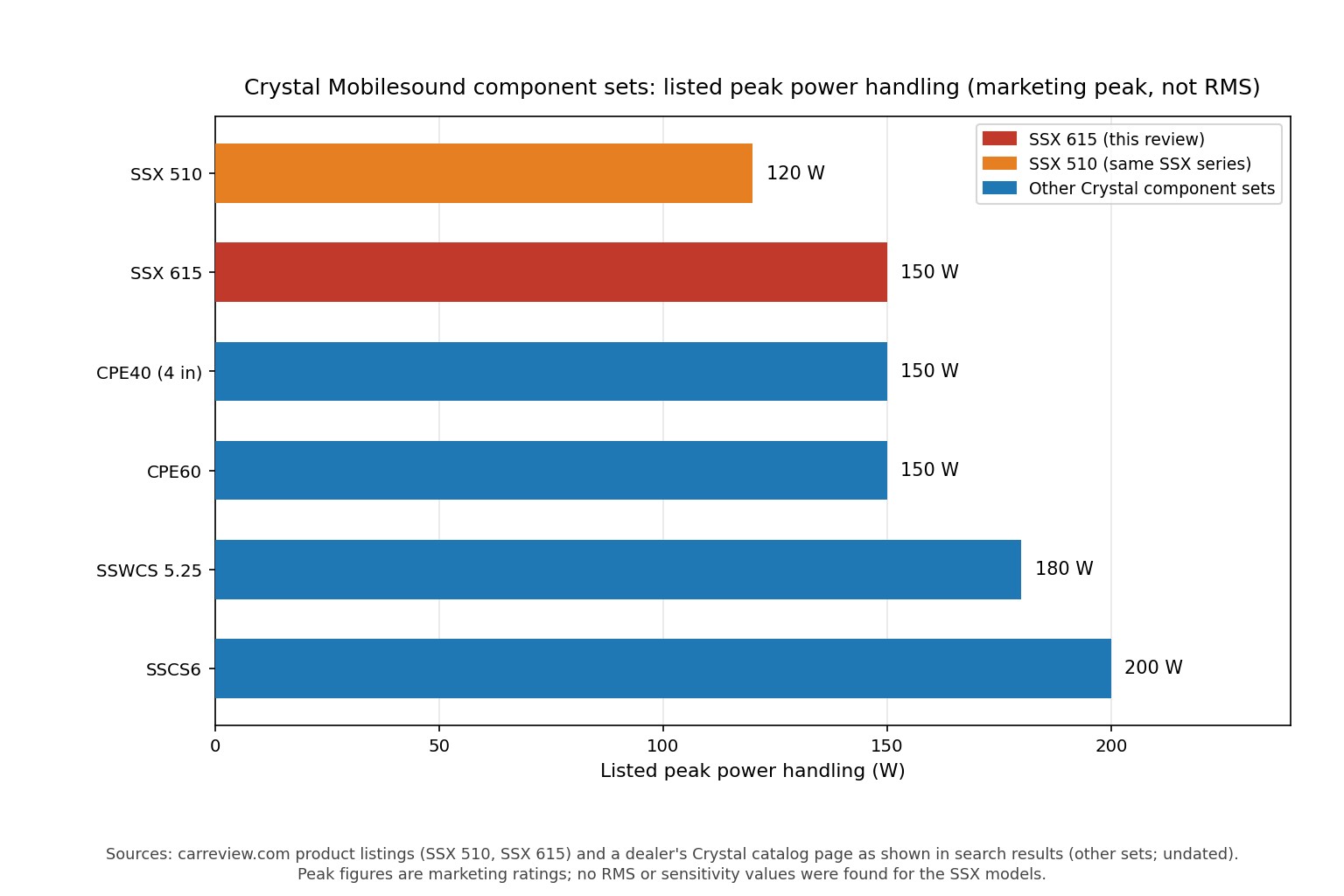
The same listing site shows the SSX 510 with an identical feature list and a 120 W peak rating. A dealer catalog page for Crystal's other component sets, which I could only read through a search-result excerpt, lists peak ratings of 150 to 200 W. It is undated, so treat it as historical context rather than current data.
Design and features
Bridge-mounted tweeter
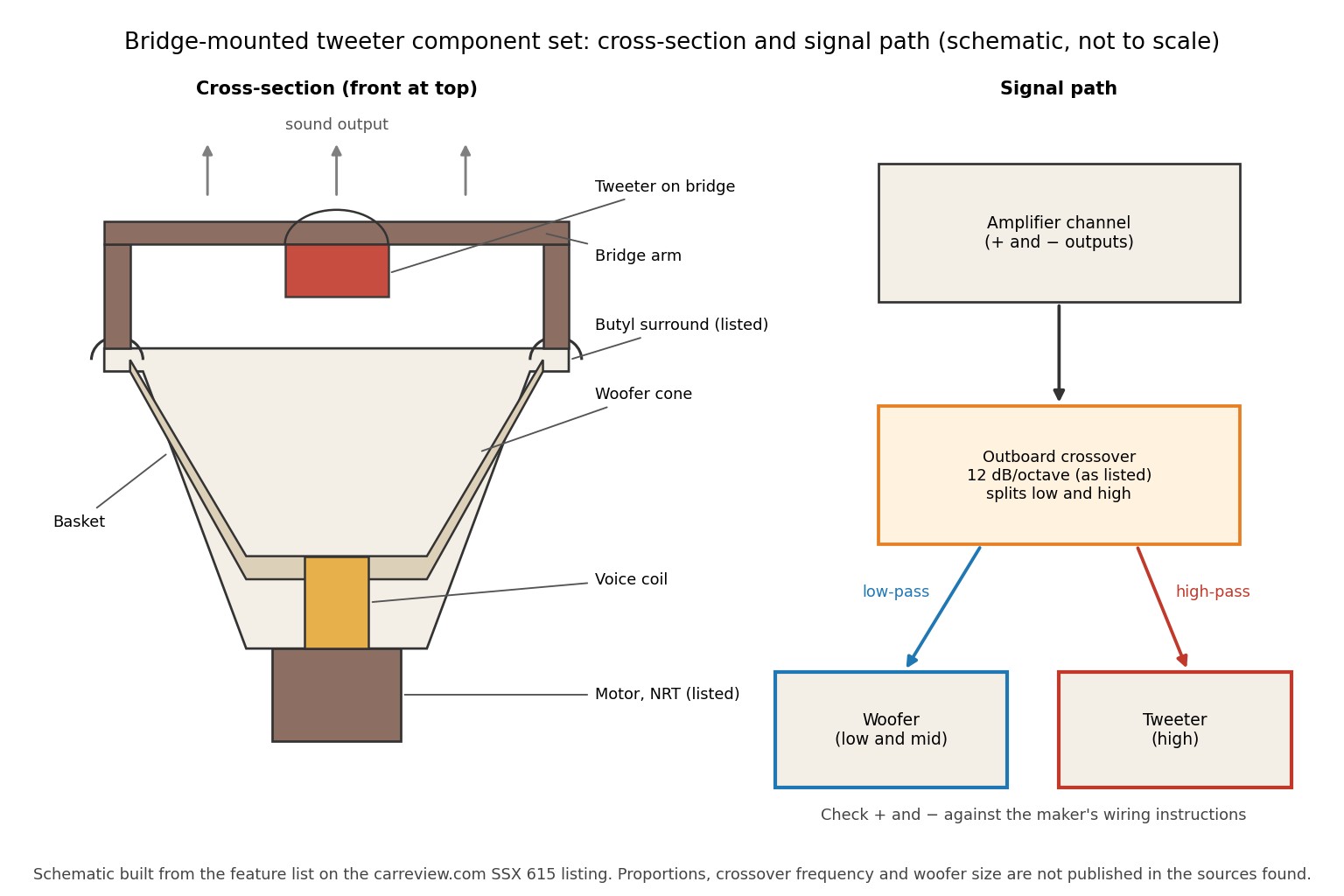
In a 2006 forum thread, a participant described the SSX series as not a true coaxial, because the tweeter sits on a separate bridge above the woofer, and noted that another brand calls this layout "braxial". That matches the listing's wording. The practical consequence is that the tweeter's position relative to the woofer is fixed by the bridge. You cannot aim it separately or move it to a pillar, as you can with many component sets. I could not verify the bridge's dimensions or how much depth it adds above the woofer frame.
NRT neo-radial motor
"NRT" is a trademarked name for Neo-Radial Technology, a magnet arrangement described in a technical paper from AuraSound. That paper claims smaller, lighter magnet structures, higher sensitivity, lower stray magnetic field and good thermal capacity compared with conventional ferrite designs. Those are the technology vendor's claims. I could not confirm that the SSX uses AuraSound's exact design or what its measured sensitivity is, so treat this section as an explanation of the technology, not a performance statement about the SSX 615.
Butyl rubber surround
Rubber surrounds such as butyl are generally chosen for durability, because foam surrounds can deteriorate with age. That is a general point about surround materials and is not a measured claim for this speaker.
Outboard 12 dB crossover
A 12 dB-per-octave crossover is a second-order filter. The SSX listing gives no crossover frequency or alignment. A dealer entry for the related SSCS6 set says "2nd Order Linkwitz", but I cannot assume the SSX uses the same design, so its polarity and summing behaviour are not confirmed.
Installation and setup notes
Safety: Disconnect the battery's negative terminal before changing speaker or power wiring. Check behind door panels for wiring, side airbags and window mechanisms before drilling or cutting. Fuse the amplifier's main power wire near the battery, and keep the volume low during setup to protect your hearing and the speakers.
Before you mount anything
Because the bridge raises the tweeter above the woofer, measure the free space behind the panel and in front of the opening, including any grille. Cutout and depth are not published in the sources I found. Read the woofer and crossover labels for the nominal impedance, and check the manufacturer's wiring instructions if you have them.
Check impedance with a multimeter
If the label is missing, disconnect the woofer from the crossover and measure the voice coil's DC resistance. A commonly cited installer rule of thumb is that this reads roughly 70 to 90% of the nominal impedance. By that rule, a 4 Ω woofer reads about 2.8 to 3.6 Ω and an 8 Ω woofer about 5.6 to 7.2 Ω. This is a field estimate, not a standard.
Crossover polarity
Polarity matters with any two-way crossover because the woofer and tweeter signals overlap near the crossover frequency. The model below uses a hypothetical 3 kHz Linkwitz-Riley second-order crossover and perfect drivers, since the SSX frequency is not published. In that ideal case each path is 6.0 dB down at crossover, at one octave away (1.5 kHz) the woofer is 1.9 dB down and the tweeter 14.0 dB down, and the combined response is flat with the tweeter inverted. With the same polarity, the two signals cancel at the crossover frequency. A second-order Butterworth filter behaves differently: with an inverted tweeter its sum rises by 3.0 dB at crossover.
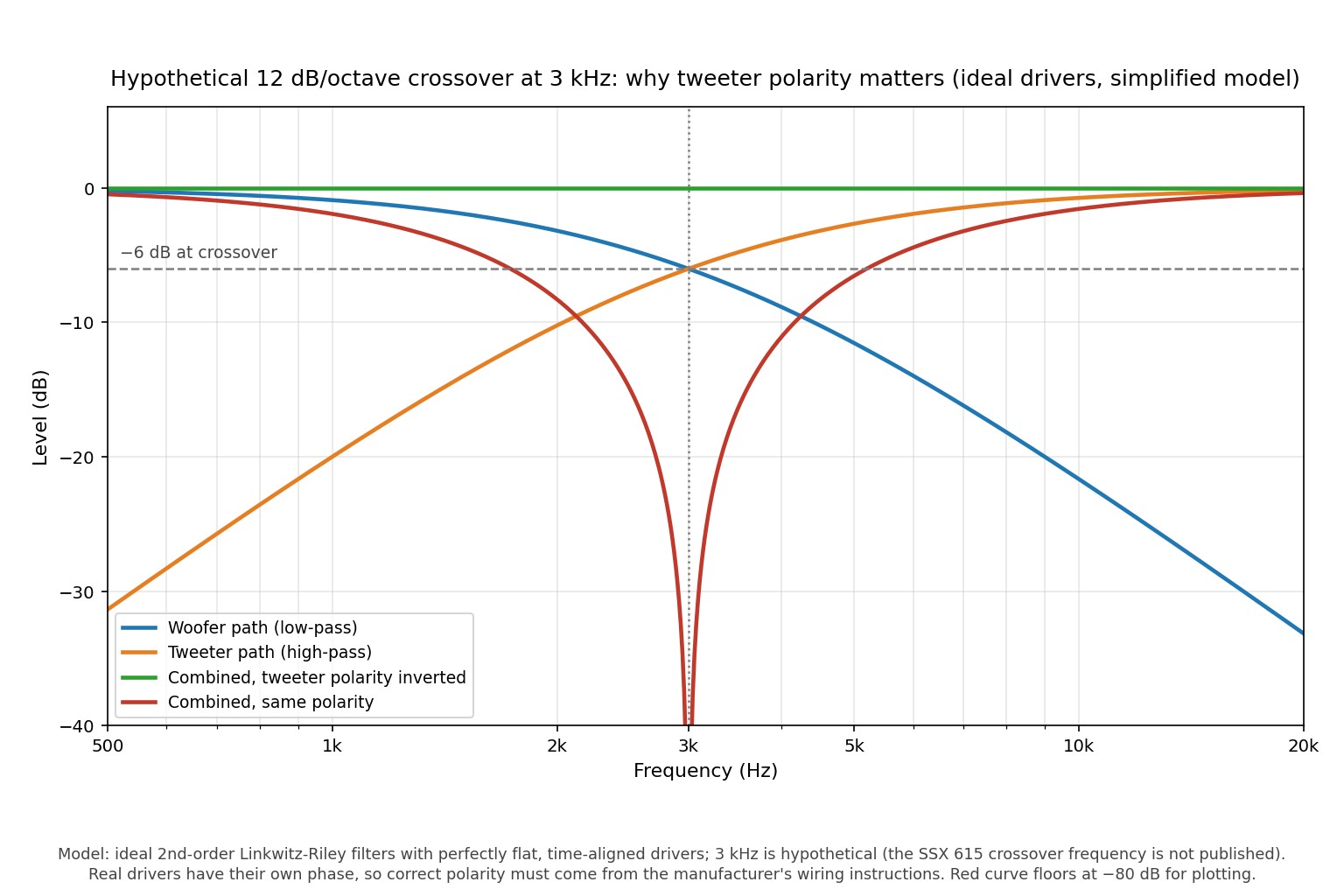
Real drivers add their own phase shifts, so the right polarity for a given set is whatever the manufacturer's wiring instructions say. Do not assume it from this model. If the instructions are missing, a dip in the upper midrange after installation is the symptom to listen for, and swapping the tweeter leads is the usual test.
Amplifier and filters
With the RMS rating unknown, pick a modest amplifier, set its gain with a measured method such as a test tone and meter rather than by ear, and use a high-pass filter to keep deep bass away from the woofer. The right high-pass frequency depends on the woofer, and none is published here. Do not run the speakers with the amplifier clipping, because clipped signals are a common cause of tweeter damage.
What to check and how it should perform
Power handling: peak is not continuous power
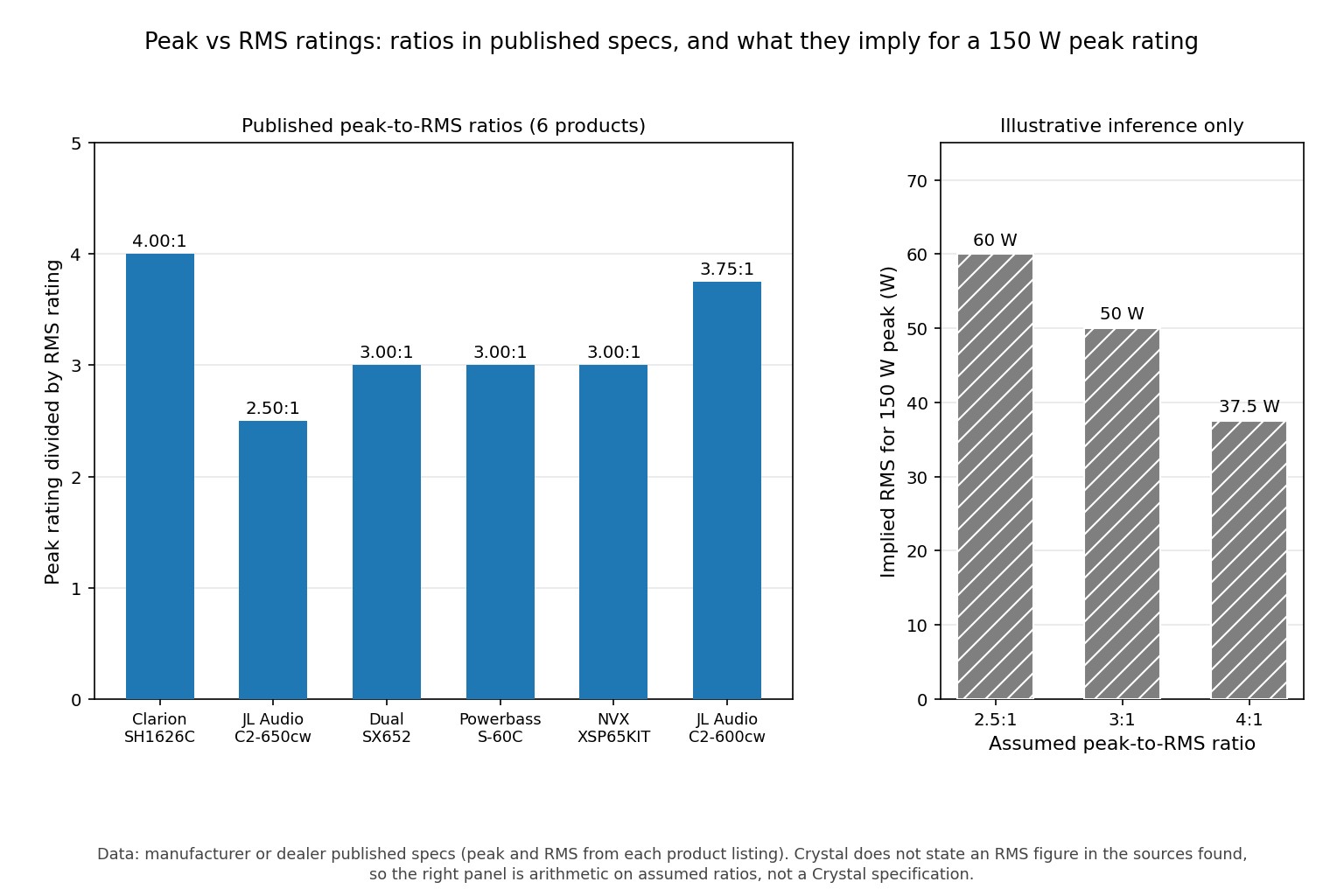
The only power figure is 150 W peak. Peak ratings are marketing numbers, and makers define them differently. I compared six published products whose listings give both values. Their peak ratings run from 2.5 to 4 times the RMS rating, with a median of 3 times. Applied to 150 W peak, that would imply roughly 37.5 to 60 W RMS, but this is arithmetic on other brands' ratios, not a Crystal specification.
Forum owners of the related SSCS6 set have claimed it can take 150 to 200 W per side. Those are anecdotes about a different model and are not a safe basis for sizing an amplifier for the SSX 615.
Sensitivity: a worked example
Sensitivity is not published for the SSX 615, so the table uses hypothetical values. SPL at 1 m (free field) is sensitivity plus 10 times the base-10 logarithm of power in watts. In a car the real figure differs, but the relative steps hold.
| Hypothetical sensitivity (dB at 1 W, 1 m) | 1 W | 10 W | 25 W | 50 W |
|---|---|---|---|---|
| 87 dB | 87.0 dB | 97.0 dB | 101.0 dB | 104.0 dB |
| 90 dB | 90.0 dB | 100.0 dB | 104.0 dB | 107.0 dB |
| 93 dB | 93.0 dB | 103.0 dB | 107.0 dB | 110.0 dB |
Doubling power adds only 3.0 dB, and going from 1 W to 150 W adds 21.8 dB. A speaker with higher sensitivity needs far less amplifier power for the same level, so confirm that figure before choosing an amplifier.
What I could not verify
I did not verify tonal balance, imaging, the effect of the bridge on tweeter dispersion, long-term durability or how the crossover performs. One owner of the related SSCS6 set described its tweeters as not silk but less harsh at high volume than two other brands. That is a single subjective comment about a different model.
Common mistakes to avoid
- Treating 150 W peak as 150 W continuous. Size the amplifier from a confirmed RMS rating, not the peak figure.
- Assuming the woofer size from the model number. Check the physical driver and the cutout before ordering a baffle or adapter.
- Ignoring tweeter polarity. Follow the maker's wiring instructions, and listen for a dip in the upper midrange if no instructions are available.
- Running the amplifier into clipping. Clipped signals are a common way to damage tweeters.
- Skipping the high-pass filter. Without a subwoofer or filter, deep bass can drive a small woofer past its limits.
- Mounting before checking clearance. The bridge adds height above the woofer frame, and the sources give no dimensions.
Pros
- Component-style design with a separate outboard crossover.
- Tweeter mounting is built in, so there is no separate tweeter location to plan.
- Rubber surround and a neo-radial motor are listed features.
- Part of a family with documented siblings, so related listings give some context.
Cons
- Core specifications are unpublished in the sources I found: impedance, sensitivity, response, RMS and dimensions.
- Only a peak power rating is given.
- The tweeter position is fixed by the bridge, and its fit in a given door is unknown.
- Availability and support are not confirmed, and the listing page I found has no user reviews.
- No independent measurements were found.
Who it is for and not for
A reasonable fit
The SSX 615 may suit someone who already owns a set, finds one in good condition and can read its labels and measure its impedance. It also suits a builder who likes the bridge-tweeter layout and has space to check fitment before buying.
Not a good fit
It is a poor choice for buyers who want guaranteed specifications, a current warranty or measured data. It is also unsuitable if you want to place the tweeter on a pillar or dash, or if you plan a high-power system without a confirmed continuous rating.
Alternatives
The Crystal rows below come from a dealer catalog excerpt that I could not open in full; the page is undated, so prices are omitted. I did not verify other brands' models.
| Option | Listed details | Trade-offs |
|---|---|---|
| Crystal SSX 615 (this set) | Bridge-mounted tweeter, 12 dB outboard crossover, butyl surround, 150 W peak | Core specifications not confirmed |
| Crystal SSCS6 | 6.5 in two-way, Kevlar woofer, 1 in titanium tweeter, 2nd-order Linkwitz 12 dB outboard crossover, 200 W peak | More fully described in the catalog; tweeter mounting not confirmed |
| Crystal CPE60 | 6.5 in two-way, PVC woofer, 0.5 in silk dome tweeter, 12 dB outboard crossover, 150 W peak | Different cone and tweeter materials |
| A current component set with published RMS and sensitivity | Confirmed continuous power, impedance and dimensions | Needs a separate check of fit and tonal match |
| A coaxial replacement | Single-unit mounting | Less freedom over tweeter position and crossover tuning |
Buying advice
I found no current price or confirmed stock. The listing page I used carries a 2018 copyright line and no user reviews, and the forum posts I found about Crystal date from the mid-2000s to the 2010s, so any set you find is likely to be old. Ask the seller for photos of the woofer label, the crossover and the tweeter bridge.
- Ask for the woofer diameter and the nominal impedance printed on the label, and measure DC resistance on arrival.
- Check the rubber surround for cracks, stiffness or tears, and look at the cone for dents.
- Confirm that both tweeters, both woofers and both crossovers are included, along with the wiring.
- Check that the bridge is not bent and that the tweeter is firmly attached and not distorted.
- Measure your door's mounting depth and clearance before you pay, and confirm the return policy.
Final verdict
On paper, the Crystal SSX 615 is an interesting hybrid: a component-style speaker with its tweeter built into a bridge over the woofer. Its listed features, a neo-radial motor, a butyl surround and an outboard 12 dB crossover, are sensible. But the information needed to buy it with confidence, especially impedance, sensitivity, RMS power and size, is missing from the sources I found, and I did no listening or bench testing. If you can inspect a set and confirm its numbers, it may be worth trying. If you need data first, a speaker with published specifications is the safer choice.
Sources and further reading
- Product listing for the Crystal SSX 615 (features and 150 W peak rating): carreview.com. The same site lists the SSX 510 at 120 W peak.
- Technical paper on Neo-Radial Technology from AuraSound, used only for the general description of NRT: AuraSound NRT whitepaper.
- Crystal Mobilesound dealer catalog and forum discussions of the SSCS6 and SSX lines, read through search-result excerpts and used only for context and anecdotes.
- Manufacturer and dealer listings for six other 6.5 in speaker products, used only for the peak-to-RMS comparison.
Last reviewed: October 2026
Crystal SSX 615 questions answered
What is the Crystal SSX 615?
It is a two-way component speaker system from Crystal Mobilesound with a bridge-mounted tweeter, an outboard 12 dB crossover, a butyl rubber surround and an NRT neo-radial motor, according to a product listing. The same listing gives a 150 W peak power rating. Other details such as size and impedance were not found.
How much power does the SSX 615 need?
Only a 150 W peak rating is published in the sources I found, and the continuous (RMS) rating is not confirmed. Other brands' peak ratings run about 2.5 to 4 times their RMS ratings, which would suggest roughly 37.5 to 60 W, but that is arithmetic, not a Crystal specification. Use a conservative amplifier setting until the real rating is confirmed.
Is the tweeter separate from the woofer?
The tweeter is mounted on a bridge above the woofer, so it is part of the same assembly rather than a pod you place elsewhere. The speakers still use an outboard crossover. Check the bridge height against your panel before mounting.
What does NRT neo-radial mean?
NRT stands for Neo-Radial Technology, a magnet arrangement that AuraSound describes in its technical paper. The paper claims benefits such as higher sensitivity and low stray magnetic field. I could not confirm that the SSX uses that exact design or what its measured performance is.
Do I need to reverse the tweeter polarity?
It depends on the crossover design. In an ideal second-order Linkwitz-Riley model the tweeter is inverted to get a flat sum, but real drivers add their own phase. Follow the manufacturer's wiring instructions rather than assuming.
What size and impedance is the SSX 615?
Neither is confirmed in the sources I found, and I did not assume them from the model number. Read the label on the woofer and crossover. You can also measure the voice coil's DC resistance, which is commonly about 70 to 90% of the nominal impedance.
How do I check the impedance before installing?
Disconnect the woofer from the crossover and measure the voice coil's resistance with a multimeter. A 4 ohm woofer typically reads roughly 2.8 to 3.6 ohms by the usual rule of thumb. It is an estimate, so confirm against the label if you can.
Is the SSX 615 still sold?
I could not confirm current availability, price or warranty. The listing page I used shows a 2018 copyright line and no user reviews, and most Crystal discussion I found is older. Ask a dealer or seller before relying on new stock or support.