Car Head Units
Kenwood EZ700SR Review: Specs, Features and Buying Notes
Published October 8, 2026
A specification-based look at the Kenwood EZ700SR CD receiver: 22 W RMS amp, 2 V preouts, Sirius tuner, MP3/WMA playback, and what to check before buying one used.
The Kenwood EZ700SR is a single DIN CD receiver with a flip-down detachable face, a built-in satellite radio tuner, MP3 and WMA disc playback, and three pairs of preamp outputs. It still turns up on used markets because it looks clean in a dash and is easy to expand with an external amplifier. This review is based on the instruction manual and retailer specification listings, not on bench testing or installation, so treat it as a research summary rather than a hands-on report.
Short version: The EZ700SR is a capable mid-2000s CD receiver with a 22 watt RMS built-in amplifier, 2 volt preamp outputs, crossovers and a good set of tone controls. It has no USB port and no Bluetooth. Its built-in satellite tuner is a Sirius-era part, and whether it works with today's SiriusXM service is not confirmed. Buy it for a period-correct or disc-based setup, and only if the detachable face is included.
Key specifications
These figures come from the Kenwood instruction manual and from retailer listings that copy the manufacturer's data. Items I could not verify, such as exact dimensions, CD signal-to-noise ratio and the original release year, are left out on purpose.
| Feature | Kenwood EZ700SR (listed specification) |
|---|---|
| Chassis | 1 DIN, flip-down detachable faceplate |
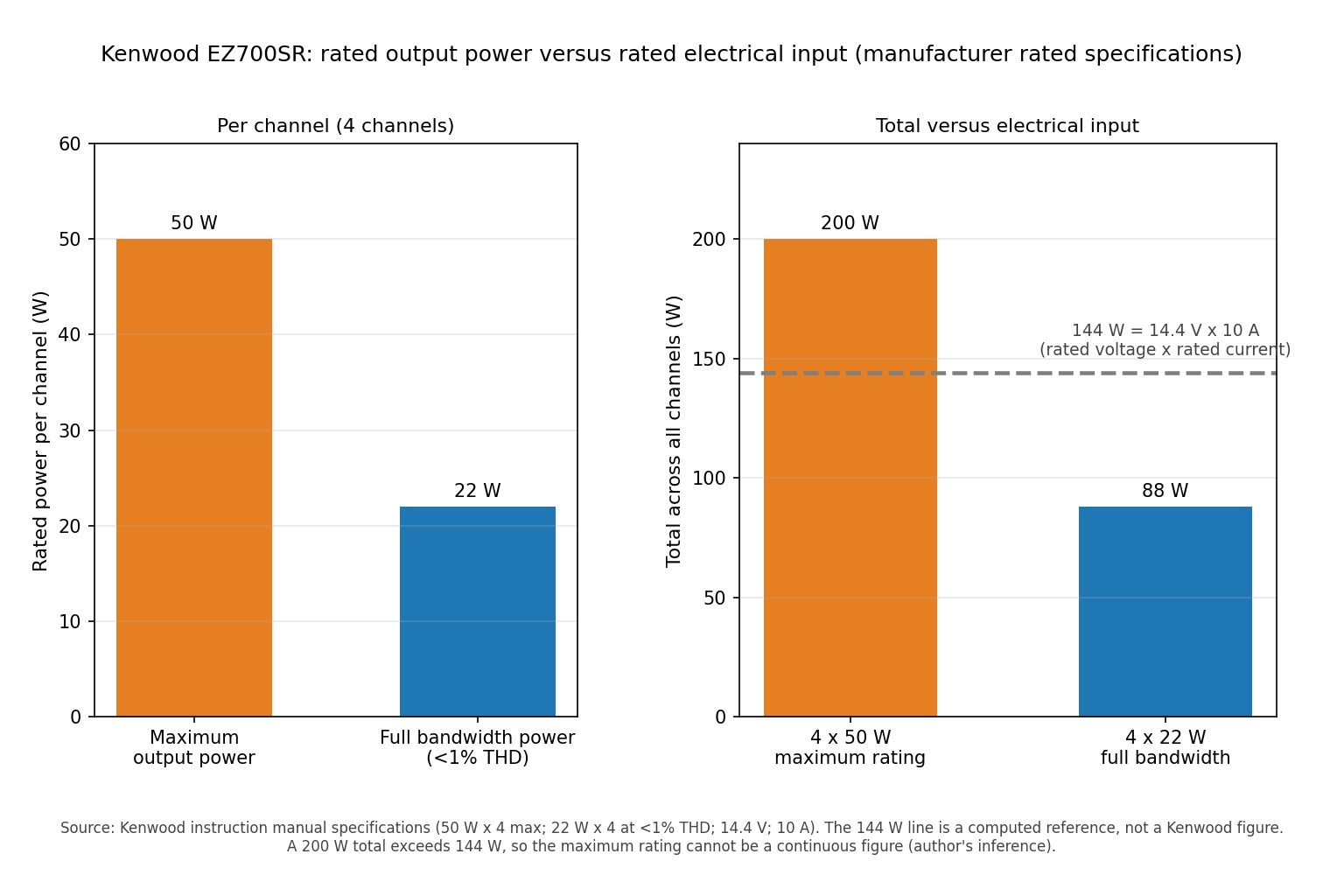
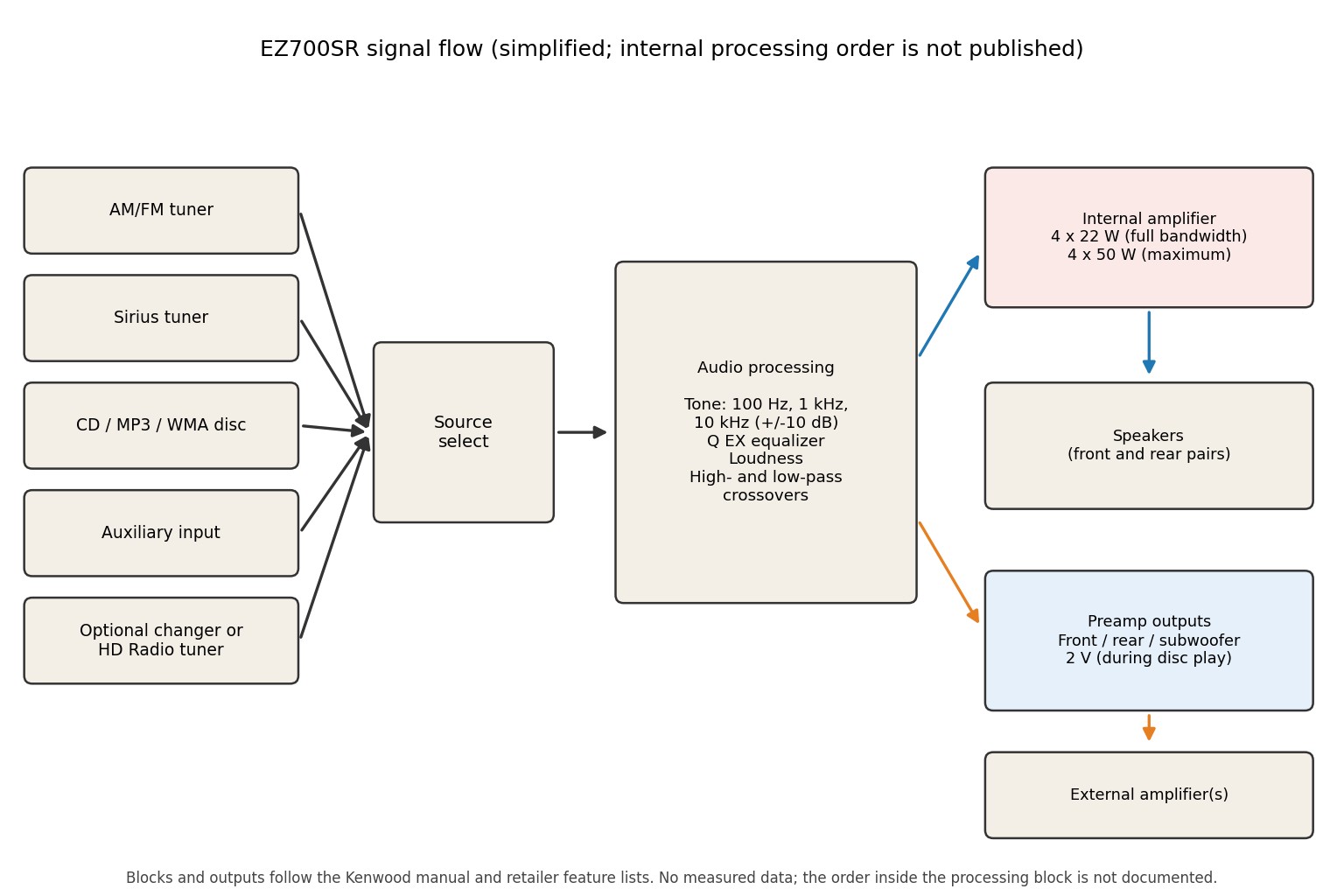
| Built-in amplifier | MOSFET, 22 watts RMS and 50 watts maximum per channel, 4 channels |
| Preamp outputs | 3 sets (front, rear, non-fading), listed at 2 volts |
| Crossovers | High-pass and low-pass electronic crossovers |
| Output modes | Dual zone and dual source output |
| Discs | CD, CD-R, CD-RW, with MP3 and WMA files; CD Text with disc naming |
| Radio | AM/FM with 24 presets and station naming; built-in Sirius satellite tuner (subscription required) |
| Sound control | System Q EX equalizer with user memory, source tone memory, loudness |
| Inputs | Rear auxiliary input; CD changer and external disc control |
| Expansion | HD Radio tuner control (optional accessory) |
| Display and illumination | Dot matrix display with white LED backlight; red or green key illumination |
| Other | Remote control, programmable security code, faceplate carrying case |
| USB, Bluetooth | Not present |
One caution on the power numbers. The listing gives 22 watts RMS and 50 watts maximum, but the retailer pages I found do not state the test conditions (load impedance, distortion level or bandwidth) behind either figure. Read the two numbers as a rating pair, not as a guarantee of what the unit delivers in your car.
Design and features
Face, controls and display
The face drops open for disc loading and detaches for theft protection. The manual refers to dropping the faceplate open, and retailers describe it as flip-down, so do not expect a motor. The controls are built around a large rubber-grip volume knob and a matching multi-function dial, which suits drivers who want to adjust things without hunting for small buttons. A retailer-hosted comment from 2006 praises exactly this, though that retailer states it moderates out negative comments, so I give it limited weight.
The display is a dot matrix panel with a white LED backlight, and the keys light in red or green. The unit also stores a programmable security code, which matters when you disconnect the battery (see the installation section).
Discs, MP3 and WMA
The player handles CD, CD-R and CD-RW, and it plays MP3 and WMA files burned to disc. The manual notes that 3 inch (8 cm) discs cannot be played, even with an adapter, and warns that forcing one in can cause damage. There is no USB input, so every file has to be burned to a disc. For anything else, the rear auxiliary input takes a standard line-level source.
Radio and Sirius
The tuner offers 24 AM and FM presets with station naming. The satellite tuner is built in and needs a subscription, an antenna and activation through the radio's ID, which the manual says can be shown in the menu. The antenna is a magnetic mount, and the manual cautions against nicking the cable insulation during installation. Whether a unit of this age still activates on SiriusXM today is not something I could confirm from the sources I found, so ask SiriusXM with the radio ID before you count on it. Treat satellite radio as a possible bonus, not a reason to buy.
Sound controls and outputs
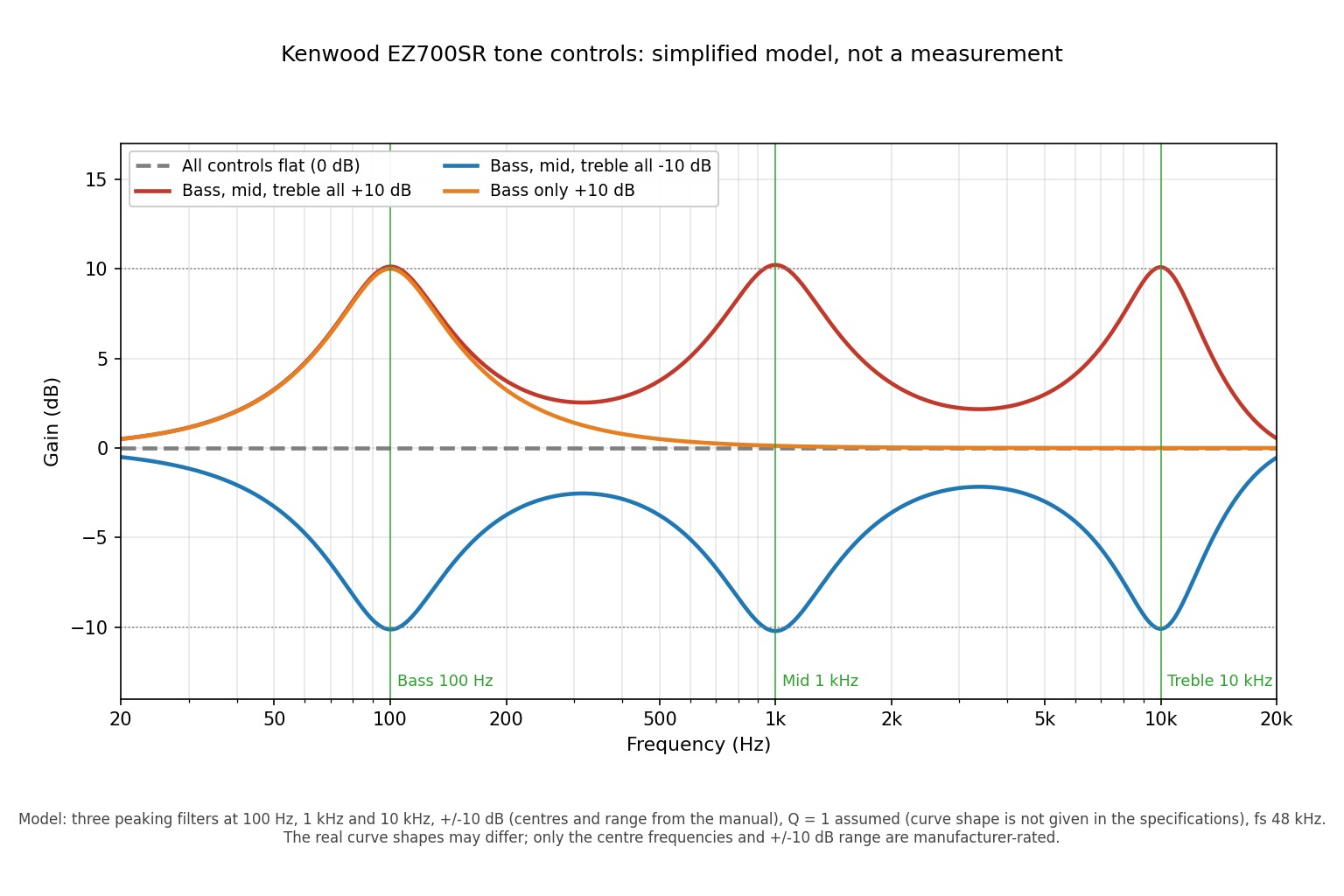
The System Q EX equalizer has user memory, and source tone memory stores separate settings per source. The unit also has loudness, high-pass and low-pass crossovers, and dual zone output. Those crossovers are the more useful feature for a car with a separate subwoofer amplifier, because you can send a low-passed signal to the sub and a high-passed signal to small front speakers without extra hardware.
The amplifier and preamp outputs in numbers
Power ratings are easier to judge once you convert them to decibels. Sound level changes with the logarithm of power: the change in dB is 10 times the base-10 logarithm of the power ratio. All figures below were computed with a short script.
Worked example (hypothetical): take a speaker rated 88 dB at 1 watt and 1 meter. At 22 watts the simple model gives 88 + 10 log10(22) = 101.4 dB at 1 meter. At 50 watts it gives 105.0 dB. The gap between the RMS rating and the maximum rating is only 3.6 dB, which most listeners would call a small difference. Limits of this model: it assumes one speaker in free field, no cabin gain, no amplifier clipping and no speaker power compression, so it shows scale, not what you will hear.
| Amplifier power | Change vs 22 W (dB) |
|---|---|
| 22 W (EZ700SR RMS rating) | 0.0 |
| 50 W (EZ700SR maximum rating) | +3.6 |
| 100 W (hypothetical external amplifier) | +6.6 |
| 200 W (hypothetical external amplifier) | +9.6 |
The takeaway: moving from the built-in amplifier to a hypothetical 100 watt amplifier adds about 6.6 dB of headroom. That is useful, but the larger gain from an external amplifier is often cleaner output at high volume rather than raw loudness.
What 2 volt preouts mean
The listing gives 2 volts for the preamp outputs. Later Kenwood models in the same family are listed at 4 or 5 volts, and the current Kenwood KDC-X705 is specified at 5,000 millivolts. A 4 volt output is 6.0 dB higher than 2 volts, and 5 volts is 8.0 dB higher. In practice a lower preout voltage means the external amplifier's gain control must be set higher to reach full output, which can raise hiss. Installers commonly report that 2 volts is workable with decent RCA cables and a carefully set gain, but that is a field rule of thumb, not a standard. Keep RCA cables away from power wiring.
Installation and setup notes
Safety: disconnect the vehicle battery before you work on dash wiring, use the fuse rating printed on the unit, and never cut into airbag or steering column wiring. If you add an external amplifier, fuse its power cable close to the battery and keep it away from signal cables. Ear damage is a real risk at high volume, so set levels with the car stationary and the amplifier gain at minimum.
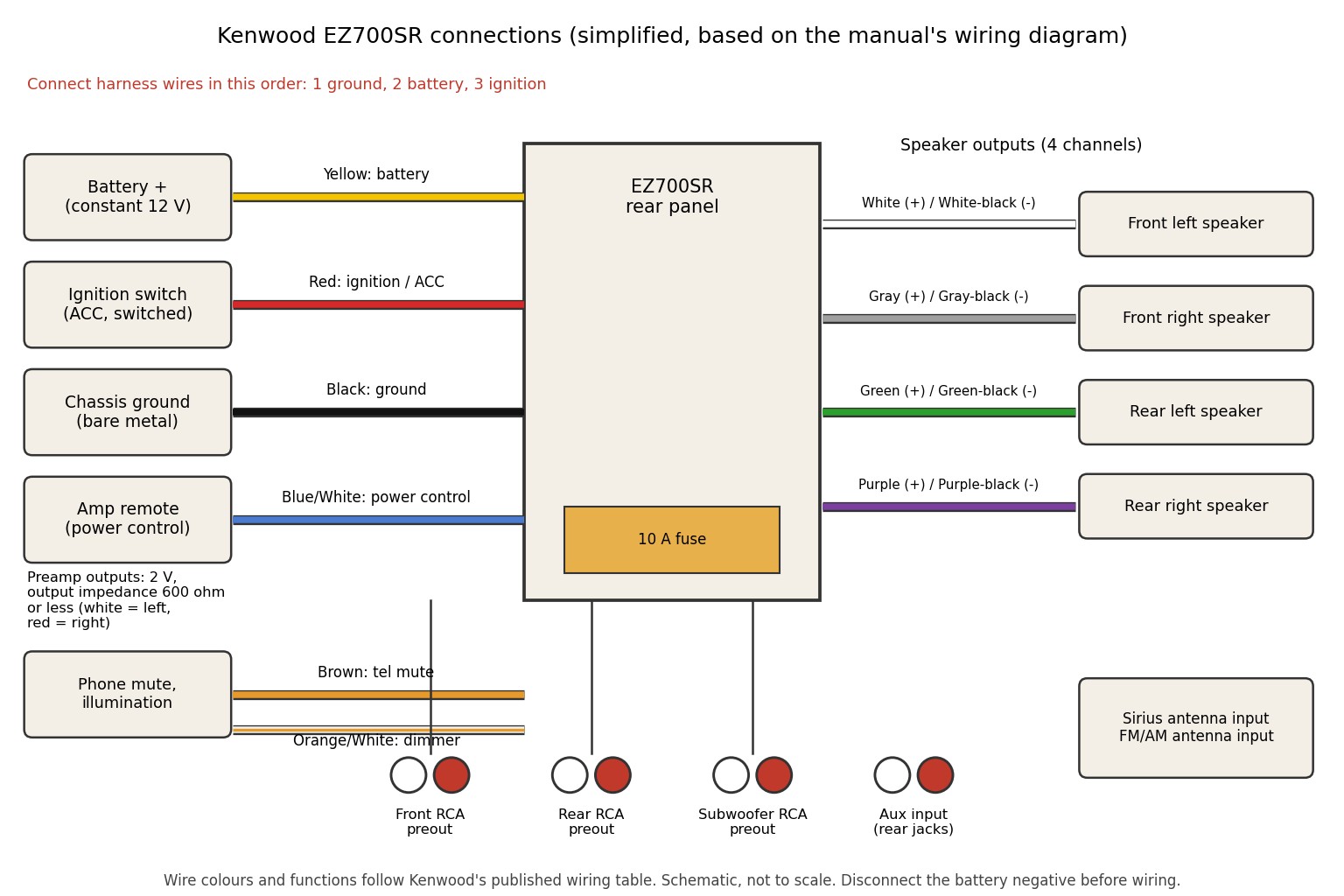
The manual covers wire connections, installation and removal, including a tool-assisted removal of the hard rubber frame. Verify every wire function against the manual's connection chart rather than relying on color memory, since harness adapters vary. The manual also lists a telephone mute input, an external amplifier control output and a connection for Kenwood navigation systems. The external amplifier control terminal is the one meant for an amplifier's remote input, so check the manual's chart before connecting it.
Security code and power loss
The unit has a programmable security code. The manual describes authorization by this code when the radio is removed from its power source. Before you disconnect the battery or buy a used unit, make sure you know the code or can reset it, or you may end up with a locked radio.
Wiring diagram
Setup steps
- Confirm the dash kit and harness adapter match your vehicle before you start.
- Disconnect the battery, then connect the harness and remote turn-on wire as the manual shows.
- Mount the Sirius antenna on bare metal and route the cable without nicking it, if you plan to use it.
- Set speaker size and crossover points for your speakers, and set the equalizer flat before you tune it.
- If you add an external amplifier, set its gain with the tone controls flat and the radio volume at a high but undistorted level (a common installer practice, not a standard), then listen for distortion.
What to check and how it should perform
On the specifications alone, the EZ700SR should drive efficient door speakers at normal listening levels and hand off to an external amplifier through the preouts. I did not listen to one, so I cannot comment on tonal balance or noise floor. If you buy used, check the following:
- The faceplate is included, opens and latches properly, and the contacts are clean. Faceplate-only listings I saw had asking prices above 100 US dollars, so a unit without its face is a poor deal.
- The disc loads and ejects, plays a burned MP3 disc and a normal CD without skipping.
- All four speaker outputs and the preamp outputs work, and the display shows no missing segments.
- Whether the security code is known, and whether Sirius activation is possible for that specific radio.
Pros and cons
Pros
- Three pairs of preamp outputs and electronic crossovers make it easy to build a front, rear and subwoofer amplifier system.
- Large knobs make basic adjustments simple.
- MP3 and WMA disc playback, a rear auxiliary input and external disc control cover the common sources of the era.
- User memory and source tone memory keep different tone settings per source.
Cons
- No USB, no Bluetooth and no hands-free calling.
- Preamp outputs are listed at 2 volts, below the 4 to 5 volt figures on later Kenwood models.
- Satellite radio compatibility with the current service is unconfirmed.
- The 50 watt rating is a maximum, not a continuous figure, and the test conditions are not stated.
- Out of production and no longer sold new; support depends on used parts.
Who it is for, and who should skip it
It suits people restoring a 2000s car, drivers who still play burned discs, and anyone who wants a simple expandable head unit for a small amplifier system. Skip it if you want wireless calls, streaming, map apps or a current display. Those needs are better met by a modern receiver, and a cheap auxiliary Bluetooth adapter is a patchwork fix.
Alternatives
| Option | Why consider it | Trade-off |
|---|---|---|
| Kenwood EZ900HDS | Sister model covered in the same instruction manual, with HD Radio features listed in the manual | Same era and age concerns; verify its specifications separately |
| Kenwood KDC-X705 | Current CD receiver with Bluetooth, USB and 5 volt preouts; 22 W RMS and 50 W maximum per channel per retailer data | Different look; retailer data, availability and price change |
| Pioneer DEH-P7700MP | Period CD receiver with a similar 22 W RMS and 50 W peak rating and three preout pairs | 2.2 volt preouts and no USB or Bluetooth; retailer data |
| Any modern single DIN receiver with Bluetooth | Hands-free calling and streaming without an adapter | Loses the period look and dedicated knobs |
Buying advice
The unit was marked no longer available on the OnlineCarStereo listing, and Crutchfield showed a factory-refurbished listing, so expect to buy used or refurbished. Ask for photos of the display lit, a video of the face opening, the security code, and proof that the faceplate and its case are included. Budget for a harness adapter and dash kit, and plan on an external amplifier if you want more volume than 22 watts RMS gives.
Common mistakes
- Setting amplifier gain by ear at high volume. Use the gain control to match input level, not to add loudness.
- Planning around the 50 watt maximum instead of the 22 watt RMS rating.
- Applying large bass boosts, which can overload a small amplifier or speaker before the system sounds loud.
- Disconnecting the battery without knowing the security code.
- Assuming the Sirius tuner will activate without checking first.
Final verdict
On paper, the Kenwood EZ700SR is a well-equipped disc receiver of its time, with expansion outputs and tone controls that still make sense. Its age shows in the missing USB and Bluetooth, the 2 volt preouts and the uncertain satellite radio. Buy it for a project car or a disc-based setup at a fair used price with the faceplate and code, and pair it with an external amplifier if volume matters. If connectivity matters most, choose a modern receiver.
Sources and further reading
- Kenwood Ez900HDS/Ez700SR instruction manual (hosted by ManualsLib)
- OnlineCarStereo product listing for the EZ700SR (specifications and features)
- Crutchfield listing for the EZ-700SR (built-in SIRIUS tuner, MP3/WMA playback)
- Kenwood USA KDC-X705 product page (for the alternatives table)
Last reviewed: October 2026. Based on manufacturer manual and retailer data; no hands-on testing.
Kenwood EZ700SR FAQ
How much power does the Kenwood EZ700SR have?
The listed rating is 22 watts RMS and 50 watts maximum per channel across four channels. The retailer pages do not state the test conditions, so plan around the 22 watt figure. For higher volume, use the preamp outputs with an external amplifier.
Does the Kenwood EZ700SR have Bluetooth or USB?
No. Retailer specifications list Bluetooth as not available, and the unit has no USB port. Its extra source is a rear auxiliary input, plus disc playback of CD, CD-R, CD-RW, MP3 and WMA.
What voltage are the EZ700SR preamp outputs?
The retailer listing gives 2 volts across three sets: front, rear and non-fading. Some later Kenwood models are listed at 4 or 5 volts, so you may need to set an external amplifier's gain higher with this unit.
Can I still use the built-in Sirius tuner?
I could not confirm that. The tuner is a Sirius-era part that needs a subscription, an antenna and activation by radio ID. Contact SiriusXM with the radio ID before you buy the unit for that feature.
What should I check when buying a used EZ700SR?
Confirm the detachable faceplate and case are included, the face latches, the disc loads and plays burned MP3 discs, the display is complete and the security code is known. A unit without its faceplate is a poor deal.
Does the EZ700SR have a security code?
Yes, the instruction manual describes a programmable security code that may be required after the radio loses its power source. Know the code before disconnecting the battery or buying a used unit.
Can the EZ700SR play 3 inch discs?
No. The manual says 3 inch (8 cm) discs cannot be played, and that using an adapter can damage the unit. Use standard 12 cm discs only.
Is the Kenwood EZ700SR a single DIN or double DIN unit?
It is a single DIN unit, per the retailer specifications. Many vehicles of the period have aftermarket dash kits for single DIN radios, so confirm the kit for your exact vehicle.