Audison · bit Nove
Audison bit Nove Review: 9-Output Car DSP With Caveats
Research-based review of the Audison bit Nove, a 6-in, 9-out car DSP with two optical inputs. Specs, price, availability, rivals and who should still buy it.
Pros
- Nine RCA outputs, each with a 10-pole parametric EQ, crossover and delay for active systems
- Six inputs accept speaker-level (3 to 20 V) or RCA (1.2 to 8 V) signals, suiting factory radios
- De-equalization and USS circuit help it work behind OEM sources that mute without a speaker load
- Two optical inputs accept up to 192 kHz/24-bit, such as the bit Play HD or bit DMI
- Rated THD of 0.005% at 1 kHz, 1 Vrms and SNR of 102 dBA analog and 110 dBA optical
- Compact 130 x 34.5 x 199 mm, 0.7 kg body with 0.08 ms time-alignment steps
Cons
- Internal processing is 24-bit/48 kHz fixed point, so 96 kHz and higher sources are not processed natively
- No current Audison product page found, and one US dealer lists it as no longer available
- Configuration needs a Windows PC; no phone app is listed, and one owner called the software clunky
- A $550 miniDSP C-DSP 8x12 lists 12 outputs and a higher rated SNR of 115 dB
- No digital output and no built-in Bluetooth listed
- No independent measurements or professional lab tests found to confirm the rated figures
Specifications
| Analog inputs | 6 channels, speaker-level 3-20 V or RCA 1.2-8 V; stereo AUX RCA 0.3-5 V |
|---|---|
| Bandwidth | 10 Hz to 22 kHz at -3 dB |
| Channel separation | 85 dBA at 1 kHz |
| Computer connection | Micro USB (USB 1.1/2.0/3.0); Windows Vista to Windows 10; 1024 x 600 minimum screen |
| Crossover | Linkwitz-Riley 12/24 dB, Butterworth 6/12/18/24 dB per octave; 68 steps, 20 Hz to 20 kHz |
| Digital inputs | 2 x optical S/PDIF, up to 192 kHz/24-bit |
| Dimensions and weight | 130 x 34.5 x 199 mm (5.11 x 1.35 x 7.83 in); 0.7 kg (1.5 lb) |
| Equalizer | 9 parametric EQs, plus or minus 12 dB, 10-pole, 20 Hz to 20 kHz |
| Outputs | 9 x RCA; max 4 V RMS at 0.1% THD; no digital output |
| Power | 7.5 to 14.4 VDC operating; 0.53 A idle; 1 mA off (4.5 mA with DRC) |
| Processing | 24-bit/48 kHz fixed point (32-bit Cirrus Logic DSP per UK distributor listing) |
| Remote | Remote in 4-15 VDC (1 mA); remote out 10-15 VDC (130 mA); ART turn-on 2-7 VDC |
| SNR (A-weighted) | 102 dBA master input, 101.5 dBA AUX input, 110 dBA optical inputs |
| THD | 0.005% at 1 kHz, 1 Vrms output |
| Time alignment | 0-15 ms (0-510 cm); 0.08 ms steps, 0.02 ms fine set |
| Type | Car audio digital signal processor, 6 inputs, 9 outputs (sold as bit Nove DRC with DRC AB controller) |
Verdict
The Audison bit Nove suits owners adding an active multi-amplifier system behind a factory or aftermarket radio who want speaker-level inputs, de-equalization and nine tunable outputs. Its main strength is that flexibility at about $499; its main compromises are 24-bit/48 kHz processing, Windows-only software and patchy availability. A $550 miniDSP C-DSP 8x12 lists more outputs and better rated noise figures, so compare before buying.
The Audison bit Nove is a nine-output car audio digital signal processor aimed at adding an active, multi-amplifier system behind a factory or aftermarket radio. Whether it is worth buying today comes down to price and availability: a US retailer listed it at $499 on 12 October 2026, which is competitive for a processor with speaker-level inputs, nine outputs and two optical inputs, but its internal processing runs at 24-bit/48 kHz, its software is Windows-only, and I could not find a current Audison product page for it. It is sold in many shops as the "bit Nove DRC", which bundles a DRC AB controller, so confirm which version you are buying. I found no direct successor from Audison; the nearest siblings are the smaller bit Ten (4 inputs, 5 outputs) and the far more expensive bit One HD Virtuoso.
How this review was made
This is a specification and research review. I did not install, listen to or measure a bit Nove, and nothing here is first-person listening or tuning experience. The facts come from the manufacturer's technical data as reproduced by a US retailer, Audison and Elettromedia store pages, US and UK dealer listings, and one forum thread, all checked on 12 October 2026. I found no independent lab measurements or professional hands-on reviews of this processor, so performance statements rest on rated manufacturer figures. Where listings disagree I say so, and anything I could not verify is marked "not confirmed". The rating at the end is based on that evidence alone.
Design and build
The processor is a compact black box rated at 130 x 34.5 x 199 mm (about 5.1 x 1.4 x 7.8 in) and 0.7 kg (1.5 lb), which works out to roughly 0.9 litre. Its low 34.5 mm height lets it slide under a seat or into a tight panel cavity. Case materials, connector quality and internal construction are not described in the sources I found, so I cannot assess them. The physical connections listed are six analog input channels, a stereo auxiliary RCA input, two optical inputs, nine RCA outputs, a micro USB port for the computer and an AC Link port for the DRC controller.
Features and usability
The six analog inputs each accept either speaker-level signals (3 to 20 V) or RCA-level signals (1.2 to 8 V), and the auxiliary RCA input takes 0.3 to 5 V, which Audison suggests for a phone or tablet. That input flexibility is the main reason to choose a processor like this for a car with a factory radio. Audison adds a de-equalization function that flattens the equalization a factory source applies, and its USS (Universal Speakers Simulator) circuit lets the processor sit behind radios that mute their output when they detect no speaker load. In North American vehicles it can also work with the iDatalink Maestro AR interface, sold separately.
Each of the nine outputs has its own 10-pole parametric equalizer (plus or minus 12 dB, 20 Hz to 20 kHz), a crossover and a delay line. Crossover filters are Linkwitz-Riley at 12 or 24 dB per octave and Butterworth at 6, 12, 18 or 24 dB per octave, selectable in 68 frequency steps from 20 Hz to 20 kHz, with a 0 or 180 degree phase switch. Time alignment runs from 0 to 15 ms in 0.08 ms steps, with a 0.02 ms fine setting. The manufacturer quotes these steps as 2.8 cm and 0.7 cm of path difference, with the 15 ms maximum corresponding to 510 cm.
Configuration happens on a Windows PC over micro USB. The listed requirements name Windows Vista through Windows 10 and a screen of at least 1024 x 600; no macOS or phone app is listed. The unit also lists a wire-controlled preset and optical-input selection and compatibility with Audison's bit Tune auto-calibration. Retail packages are described as including a CD-ROM with software, the owner's manual and test tracks, though I could not verify the full box contents. One owner on a car audio forum said the software felt clunky compared with Helix tuning software and suggested trying both programs offline before deciding; that is one anecdote, not a finding.
Sound and performance
With no independent measurements available, the evidence is the rated specification. The manufacturer data lists THD of 0.005% at 1 kHz with a 1 Vrms output, a bandwidth of 10 Hz to 22 kHz at -3 dB, and A-weighted signal-to-noise ratios of 102 dBA for the master inputs, 101.5 dBA for the auxiliary input and 110 dBA for the optical inputs. Channel separation is rated at 85 dBA, and the maximum output level is 4 V RMS at 0.1% THD. These are the manufacturer's figures under its own conditions.
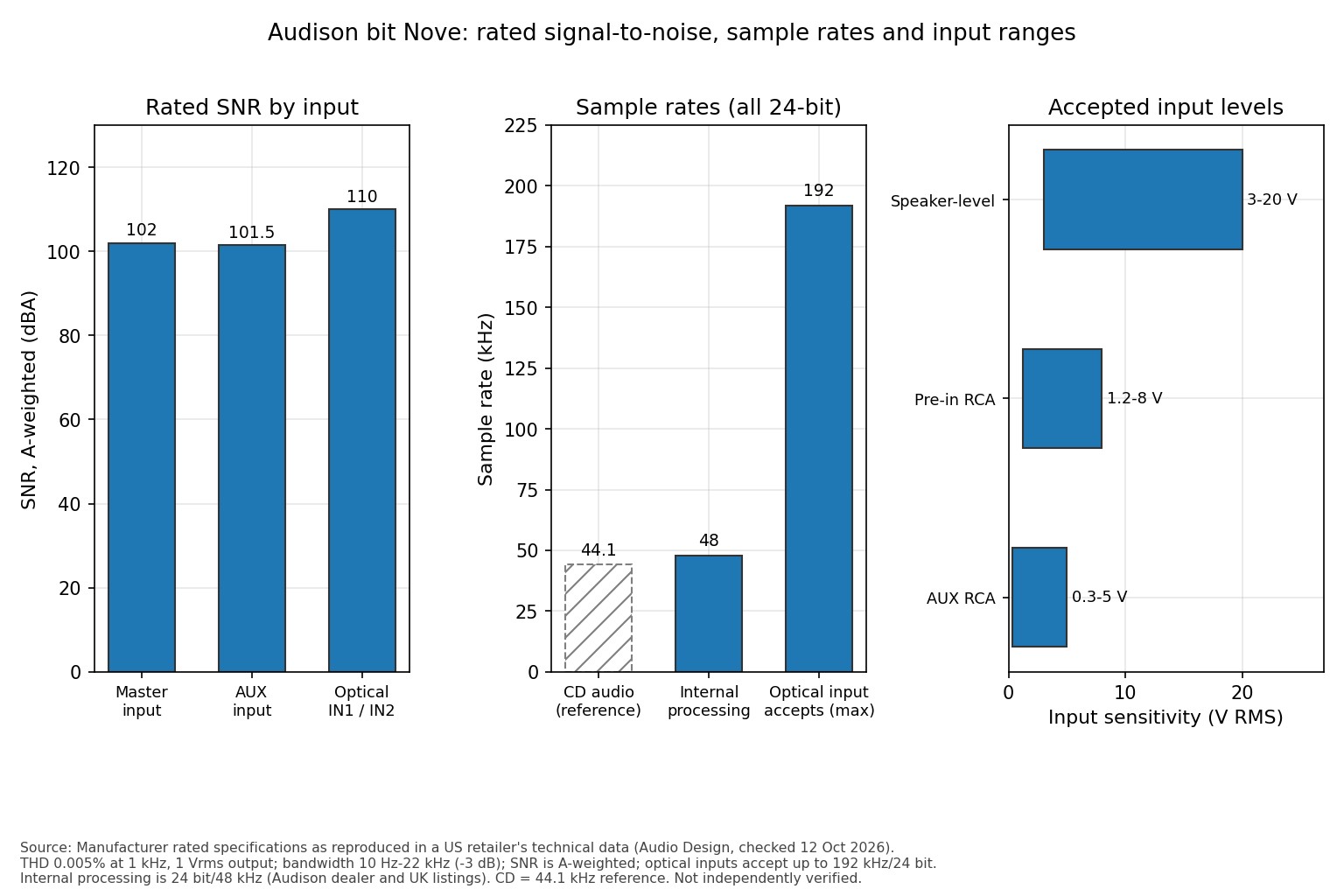
The most important detail is the sample rate. The two optical inputs accept up to 192 kHz/24-bit, but US and UK dealer listings describe the processing itself as 24-bit/48 kHz fixed point, using a 32-bit Cirrus Logic DSP and matching converters. The sources do not say how higher-rate material is converted, so a hi-res source such as the bit Play HD, which outputs up to 96 kHz, would not be processed at its native rate. For comparison, Audison lists the bit One HD Virtuoso with 24-bit/96 kHz floating-point processing. If your plan is an end-to-end hi-res chain, that difference matters; if you mostly feed it a factory radio, it probably does not.
Setup, installation and daily use
The listed operating supply is 7.5 to 14.4 VDC with an idle current of 0.53 A, about 6.4 W at 12 V. Turn-on comes from a 4 to 15 VDC remote-in signal, or from the automatic remote turn-on (ART) feature listed at 2 to 7 VDC, and a remote-out lead supplies 10 to 15 VDC at up to 130 mA for amplifiers. Standby draw is listed as 1 mA without the DRC controller and 4.5 mA with it, which is about 0.11 Ah per day for the latter.
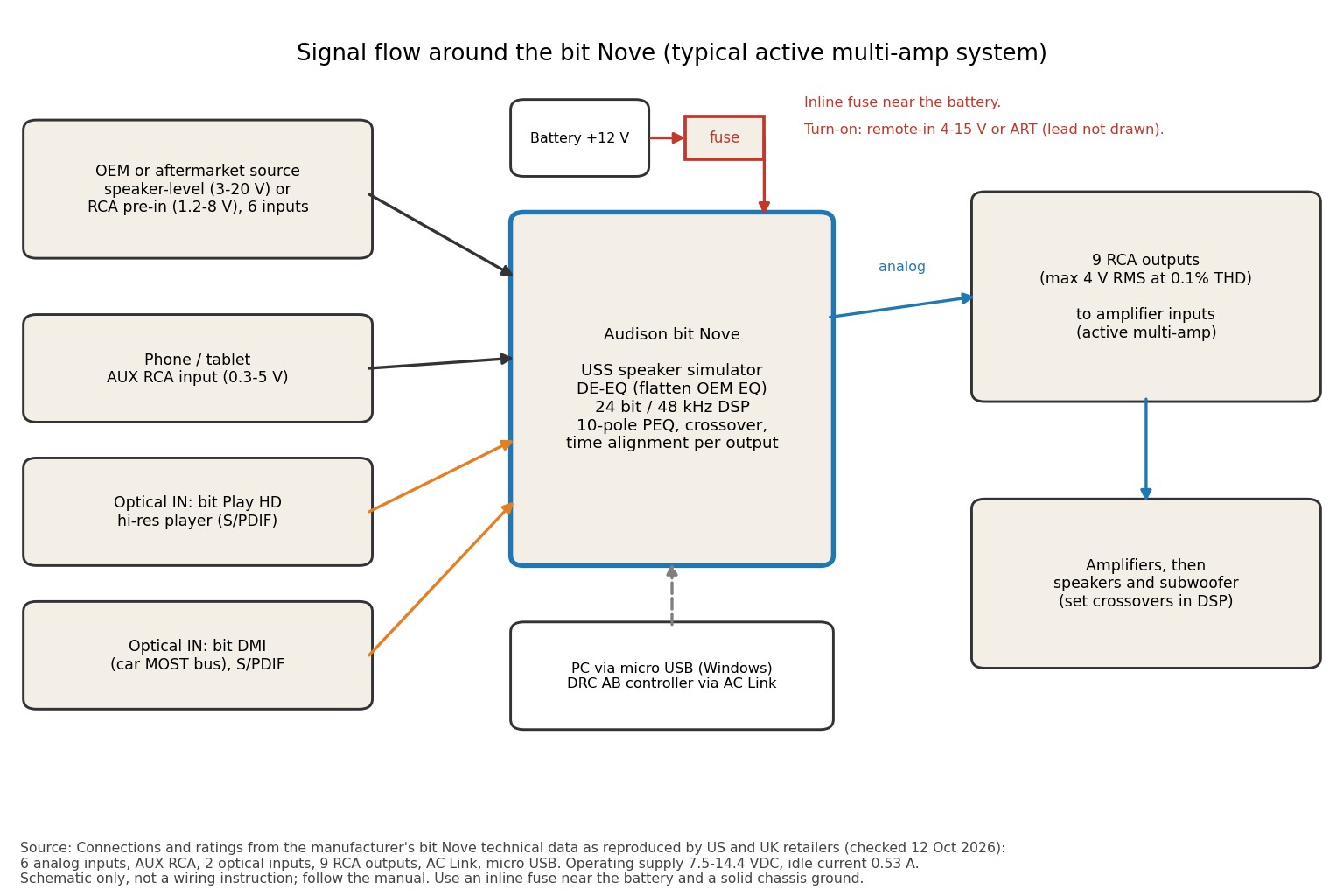
Safety notes for anyone installing one: disconnect the battery before touching the power lead, fit an inline fuse close to the battery on the supply, and use a solid chassis ground. Set crossovers before you power amplifiers that drive tweeters, because an unfiltered signal can damage them. Start with amplifier gains low and the master volume down, since a maximum output of 4 V RMS can overdrive an amplifier set for a lower input. Professional installation is sensible for vehicles with factory amplifiers or digital buses.
How it compares
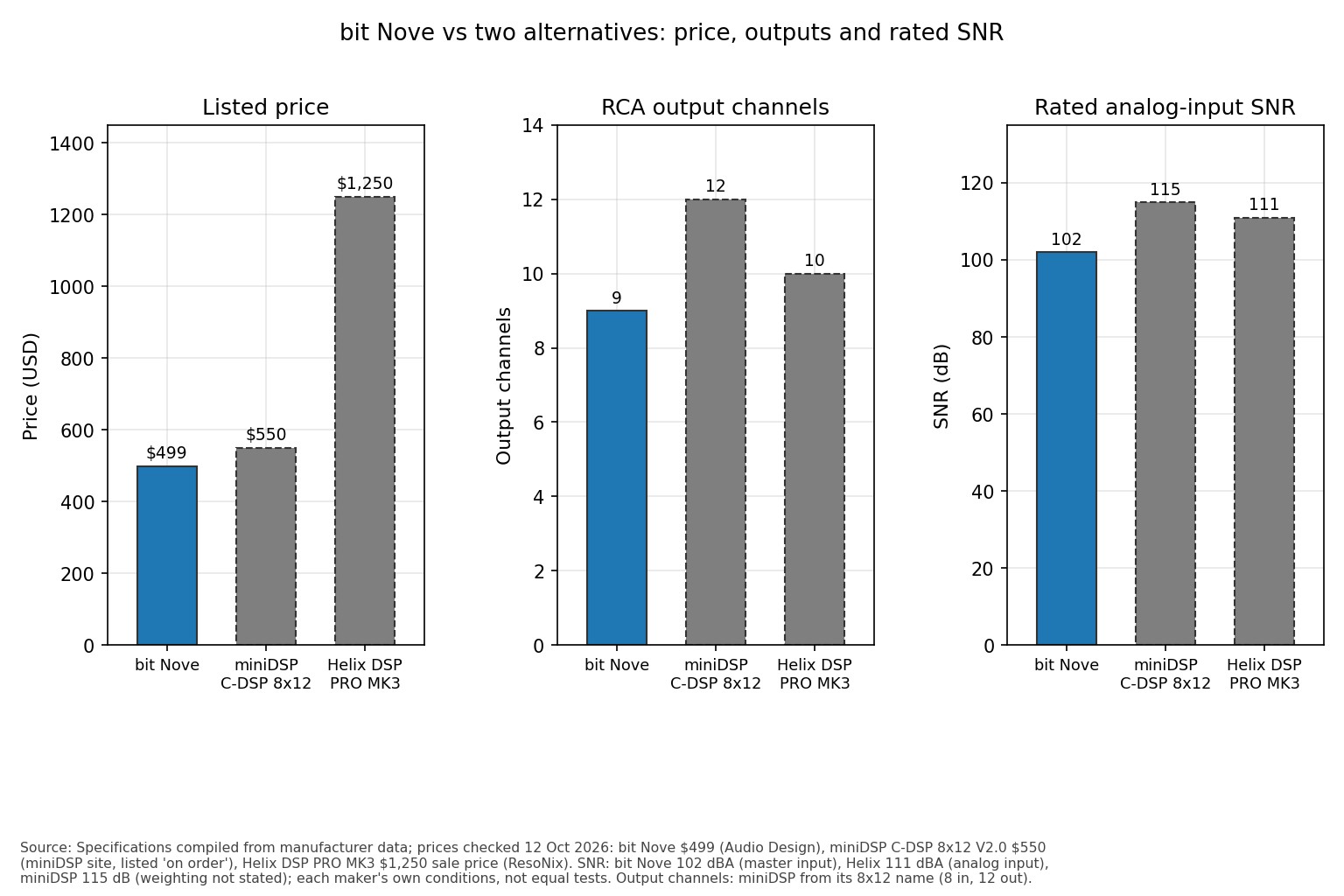
The two alternatives below are the closest like-for-like processors I could verify at nearby prices. The miniDSP C-DSP 8x12 V2.0 is a direct price rival, and the Helix DSP PRO MK3 is a widely used step-up model at more than twice the price.
| Item | Audison bit Nove | miniDSP C-DSP 8x12 V2.0 | Helix DSP PRO MK3 |
|---|---|---|---|
| Price (checked 12 Oct 2026) | $499 (US retailer) | $550 (miniDSP site, listed on order) | $1,250 sale, $1,350 regular (US retailer) |
| Analog inputs | 6 speaker-level or RCA, plus stereo AUX | 8 (8x12 design); input types not confirmed | 8 RCA plus 8 speaker-level |
| Digital inputs | 2 optical, up to 192 kHz/24-bit | Not confirmed | 1 optical (12-96 kHz), 1 coaxial (12-192 kHz) |
| Outputs | 9 RCA, 4 V RMS max at 0.1% THD | 12 RCA; level not confirmed | 10 RCA, 8 V |
| Processing | 24-bit/48 kHz fixed point | 32-bit floating point, 400 MHz SHARC; up to 192 kHz | 64-bit DSP, 96 kHz sampling |
| Rated SNR | 102 dBA master, 110 dBA optical | 115 dB (weighting not stated) | 111 dBA analog, 116 dBA digital |
| Rated distortion | 0.005% THD, 1 kHz, 1 Vrms out | 0.0007% THD+N (conditions not stated) | Below 0.001% THD+N analog, below 0.0005% digital |
| Size and weight | 130 x 34.5 x 199 mm, 0.7 kg | Not confirmed | 40 x 177 x 120 mm (retailer listing) |
On paper the miniDSP offers more outputs and better rated noise and distortion for about $51 more, while the Helix adds higher output voltage and more input options at a much higher price. Rated figures use different conditions, so treat the gaps as indicative, not exact. The bit Nove's case rests on Audison integration: its optical inputs are meant for the bit Play HD player and the bit DMI interface that taps the digital audio on some cars' MOST bus.
Who should buy it and who should skip it
It suits owners adding amplifiers and a fully active speaker system to a factory radio who value speaker-level inputs, de-equalization and Audison's DRC controller, or anyone extending an existing Audison system who can find one at a fair price. It also suits installers who already know the Audison software.
Skip it if you want end-to-end hi-res processing, a phone app for tuning, built-in Bluetooth or digital output, or the lowest noise figures for the money. Also skip it if you cannot confirm warranty and support, since availability looks patchy.
Buying advice
On 12 October 2026 a US retailer listed the processor at $499. One other US dealer showed the bit Nove DRC as no longer available, a second showed it out of stock, UK listings were around 599 pounds and a Lithuanian shop listed 507 euros as backordered, so stock and price vary widely by region. Before you buy, confirm whether a DRC AB controller is included (many listings say so for the bit Nove DRC), that the seller is an authorized Audison dealer so the warranty is valid, and that the software runs on your Windows laptop. Budget for installation, amplifiers, optical cable and any vehicle-specific interface, and check return terms. Because the manufacturer product page no longer resolves, ask the seller or Audison support for the manual and software before the shop's return window closes. I could not verify the warranty length or the full box contents.
Final thoughts
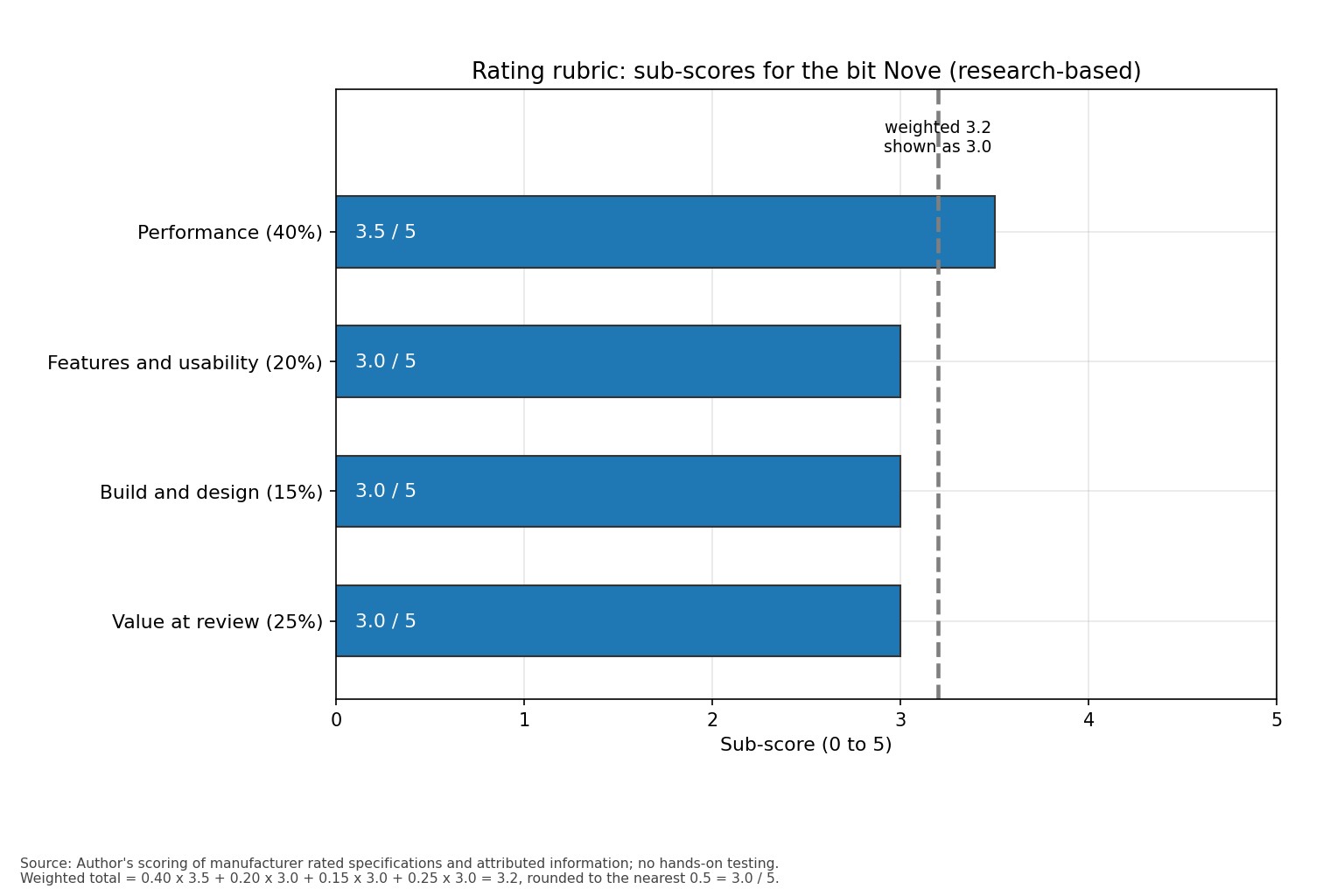
I rate the Audison bit Nove 3.0 out of 5. The scoring uses four weighted categories: performance (40%), features and usability (20%), build and design (15%) and value at the review price (25%). Because this is a research-only review, each score reflects verified specifications and attributed information rather than testing. The weighted result is 3.2, which rounds to 3.0.
| Category | Weight | Score (0 to 5) | Why |
|---|---|---|---|
| Performance and function | 40% | 3.5 | Solid rated noise and distortion and strong per-output tuning, but 48 kHz processing and no independent measurements |
| Features and usability | 20% | 3.0 | Speaker-level inputs, de-equalization and two optical inputs, but Windows-only software and no phone app listed |
| Build and design | 15% | 3.0 | Compact and light, but materials and construction are not documented |
| Value at review price | 25% | 3.0 | $499 is reasonable, but a $550 rival lists more outputs and better noise figures, and availability is uncertain |
Some links on this page are affiliate links; they never affect our ratings. As an Amazon Associate I earn from qualifying purchases.
Sources and further reading
- Audio Design, bit Nove listing with technical specification (price checked 12 October 2026)
- Audison UK distributor listing: DSP and converter description
- OnlineCarStereo, bit Nove DRC listing (shown as no longer available)
- Sound of Tristate, bit Nove DRC listing (shown as out of stock)
- Elettromedia store, Audison range including bit One HD Virtuoso
- miniDSP, C-DSP 8x12 V2.0 product page
- ResoNix, Helix DSP PRO MK3 listing
- DIY Mobile Audio forum thread on the bit Nove (anecdotal)
Audison bit Nove FAQ
Is the Audison bit Nove still available?
US availability is mixed. One US retailer listed it at $499 on 12 October 2026, another showed it as no longer available and a third as out of stock. Audison's own product page did not load, and I found no official discontinuation notice, so confirm stock and warranty with an authorized dealer.
What is the difference between the bit Nove and the bit Nove DRC?
Most listings sell it as the bit Nove DRC, which includes a DRC AB dashboard controller, while some list the plain bit Nove. The processor specifications are the same in the listings I found. Confirm that the controller is in the box before buying.
Will it work with a factory radio?
Yes, that is a main use. Its six inputs accept speaker-level signals from 3 to 20 V, it has a de-equalization function and its USS circuit prevents radios that detect no speaker load from muting. On some North American vehicles it can also pair with the iDatalink Maestro AR interface, sold separately.
Can it process hi-res digital audio?
The two optical inputs accept up to 192 kHz/24-bit, but dealer listings describe the processing as 24-bit/48 kHz fixed point. Higher-rate sources are therefore not processed at their native rate. Audison lists its bit One HD Virtuoso with 24-bit/96 kHz floating-point processing.
Can I tune it from my phone?
The technical data lists configuration from a Windows PC over micro USB and names no phone app. A DRC AB controller handles dashboard control. Audison's bit Tune auto-calibration is listed as compatible, but I did not verify its price.
How many amplifier channels can it drive?
It has nine RCA outputs. A fully active three-way front stage uses six, which leaves two for rear speakers and one for a subwoofer. Each output has its own equalizer, crossover and delay.
How much power does it use?
The manufacturer lists an idle current of 0.53 A, about 6.4 W at 12 V. Standby draw is 1 mA without the DRC controller and 4.5 mA with it, roughly 0.11 Ah per day for the latter. Wire its turn-on lead to a remote or ignition-switched signal.
Is it better than the miniDSP C-DSP 8x12?
On paper the miniDSP lists more outputs (12 against 9) and a higher rated SNR (115 dB against 102 dBA) for about $550 against $499. The bit Nove offers speaker-level inputs and tighter Audison integration. Ratings use different test conditions, so compare tuning software and your own needs.