Audison · bit Ten D
Audison bit Ten D Review: Capable but Dated Car DSP
Audison's bit Ten D is a five-channel car DSP with optical input and AD Link output. We check its published specs, status and value against newer rivals.
Pros
- Automatic de-equalization of speaker-level inputs, with basic calibration possible without a computer
- Optical S/PDIF input accepts PCM up to 96 kHz and 24 bit, bypassing the analog-to-digital stage
- AD Link output carries 8 digital channels to compatible Audison amplifiers over one CAT5 cable
- 31-band graphic equalizer, crossover and time alignment on each of the five outputs
- Rated 0.005% THD at 1 kHz and 105 dBA signal-to-noise on the digital input
- Dash remote (DRC) controls volume, subwoofer level, balance, fader and memory selection
- Compact body of 191 x 34 x 131 mm and 0.6 kg
Cons
- Only five analog outputs, so larger active systems need AD Link amplifiers or a bigger processor
- Processing is fixed at 48 kHz while the Helix DSP MINI MK2 is rated at 96 kHz
- Graphic equalizer only, with two stored setups and no parametric equalizer listed
- Not listed on Audison's current bit range page, and one large retailer shows it as unavailable
- Optical input cannot decode Dolby Digital or DTS, and a signal above 96 kHz makes the unit lock up
- Some forum owners report dropouts or failures (anecdotal), and the value is weak at about $530
Specifications
| Bandwidth | 10 Hz to 22 kHz at -3 dB |
|---|---|
| Channel separation | 85 dB at 1 kHz |
| Converters | 24-bit A/D and D/A, PCM at 48 kHz |
| Crossover | Per output: full, high, low or band pass; Linkwitz 12/24 dB, Butterworth 6/12/18/24 dB per octave; 68 steps, 20 Hz to 20 kHz |
| Equalizer | 31-band graphic, 1/3 octave, +/-12 dB, on each output |
| Inputs | 4 speaker-level (auto-summing), 1 stereo AUX (RCA), 1 optical, 1 phone-mute input |
| Maximum output | 4 V RMS at 0.1% THD |
| Optical input | S/PDIF PCM, up to 96 kHz / 24 bit |
| Outputs | 5 analog RCA (front L/R, rear L/R, sub); AD Link with 8 digital channels (8 outputs maximum in total) |
| Power supply | 11 to 15 V DC, 0.4 A idle |
| Processor | 32-bit Cirrus Logic DSP, 147 MHz clock |
| Remote | DRC dash controller supplied (per manufacturer description) |
| Signal-to-noise (A-weighted) | Digital input 105 dBA, AUX 96 dBA, master input 95 dBA |
| Size and weight | 191 x 34 x 131 mm, 0.6 kg |
| THD | 0.005% at 1 kHz, 1 V RMS output |
| Time alignment | 0 to 510 cm (0 to 15 ms), 0.08 ms steps, 0.02 ms fine set |
Verdict
The Audison bit Ten D suits owners of factory radios or Audison AD Link amplifiers who want automatic de-equalization and a five-channel active setup. Its main strength is the combination of optical input, AD Link digital output and a 31-band equalizer on every output. Its main compromise is age: five analog outputs, 48 kHz processing and absence from Audison's current bit range. At about $530 it is hard to justify against newer processors.
The Audison bit Ten D is a car audio signal processor that takes factory or aftermarket signals, flattens the factory equalization, and sends up to five analog or eight digital channels to your amplifiers. It is worth buying only in a narrow case: you want its automatic de-equalization, its optical input or its AD Link digital output, and you can find it at a fair price. Otherwise, newer processors list more outputs and a 96 kHz sample rate for similar money. This review rates it 3.0 out of 5 on published specifications and independent research, not hands-on testing. The verdict, pros, cons and full specification list appear in their own sections on this page.
One status point matters before anything else. On 11 October 2026, Audison's bit processor range page listed the bit Ten (without the D) and the bit One HD Virtuoso. The bit Ten D was not on that page. Audison still mentions it in the accessory and test-track listings on the bit Ten page, so manuals and support files remain available, and some US retailers still list it for sale.
How this review was made
This is a specification and research review. I did not install, listen to, measure or own this processor, and nothing here describes my own listening. Every figure comes from Audison's manual and product pages, or from retailer pages that repeat Audison's specification sheet. Where retailer copies disagreed, I used the manual. I searched for independent bench measurements of the bit Ten D and found none, so the performance section relies on published numbers, with owner reports labeled as anecdotal. Prices were checked on 11 October 2026 and are quoted in US dollars. If you own one and can add notes about reliability or setup, those would strengthen this page.
Design and build
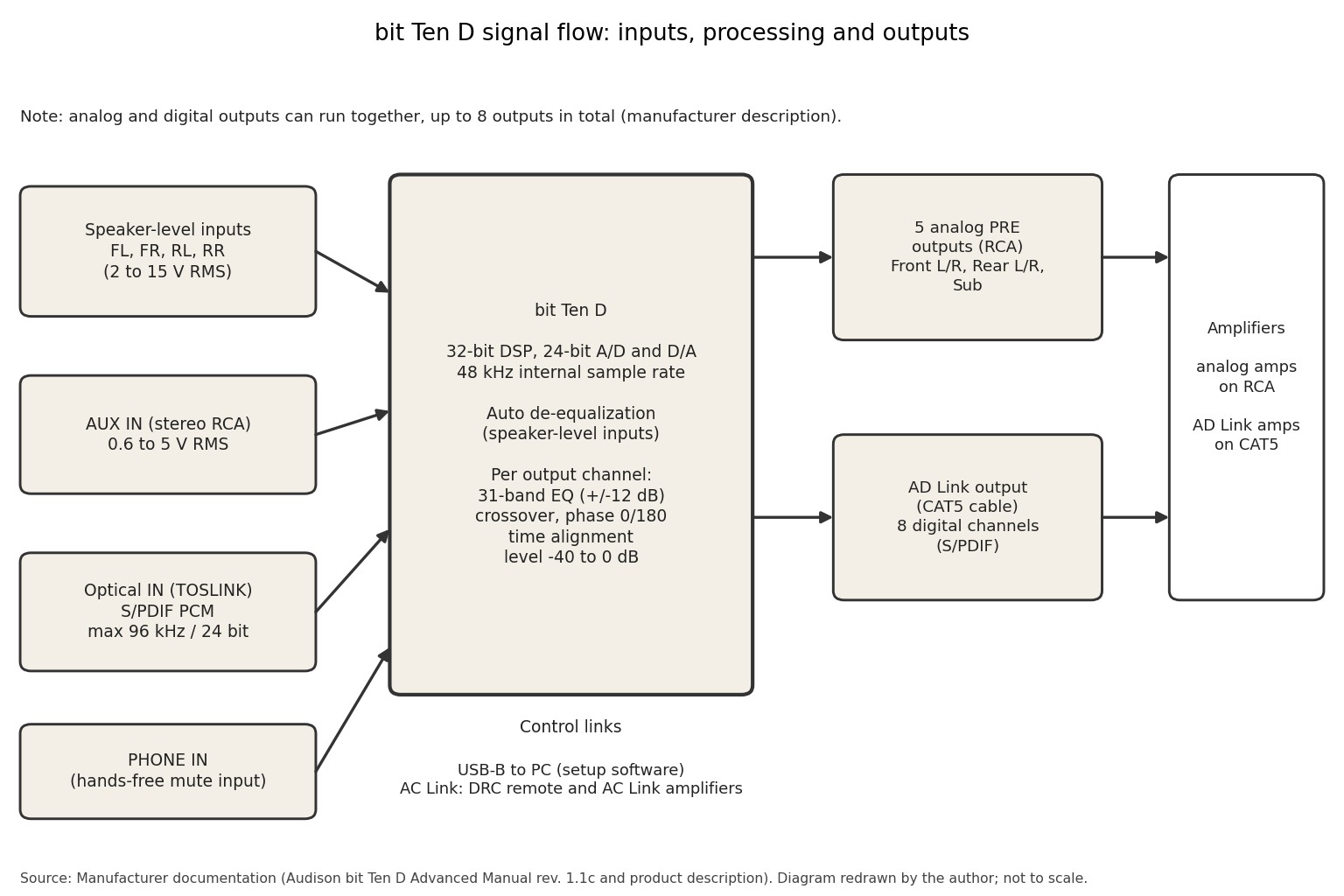
The bit Ten D is a slim box measuring 191 x 34 x 131 mm and weighing 0.6 kg, according to Audison's manual. It is meant to be screwed down out of sight, under a seat or behind a panel, and it uses a multi-pin connector harness for power, remote and speaker-level inputs rather than individual removable plugs. Connectors include a USB-B port for the computer, an optical input, RCA outputs, an AD Link output on a CAT5 cable, and AC Link ports for the dash remote and for compatible Audison amplifiers.
Audison's descriptions say the Digital Remote Control (DRC) is supplied with the bit Ten D. Build quality has not been assessed by any independent source I could find, so I scored it conservatively. Owner reports of failures on forums are covered below and should be read as anecdotes, not as failure rates.
Features and usability
The input side is where the D version differs from the plain bit Ten. Audison lists four speaker-level channels with automatic summing, one stereo AUX input, one optical S/PDIF input and a phone-mute input. The speaker-level inputs accept 2 to 15 V RMS, and the manual describes an automatic de-equalization routine that uses a supplied test CD to flatten the factory curve. The manual says de-equalization and basic calibration can be done without a computer.
Each of the five outputs gets a 31-band graphic equalizer (1/3 octave, plus or minus 12 dB), a crossover (full range, high-pass, low-pass or band-pass, Linkwitz at 12 or 24 dB per octave, Butterworth at 6, 12, 18 or 24 dB per octave), a phase switch, time alignment and an output level control. There is no parametric equalizer in the specifications. Two setups can be stored and recalled. The DRC controls master volume, subwoofer volume, balance, fader, input selection and memory selection.
Setup software is Windows-based, and Audison's listing names Windows XP, Vista and 7. Compatibility with newer Windows versions is not confirmed in the sources I used, so check before buying. The manual also contains several practical warnings. After changing settings you must run the "Finalize to bit Ten D" step or the changes are lost. When a laptop is connected by USB, the manual says the laptop should run on its own battery, not on mains power. Without a computer, the AD Link digital outputs cannot be used.
Sound and performance
Audison's rated figures are respectable for the processor's era. Total harmonic distortion is listed at 0.005 percent at 1 kHz with a 1 V RMS output, bandwidth is 10 Hz to 22 kHz at -3 dB, and channel separation is 85 dB at 1 kHz. Signal-to-noise ratio is rated at 105 dBA on the digital input, 96 dBA on the AUX input and 95 dBA on the master speaker-level inputs. Maximum output is 4 V RMS at 0.1 percent distortion. Internal processing runs at 48 kHz with 24-bit converters.
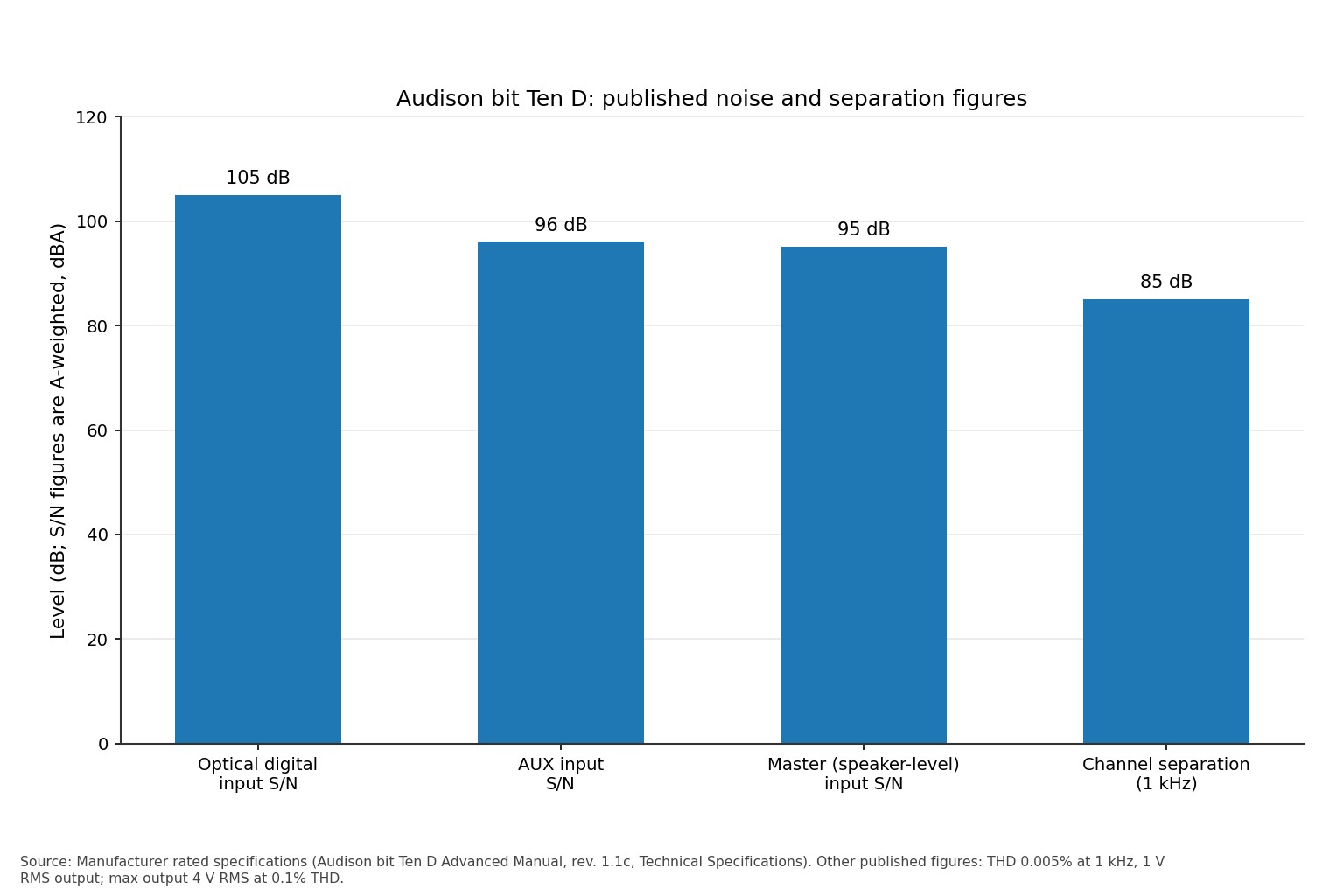
These numbers suggest a clean signal path, but they are manufacturer figures measured under Audison's own conditions, and I found no independent lab test to confirm them. For context, Audiotec Fischer rates its Helix DSP MINI MK2 at 107 dBA on analog input and 112 dBA on digital input, with an internal 96 kHz sample rate. The measurement conditions of the two companies are not identical, so treat the comparison as a rough guide only.
The optical input has limits worth knowing. It accepts PCM up to 96 kHz at 24 bits. The manual says encoded Dolby Digital or DTS streams cannot be reproduced, so the source must output stereo PCM. It also says that feeding a signal above 96 kHz, such as 192 kHz, makes the unit lock up.
Owner reports are mixed and old. Forum posts roughly eight to eleven years old include one poster who said a unit they knew of dropped out and was replaced, another who had owned three without trouble, and a person who said they had worked for both Audison and a rival and believed most problems were installation related. Others praised the software as easy to use, while some said the Audison processors had fallen behind the competition. None of this is measured evidence.
Setup, installation and daily use
A typical installation feeds the processor from the factory radio's speaker wires (or from a head unit's RCA outputs through an accessory adapter), then runs RCA cables from the five analog outputs to your amplifiers. If you own Audison amplifiers with an AD Link input, one CAT5 cable can carry eight digital channels instead.
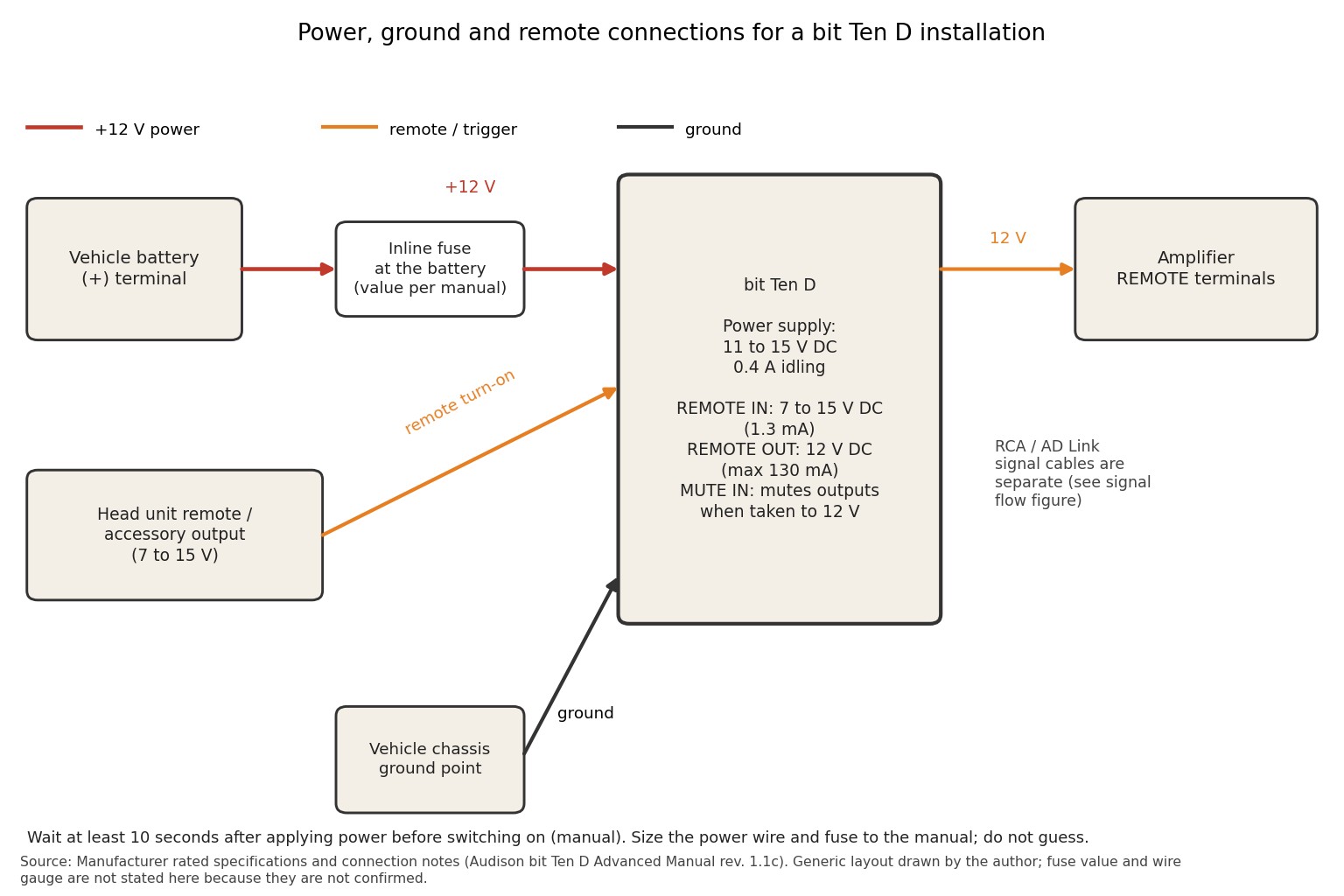
Safety and wiring note. Disconnect the vehicle battery before working on wiring. Fit a fuse in the power wire close to the battery, and choose the fuse and wire gauge from the manual and the cable maker's ratings, not by guesswork. Audison rates the unit for 11 to 15 V DC with a 0.4 A idle draw. After power is applied, the manual says to wait at least 10 seconds before turning the unit on. Keep power wiring away from signal cables to avoid noise, and never splice into airbag or safety-system wiring.
Some vehicles with start-stop systems can drop battery voltage low enough to reset a processor. Audison sells an accessory called the ES3 for this purpose and names the bit One and bit Ten on its page. Confirm with a dealer that it suits the bit Ten D. The current bit Ten page also lists a speaker-load simulator for head units that mute when they detect no speaker; that feature is not mentioned in the bit Ten D descriptions I reviewed, so it is not confirmed for this model.
How it compares
I chose three comparison products with verified specifications. The current Audison bit Ten is the sibling without the D features. The Helix DSP MINI MK2 and the miniDSP C-DSP 6x8 are compact car DSPs from other makers. I left out the bit One HD Virtuoso as a direct rival, because Audison lists it with 12 inputs, 13 outputs and 24-bit/96 kHz floating-point processing, which places it in a much higher class.
| Specification | Audison bit Ten D | Audison bit Ten (current) | Helix DSP MINI MK2 | miniDSP C-DSP 6x8 |
|---|---|---|---|---|
| Analog outputs | 5 RCA | 5 RCA | 6 RCA | 8 RCA |
| Inputs | 4 speaker-level, AUX, optical | 4 speaker-level, low-level AUX; no digital input listed | 4 RCA, 4 speaker-level, optical (12 to 96 kHz) | 4 high-level, 4 RCA, S/PDIF |
| Digital output | AD Link, 8 channels | None listed | None listed | None listed |
| Sample rate | 48 kHz | 48 kHz | 96 kHz | 48 kHz |
| Max output level | 4 V RMS | 4 V RMS | 6 V | 2 Vrms |
| S/N, analog input | 96 dBA (AUX), 95 dBA (master) | 96 dBA (master, 2 V in) | 107 dBA | Not confirmed |
| Stored setups | 2 | Not listed on Audison page | 10 | Up to 4 |
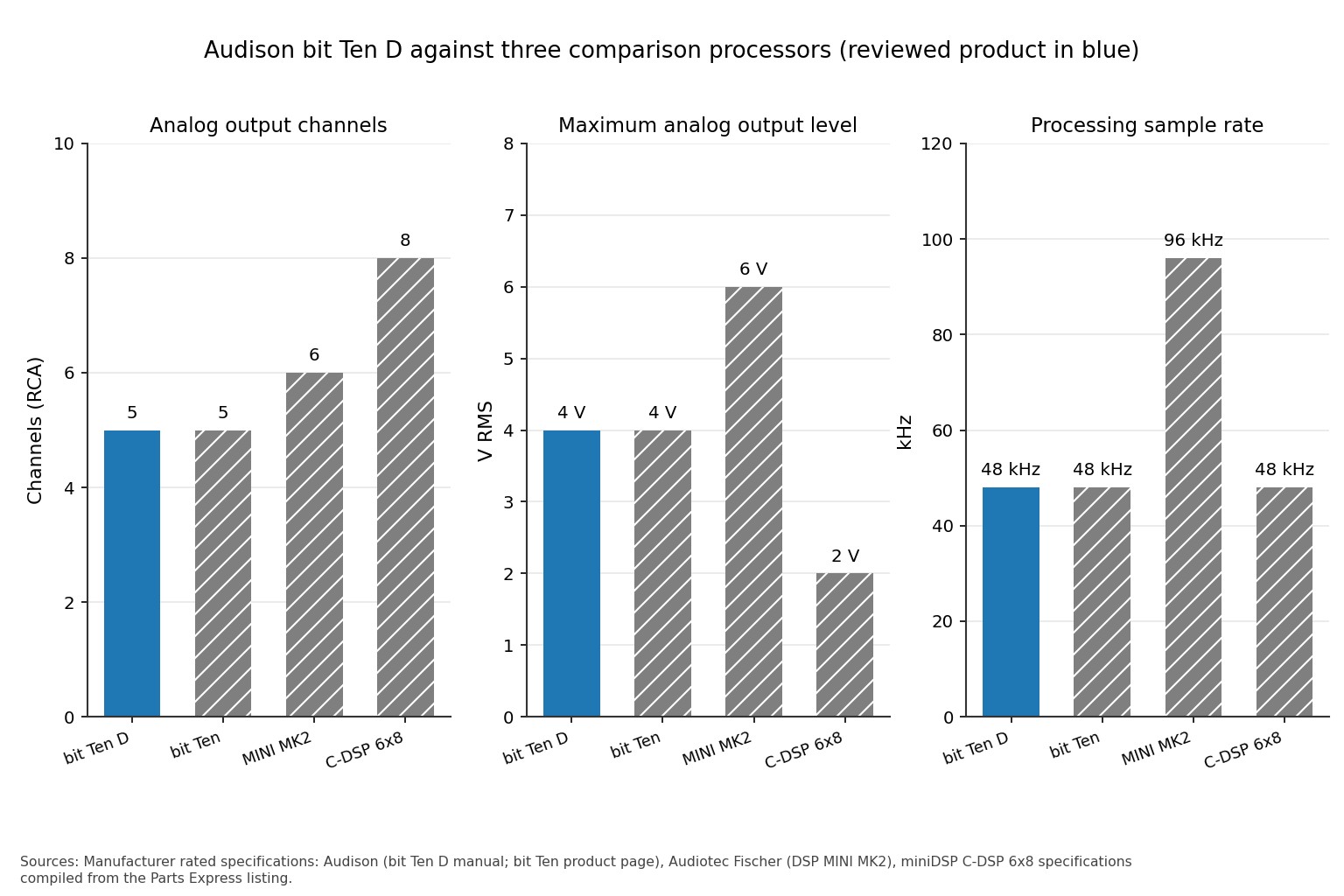
The table shows the bit Ten D's niche: it is the only one here with an AD Link output. On raw numbers, the Helix leads on sample rate, output voltage and stored setups, while the miniDSP offers the most analog outputs. Keep in mind the miniDSP's conditions are only partly published here.
Who should buy it and who should skip it
It suits people who keep a factory radio and want it de-equalized, owners of Audison amplifiers with AD Link or AC Link inputs who want a matching digital path, and installers who already know the bit software and have a bit Ten D at a good price. A five-channel active layout, such as front left and right, rear and a subwoofer, fits it well.
Skip it if you need more than five analog outputs for a fully active three-way front stage, want 96 kHz processing, prefer parametric equalization, need modern operating system support confirmed, or want a product Audison still lists in its current range. In those cases, look at the comparison products above or at Audison's bit One HD Virtuoso.
Buying advice
On 11 October 2026, Safe and Sound HQ listed the bit Ten D with DRC at $529.99. Another US retailer showed $499.99 with availability marked "please call" (the date of that listing is not confirmed), and a large retailer listed the product as no longer available. For comparison, I saw the Helix DSP MINI MK2 at about $550 at one US shop (undated) and at 349 euros at a Lithuanian shop. Prices vary by region and change often, so check them yourself.
Before buying, confirm that the DRC is included, that the seller is an authorized Audison dealer (one forum comment says service requires an authorized purchase, which is anecdotal; ask Audison), what warranty applies, and the return policy. Check that the setup software runs on the computer you plan to use. Budget for the extras you may need: RCA cables, an optical cable if you use that input, a CAT5 cable for AD Link, and power wire, fuse and ground hardware.
Final thoughts
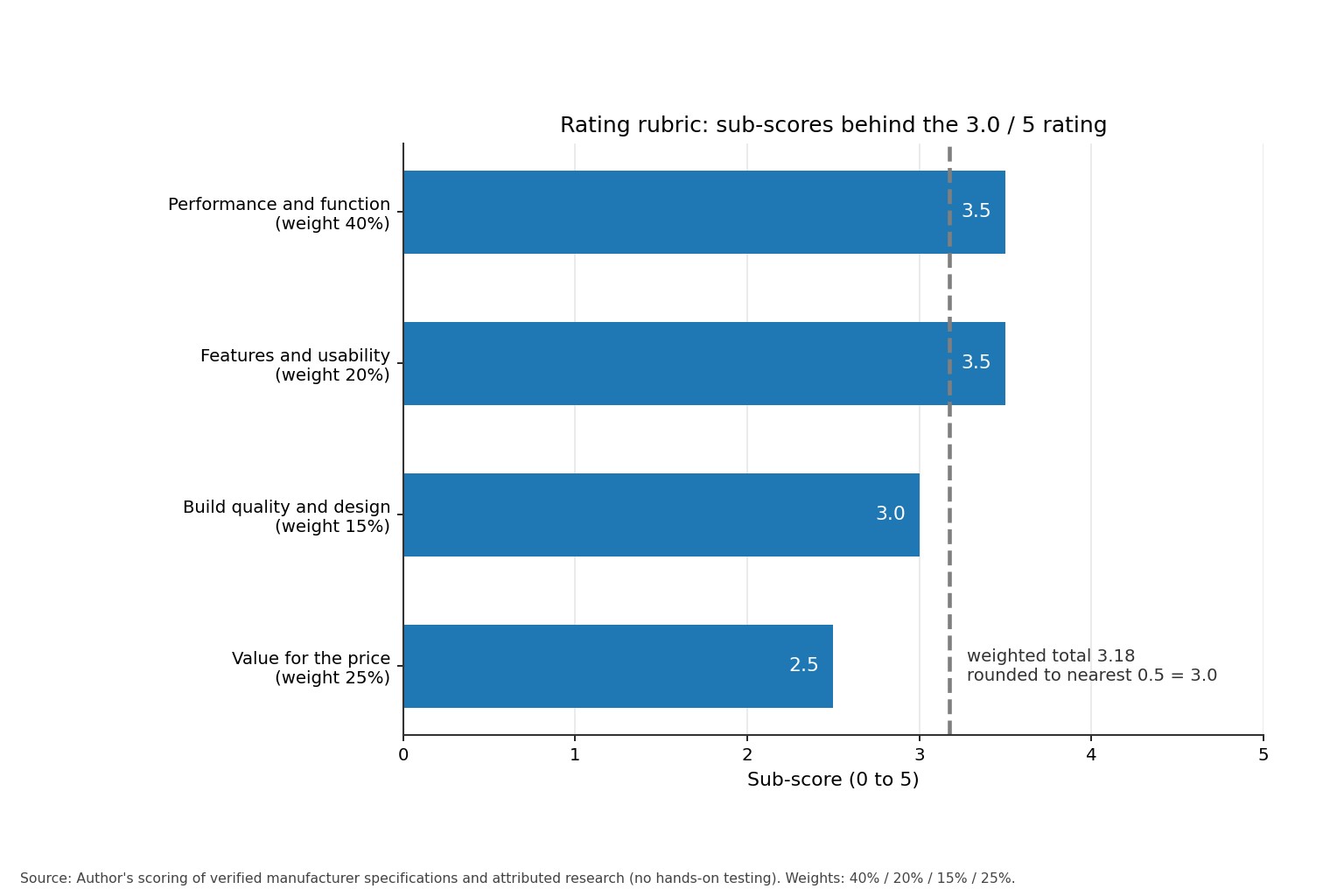
The bit Ten D earns a rating of 3.0 out of 5. Its published performance and de-equalization tools are solid, and the optical and AD Link connections are useful in the right system. It loses points for five analog outputs, a 48 kHz sample rate, its absence from Audison's current bit range and a price that is hard to justify against newer processors. The weighted total was 3.18 and rounds to 3.0. The rubric weights performance and function at 40 percent, features and usability at 20 percent, build quality and design at 15 percent, and value at 25 percent. Because this is a research-only review, the scores rest on verified specifications and attributed findings. Build quality is scored conservatively because no independent evidence was found.
| Category | Weight | Sub-score (0 to 5) |
|---|---|---|
| Performance and function | 40% | 3.5 |
| Features and usability | 20% | 3.5 |
| Build quality and design | 15% | 3.0 |
| Value for the price | 25% | 2.5 |
| Weighted total | 100% | 3.18, rounded to 3.0 |
Sources and further reading
- Audison bit Ten D Advanced Manual (rev. 1.1c), via ManualsLib
- Audison bit Ten product page, which lists the current bit Ten and its accessories
- Audison bit processor range page
- Audiotec Fischer Helix DSP MINI MK2 page
- miniDSP C-DSP 6x8 listing at Parts Express
- Safe and Sound HQ bit Ten D listing, for the price noted above
- DIYMobileAudio forum thread on the Hertz H8 and bit Ten D, anecdotal owner comments only
Audison bit Ten D FAQ
Does the Audison bit Ten D work with a factory radio?
Yes. It takes up to four speaker-level channels with automatic summing and has a de-equalization routine to flatten the factory curve. Some radios mute when they detect no speaker, and a speaker-load simulator is listed on the current bit Ten but not confirmed for the D, so ask a dealer about your vehicle.
How many channels does the bit Ten D have?
It has five analog RCA outputs: front left and right, rear left and right, and a subwoofer. The AD Link output carries eight digital channels to compatible Audison amplifiers. Audison describes eight outputs as the maximum when analog and digital are used together.
What is the difference between the bit Ten and the bit Ten D?
The D version adds an optical digital input and the AD Link digital output, and Audison's descriptions say the DRC remote is supplied with it. The current bit Ten page lists no digital input and no AD Link output. Core processing, including the 31-band equalizer, is described as the same.
Is the Audison bit Ten D still available?
On 11 October 2026, Audison's bit range page listed the bit Ten and bit One HD Virtuoso, not the bit Ten D. Some US retailers still list it, while another large retailer shows it as no longer available. Stock changes, so confirm with the seller.
Can I set up the bit Ten D without a computer?
Only partly. The manual says you can run the de-equalization and basic calibration without a PC. Crossovers, equalizers, time alignment and the AD Link digital outputs need the Windows software.
Does the optical input support Dolby Digital or high-resolution files?
It accepts stereo PCM up to 96 kHz and 24 bit. The manual says Dolby Digital and DTS streams cannot be reproduced and that signals above 96 kHz make the unit lock up. Set the source to output stereo PCM at 96 kHz or lower.
Is the Audison bit Ten D worth buying in 2026?
It can be, if you want its AD Link output or its de-equalization and can get it at a fair price. Newer processors such as the Helix DSP MINI MK2 list 96 kHz processing and more outputs at similar prices. Check the price, warranty and software compatibility first.
What are alternatives to the bit Ten D?
The Helix DSP MINI MK2 offers six outputs and 96 kHz processing, and the miniDSP C-DSP 6x8 offers eight outputs. Audison's own bit One HD Virtuoso is a much larger processor with 13 outputs. Pick based on how many channels your speaker layout needs.