Helix · DSP PRO MK2
Helix DSP PRO MK2 Review: Archived but Still Capable
Research review of the archived Helix DSP PRO MK2: 10 outputs, 96 kHz/32-bit path, 8 V output, how it compares with the newer MK3 and what to check on used units.
Pros
- 8 speaker-level inputs, 8 RCA inputs, optical and coaxial digital inputs, plus an expansion slot
- ADEP circuit is designed to avoid speaker-diagnostic faults when fed from a factory radio (manufacturer claim)
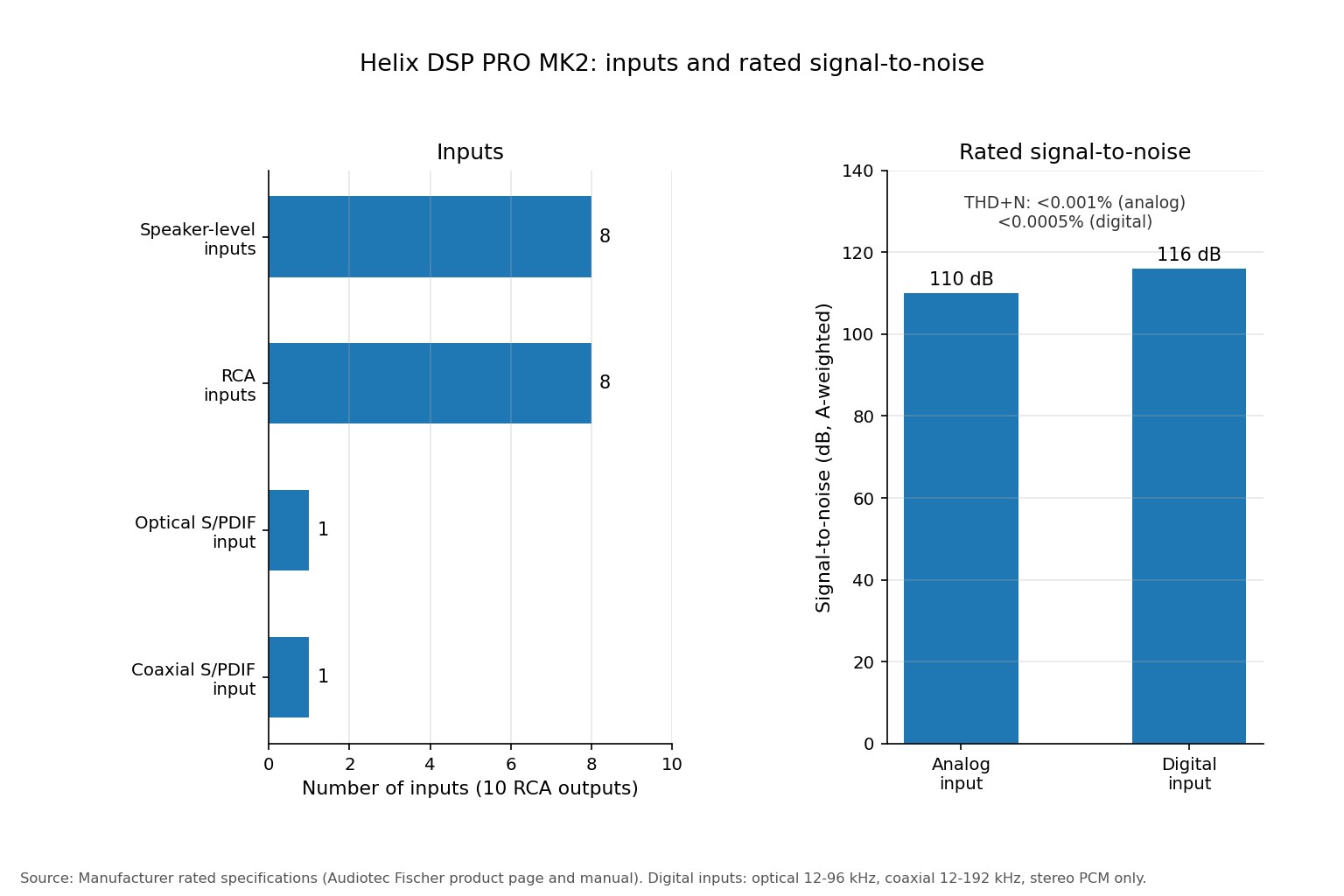
- Rated 110 dB analog and 116 dB digital signal-to-noise, with THD+N below 0.001% and 0.0005% (manufacturer figures)
- 10 RCA outputs with up to 8 V output voltage
- Power supply is specified to ride through battery dips down to 6 V for up to 5 seconds, for start-stop vehicles
- Power Save Mode switches the amplifier remote off after 60 seconds without signal
- Three-position ground-lift switch helps with ground-loop troubleshooting
Cons
- Archived by Audiotec Fischer: the DSP PRO MK3 is the stated successor with twice the DSP power
- No new retail price could be verified, and used units may carry no warranty
- Input sensitivity is set with internal trim pots and jumpers, so the case must be opened
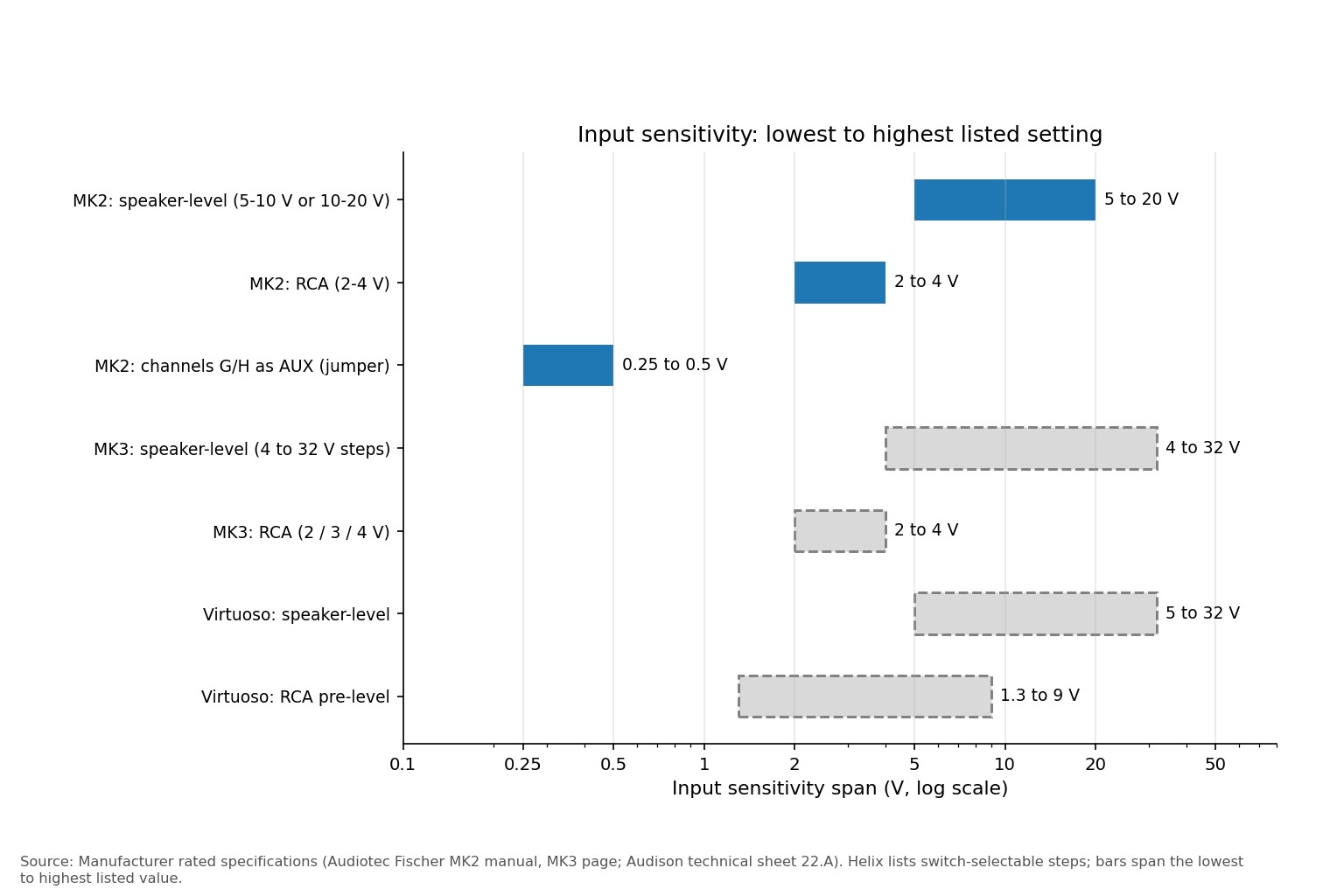
- Speaker-level inputs top out at 20 V, against 32 V listed for the MK3
- Digital inputs carry no volume control, so full level reaches the amplifiers unless a remote is fitted
- Needs a Windows PC and the DSP PC-Tool for setup; one owner reported a turn-on pop with a factory radio (anecdotal)
Specifications
| Converters | Asahi Kasei 32-bit A/D and D/A |
|---|---|
| Crosstalk | >90 dB |
| Expansion and size | HEC slot; 40 x 177 x 150 mm (H x W x D) |
| Frequency response | 10 Hz to 44,000 Hz |
| IM distortion | <0.004% analog input, <0.002% digital input |
| Input sensitivity | RCA 2-4 V; speaker-level 5-10 V or 10-20 V (jumper); channels G/H as AUX 250-500 mV (jumper) |
| Inputs | 8 speaker-level, 8 RCA, 1 optical S/PDIF (12-96 kHz), 1 coaxial S/PDIF (12-192 kHz), remote in |
| Output voltage | 8 V max |
| Outputs | 10 RCA, remote out (500 mA max) |
| Power | 9.6-18 V DC (max 5 s down to 6 V), 510 mA current draw |
| Processing | 64-bit fixed point DSP, 295 MHz (1.2 billion MAC operations/s), 96 kHz sampling |
| Signal-to-noise (A-weighted) | 110 dB analog input, 116 dB digital input |
| THD+N | <0.001% analog input, <0.0005% digital input |
| Time alignment | Up to 20 ms per channel |
| Type | Car audio digital signal processor (DSP), archived model |
Verdict
The Helix DSP PRO MK2 suits installers who find a used or open-box unit and want a 10-output processor with 8 speaker-level inputs and an expansion slot. Its main strength is rated electrical performance close to the newer MK3 (110 dB analog and 116 dB digital signal-to-noise, 8 V output); its main compromise is that it is archived, has half the MK3's DSP power and has no new retail price I could verify. If new is the goal, the MK3 listed at $1,299 in the US on 11 October 2026, so a used MK2 only makes sense at a clear discount.
The Helix DSP PRO MK2 is still a capable 10-output processor on paper, but it is an archived model and I could not verify a new retail price for it. It is worth considering only if you find a used or open-box unit well below the $1,299 that the newer DSP PRO MK3 listed for at ResoNix on 11 October 2026 (backordered), because the MK3 doubles the DSP power and adds features the MK2 lacks. If you can pay for new, the MK3 is the safer buy.
This page covers what the MK2 offers, how its rated performance compares with its successor and two rivals, and what to check before buying one second-hand. The verdict, pros and cons and full specifications appear in their own sections of this page, so they are not repeated here.
How this review was made
This is a specification and research review. I did not install, listen to, measure or own this processor, and nothing below describes personal listening. I compared Audiotec Fischer's product page and installation manual with its MK3 and Ultra S pages, Audison's technical sheet, retailer listings and owner discussions on the DIY Mobile Audio forum.
Four limits matter. I found no independent lab measurements of the MK2, so every performance figure is the manufacturer's rating. A PASMAG bench test I found covered the original DSP PRO, not the MK2, so it is context only. The award badges on the manufacturer's page are manufacturer-listed. Forum comments are anecdotal, and used-market prices are seller-set and unverified.
Design and build
The MK2 is a compact unit measuring 40 x 177 x 150 mm (H x W x D). Audiotec Fischer rates it at 9.6 to 18 V with a 510 mA current draw, which works out to 6.1 W at 12 V. Its 64-bit fixed-point DSP runs at 295 MHz, giving 1.2 billion MAC operations per second, and the converters are listed as Asahi Kasei 32-bit parts. I found no independent teardown, so build quality rests on the manufacturer's description.
The manual says to mount it in a dry place with enough air circulation, not in a small closed box or near heat sources, and to check behind the mounting surface for wiring, brake lines or the fuel tank. A status LED shows the active setup and, if it flashes orange, that temperature protection has switched the remote output off.
Features and usability
The MK2 takes 8 speaker-level inputs, 8 RCA inputs, one optical input (12 to 96 kHz), one coaxial input (12 to 192 kHz) and a remote input, with 10 RCA outputs. Digital inputs accept stereo PCM only, not Dolby-coded streams. The speaker-level inputs use Helix's ADEP circuit, which the manufacturer says prevents the fault messages and lost functions some factory radios show when a processor is connected. With a radio that has BTL output stages, the processor can turn on from the speaker signal.
Setup has a hardware step. Input sensitivity is set with eight internal trim pots and jumpers, so you open the case by removing five screws. Speaker-level inputs ship at 10 V and can be moved to 5 to 10 V or 10 to 20 V, RCA inputs ship at 4 V and span 2 to 4 V, and channels G and H can be switched to an AUX range of 250 to 500 mV. A clipping LED helps you adjust each channel.
In software, each of the 10 channels is configured through the DSP PC-Tool over USB. Time alignment reaches 20 ms per channel, which is about 6.9 m of path difference at 343 m/s (computed), and the page also lists an all-pass filter option, reverse time alignment and selectable D/A converter sound options. Two setups can be stored and switched from the unit's button. Power Save Mode switches the amplifier remote off after 60 seconds without signal and restarts it within a second of music returning.
The HEC slot accepts add-on modules such as Bluetooth streaming, USB audio, an extra optical input or an AUX input. The manual says to use only modules specified for the MK2, and retailers list separate HEC modules for the MK2 and MK3. Remote controls listed on the manufacturer's page include the URC.3, DIRECTOR and WIFI CONTROL. For comparison, the MK3 adds an input signal analyzer, input EQ, TuneEQ auto-correction, sound effects such as RealCenter and a three-step sensitivity switch, with twice the DSP power.
Sound and performance
Audiotec Fischer rates signal-to-noise at 110 dB for analog inputs and 116 dB for digital inputs (A-weighted), THD+N below 0.001% and 0.0005%, intermodulation distortion below 0.004% and 0.002%, crosstalk above 90 dB and a frequency response of 10 Hz to 44 kHz. Maximum output is 8 V. These are manufacturer figures, not measurements from this site.
Against the newer models the electrical numbers are close. The MK3 lists 111 dB and 116 dB with the same distortion figures, and the DSP Ultra S lists 111 dB and 117 dB. The Audison bit One HD Virtuoso rates 104 dB and 110 dB with 0.004% THD and a 4 V output, though the brands test differently. The MK2's gap to its successor is mainly in DSP power, tuning aids and input range, not in rated noise or distortion.
The manufacturer's page shows a 2017 Auto Sound Award badge and a Car Hifi magazine badge dated March 2017; I could not read the original test text, so I treat them as manufacturer-listed. Owner reports in a DIY Mobile Audio thread are positive overall: one owner called it a clear improvement over a previous processor, and another found the software easy to use. One owner reported an audible turn-on pop when fed from a factory radio, while another had powered several amplifiers from the remote output without trouble. These are subjective, dated reports, not test results.
Setup, installation and daily use
Plan the channel map first, then mount the unit, run the power and remote leads, set input sensitivity with the amplifiers disconnected, make the basic DSP settings in software and only then connect the amplifiers. The manual recommends installation by an authorized Helix dealer to ensure full warranty coverage.
Safety and wiring notes
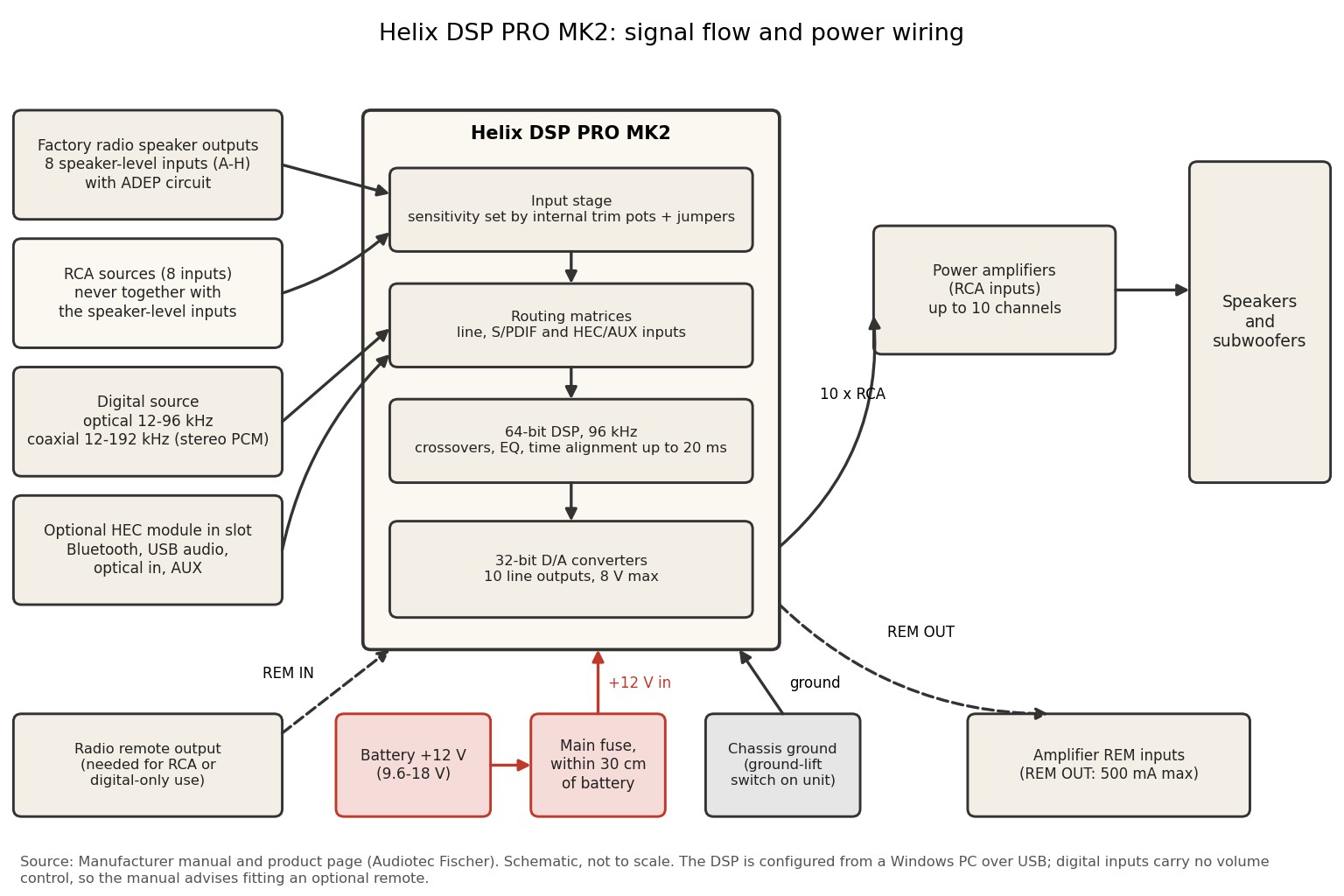
- Disconnect the battery negative before wiring, and fit a main fuse on the positive lead within 30 cm of the battery, rated for the whole system's current draw.
- Use only the supplied power connector and screw-terminal plugs, and wire of at least 1 mm2 (AWG 18) for power. Speaker-level input wires should be no thicker than 1 mm2.
- Never use the speaker-level and RCA inputs at the same time, because the manual warns this can damage the radio.
- Always turn amplifiers on from the processor's remote output, which is rated at 500 mA, and not from another signal.
- Digital sources send full level to the amplifiers, so fit a remote to control volume before playing music through the digital inputs.
- Identify factory speaker wires with a meter or wiring diagram before tapping them, never splice into airbag wiring, and keep volume at minimum on first start-up of an active system to protect tweeters.
Day to day, the unit runs unattended once configured. Everything beyond switching between the two stored setups needs the Windows software or an optional remote, so most owners will want a professional tune or a Windows laptop and a measurement microphone.
How it compares
The table uses verified figures from manufacturer pages and retailer listings. The DSP PRO MK3 is the direct successor, the DSP Ultra S is Helix's 12-output step up and the Virtuoso is Audison's 13-output rival.
| Model | Price | Outputs | Inputs | DSP | S/N analog / digital | Distortion | Max output | Max speaker-level input |
|---|---|---|---|---|---|---|---|---|
| Helix DSP PRO MK2 | No new price verified; used or open-box listings seen at about $800 to $1,100 (unverified) | 10 | 8 speaker-level, 8 RCA, optical + coax | 64-bit, 1.2 billion MAC/s, 96 kHz | 110 / 116 dB | <0.001% / <0.0005% THD+N | 8 V | 20 V |
| Helix DSP PRO MK3 | US$1,299 (backordered) | 10 | 8 speaker-level, 8 RCA, optical + coax | Dual 64-bit, 2.4 billion MAC/s, 96 kHz | 111 / 116 dB | <0.001% / <0.0005% THD+N | 8 V | 32 V |
| Helix DSP Ultra S | about US$1,600 (open-box listing) | 12 | 8 speaker-level, 8 RCA, optical + coax | 64-bit, 96 kHz | 111 / 117 dB | <0.0008% / <0.0004% THD+N | 8 V | 32 V |
| Audison bit One HD Virtuoso | US$1,779.99 | 13 (9 in FIR mode) | 12 speaker-level, 6 RCA + AUX pair, 2 optical | 24-bit / 96 kHz floating point | 104 / 110 dBA | 0.004% THD (1 kHz, 1 V out) | 4 V | 32 V |
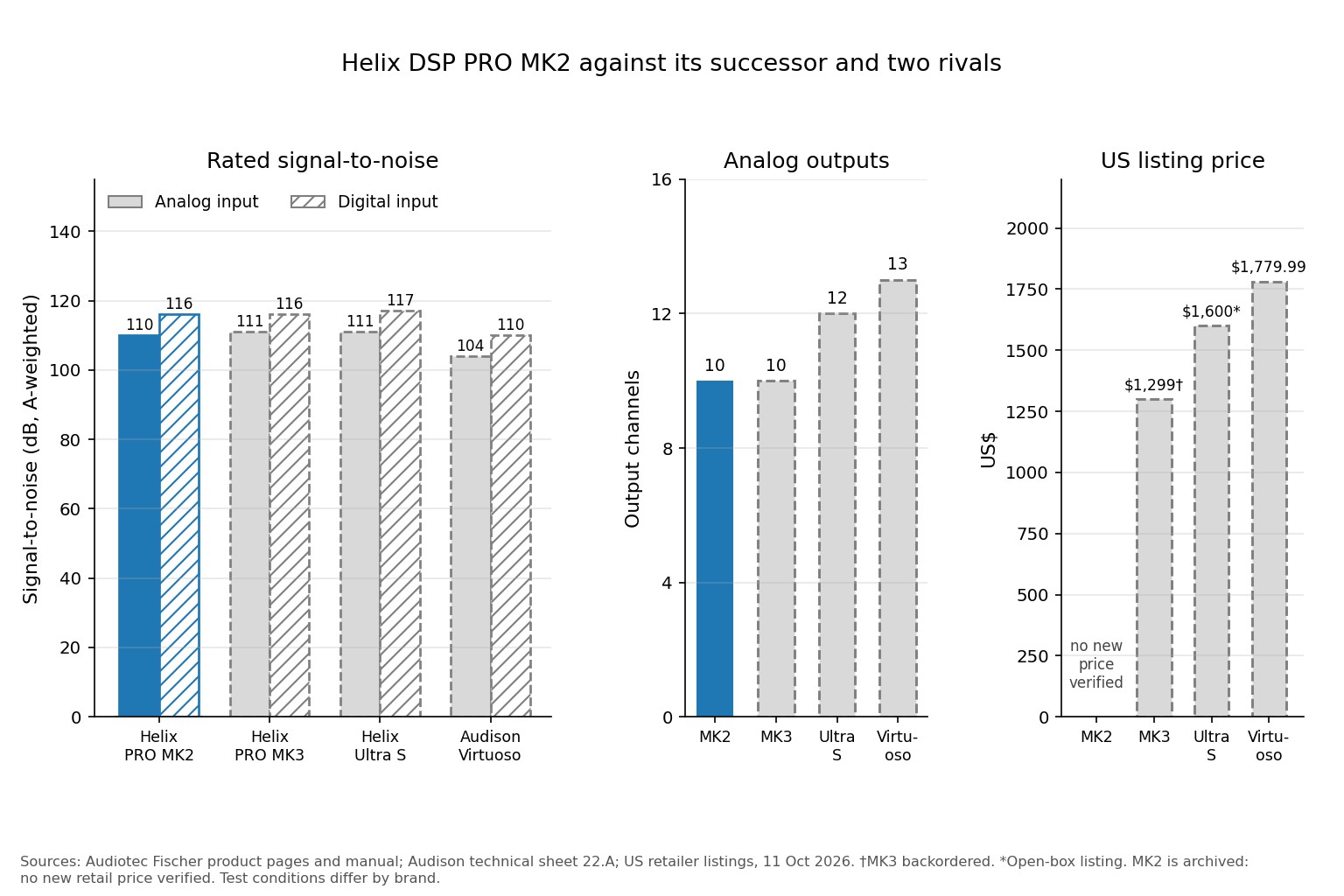
The MK2 is the only one here without a verifiable new price. A used MK2 at the listings I saw would cost 15% to 38% less than the MK3 before delivery and import fees (computed from $1,100 and $800.49 against $1,299), so the saving can be small at the top of that range.
Who should buy it and who should skip it
Buy it if you find a used or open-box unit at a clear discount, you need 8 speaker-level inputs and 10 outputs, your installer already knows the DSP PC-Tool, and a factory radio's speaker diagnostics are the problem you want solved.
Skip it if you want a new unit with a manufacturer warranty, you need speaker-level inputs above 20 V for a high-power factory amplifier, you want auto-correction or sound effects, you want more than 10 outputs, or you do not have a Windows PC.
Buying advice
Price context. I could not verify a new retail price for the MK2. Used and open-box listings seen on eBay ranged from about $800 to $1,100, one from a Japan seller with $164 delivery including import fees, all seller-set and unverified. The MK3 listed at $1,299 at ResoNix on 11 October 2026 and was backordered.
Model status. Audiotec Fischer files the MK2 under its product archive and calls the MK3 the successor. The current Helix processor range lists the NEXT DSP Ultra XT, DSP Ultra S, DSP PRO MK3, DSP.3S and DSP MINI MK2.
What to check. Confirm the seller's condition description, return policy and any warranty, and that the USB cable and the supplied screw-terminal connectors are included, because the manual says to use only those connectors. Ask whether a HEC module is fitted and which model it is for. Check which DSP PC-Tool version supports the unit, since the MK2 page lists version 4. Budget for a remote to control digital-source volume, the optional Easy Plug Cable for factory radios, a Windows PC and professional tuning.
Final thoughts
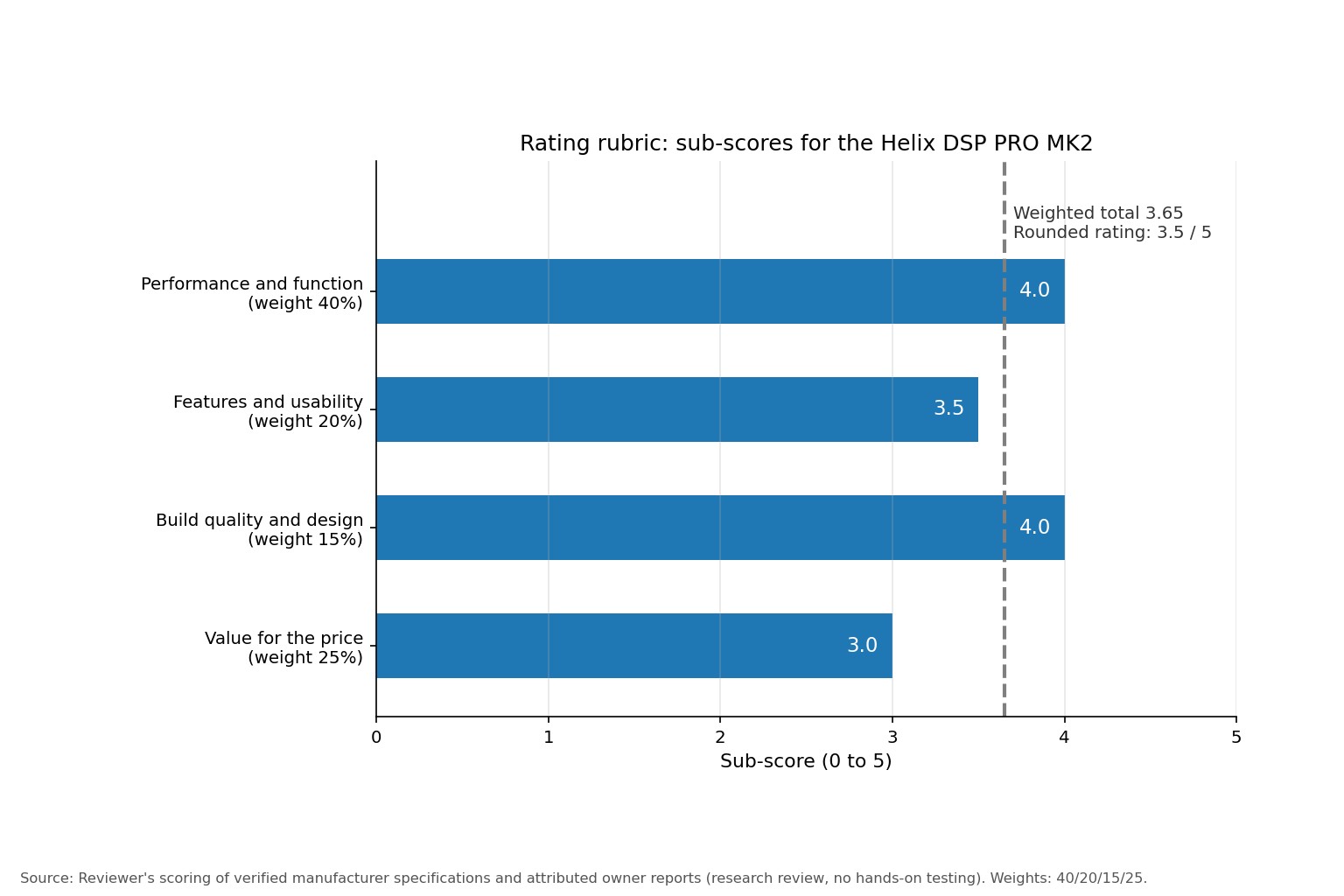
The MK2 earns 3.5 out of 5. It is a capable, well-specified 10-output processor with strong rated noise and distortion figures and good factory-radio features, held back by its archived status, half the MK3's DSP power, internal sensitivity adjustment, a 20 V speaker-level ceiling and the lack of a verifiable new price. The rating is based on verified specifications and attributed reports, not hands-on testing. The rubric weights are performance and function 40%, features and usability 20%, build quality and design 15%, and value for the price 25%.
| Criterion | Weight | Score | Basis |
|---|---|---|---|
| Performance and function | 40% | 4.0 | Rated figures close to the MK3; no independent measurements |
| Features and usability | 20% | 3.5 | ADEP, HEC slot, Power Save; internal trim pots and no auto-tuning aids |
| Build quality and design | 15% | 4.0 | Compact, quality converters listed; no independent teardown |
| Value for the price | 25% | 3.0 | Archived, no new price verified; used saving can be small against the MK3 |
| Weighted total | 100% | 3.65 | Rounded to the nearest half step: 3.5 |
Sources and further reading
- Audiotec Fischer: HELIX DSP PRO MK2
- HELIX DSP PRO MK2 manual (PDF)
- Audiotec Fischer: HELIX DSP PRO MK3
- Audiotec Fischer: current HELIX processor range
- Audiotec Fischer: HELIX DSP ULTRA S
- Audison Virtuoso technical sheet (PDF)
- DIY Mobile Audio forum: Helix DSP PRO MK2 owner thread
- ResoNix: DSP PRO MK3 listing
Last reviewed: October 2026
Helix DSP PRO MK2 FAQ
Is the Helix DSP PRO MK2 still worth buying?
Only at a clear discount. Its rated signal-to-noise and distortion figures are close to the newer MK3, but it is archived and no new retail price was found. A used unit makes sense if the price and warranty are right; otherwise the MK3 is the safer choice.
What is the difference between the DSP PRO MK2 and MK3?
Audiotec Fischer lists the MK3 with two DSPs for 2.4 billion MAC operations per second, double the MK2's 1.2 billion. The MK3 adds an input signal analyzer, TuneEQ auto-correction, sound effects, three-step input sensitivity and speaker-level inputs up to 32 V. Rated signal-to-noise is almost the same at 111 and 116 dB for the MK3 against 110 and 116 dB.
Can it be used with a factory radio?
Yes, that is one of its main uses. It has 8 speaker-level inputs with the ADEP circuit, which the manufacturer says avoids speaker-diagnostic faults, and it turns on automatically from a speaker signal if the radio has BTL output stages. Set the input sensitivity to match the source before connecting amplifiers.
Can I use the RCA and speaker-level inputs together?
No. The manual forbids using them at the same time because it can damage the radio's preamp outputs. You can combine either of them with a digital input.
Can I add Bluetooth or USB audio?
Yes, through the HEC expansion slot, which takes modules such as Bluetooth streaming, USB audio, an extra optical input or an AUX input. The manual says to fit only modules made for the DSP PRO MK2. Retailers list MK2 and MK3 modules separately, so check the exact model before buying.
Do I need a computer to set it up?
Yes. The processor is configured with Audiotec Fischer's DSP PC-Tool over USB, and two setups can be stored and switched with the unit's control button. Check which version of the tool supports the MK2, since the manufacturer's page lists version 4 for download.
Is it safe to use the digital inputs without a remote?
The manual warns against it. A digital source has no volume control, so full level reaches the outputs and the amplifiers, which can damage speakers. It strongly advises fitting an optional remote to set the volume.
Is the Helix DSP PRO MK2 discontinued?
Audiotec Fischer files it under its product archive, and the current Helix processor range lists the DSP PRO MK3 instead. The company does not use the word discontinued on the pages checked. Stock now comes from remaining new units or the used market.